LASIK or SMILE: Which Vision Correction Fits You Better?
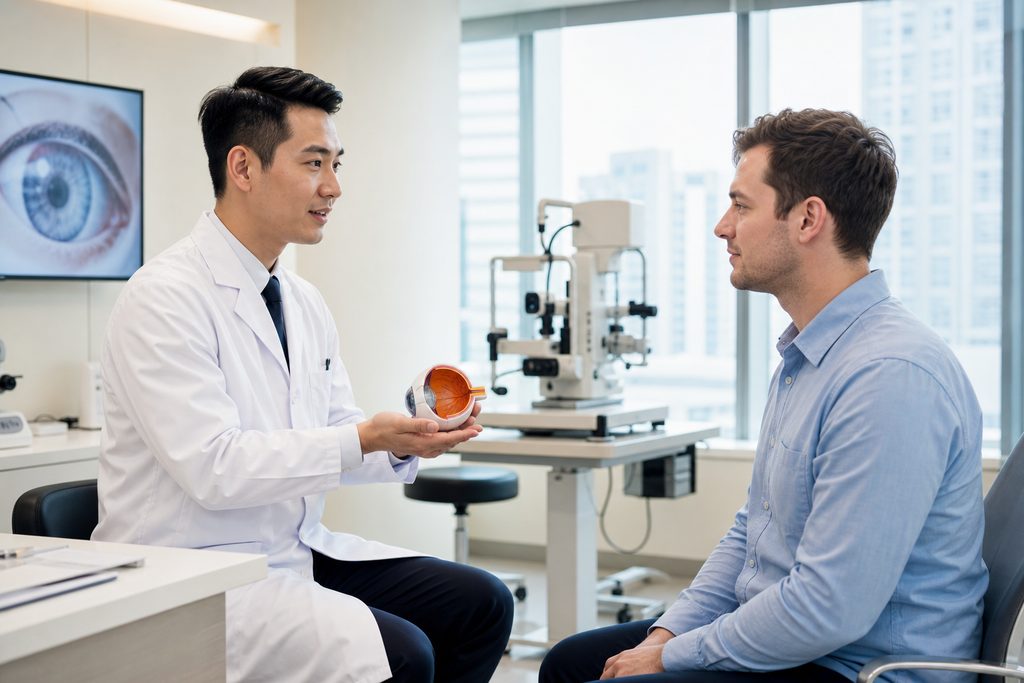
You’ve probably heard that choosing between LASIK and SMILE is just a matter of price or a surgeon’s preference. The reality is far more specific: the right procedure depends on your corneal thickness, prescription stability, lifestyle, and how your eyes respond to different laser platforms. A decision made on cost alone often leads to a second surgery or lingering dry eye. And if you’re considering traveling for treatment, understanding the LASIK vs SMILE cost China equation matters as much as the clinical differences.
Both procedures reshape the cornea to correct myopia and astigmatism. LASIK creates a thin corneal flap with a femtosecond laser or microkeratome, lifts it, then applies an excimer laser to the exposed stromal bed. SMILE (Small Incision Lenticule Extraction) uses a single femtosecond laser to cut a small lens-shaped piece of tissue inside the cornea, then removes it through a 2–4 mm incision. No flap. That structural difference drives most of the safety, recovery, and suitability debate.
Our team at China Medical Services regularly helps international patients evaluate these options with top-tier Chinese eye centers. We don’t perform surgery. We connect you with hospitals that do thousands of these procedures annually, and we translate the clinical and financial details before you commit.
How This Actually Works, Step by Step
If you’re starting from scratch, the path to a decision looks like this.
Step 1 — You send your existing eye records. That means your most recent refraction, corneal topography or tomography, pachymetry (corneal thickness), and any history of dry eye or contact lens wear. If you don’t have these, a local optometrist can produce them within a week.
Step 2 — A Chinese refractive surgeon reviews them. Through a written second opinion or video consultation, the specialist assesses whether your cornea qualifies for LASIK, SMILE, or neither. This typically costs $300–500 for a written opinion or $500–800 for a top-specialist video consult.
Step 3 — You receive a candid recommendation. Not a sales pitch. If your corneal thickness is marginal, a responsible surgeon will say so. SMILE requires a minimum corneal thickness because it removes tissue from a deeper layer without a flap to compensate.
Step 4 — You decide whether to travel. If you proceed, we coordinate the hospital appointment, visa guidance, and a bilingual medical companion for the day of surgery and follow-up. Surgery itself happens after an in-person examination confirms the remote assessment.
Step 5 — Post-operative care. You’ll need at least one follow-up within 24–48 hours, then another at one week. If you fly home, your local ophthalmologist can handle later checks, but the first days matter.
LASIK vs SMILE Cost China: What the Numbers Actually Look Like
Let’s talk money, because the LASIK vs SMILE cost China difference surprises many patients. In Chinese private international hospitals and top public hospital international departments, LASIK typically ranges from $1,500 to $3,000 per eye. SMILE runs higher, generally $2,500 to $4,500 per eye. The gap reflects the newer femtosecond platform, higher consumable costs, and the additional surgical training required.
In the United States, LASIK averages $2,200 per eye, and SMILE often exceeds $3,500 per eye. So the savings in China are real but not dramatic for refractive surgery — unlike cardiac or orthopedic procedures where costs drop by 80–90%. The bigger advantage is access: top Chinese refractive centers perform SMILE volumes that many Western clinics can’t match, and wait times are typically days, not months.
| Procedure | China (per eye, USD) | United States (per eye, USD) | Flap Created? | Typical Incision |
|---|---|---|---|---|
| LASIK | $1,500 – $3,000 | $2,000 – $2,800 | Yes | ~20 mm |
| SMILE | $2,500 – $4,500 | $3,000 – $4,500 | No | 2 – 4 mm |
Prices vary by hospital tier, surgeon seniority, and whether you go through a public hospital international department or a private JCI-accredited facility. The Shanghai market, for instance, has several high-volume refractive centers where SMILE eye surgery price Shanghai patients pay sits at the upper end of the China range — reflecting the city’s concentration of experienced surgeons and international-standard equipment.
One thing to check carefully: whether the quoted price includes pre-operative testing, post-operative medications, and follow-up visits. Some clinics advertise a low surgical fee then itemize everything else. Ask for an all-inclusive breakdown before you book.
Is SMILE Safer Than LASIK? The Evidence
The short answer: for most patients, both are safe. But safety profiles differ in specific ways.
SMILE avoids the corneal flap, which eliminates flap-related complications: dislocation, striae, epithelial ingrowth, and late traumatic flap displacement. For patients in contact sports, military roles, or jobs with facial impact risk, that’s a meaningful advantage. A 2019 meta-analysis in the Journal of Refractive Surgery found SMILE produced less postoperative dry eye than LASIK at three and six months, likely because fewer corneal nerves are severed.
LASIK’s safety record is enormous. Hundreds of millions of procedures worldwide. The flap heals reliably in the vast majority of cases, and visual recovery is faster — most patients see 20/20 or better within 24 hours. SMILE visual recovery is slightly slower, often taking a few days to a week for crisp acuity.
So is SMILE safer than LASIK? For dry eye and flap trauma, yes. For speed of visual recovery and ease of enhancement, LASIK has the edge. Neither is universally “safer.” The right question is: safer for whom, given which corneal profile and lifestyle?
A Realistic Timeline
Here’s what a typical international patient timeline looks like, assuming you’ve already decided to pursue treatment in China.
| Stage | What Happens | Duration |
|---|---|---|
| Week 1 | Collect and translate eye records; submit for remote review | 3–7 days |
| Week 2 | Written second opinion or video consultation with refractive surgeon | 5–10 days |
| Week 3–4 | Visa application (S2 for medical treatment), flight booking, hospital scheduling | 2–4 weeks |
| Day 1 in China | In-person comprehensive exam: topography, pachymetry, dilation, dry eye assessment | Half day |
| Day 2 | Surgery (LASIK or SMILE); rest; first follow-up within hours | 1 day |
| Day 3–7 | Second follow-up; vision stabilizing; medication schedule confirmed | 3–5 days |
| Month 1 | Local ophthalmologist follow-up at home; report sent to Chinese surgeon | 1 visit |
| Month 3–6 | Final refraction stability; any enhancement discussion if needed | 1–2 visits |
People forget the document translation step. Your records need to be in English or Chinese for the reviewing surgeon. If they’re in Arabic, Russian, or another language, add 3–5 days for certified translation. And S2 visa processing times vary by consulate — some issue within a week, others take three to four weeks. Apply early.
What Can Go Wrong — and What Happens Then
Refractive surgery is elective. That means the bar for “acceptable risk” is high, and complications, while rare, do occur.
Undercorrection or overcorrection. Roughly 1–5% of patients need an enhancement procedure. With LASIK, the flap can be lifted again months later. With SMILE, enhancement usually means converting to PRK or performing a secondary LASIK flap — a more complex path. Ask your surgeon about their enhancement policy before the first surgery.
Dry eye. Both procedures can worsen dry eye, though SMILE tends to cause less. If you already have significant dry eye, a responsible surgeon will treat it first or recommend against surgery entirely. Recourse: aggressive lubrication, punctal plugs, or prescription drops like cyclosporine.
Ectasia. This is the rare but serious complication where the cornea weakens and bulges. It’s almost always the result of operating on a cornea that was too thin or irregular to begin with. The best protection is strict pre-operative screening — which is why we emphasize sending high-quality topography before you travel.
Infection. Incidence is below 0.1% with modern protocols, but it happens. Treatment requires intensive topical antibiotics and close monitoring. This is one reason we advise staying in the city for at least 3–5 days after surgery rather than flying out the next morning.
If a complication occurs, the hospital’s international department handles it. You’re not abandoned. But you should understand the risks before you board a plane.
How to Choose a Provider: What the Numbers Don’t Tell You
Surgeon volume matters more than hospital brand. A refractive surgeon performing 500+ SMILE procedures annually has seen the edge cases: unusual astigmatism, decentered lenticules, difficult extractions. A surgeon doing 50 a year hasn’t. Ask directly: “How many SMILE procedures have you personally performed, and how many in the last 12 months?”
Equipment generation is another factor. The latest femtosecond platforms — Zeiss VisuMax 800, for instance — offer faster lenticule creation and smoother extraction. Older platforms work, but the experience differs. Chinese refractive centers often upgrade equipment frequently because patient volume justifies the investment.
Also check how the clinic handles follow-up for international patients. Will they review your one-month results remotely? Do they have an English-speaking coordinator? These details determine whether your post-operative experience is smooth or stressful.
For patients seeking the best eye hospital for LASIK in China, the Fudan University hospital rankings list top ophthalmology departments, though refractive surgery volume isn’t always captured in those rankings. Private international hospitals like United Family and Jiahui offer English-speaking care and direct insurance billing, while public hospital international departments often have the highest surgical volumes. Both are valid paths — the right one depends on your priorities.
Practical Considerations: Records, Visa, Payment, and Language
Before you commit to traveling for refractive surgery, sort these logistics.
Records. Bring your complete eye history: old prescriptions, any prior eye surgery, contact lens wear schedule. Stop wearing soft contact lenses at least one week before your exam, and rigid gas permeable lenses two to four weeks before. Lenses reshape the cornea and can skew measurements.
Visa. For medical treatment in China, the applicable short-stay category is the S2 visa, issued for private affairs including medical treatment. You’ll need an invitation letter or supporting documents from the hospital. Family members accompanying you also apply for S2. Processing times vary, so start early. We guide this process but never guarantee approval — that’s the consulate’s decision.
Payment. Public hospital international departments generally require prepayment before surgery. Private international hospitals may accept direct billing from major insurers. Confirm your insurance coverage before you travel; refractive surgery is often excluded as elective. If you pay out of pocket, keep every receipt.
Language. Top public hospitals see thousands of patients daily. Without Chinese language skills, navigating registration, payment, and post-op instructions is extremely difficult. A bilingual medical companion handles this — from $300 per day — so you focus on recovery, not logistics.
Follow-up at home. Arrange a local ophthalmologist before you leave. Your Chinese surgeon will provide a discharge summary and medication schedule; your home doctor handles the one-month and three-month checks. This shared-care model works well when both sides communicate clearly.
Frequently Asked Questions
SMILE recovery is typically slower in the first 48 hours. Most LASIK patients see clearly within 24 hours; SMILE patients often need 3–7 days for sharp vision. But SMILE patients usually report less dry eye and discomfort during the first month. By three months, outcomes are comparable.
You can coordinate the appointment and surgical slot through a hospital’s international department, but no responsible surgeon will operate without an in-person examination first. Remote records get you pre-qualified; the final decision happens after topography and pachymetry in China. We help arrange the scheduling so you don’t arrive without a plan.
Alternatives include PRK, implantable collamer lenses (ICL), or refractive lens exchange. PRK removes the surface epithelium instead of creating a flap, making it suitable for thinner corneas. ICL implants a lens inside the eye and is reversible. Your surgeon should explain all options, not just the two most marketed ones.
If you have dry eye risk factors, a thin cornea, or an active lifestyle with impact risk, the extra cost of SMILE is often justified. If you want the fastest visual recovery and the most established enhancement pathway, LASIK offers better value. The decision should be clinical first, financial second.
In most cases, yes. Provide the discharge summary, surgical parameters, and medication list. Some ophthalmologists prefer to receive records before you travel so they can review them. Communication between your Chinese surgeon and home doctor is straightforward when documents are properly translated.
Your Next Step
Choosing between LASIK and SMILE isn’t about which one is “better” in the abstract. It’s about your corneal anatomy, your lifestyle, your dry eye risk, and your tolerance for different recovery curves. Get the data first. Then decide.
China Medical Services helps international patients connect with high-volume refractive surgery centers across China’s top-ranked hospitals. We handle record translation, surgeon matching, appointment coordination, and on-the-ground bilingual support. We don’t perform surgery, and we don’t push one procedure over another. If you want a candid assessment of whether your eyes qualify and what treatment in China would actually cost, request a free consultation. Send your records, get an honest answer, and take it from there.
For more medical information and treatment options in China, visit chinamedservices.com (China Medical Services).
