Aortic Aneurysm Repair: When to Act, Where to Go, What It Costs
You have probably heard that a diagnosis of an aortic aneurysm means immediate, terrifying surgery. The reality is far more nuanced. Most aneurysms never rupture. Many patients live with them for years under careful surveillance. The question — when should an aortic aneurysm be repaired? — has a surprisingly precise, evidence-based answer. And for those who do need intervention, the aortic aneurysm repair cost China is a fraction of what Western hospitals charge, without sacrificing clinical quality at top-ranked centers.
This guide walks through the actual decision thresholds vascular surgeons use, what the repair looks like, and how international patients can realistically access care at hospitals like Zhongshan Hospital in Shanghai or Fuwai Hospital in Beijing. No scare tactics. No vague reassurances. Just the numbers and the process.
How This Actually Works, Step by Step
You have imaging — probably a CT angiogram or an echocardiogram — showing an aortic aneurysm. The diameter measurement on that report is the single most important number. Here is the sequence from that report to a treatment decision.
First, your existing scans and medical history go to a vascular surgery team for review. In China’s top hospitals, this often starts as a written second opinion. You send the DICOM files or high-resolution images, plus your cardiology notes and any prior surgical records. A specialist reviews them and issues a written analysis with a recommended threshold for intervention.
Second, if the diameter is near or above the repair threshold, the team schedules a video consultation. You speak directly with the surgeon who would perform the procedure. They explain the options — open repair versus endovascular stent grafting — and the risks specific to your anatomy.
Third, you decide. If surgery is indicated and you choose to proceed in China, the hospital’s international department coordinates admission, pre-operative testing, and the procedure date. You apply for an S2 visa with the hospital’s invitation letter and medical documentation. Then you travel.
That is the pathway. It is staged. It lets you build confidence before committing to a flight.
When Should an Aortic Aneurysm Be Repaired? The Numbers That Decide
Surgeons do not guess. The decision to repair an aortic aneurysm rests on diameter thresholds established by large registry studies and randomized trials. These thresholds differ by aneurysm location.
For an ascending aortic aneurysm, the general trigger is 5.5 centimeters in patients without a genetic syndrome. If you have Marfan syndrome, a bicuspid aortic valve, or a family history of aortic dissection, the threshold drops to 5.0 centimeters — or sometimes 4.5 centimeters if you are already undergoing cardiac surgery for another reason. The 2010 AHA/ACC guidelines and subsequent updates anchor these numbers.
For a descending thoracic aortic aneurysm, repair is typically considered at 5.5 to 6.0 centimeters. Growth rate matters too. An aneurysm expanding faster than 0.5 centimeters per year in a descending segment may warrant earlier intervention.
For an abdominal aortic aneurysm, the magic number is 5.5 centimeters in men and 5.0 centimeters in women. The UK Small Aneurysm Trial and the ADAM trial both showed no survival benefit from repairing aneurysms below these thresholds. Below 5.5 centimeters, the annual rupture risk is under 1%. Above 6.0 centimeters, that risk climbs sharply — 10% to 15% per year or higher.
Symptoms override size. Any aneurysm causing pain, tenderness, or signs of compression demands urgent evaluation regardless of diameter. A ruptured aneurysm is a surgical emergency with mortality above 50% even in excellent centers.
So the answer to when should an aortic aneurysm be repaired is not “as soon as possible.” It is “when the rupture risk exceeds the surgical risk.” That crossover point is what the diameter thresholds represent.
Key takeaway: Repair thresholds are 5.5 cm for most ascending and abdominal aneurysms, 5.0 cm for women with abdominal aneurysms and for patients with genetic syndromes. Growth rate and symptoms can lower the bar.
What the Repair Actually Involves
Two fundamentally different approaches exist. The choice depends on aneurysm location, anatomy, and your overall health.
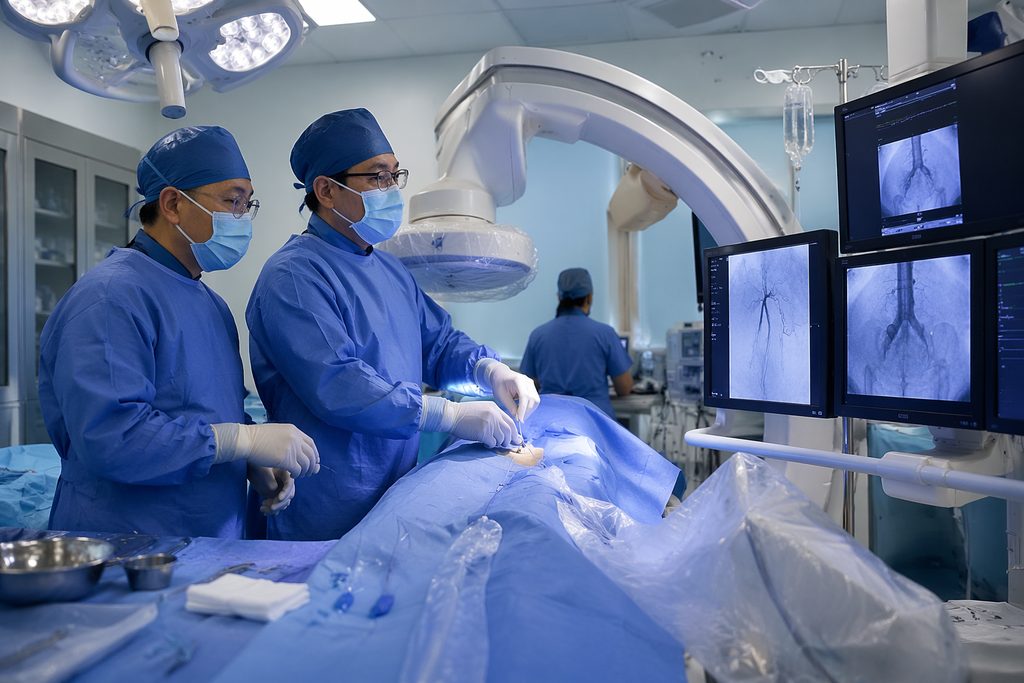
Open surgical repair replaces the diseased aortic segment with a synthetic graft. For ascending aneurysms, this means open-heart surgery with cardiopulmonary bypass. For abdominal aneurysms, it means a large midline incision and cross-clamping the aorta. Open repair is durable — the graft lasts decades — but recovery takes two to three months.
Endovascular aneurysm repair (EVAR) threads a stent-graft through the femoral artery in the groin up into the aorta. No large incision. Hospital stay of two to four days. Recovery measured in weeks, not months. The trade-off: EVAR requires lifelong imaging surveillance to check for endoleaks, and reintervention rates run higher than open repair at the five-year mark.
In China’s high-volume centers, both techniques are routine. Fuwai Hospital in Beijing performs more than 14,000 cardiac surgeries annually — the highest volume globally. Zhongshan Hospital in Shanghai runs one of Asia’s busiest vascular surgery departments. Volume matters in aortic surgery. Studies consistently link higher case volumes to lower mortality for complex aortic procedures.
A Realistic Timeline
| Stage | What Happens | Typical Duration |
|---|---|---|
| Week 1 | You submit existing scans and records; we arrange translation | 2–3 days |
| Week 1–2 | Specialist reviews records and issues written second opinion | 3–7 days |
| Week 2–3 | Video consultation with the surgical team | 30–60 minutes |
| Week 3–6 | S2 visa application with hospital invitation letter | 1–4 weeks depending on consulate |
| Week 6–8 | Arrival, pre-operative testing, admission | 2–4 days |
| Week 8 | Surgery (open repair or EVAR) | 3–8 hours |
| Week 8–10 | Hospital recovery; EVAR patients often discharge in 3–5 days, open repair in 7–14 days | 3–14 days |
| Month 2–3 | Follow-up imaging before return home; remote follow-up thereafter | 1–2 days |
People forget the visa step. It is real time. Consulates in some countries process S2 applications in under a week. Others take a month. Plan for the longer end. The hospital’s international department provides the invitation letter, but the embassy sets the pace.
Document translation also takes time. Chinese hospitals require translated summaries of your medical history, not the original English records alone. Budget two to three days for certified translation.
What Can Go Wrong — and What Happens Then
Honesty here. Things do not always go smoothly.
The second opinion says you do not need surgery. This happens. If your aneurysm measures 4.8 centimeters and you are asymptomatic, the Chinese specialist will likely recommend surveillance, not repair. That is the correct medical answer, even if it is not what you wanted to hear. You have paid for an honest assessment. Use it.
You arrive and pre-operative testing finds a new problem. Coronary artery disease, poor kidney function, uncontrolled hypertension. Any of these can delay or cancel surgery. The hospital will not proceed until the risk is managed. That delay is frustrating but protective. In some cases, the team recommends staged treatment — coronary stenting first, aneurysm repair months later.
Visa delays push your surgery date. The hospital holds your slot for a reasonable window, but it cannot hold it indefinitely. If the visa takes six weeks, the surgery date moves. The international department re-coordinates. This is inconvenient, not catastrophic.
Surgical complications occur. Aortic surgery carries real risk — stroke, paraplegia, renal failure, death. The best centers report elective open abdominal aortic aneurysm repair mortality around 2% to 4% and EVAR mortality around 1% to 2%. Ascending aortic repair mortality at high-volume centers runs 3% to 5%. These are not zero. Anyone who tells you otherwise is lying. What a high-volume center buys you is a lower probability of complications and a team equipped to rescue you if they happen.
Post-operative care back home is fragmented. Chinese hospitals provide excellent in-hospital care. Once you return to your home country, your local cardiologist or vascular surgeon takes over surveillance. You need to arrange that handoff before you leave. Bring translated discharge summaries, imaging on a USB drive, and medication lists.
Is Aortic Aneurysm Surgery Safe in China — and What Does It Cost?
Let us address the two questions every international patient asks in the same breath.
Safety. The top tier of Chinese hospitals — the 340+ institutions in the Fudan-ranked Top 100 and JCI-accredited group — operate at international standards. They publish outcomes data. They participate in multinational registries. Their vascular surgeons train in Europe and North America and return to run high-volume programs. Fuwai Hospital’s cardiac surgery volume exceeds any single center in the United States. Volume is not everything, but for aortic surgery it correlates strongly with outcomes.
That said, safety is not uniform across all Chinese hospitals. The gap between a top-tier academic center and a provincial hospital is wide. Choosing the right hospital matters enormously. This is where a specialty-specific hospital ranking helps — the Fudan specialty reputation rankings identify which hospitals lead in vascular surgery and cardiac surgery.
Cost. The aortic aneurysm surgery price abroad varies dramatically by country. In the United States, open repair of an abdominal aortic aneurysm typically bills between $50,000 and $120,000. Endovascular repair runs $60,000 to $150,000. Ascending aortic replacement with cardiopulmonary bypass can exceed $200,000.
In China’s top public hospitals, an open abdominal aortic aneurysm repair typically costs $15,000 to $30,000. EVAR runs $25,000 to $45,000 depending on the stent-graft used. Ascending aortic replacement at a center like Fuwai or Zhongshan generally falls between $25,000 and $50,000. The aortic aneurysm repair cost China is roughly one-fifth to one-third of the US price, including hospital stay and surgeon fees.
| Procedure | US Estimated Cost | China Estimated Cost |
|---|---|---|
| Open AAA repair | $50,000 – $120,000 | $15,000 – $30,000 |
| EVAR (endovascular AAA) | $60,000 – $150,000 | $25,000 – $45,000 |
| Ascending aortic replacement | $100,000 – $200,000+ | $25,000 – $50,000 |
These are ranges. Final pricing depends on stent-graft choice, ICU days, and case complexity. International department services add 50% to 100% on top of standard public pricing — that is the cost of English-speaking coordination, expedited scheduling, and private rooms. The total still lands well below Western bills.
If you are asking is aortic aneurysm surgery safe in China, the answer depends on the hospital. At a top-10 vascular surgery center, the safety profile matches Western academic centers. At an unvetted provincial hospital, it may not. Hospital selection is the safety decision.
Practical Considerations: Records, Visa, Payment, Follow-Up
You cannot book surgery directly without a prior consultation. Chinese public hospitals require a specialist to review your records and, in most cases, conduct a video or in-person consultation before scheduling. What you can do in advance is arrange the written second opinion and video consultation, then secure a surgery date once the team confirms the indication.
Most patients with stable aneurysms below 5.0 centimeters can fly without restriction. If your aneurysm is larger or symptomatic, discuss air travel with your doctor before booking. Cabin pressurization does not significantly increase rupture risk in stable aneurysms, but long-haul travel with an expanding aneurysm warrants caution.
Open abdominal aortic aneurysm repair typically costs $15,000 to $30,000 in top Chinese public hospitals. Endovascular repair runs $25,000 to $45,000. Ascending aortic replacement runs $25,000 to $50,000. International department services add 50% to 100% on top of these figures. Final pricing varies by hospital and case complexity.
Zhongshan Hospital, affiliated with Fudan University, consistently ranks among China’s top centers for vascular surgery and cardiac surgery. Its vascular surgery department handles high volumes of complex aortic cases. Other strong options include Ruijin Hospital in Shanghai and Fuwai Hospital in Beijing for ascending aortic pathology.
Your Next Step
The threshold for repair is a number, not a feeling. If your aneurysm measures near or above 5.5 centimeters — or 5.0 with risk factors — get a specialist review. If you are considering treatment abroad, the aortic aneurysm repair cost China makes high-volume, high-quality care financially accessible for many patients who cannot afford Western prices.
We are China Medical Services, a coordination team that connects international patients with top-ranked Chinese hospitals. We handle record translation, specialist matching, appointment coordination, and bilingual support. We do not perform surgery, and we do not promise outcomes. What we do is make the process navigable.
If you want a written second opinion on your imaging, or a video consultation with a vascular surgeon at a top Chinese center, start with a free consultation. Tell us your diagnosis and what your scans show. We will tell you honestly whether China is a good fit for your case.
Frequently Asked Questions
Yes. The hospitals used for international patients are JCI-accredited and follow the same international safety standards as top hospitals in the US and Europe. Surgical teams perform high volumes of procedures — often more than their Western counterparts — which studies show leads to better outcomes.
Costs vary by procedure and hospital, but international patients typically save 40-80% compared to US prices — even when factoring in travel and accommodation. A consultation with our team will give you an exact, all-inclusive quote with no hidden fees.
Send us your existing medical reports to get started. We handle everything from hospital selection and appointment scheduling to visa assistance and post-operative recovery planning. Your medical records are reviewed by the specialist before you even book a flight.
For more medical information and treatment options in China, visit chinamedservices.com (China Medical Services).
