Indonesian Patient Medical Service to China: Full Jakarta Surabaya Treatment Support
Key Takeaways
- China’s top-tier hospitals perform complex procedures at 70–90% less than Western equivalents, with cardiac bypass often costing $12,000–$20,000 compared to $120,000+ in the United States.
- Indonesian patients face a structural gap: direct hospital access is nearly impossible without navigating China’s domestic registration systems, language barriers, and visa protocols designed for business travelers, not medical tourists.
- The S2 medical visa is mandatory for treatment in China—using an M business visa for medical purposes risks denial at the port of entry and disrupts treatment timelines.
- Full-service coordination from Jakarta or Surabaya transforms a fragmented, high-risk process into a single, predictable care journey with bilingual support at every stage.
The Problem: When Local Options Run Out, Where Do You Turn?
Indonesia’s healthcare system has made real progress, but gaps remain stark. The country has fewer than 50 cardiac surgery centers for a population of 278 million. That ratio forces families into impossible choices. A 2023 report from the Indonesian Ministry of Health noted that thousands of patients seek treatment abroad each year, with cancer care, cardiac surgery, and complex orthopedics topping the list. Singapore and Malaysia are common destinations. But for many, the costs in those markets still run prohibitively high. A coronary artery bypass in Singapore can easily exceed $40,000. For a family in Surabaya or Jakarta, that figure represents years of income—or an unreachable sum.
So patients search further. They look north. China’s medical infrastructure has transformed over the past two decades. Hospitals like Fuwai Hospital in Beijing now perform over 14,000 cardiac surgeries annually, the highest volume of any center globally. But the distance between knowing China has world-class hospitals and actually receiving treatment inside one is enormous. That gap is not about clinical quality. It is about access. Language. Visas. Knowing which of the 340+ top-ranked hospitals is right for a specific diagnosis. And that is where most Indonesian patients get stuck before they even begin.
We see this pattern constantly. A family in Jakarta gets a difficult diagnosis. They research hospitals online. They find impressive statistics. But then they try to book an appointment and hit a wall. Chinese public hospitals do not accept overseas self-bookings for general outpatient services. The phone systems operate in Mandarin. The websites assume domestic identity verification. A patient with a serious condition cannot afford to spend weeks navigating these barriers alone. That is the problem we solve.
Who We Are
We are China Medical Services, a medical concierge organization that connects international patients with China’s top-tier hospitals. We are not a hospital. We do not provide medical treatment or clinical diagnoses. Our team handles the entire logistical architecture—hospital matching based on your specific condition, appointment coordination through official international departments, bilingual medical companions who stay with you on the ground, and visa guidance that ensures you arrive with the correct documentation. We operate across 37 cities and maintain relationships with 340+ top-ranked hospitals, covering public teaching hospitals, private international facilities, and traditional Chinese medicine centers. We exist because world-class care should not be locked behind language and administrative barriers.
Why China Delivers Results for Indonesian Patients
Clinical Volume Drives Better Outcomes
There is a straightforward relationship between how often a surgical team performs a procedure and how well their patients do. China’s top hospitals operate at a scale that few Western centers match. A cardiac surgeon at a high-volume Chinese center may perform 300–400 procedures per year. The average US cardiac surgeon performs roughly 100–150. This volume effect shows up most clearly in complex procedures. Fuwai Hospital’s 30-day mortality rate for isolated coronary artery bypass grafting sits below 0.5%, a figure that matches or beats the best centers in North America and Europe. For Indonesian patients considering cardiac surgery, that statistic matters more than any marketing claim. It means the team handling your case has likely seen your exact clinical scenario dozens of times this month alone.
Cancer care follows a similar pattern. China’s National Cancer Center treats volumes that generate deep subspecialty expertise. A thoracic surgeon there may focus exclusively on lung cancer resections, performing several hundred annually. Subspecialization at that level is rare in lower-volume systems. When an Indonesian patient with a specific cancer subtype seeks treatment, they benefit from a team that has managed that exact presentation repeatedly.
Technology Deployed at Scale
Chinese hospitals have invested heavily in advanced surgical platforms. Robotic-assisted surgery systems are now common in major centers, with some hospitals operating multiple da Vinci systems running daily schedules. The adoption of minimally invasive techniques has shortened recovery times significantly. A patient traveling from Jakarta for a complex abdominal surgery may now face a hospital stay measured in days rather than weeks. That matters financially—shorter stays reduce accommodation costs for accompanying family members—and it matters clinically, since faster mobilization reduces complication risks.
But the technology story is not just about robots. It is about integration. Chinese hospitals have built digital infrastructure that connects imaging, pathology, and clinical records across departments. For an international patient, that means test results move quickly between specialists. A CT scan taken in the morning can inform a multidisciplinary team discussion that afternoon. Efficiency at that level is not a luxury. For a patient with an aggressive cancer, it changes the treatment timeline from weeks to days.
The medical treatment cost in China for Indonesian patients: Structural Savings Without Quality Compromise
Let us address the question every patient from Jakarta and Surabaya asks first: what is the actual medical treatment cost in China for Indonesian patients? The numbers are striking because the underlying economics are structural, not promotional. A cardiac bypass that costs $120,000–$200,000 in the United States typically runs $12,000–$20,000 at a top Chinese public hospital. A hip replacement that might cost $40,000 in Singapore falls in the $8,000–$15,000 range in China. Cancer treatment packages show similar differentials—a course of radiation therapy that costs $30,000 in Australia may cost $5,000–$10,000 in a major Chinese cancer center.
These differences exist because of fundamental cost structures. Physician salaries in China are lower. Hospital administrative overhead is leaner. The sheer volume of patients spreads fixed equipment costs across far more procedures. None of this reflects lower clinical standards. The same hospitals that charge these rates appear on the Fudan University hospital rankings, which evaluate clinical capability, research output, and reputation among Chinese medical professionals. Many hold Joint Commission International accreditation. The quality indicators—infection rates, mortality ratios, readmission statistics—are tracked rigorously and compare favorably with international benchmarks.
For Indonesian families, this cost structure changes what is possible. It transforms a financially devastating diagnosis into a manageable expense. It means a patient in Surabaya who needs a complex neurosurgical procedure can access care at a center like Huashan Hospital in Shanghai without liquidating family assets. That is not a marketing point. It is arithmetic.
What You Need to Know Before Going Alone
We have watched capable, resourceful Indonesian families attempt to arrange treatment in China independently. Some succeed after months of effort. Many give up. The barriers are real, and understanding them upfront prevents painful setbacks.
- Visa Requirements Are Specific and Unforgiving: China issues S2 visas for short-term medical treatment, and S1 visas for stays exceeding 180 days. The M visa is a business visa. It is not valid for medical treatment. We have seen Indonesian patients arrive with M visas based on bad advice from travel agents, only to be denied entry or forced to leave and reapply. The S2 application requires an invitation letter from the Chinese hospital—which means you must have a confirmed treatment arrangement before applying. This creates a chicken-and-egg problem for solo patients. You cannot get the visa without the hospital letter. You cannot easily get the hospital letter without local representation.
- Payment Systems Are Not Built for Foreigners: Chinese public hospitals require pre-payment for services. International credit cards are not universally accepted. WeChat Pay and Alipay dominate the payment ecosystem, but linking a foreign bank account to these platforms often fails due to verification requirements. A patient arriving alone may find themselves unable to pay for a scheduled surgery because their Visa card is declined and they have no local payment method. Cash deposits work but carrying large sums creates its own risks.
- Language Barriers Extend Beyond Conversation: Medical Chinese is a specialized vocabulary. Even Indonesian patients who speak conversational Mandarin struggle with oncology terminology, surgical consent forms, and discharge instructions. Misunderstanding a medication schedule or a post-operative warning sign has real clinical consequences. Hospital interpreters exist but are not guaranteed for every appointment. Relying on Google Translate for a pathology report is not a strategy. It is a gamble.
- Domestic Registration Systems Assume Local Identity: Chinese hospital registration platforms require identity verification tied to Chinese national ID numbers or local phone numbers. Foreign passport numbers often do not validate in these systems. Attempting to book an appointment online from Jakarta typically ends at a dead-end error message. The official international departments of these hospitals handle foreign patients, but reaching them directly requires knowing the right contact channels—and those are rarely published in English on the hospital’s public website.
How We Help You Navigate This
These barriers exist for structural reasons, not malice. China’s healthcare system was built to serve 1.4 billion domestic patients first. International patient services are a specialized layer on top of that massive system, and accessing them requires knowing exactly where that layer sits and how to operate within it. That is what our team does.
When a patient contacts us from Jakarta or Surabaya, the process starts with medical documentation. We review your existing diagnostic reports, imaging, and treatment history. Our team identifies the hospitals and departments that specialize in your specific condition. We do not send every cardiac patient to the same hospital. A patient with a complex valve condition may be better served at one center, while a patient needing a straightforward bypass may be directed to another with shorter wait times and lower costs. This matching process draws on our database of 340+ hospitals and the Fudan University specialty rankings, which rank departments across 45 clinical areas.
Once we identify the right hospital, we coordinate through the official international patient department to secure an appointment. This is not a backdoor arrangement. It is the proper channel—the same one used by patients from Europe, the Middle East, and North America. The difference is that we speak the language, understand the documentation requirements, and know how to move things forward when a response is slow. We arrange for your medical records to be translated into Chinese with clinical accuracy—not just linguistic fluency, but terminology that Chinese physicians will recognize and trust.
The visa process runs in parallel. We provide the official invitation documentation from the hospital that the Chinese embassy or consulate in Jakarta requires for S2 visa issuance. We guide you through the application steps and flag common pitfalls before they delay your travel. Accompanying family members receive the same support for their own S2 applications.
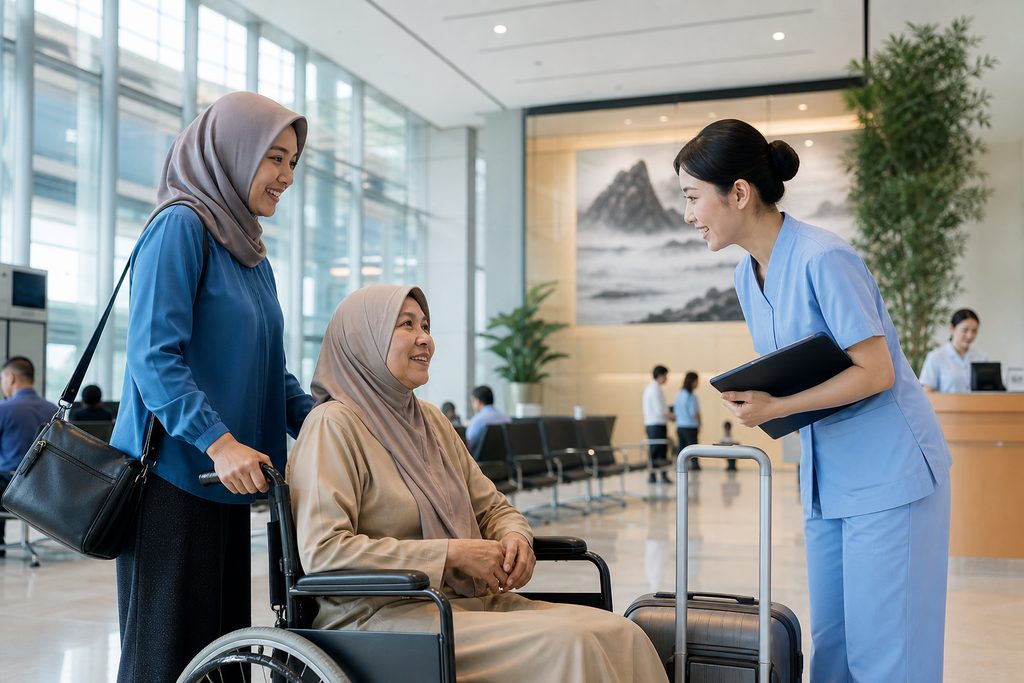
On the ground in China, a bilingual medical companion meets you at the airport. This person is not a translator on a phone. They are physically present with you at every appointment, navigating the hospital campus, handling registration, collecting test results, and translating conversations with your physicians in real time. They ensure your medical history is communicated accurately and that you understand every treatment recommendation before you consent. After discharge, they coordinate follow-up appointments, medication instructions, and any rehabilitation arrangements. The companion stays with you until you are stable and ready to return to Indonesia.
The full medical support service China Jakarta Surabaya pathway works because we handle the parts that break when patients try to go it alone. We do not treat your disease. We treat the logistics that stand between you and the doctors who can treat your disease.
Frequently Asked Questions
Indonesian patients access Chinese hospitals through the hospital’s official international patient department, not through the general public registration system. These departments handle foreign patients exclusively and operate in English and other languages. The challenge is that contacting them directly from Indonesia often fails due to unpublished contact channels and language barriers. Our team serves as the bridge—we coordinate with these departments on your behalf, submit your medical records, and secure confirmed appointments before you travel. This is not a workaround. It is the standard pathway for all international patients at major Chinese hospitals.
Our coordination service covers hospital selection and matching, medical record translation, appointment scheduling through international departments, S2 visa invitation documentation, airport transfer, and a bilingual medical companion who stays with you throughout your treatment. The companion handles registration, payment navigation, physician communication, and discharge coordination. Accommodation and hospital treatment costs are separate and paid directly to the hospital or hotel. We provide a detailed cost estimate based on your specific diagnosis and chosen hospital before you commit to anything. The coordination fee varies by case complexity, starting from $300 for basic appointment coordination and scaling up for comprehensive end-to-end support.
Yes, but the process requires remote evaluation first. Chinese oncologists will not schedule treatment without reviewing your complete medical records, imaging, and pathology reports. For many patients, we arrange a video consultation with a specialist at the target hospital before travel. This costs $100–$300 for a standard international department consultation, or $500–$800 for a top-specialist session. The physician reviews your case, confirms that treatment is appropriate, and provides a preliminary treatment plan. This step protects you from traveling to China only to discover that the recommended approach differs from what you expected. If you later proceed with in-person treatment through our coordination service, the video consultation fee is credited in full toward the coordination cost.
The best hospitals in China for international patients cost-wise are typically the public teaching hospitals with established international departments. These include Peking Union Medical College Hospital in Beijing, Zhongshan Hospital Fudan University in Shanghai, West China Hospital in Chengdu, and Ruijin Hospital in Shanghai. These institutions charge international patient rates that are higher than domestic rates but still far below Western prices—typically 1.5 to 2 times the domestic fee schedule. A cardiac bypass at one of these centers runs $12,000–$20,000. The same procedure at a private international hospital like United Family or Jiahui may cost $30,000–$50,000, which is still well below US prices but higher than the public option. The tradeoff is that private hospitals offer more Western-style amenities, direct insurance billing, and fully English-speaking environments. We help patients weigh these factors against their budget and clinical needs rather than pushing one model over the other.
This is the question every patient should ask. Chinese top-tier hospitals have robust complication management protocols. Their intensive care units are equipped to handle post-surgical emergencies, and specialist consultation is available in-house. From a logistics perspective, our bilingual companion remains with you throughout any extended hospitalization, ensuring communication does not break down at the moment you need it most. We also help coordinate with your family in Indonesia, providing updates and arranging emergency travel if a family member needs to join you. That said, we are honest about limitations. We do not control clinical outcomes. We do not intervene in medical decisions. We ensure the channels of communication stay open and that you are never left alone in a system where you cannot speak the language. For patients with very high surgical risk, we often recommend hospitals with dedicated international patient coordinators on staff, adding an additional layer of institutional support beyond our own team.
Your Next Step
Traveling to another country for medical treatment is never a small decision. It involves trust, money, and vulnerability. What makes it manageable is clarity—knowing exactly which hospital you are going to, what it will cost, how long you will stay, and who will be with you. That clarity is what we provide. If you are in Jakarta or Surabaya and considering treatment in China, start with a conversation. Tell us your diagnosis. Share your records. We will tell you honestly whether China’s hospitals offer a meaningful advantage for your specific situation, and if they do, we will map the path from where you are now to the recovery you are hoping for. Reach out through our patient coordination page. No pressure. No pitch. Just the information you need to make a clear-eyed decision.
For more medical information and treatment options in China, visit chinamedservices.com (China Medical Services).
