Cardiac Rehab Duration: How Long Does Recovery Take After Heart Surgery?
When 54-year-old Daniel woke up in the ICU after his triple bypass at a Shanghai hospital, his first question wasn’t about the surgery. It was about getting back to his life. “How many weeks until I can play with my grandkids again?” The cardiac surgeon gave him a number. The rehab team gave him a different one. Daniel’s confusion is exactly what we see with international patients every week — because the answer depends on far more than the operation itself. If you’ve searched for how long cardiac rehab takes, you already know the frustrating truth: every website gives a different range. Twelve weeks. Six months. A year. The real answer sits somewhere in the middle, and it shifts based on your starting point, your procedure, and where you recover. For patients weighing cardiac rehab cost China against programs back home, understanding this timeline matters before you book a single flight.
How This Actually Works, Step by Step
Cardiac rehabilitation isn’t a spa stay. It’s a structured medical program delivered in phases, and the clock starts the moment your chest is closed. Here’s the sequence we walk patients through when they contact us from abroad.
You send us your discharge summary, surgical notes, and latest echocardiogram. Our cardiac rehab coordinators at partner hospitals review these — usually within three business days. They assess your ejection fraction, sternal stability, and any comorbidities like diabetes or COPD that affect exercise tolerance. Then they place you into one of three tracks: post-MI (heart attack), post-CABG (bypass surgery), or post-valve replacement. Each track has a different duration.
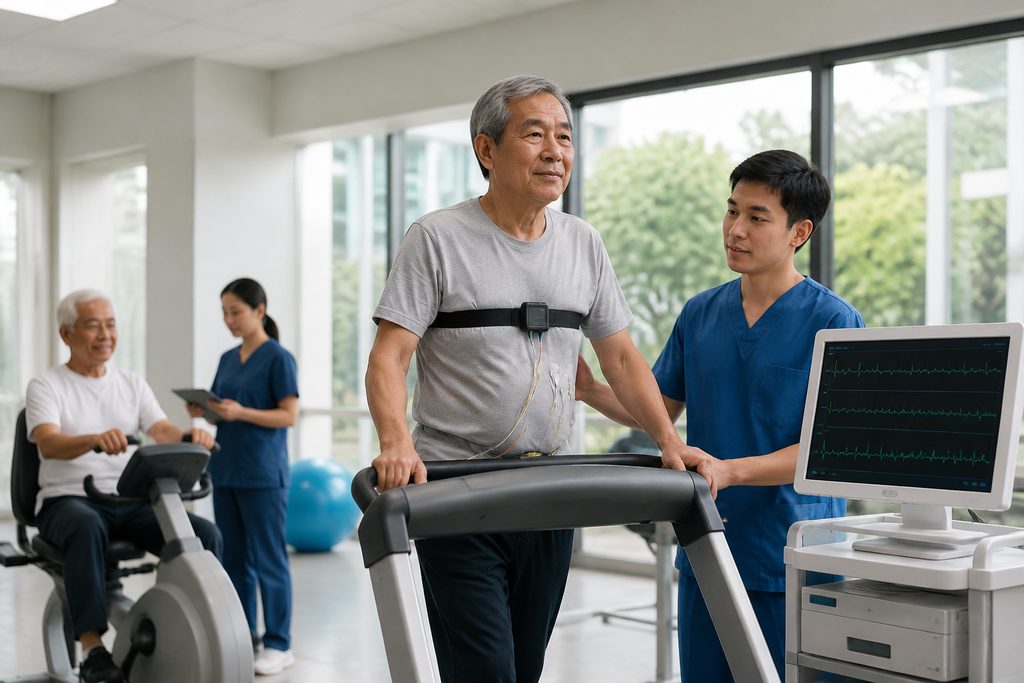
Phase 1 begins in the hospital bed. It’s not glamorous — sitting up, dangling legs, walking to the bathroom with a nurse. Most patients complete this in five to seven days. Phase 2 is the outpatient phase, the one everyone thinks of when they ask about duration. It typically runs 12 weeks, three sessions per week. That’s 36 supervised exercise sessions, each lasting 60 to 90 minutes. Phase 3 is maintenance — often lifelong, self-directed, with periodic check-ins.
What surprises international patients most: the paperwork gatekeeping. Before you can start Phase 2 in China, you need your translated medical records, a cardiologist’s referral, and a stress test. Translation takes two to four days. Booking the stress test at a top cardiology department in Shanghai or Beijing adds another three to five days. The S2 visa for medical treatment and private affairs — the correct category for rehab, not the M visa — takes one to two weeks at most embassies. Add it up: from contacting us to your first supervised session, expect three to four weeks of lead time.
How Long Does Cardiac Rehab Take After Bypass Surgery?
Bypass surgery is the most common reason international patients seek rehab in China. It’s also the procedure with the longest recovery arc. The sternum — the breastbone split during surgery — needs six to eight weeks to heal enough for upper-body exercise. That single fact dictates the entire timeline.
Weeks one through four: walking only. Treadmill at low intensity, no lifting more than five kilograms, no pushing or pulling motions. Patients who rush this phase crack their sternal wires. We’ve seen it. The repair surgery is worse than the original operation. Weeks five through eight: gradual resistance training begins, but still no overhead movements. By week twelve, most bypass patients complete their 36 supervised sessions and transition to home-based exercise.
But “complete” doesn’t mean “recovered.” A 2023 study in the European Journal of Preventive Cardiology tracked 1,200 CABG patients and found that functional capacity — measured by VO2 max — kept improving for six months after formal rehab ended. The patients who plateaued early were the ones who stopped exercising entirely. That’s the honest answer: structured rehab takes 12 weeks, but real recovery continues for six to nine months. Anyone promising faster results is selling something.
A Realistic Timeline
Here’s what actually happens, week by week, for an international patient pursuing cardiac rehab in China. These are ranges, not guarantees — your cardiologist’s clearance overrides everything.
| Stage | Duration | What Happens | What People Forget |
|---|---|---|---|
| Remote evaluation | 3–5 business days | We send your records to the rehab team; they assess eligibility and risk level | Incomplete records are the #1 delay — lab results older than 3 months get rejected |
| Document translation | 2–4 days | Discharge summary, surgical notes, medication list translated to Chinese | Hospitals require certified translation, not Google Translate |
| Visa processing (S2) | 1–2 weeks | S2 visa for medical treatment and private affairs, with hospital invitation letter | Embassy backlogs vary by country; apply before booking flights |
| Arrival + initial assessment | 2–3 days | Cardiologist consult, stress test, blood work, exercise prescription | Jet lag affects stress test results — rest 48 hours before testing |
| Phase 2 supervised rehab | 12 weeks (36 sessions) | 3 sessions/week: monitored exercise, nutrition counseling, medication adherence | Missed sessions extend the program; consistency beats intensity |
| Phase 3 transition | Month 4–6 | Home exercise plan, remote check-ins, repeat stress test at 6 months | Most patients underestimate how hard self-discipline is without supervision |
Total realistic commitment: four to six months for full functional recovery, with the first 12 weeks requiring active participation in a structured program. Some patients compress Phase 2 into eight weeks with daily sessions, but that’s only safe for low-risk patients under close monitoring.
What Can Go Wrong — and What Happens Then
Let’s be direct about the failure modes. We’ve coordinated enough cardiac rehab cases to know exactly where things derail.
Arrhythmia during exercise. Atrial fibrillation affects roughly 20% of post-CABG patients in the first month. If your heart rhythm goes irregular during a supervised session, the team stops exercise immediately, runs an ECG, and adjusts your beta-blocker dosage. You don’t get sent home — you get monitored more closely. That’s the entire point of supervised rehab.
Sternal infection. Rare — about 1-2% of cases — but serious. If your incision site shows redness, warmth, or drainage, rehab pauses. You’ll see an infectious disease specialist, likely start IV antibiotics, and resume exercise only after surgical clearance. This can add four to six weeks to your timeline.
Insurance rejection. Many international insurers classify cardiac rehab as “maintenance” rather than “treatment.” We’ve seen claims denied five weeks into a program. Before you travel, get written pre-authorization specifying the exact number of sessions and the billing codes. If denied, most Chinese hospital international departments will provide the documentation needed for appeal — but it takes time.
Language barrier in emergencies. During a supervised session, if you feel chest pain and can’t describe it in Chinese, the delay matters. That’s why we require a bilingual medical companion for patients who don’t speak Mandarin — not as a luxury, but as a safety protocol. The companion translates your symptoms in real time, so the team can act on seconds, not on a translation app.
Best Cardiac Rehabilitation Hospital Shanghai: What to Actually Look For
Patients ask us for the “best” hospital in Shanghai for cardiac rehab. The honest answer: the best hospital for you depends on your risk profile, not on a ranking list. But there are concrete criteria that separate excellent rehab programs from mediocre ones.
First, check the staff-to-patient ratio during exercise sessions. A good program runs one cardiac nurse per four patients, with a physician on the floor at all times. Ask this directly. If the hospital hesitates to answer, that’s your answer. Second, look at the monitoring equipment. Telemetry — continuous ECG monitoring during exercise — should be standard for high-risk patients, not an upgrade. Third, ask about the discharge process. Does the program hand you a written home exercise plan, or just wave goodbye at week 12? The difference determines whether your recovery lasts.
Shanghai’s top cardiac centers — including the large public hospitals with international departments — generally meet these standards. Some private international hospitals in Shanghai offer rehab programs with English-speaking staff and direct insurance billing, which simplifies logistics but costs more. For a deeper look at hospital options across specialties, our department rankings page breaks down China’s top cardiac surgery and cardiology programs by city.
One more criterion that matters more than patients expect: proximity to your accommodation. Rehab is three times a week for three months. If you’re commuting 90 minutes each way, you’ll skip sessions. Book housing within 20 minutes of the hospital, or ask the hospital about on-campus or affiliated accommodations. We help patients arrange this before arrival because it quietly determines program completion rates.
Cardiac Rehab Program Price Beijing vs. Shanghai: What the Numbers Mean
Let’s talk numbers, because cardiac rehab cost China is the question behind the question. The duration matters, but so does what you’re paying per week of supervised recovery.
In Beijing, a 12-week outpatient cardiac rehab program at a top public hospital’s international department typically runs $4,000 to $7,000 total. That covers the initial assessment, 36 supervised sessions, nutrition counseling, and the final stress test. Shanghai prices are comparable, often $3,500 to $6,500 depending on the hospital tier. Private international hospitals in both cities charge more — $8,000 to $15,000 for the same 12 weeks — but include English-speaking physicians, direct insurance billing, and shorter wait times for initial assessment.
Compare that to the United States, where a 12-week cardiac rehab program averages $6,000 to $12,000 without insurance, and often $2,000 to $5,000 even with coverage due to copays and deductibles. The cost difference isn’t as dramatic as surgical pricing, but it’s real — and for patients whose insurance doesn’t cover rehab at all, China’s cash prices become genuinely attractive.
What these numbers don’t include: accommodation, visa fees, flights, and the bilingual companion service. A three-month stay in Beijing or Shanghai, with a modest apartment and daily expenses, adds $4,000 to $8,000. That’s the honest math. For some patients, the total still beats U.S. out-of-pocket costs. For others, it doesn’t. We tell patients to run the full budget before deciding — and we provide the itemized estimates to make that possible.
For patients looking at broader treatment options in China, our top hospital rankings page lists the institutions with the strongest cardiac programs across 37 cities.
Is Cardiac Rehab Available for International Patients in China?
Yes — but with qualifications that matter. International patients can access cardiac rehab in China through two main routes: the international departments of large public hospitals, and private international hospitals. Both accept foreign patients. Both can provide English-language coordination. But they differ in how they handle the logistics.
Public hospital international departments offer the most experienced rehab teams — these are the hospitals performing thousands of cardiac surgeries annually, and their rehab programs see high patient volumes. The trade-off: administrative friction. Registration, payment, and scheduling run through a separate international office, and wait times for initial assessment can stretch to two weeks during peak seasons. A bilingual medical companion is effectively required for patients without Mandarin, not optional.
Private international hospitals — United Family, Jiahui, Raffles — offer smoother logistics. English-speaking staff throughout, direct insurance billing, faster assessment booking. The rehab programs are smaller and newer, which means less volume experience but more individualized attention. For low-risk patients, this works well. For complex post-surgical cases, the public hospital international departments remain the stronger clinical choice.
One thing that surprises patients: you cannot simply show up and register. Cardiac rehab in China requires a referral from a Chinese cardiologist, which means an initial consultation first. The hospital needs to confirm you’re stable enough for exercise before accepting you into the program. This protects you, but it adds a step — and a cost — that patients don’t always anticipate.
Practical Considerations: Records, Visa, Payment, and Follow-Up
What you need before you can book a cardiac rehab package in China, in practical terms.
Medical records. Bring everything: discharge summary, surgical report, current medication list, recent ECG, recent echocardiogram, and any stress test results. Hospitals want records less than three months old. Older than that, and you’ll repeat the tests in China — which costs money and delays your start date.
Visa. The S2 visa covers medical treatment and private affairs, including cardiac rehab. Your hospital invitation letter serves as supporting documentation. Family members accompanying you apply for their own S2 visas. Processing takes one to two weeks at most embassies, but check your local consulate’s current timeline before booking flights. No visa category guarantees approval, and requirements shift — always verify with the embassy, not with a blog.
Payment. Public hospital international departments require prepayment for the rehab program, typically in full at registration. Private international hospitals may bill per session or per month, and many accept direct insurance billing. If your insurer reimburses rather than pays directly, keep every receipt and ask for itemized invoices in English — most international departments provide these on request.
Follow-up at home. The program doesn’t end when you board the flight home. Ask your Chinese rehab team for a written home exercise prescription, a medication summary, and a six-month follow-up plan. Some hospitals offer remote check-ins via video consultation for international patients — worth arranging before you leave, not after you’re home and the time zone math gets complicated.
Frequently Asked Questions
Yes. Chinese cardiac rehab programs routinely accept patients who had bypass surgery, valve replacement, or stent placement abroad. You’ll need your complete surgical records and a cardiologist’s clearance. The initial assessment in China will confirm your exercise readiness before the program starts.
Some hospitals offer compressed programs — daily sessions over 6 to 8 weeks — for low-risk patients. This requires medical approval and isn’t appropriate for everyone. Alternatively, you can complete the initial 4 to 6 weeks in China and continue with a structured home program, with remote check-ins from your Chinese rehab team. Discuss this before booking, not after you’ve booked return flights.
Supervised cardiac rehab is designed for older patients — the average participant is over 60. The monitoring equipment and staff ratios exist precisely because cardiac patients are high-risk. Age alone doesn’t disqualify you. Frailty, uncontrolled arrhythmias, or recent complications might delay your start, but the initial assessment determines this.
It depends entirely on your insurer and policy. Some international policies cover rehab as part of post-surgical care; others classify it as maintenance and exclude it. Get written pre-authorization before you travel, with the specific program details and billing codes from the Chinese hospital. Without pre-authorization, assume you’re paying out of pocket.
Most cardiac surgeons advise waiting 2 to 4 weeks after bypass surgery before long-haul flights, due to the risk of blood clots and the stress of travel on a healing sternum. Your surgeon’s clearance is mandatory. Once cleared, arrange a wheelchair at airports and an aisle seat to allow movement during the flight. We coordinate airport transfer and hospital admission timing so you’re not navigating Shanghai or Beijing alone on day one.
Your Next Step
Cardiac rehab duration isn’t a mystery — it’s a medical protocol with clear phases, and the 12-week supervised program is the backbone of recovery after heart surgery. What varies is everything around it: where you do it, what it costs, how you handle the logistics, and whether you finish the program or drop out at week six. For international patients, cardiac rehab cost China and the availability of structured programs make the country a serious option — but only if you plan the timeline honestly.
We’re China Medical Services, and our team helps international patients navigate Chinese cardiac care — from hospital matching to bilingual medical companions to visa guidance. We don’t perform rehab, we don’t make medical decisions, and we don’t promise outcomes. What we do is handle the coordination so you can focus on the exercise, the nutrition, and the recovery. If you’re weighing cardiac rehab in China, start with
For more medical information and treatment options in China, visit chinamedservices.com (China Medical Services).
