Cardiac Rehabilitation in China: What Actually Happens, Step by Step
You’ve probably heard that recovering from heart surgery means months of uncertainty, expensive therapy sessions, and a vague sense of what “rehab” even involves. The reality is more structured than that — and far more accessible than most international patients assume. What happens during cardiac rehabilitation follows a defined clinical pathway, whether you’re in Cleveland or Chengdu. The difference is that cardiac rehab cost China runs roughly one-fifth to one-tenth of what American facilities charge, and the top cardiac centers in Beijing and Shanghai run programs with case volumes that dwarf most Western hospitals.
This article walks through the actual sequence: what you do in each phase, how long it takes, what the sessions feel like, and what it costs. No vague promises. Just the mechanics, the numbers, and the honest trade-offs.
How This Actually Works, Step by Step
Cardiac rehabilitation is not a single appointment. It’s a staged program that starts while you’re still in the hospital bed and continues for months after discharge. Most programs in China follow the same three-phase model used internationally, adapted to local hospital protocols.
Here’s the sequence:
- Phase 1 (Inpatient, days 1–7 post-procedure): You’re still in the hospital. A rehab nurse or physiotherapist gets you sitting up, then standing, then walking short distances in the ward. This phase focuses on preventing blood clots, restoring basic mobility, and teaching you how to move without straining the sternum if you had open-heart surgery.
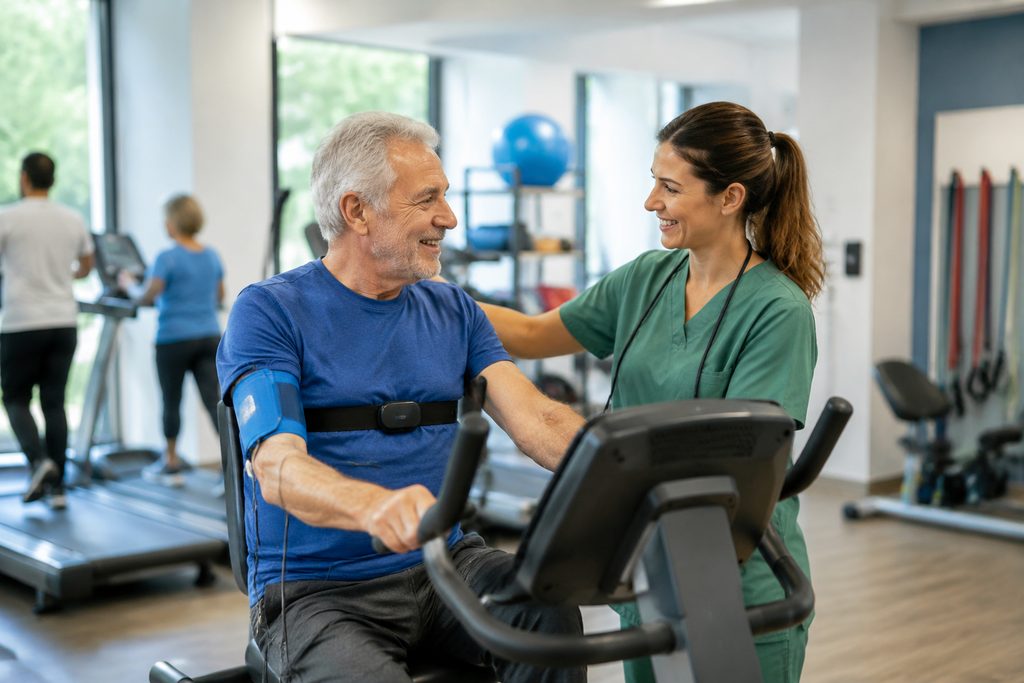
- Phase 2 (Outpatient, weeks 2–12): This is the core program. You visit the hospital’s rehab center 2–3 times per week. Each visit lasts 60–90 minutes and includes monitored exercise, education sessions, and medication review. An ECG monitor tracks your heart rhythm while you walk on a treadmill or cycle.
- Phase 3 (Maintenance, months 3–12): You transition to a self-directed routine, often with periodic check-ins. Some patients join hospital-affiliated exercise groups. Others continue at home with a prescribed plan and wearable monitoring.
What do you actually send or provide to get started? Your discharge summary, recent echocardiogram, angiogram report if applicable, current medication list, and a referral letter from your cardiologist. Our team translates these documents and coordinates with the rehab department before you arrive. That step alone saves most patients two to three weeks of back-and-forth.
What Is Cardiac Rehabilitation Like in China: The Session Breakdown
If you’ve never been inside a Chinese cardiac rehab center, the first thing you’ll notice is the volume. Top hospitals like Fuwai Hospital in Beijing run over 14,000 cardiac surgeries annually. Their rehab departments see hundreds of patients daily. That scale translates into efficiency — but also into a clinical rhythm that can feel fast if you’re not prepared.
A typical Phase 2 session at a major center looks like this:
- Check-in and vitals (10 minutes): Blood pressure, resting heart rate, oxygen saturation. A nurse logs everything into your electronic record.
- Warm-up (10 minutes): Light stretching, slow walking, or cycling at minimal resistance.
- Monitored aerobic exercise (30–40 minutes): You’re connected to a telemetry monitor. The physiotherapist adjusts intensity based on your target heart rate zone — usually 50–70% of your maximum predicted rate, adjusted for medications like beta-blockers.
- Resistance training (15 minutes): Light weights, resistance bands, or bodyweight exercises. This is where many programs differ — some Chinese centers emphasize traditional exercises like simplified Tai Chi for balance and breathing control.
- Education and cool-down (15 minutes): A nurse or dietitian covers topics like sodium intake, smoking cessation, stress management, and recognizing warning signs.
Language matters here. Public hospital rehab departments operate almost entirely in Chinese. That’s the single biggest practical barrier for international patients — and the reason bilingual coordination exists. Without it, you’ll struggle to understand exercise instructions or medication adjustments. With it, the clinical quality is identical to what you’d receive in any Western cardiac center.
Some international patients choose private facilities instead. Hospitals like United Family or Jiahui in Shanghai offer English-speaking rehab teams and Western-style care protocols. The trade-off is cost: private programs run 1.5 to 2 times the price of public hospital international departments. You can compare options on our private international hospitals page.
A Realistic Timeline
How long does cardiac rehab take after bypass surgery? The honest answer: longer than most patients expect, and the waiting periods before you start are often the most frustrating part.
| Stage | Typical Duration | What Happens |
|---|---|---|
| Document collection and translation | 3–7 days | You gather discharge summaries, imaging reports, medication lists. Our team translates them into Chinese for the hospital. |
| Hospital review and program acceptance | 5–10 days | The rehab department reviews your case, confirms eligibility, and assigns a start date. |
| Visa processing (S2) | 2–6 weeks | You apply for an S2 visa with the hospital’s invitation letter. Processing time varies by country and consulate workload. |
| Phase 1 (inpatient) | 3–7 days | Begins immediately after surgery if you had your procedure in China. If you’re coming for rehab only, this phase is skipped or compressed. |
| Phase 2 (outpatient) | 8–12 weeks | 2–3 sessions per week. This is the core rehab period. |
| Phase 3 (maintenance) | 6–12 months | Self-directed with periodic check-ins. Can be completed in your home country with a discharge plan. |
People forget the document translation step. They assume they can email a PDF and show up. Chinese hospitals require certified translations of key medical records before they’ll schedule rehab. Budget a week for this. Also note that S2 visa processing has no guaranteed timeline — apply as early as possible once the hospital confirms your program slot.
What Can Go Wrong — and What Happens Then
Cardiac rehab is generally safe. Serious complications occur in approximately 1 in 50,000 patient-hours of exercise, according to published registry data. But things do go wrong, and you should know the failure modes before you commit.
Your records are incomplete. You arrive without a recent echocardiogram or stress test. The rehab team can’t establish your safe exercise zone. Result: your start date is delayed while you get tested locally. That adds 3–5 days and several hundred dollars. Fix: send everything before you book flights, and let a coordinator verify completeness.
Your blood pressure is unstable. You show up for a session and your resting BP is 170/100. The nurse stops the session. You’re sent back to your cardiologist for medication adjustment. This happens more often than you’d think — especially in patients who flew long-haul within the previous 48 hours. Fix: arrive 3–4 days before your first rehab session to adjust to time zone and altitude changes.
The program feels too fast or too slow. Some patients find Chinese rehab departments move quickly — you’re in, monitored, exercised, and out in 75 minutes. Others find the intensity lower than expected, especially in the first two weeks. Fix: speak up. Physiotherapists adjust protocols based on your feedback, but they won’t know you’re struggling unless you say so. A bilingual companion helps here.
Insurance refuses coverage. Most international insurers don’t cover rehab in China unless it’s part of a pre-authorized treatment plan. You pay out of pocket and seek reimbursement later, which may or may not succeed. Fix: get pre-authorization in writing before you travel. If your insurer won’t cover it, factor the cash price into your decision.
Is Cardiac Rehab Safe in Beijing Hospitals? Evaluating Quality and Choosing Where to Go
The short answer is yes — at accredited centers. The longer answer depends on which hospital you choose and what you’re comparing it to.
Beijing and Shanghai host the majority of China’s top-ranked cardiac programs. Fuwai Hospital performs the highest volume of cardiac surgeries globally. Zhongshan Hospital in Shanghai runs one of the country’s largest cardiac rehab departments. Both are ranked among China’s top 10 for cardiac surgery on the Fudan specialty rankings. You can browse cardiac surgery rankings on our department rankings page.
What should you look for when evaluating a program?
- Accreditation: JCI accreditation or Fudan ranking indicates external quality review. Not every good program has both, but the absence of either is a yellow flag.
- Staffing ratios: Ask how many patients each physiotherapist handles per session. At top centers, it’s 4–6. At lower-tier hospitals, it can be 12–15, which means less individualized attention.
- Monitoring equipment: Telemetry during exercise is standard at major centers. If a facility doesn’t offer continuous ECG monitoring during Phase 2, walk away.
- Language support: Public hospitals rarely have English-speaking rehab staff. Private international hospitals do. Decide whether you’ll bring your own interpreter or pay for a facility with built-in language support.
One common mistake international patients make: choosing a hospital based on its cardiology reputation alone, without checking whether its rehab department is equally strong. A hospital can be world-class at surgery and mediocre at post-operative rehabilitation. Ask specifically about the rehab program — not just the cardiac surgery department.
Another consideration: best cardiac rehab hospital Shanghai searches often surface private facilities with polished websites but limited clinical depth. Don’t confuse a good website with a good program. Look for patient volume, published outcomes, and physician training backgrounds.
Practical Considerations: Records, Visa, Payment, and Follow-Up
Let’s talk about the things that actually delay or derail international rehab plans.
Medical records: You need your discharge summary, most recent echocardiogram (within 6 months), coronary angiogram or PCI report if applicable, current medication list with dosages, and any stress test results. Certified Chinese translations are required. Budget $80–150 for translation of a typical 20-page record set.
Visa: Medical treatment in China falls under the S2 visa category. Your family members accompanying you also apply for S2 visas. Processing takes 2–6 weeks depending on your home country’s consulate. You’ll need an invitation letter from the hospital — which means you need a confirmed program slot first. The sequence matters: hospital confirmation, then visa, then flights.
Payment: Public hospital international departments require cash payment or bank transfer before each phase. Most do not accept foreign insurance directly. Private international hospitals often do direct billing with major insurers. Out-of-pocket cardiac rehab cost China at a top public hospital international department typically runs $2,000–4,000 for a full 12-week Phase 2 program. Private facilities charge $5,000–10,000. Compare that to the $15,000–30,000 a comparable US program costs, and the value proposition is clear.
Language: Without Chinese ability, you’ll need a bilingual medical companion for at least the first two weeks. From $300 per day, this covers registration, queue management, interpretation during sessions, and translation of written instructions. It’s not a luxury — it’s the difference between understanding your exercise limits and guessing.
Follow-up at home: Before you leave China, ask the rehab team for a written discharge plan: target heart rate zones, exercise prescriptions, dietary guidelines, and medication schedule. Bring this to your home cardiologist. Most Chinese rehab departments will provide this in Chinese; request an English version or pay for translation before you fly home.
Frequently Asked Questions
At a top public hospital international department, expect $2,000–4,000 for a complete 12-week Phase 2 program, including monitoring and education sessions. Private international hospitals charge $5,000–10,000. This varies by hospital and case complexity, and does not include accommodation, visa fees, or translation services.
Yes, but the process is different from booking a hotel. You submit your medical records for review first. The hospital’s rehab department confirms eligibility and assigns a start date. Only then can you apply for the S2 visa. You cannot simply reserve a slot online without medical review. A coordination service can handle the document submission and communication with the hospital’s international department.
At accredited centers like Fuwai Hospital or Peking Union Medical College Hospital, yes. Safety protocols match international standards — monitored exercise, staged progression, and emergency response teams on site. The main risks for foreign patients are logistical: language barriers, incomplete records, and arriving without adequate rest after long flights. These are manageable with proper preparation.
Phase 1 begins in the hospital immediately after surgery and lasts 3–7 days. Phase 2 runs 8–12 weeks with 2–3 sessions per week. Phase 3 continues for 6–12 months as a maintenance program. Total structured rehab time: roughly 3–4 months. Full functional recovery can take up to a year.
At public hospitals, yes — or you need a bilingual medical companion. Rehab nurses and physiotherapists at public facilities rarely speak English. Private international hospitals like United Family or Jiahui offer English-speaking staff, but at roughly double the cost. If you choose a public hospital, budget for interpretation support.
Your Next Step
Cardiac rehabilitation in China follows the same clinical pathway you’d find anywhere — the difference is cost, scale, and the practical challenge of navigating a system that wasn’t designed for English speakers. That’s where we come in. China Medical Services connects international patients with top-ranked cardiac centers across 340+ hospitals in 37 cities, handling document translation, program coordination, and bilingual support throughout your rehab.
We don’t provide medical advice, and we don’t guarantee clinical outcomes. What we do is handle the logistics — so you can focus on recovery. If you’re considering cardiac rehab in China, start with a conversation. Tell us your situation, and we’ll help you understand whether this path makes sense for you.
Request a free consultation to discuss your cardiac rehab options in China.
For more medical information and treatment options in China, visit chinamedservices.com (China Medical Services).
