Complex Spine Surgery in China: Should You Travel for Care?
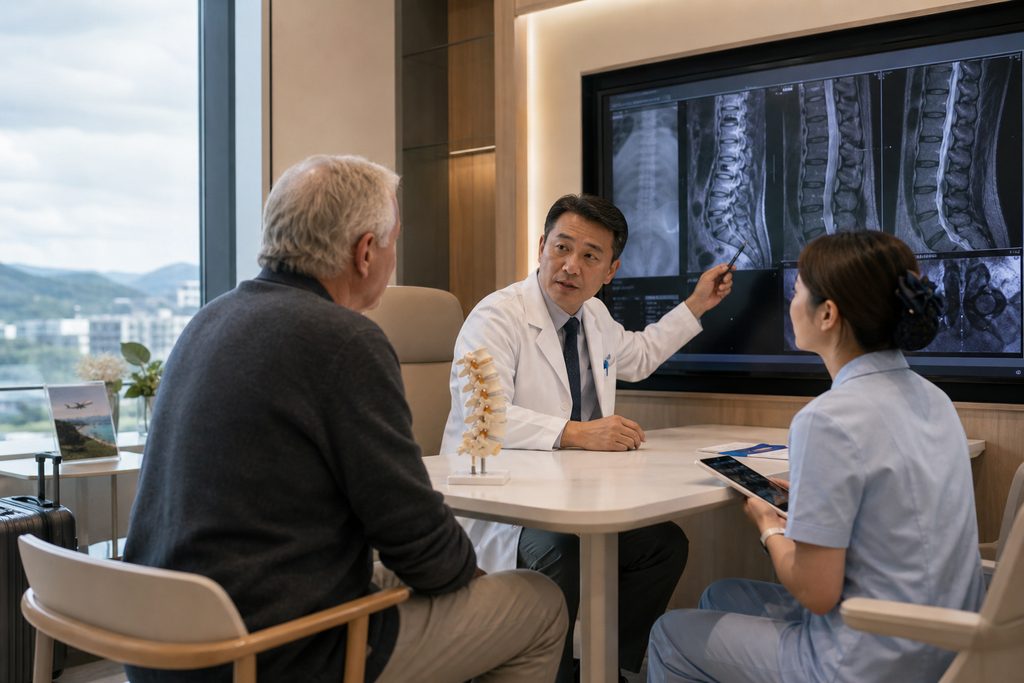
According to a 2023 report from the China Association of Medical Equipment, the country’s top-tier hospitals now perform over 400,000 spinal fusion procedures annually, with a growing share involving international patients. The decision to fly halfway around the world for a multilevel fusion or scoliosis correction is not a light one. But for many patients facing six-figure quotes and year-long waits at home, the complex spine surgery cost China has become impossible to ignore. We help patients evaluate this decision every week. Here is what the data actually shows.
Complex Spine Surgery in China: The Short Answer
For most patients, the answer is yes — if you select the right hospital tier and understand the system. The complex spine surgery cost China runs between $18,000 and $45,000 for procedures that typically bill at $120,000 to $250,000 in the United States. That is a 70–85% reduction. But the real question is not just cost. It is whether you can access the surgeons who perform these operations at high volume, and whether the logistical friction is manageable. For many people, it is. For some, it is not.
China’s top orthopedic centers — concentrated in Beijing, Shanghai, and Guangzhou — now handle case volumes that dwarf most Western academic hospitals. A single spine department at a major Shanghai hospital may complete 3,000 or more instrumented fusions per year. Volume matters in spine surgery. It correlates with lower complication rates and shorter operative times.
Who This Is Right For — and Who It Isn’t
Honest assessment matters more than enthusiasm. We tell patients the same thing regardless of where they ultimately go. You should seriously consider traveling to China for complex spine surgery if you fall into one of these categories:
- You need a multilevel fusion, revision surgery, or deformity correction quoted above $100,000 at home.
- You have been waiting more than 6 months for a surgical date and your condition is deteriorating.
- You are comfortable traveling and can commit to a 3–4 week stay for surgery and initial recovery.
- You have imaging and records that are complete and can be translated.
- You want access to surgeons who perform 200+ complex spine cases per year.
And here is who should not pursue this path. If you have unstable cardiovascular disease, active infection, or a condition that requires immediate emergency intervention, stay home. If you cannot tolerate a long-haul flight, the trip itself becomes a risk. If you need ongoing postoperative care that your home provider refuses to coordinate, the math changes. And if you expect the same administrative hand-holding you would get at a US private hospital without hiring support, you will be frustrated. The system is excellent clinically. It is not designed around English-speaking foreigners by default.
The Options, Compared
Patients weighing complex spine surgery cost China against other destinations usually consider three or four pathways. Here is how they stack up.
| Factor | China Top Public (International Dept) | China Private International | United States | Thailand / India |
|---|---|---|---|---|
| Multilevel fusion cost | $18,000–$35,000 | $35,000–$60,000 | $120,000–$250,000 | $25,000–$50,000 |
| Surgeon annual complex case volume | 150–300+ | 80–150 | 50–150 | 100–200 |
| Wait for surgery after consult | 2–6 weeks | 2–4 weeks | 3–12 months | 4–10 weeks |
| English-speaking staff | Limited; interpreter needed | Standard | Standard | Standard |
| JCI accreditation | Some international depts | Most | Most | Many |
| Post-op rehab on site | Basic; TCM adjunct available | Comprehensive | Comprehensive | Moderate |
If your priority is the lowest possible cost with high surgical volume, the international department of a top public hospital is the strongest option. If you want Western-style service and direct insurance billing, a private international hospital in Shanghai or Beijing makes more sense. The US remains the benchmark for integrated care but at a price that is simply out of reach for many. Thailand and India are viable, but top Chinese centers now match or exceed their surgical volumes in complex deformity work.
What “Complex Spine Surgery in China” Actually Means
A reader searching this exact phrase usually has a specific case in mind: adult scoliosis, severe kyphosis, failed previous fusion, multilevel stenosis with instability, or a tumor requiring en bloc resection and reconstruction. These are not single-level microdiscectomies. They involve long-segment instrumentation, osteotomies, neuromonitoring, and sometimes staged procedures.
Chinese spine centers have developed particular strength in three areas. First, severe deformity correction — surgeons at centers like Peking University Third Hospital and Shanghai Changzheng Hospital handle curves that many Western surgeons see only a handful of times per year. Second, minimally invasive techniques for multilevel disease, including endoscopic and tubular approaches that reduce blood loss and recovery time. Third, revision surgery, where prior hardware must be removed and reconstruction planned around scar tissue and altered anatomy. The orthopedics and spine surgery department rankings on our site list the centers with the strongest published outcomes.
What you should not expect is a boutique experience. These are high-volume academic centers. Rounds are efficient. Discharge planning is practical. You will need a bilingual companion to navigate registration, imaging, and payment. That is simply the reality of the system.
What It Costs
The complex spine surgery cost China breaks down into several components. Hospital charges for a 4–6 level fusion with instrumentation typically run $12,000 to $25,000. Surgeon and anesthesia fees add $4,000 to $8,000. Implants — rods, screws, cages — are a major variable, ranging from $5,000 to $15,000 depending on whether domestic or imported hardware is used. A two-week inpatient stay adds $3,000 to $6,000. That puts the total for a public hospital international department at $18,000 to $35,000. A private international hospital in Shanghai will charge $35,000 to $60,000 for the same procedure, with more comfortable rooms and direct insurance billing.
For reference, how much does scoliosis surgery cost in Shanghai specifically? At a public hospital international department, a typical adolescent or adult scoliosis correction runs $22,000 to $38,000. At a private facility like Jiahui or United Family, expect $45,000 to $65,000. These figures include the hospital stay but not airfare, accommodation for family, or post-discharge rehabilitation.
What is not included: pre-operative medical clearance if done at home, visa fees, interpreter services, and any revision surgery. Payment at public hospitals is generally required upfront, with insurance reimbursement claimed afterward. Private international hospitals often bill insurers directly.
Practical Considerations: Records, Visa, and Follow-Up
You cannot book complex spine surgery in China from abroad through the standard public registration system. The pathway works differently. First, you submit complete records — MRI, CT, X-rays, prior operative notes if applicable — for a written second opinion or video consultation. The surgical team reviews your case and confirms they will accept it. Only then do you travel for an in-person evaluation and surgical scheduling. This protects you from arriving in a foreign country only to learn your case is not suitable.
Visa is the next hurdle. Foreign nationals traveling to China for medical treatment use an S2 visa, annotated for medical purposes. Family members accompanying you also apply for S2. Processing times vary by embassy, and you will need supporting documents from the hospital — typically an invitation letter and treatment confirmation. We provide guidance on this but never guarantee approval. The M visa is for commercial trade and has no relevance to medical travel. Do not apply for one.
Language is the single largest practical barrier. Top public hospitals see thousands of patients daily. Signage is often bilingual in international departments, but the workflow — registration windows, imaging queues, pharmacy pickup — is not designed for non-Chinese speakers. A bilingual medical companion who handles queueing, payment, and translation is not a luxury. It is the difference between a manageable stay and a genuinely stressful one.
Follow-up after returning home deserves serious planning. Your surgeon in China will provide a detailed operative report and imaging. You need a local spine specialist willing to review it and manage late complications. Some patients return to China at 3 or 6 months for follow-up imaging. Others coordinate remote review. Either way, do not assume your home provider will seamlessly take over. Confirm this before you travel.
Is Complex Spine Surgery Safe in China?
Safety is the question behind every other question. The honest answer: at top-ranked centers, the safety profile for complex spine surgery is comparable to Western academic hospitals. Complication rates for major deformity surgery at leading Chinese centers run in the 5–10% range for significant adverse events, consistent with published international benchmarks. Neuromonitoring is standard. Blood management protocols are mature. ICU capacity is substantial.
But — and this matters — the variance between hospitals is enormous. China has over 35,000 hospitals. The top 5% perform at an international standard. The rest do not. This is why hospital selection is the single most important decision you will make. Our database covers 340+ top-ranked hospitals across 37 cities, filtered by Fudan rankings and JCI accreditation. If a facility is not in that tier, we do not recommend it for international patients seeking complex spine surgery.
Infection control at top centers is rigorous. Implant quality is regulated. But do not expect the same patient-satisfaction infrastructure you would find in a US private hospital. Communication is direct. Families are expected to provide some bedside support. The clinical care is excellent; the hospitality layer is thinner unless you pay for a private international hospital.
How to Book Spine Surgery in China: Medical Tourism Pathways
Patients often search for a way to book spine surgery China medical tourism as if it were a hotel reservation. It is not. The sequence matters. A written second opinion comes first. You send records, the Chinese team reviews them, and you receive a written assessment with treatment recommendations. This costs $300–500 at a top hospital and is credited toward coordination if you proceed. A video consultation follows, allowing you to speak directly with the surgical team. That runs $500–800 for a top specialist.
Only after remote evaluation confirms a feasible plan do you travel. The in-person evaluation, surgical scheduling, and admission are coordinated through the hospital’s international department. A spine surgery abroad fast track China pathway exists — but it means the international department channel, not skipping the line at a public hospital. You are paying for expedited coordination and English-language support, not for jumping a clinical queue. That distinction matters. It is legitimate case management, not access buying.
For patients who cannot travel immediately, a proxy consultation is available. You designate the hospital and department, and we arrange registration and an in-person visit using your materials. Any subsequent admission remains subject to hospital rules. This staged approach — remote opinion first, travel second — reduces the risk of an expensive trip that produces no surgical plan.
Frequently Asked Questions
Most US and European insurers will not directly cover surgery at a Chinese public hospital. You pay upfront and submit for reimbursement, which may be partial or denied depending on your policy. Private international hospitals in China with JCI accreditation are more likely to have direct billing arrangements with major insurers. Check your policy’s out-of-network and international coverage clauses before committing. Some patients use medical loans or health savings accounts. Others self-pay because the total cost is lower than their deductible plus coinsurance at home.
This is the hardest question to answer honestly. Your Chinese surgeon will provide operative notes and imaging, but they cannot manage a wound infection or hardware failure from 7,000 miles away. You need a local spine surgeon who agrees in advance to see you for complications. Some will. Some will not, citing unfamiliarity with the implants or technique. Ask before you travel. Get it in writing if possible. Remote follow-up with your Chinese team via video is available, but it does not replace hands-on care. The risk is real, and it is manageable only with planning.
Plan for three to four weeks minimum. You will arrive several days before surgery for pre-operative testing and surgical planning. The hospital stay for a complex fusion is typically 7 to 14 days. After discharge, you need another week to ten days locally before flying home — sitting for long periods immediately after multilevel fusion is not advisable, and your surgeon will want to see you once for wound check and early imaging. Some patients stay longer if they want inpatient rehabilitation or TCM adjunct therapy before departure.
Yes, and you should. A family member or friend who can assist with basic care and communication makes a significant difference. They apply for the same S2 visa category, annotated for accompanying a medical patient. Both patient and companion need supporting documents from the hospital. Our team provides the document checklist and coordinates with the hospital’s international office, but the embassy makes the final decision.
Top Chinese centers use both domestic and imported implant systems. Imported systems — from the same manufacturers used in US and European hospitals — are available and commonly selected for international patients. Domestic systems have improved substantially and are regulated by the NMPA, but if you have a strong preference for a specific manufacturer, state it during your video consultation. The implant choice affects cost by several thousand dollars. It does not affect the surgeon’s technique, which is the larger determinant of outcome.
Your Next Step
The decision to travel for complex spine surgery is not one to make from a brochure. It requires specific medical records, a realistic assessment of your case, and honest answers about cost, risk, and follow-up. That is the work we do. We are not a hospital, and we do not diagnose or treat. We are a coordination team that connects international patients with China’s top-ranked spine centers, manages the documentation and scheduling, and provides bilingual support on the ground. If you want to know whether your specific case is suitable, start with a written second opinion. It is the lowest-cost, lowest-risk way to get real answers from the surgeons who would actually operate on you. Reach out through our consultation page and we will walk you through what to send and what to expect. No pressure. Just a clear path forward.
For more medical information and treatment options in China, visit chinamedservices.com (China Medical Services).
