Hip Surgery Recovery: How Long You’ll Need Crutches and Why China Is an Option
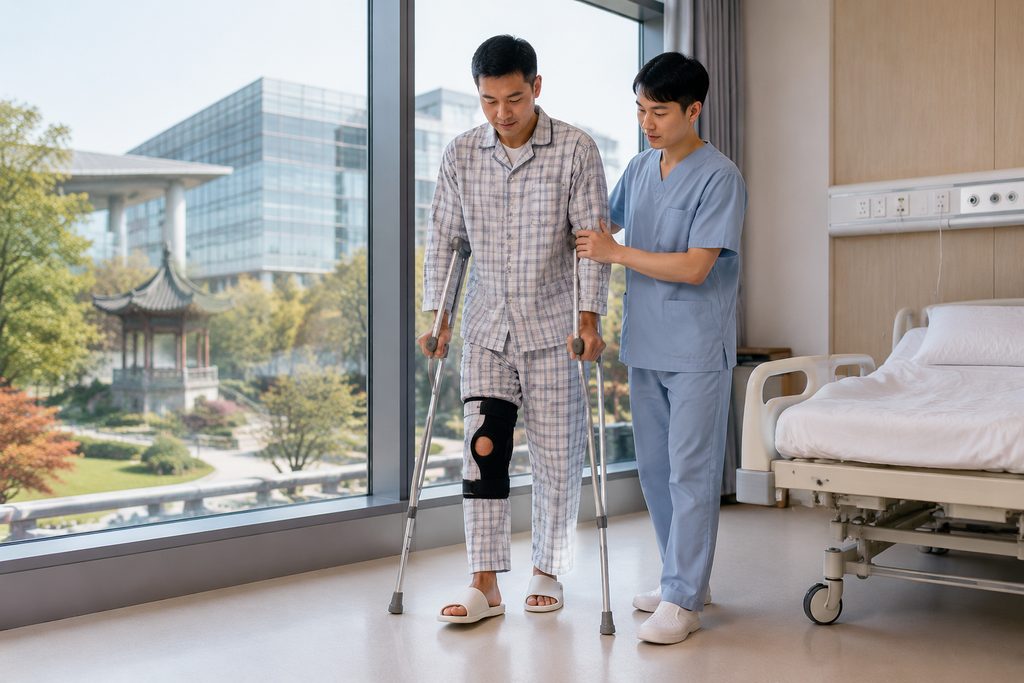
How Long Do I Need Crutches After Hip Surgery?: The Short Answer
Most patients use crutches for 2 to 4 weeks after a standard total hip replacement. Some are cleared to walk unaided at the 3-week mark. Others — especially those who had complex revisions, poor pre-surgery mobility, or significant muscle atrophy — stay on crutches for 6 to 8 weeks. Your surgeon’s protocol matters more than the national average.
But here’s what changes the math. The type of surgical approach matters enormously. Anterior approach patients often ditch crutches faster than posterior approach patients because fewer muscles get cut. Your age, bone quality, body weight, and whether you did prehabilitation before surgery all shift the timeline. And if you’re comparing orthopedic surgery programs internationally, recovery protocols differ by hospital philosophy — some Chinese joint replacement centers now use enhanced recovery after surgery (ERAS) pathways that get patients walking with a walker within 24 hours and transitioning to a cane by day 10.
Who This Is Right For — and Who It Isn’t
Traveling abroad for hip replacement makes sense for a specific patient profile. You should be medically stable, cleared for elective surgery, and able to sit comfortably for a 10–14 hour flight home after discharge. You should have realistic expectations about language barriers and follow-up logistics.
Good candidates typically include:
- Patients facing 6–18 month wait times in Canada, the UK, or parts of Europe
- Uninsured or underinsured Americans looking at $40,000–$80,000 out-of-pocket quotes
- Patients who need bilateral hip replacement and want both done in one coordinated trip
- People with family or business ties in China who can extend their stay
- Patients who value high surgical volume — Chinese top-tier orthopedic centers perform thousands of joint replacements annually
Who should not pursue this? Anyone with unstable cardiovascular disease, uncontrolled diabetes, active infection, or a BMI over 40 without prior surgeon clearance. Patients who need complex revision surgery with custom implants may find domestic options safer due to easier follow-up. And if you cannot arrange at least 3–4 weeks in-country for surgery plus initial rehab, the logistics won’t work.
The Options, Compared
When patients ask us about hip replacement cost China, they’re usually weighing three scenarios: staying home and waiting, going private domestically, or traveling. Here’s the honest comparison.
| Factor | US Private Pay | UK NHS Wait | China Top-Tier Public | China Private International |
|---|---|---|---|---|
| Total hip replacement cost | $40,000–$80,000 | Free but 6–18 month wait | $12,000–$20,000 | $25,000–$40,000 |
| Time from consult to surgery | 2–8 weeks | 6–18 months | 2–6 weeks via international dept | 1–4 weeks |
| Surgeon annual volume | 50–200 hips | 100–300 hips | 300–800 hips | 100–300 hips |
| English-speaking staff | Yes | Yes | Limited — companion recommended | Yes |
| Implant brands available | Zimmer, Stryker, DePuy | Mixed, cost-driven | Zimmer, DePuy, Link, domestic | Zimmer, Stryker, DePuy |
| Post-op rehab included | Often separate cost | Basic physio | Inpatient rehab 1–2 weeks | Bundled packages available |
The China public hospital column suits cost-sensitive patients who don’t mind navigating language friction with a bilingual companion. The private international column suits patients who want Western-style service and direct insurance billing. Neither is objectively better — it depends on your budget and your tolerance for unfamiliar systems.
Crutches Recovery Timeline: What Week 1 Through Week 8 Actually Looks Like
This is the section every patient of this exact title needs. Not the brochure version — the real one.
Days 1–3 (in hospital): You’ll stand with a walker within 24 hours if the ERAS protocol is followed. Crutches come on day 2 or 3. The goal is not distance — it’s confidence bearing weight through the operated leg. Expect swelling, pain managed by multimodal analgesia (not just opioids), and the first awkward toilet transfer.
Week 1: You’re on two crutches. Walking 50–100 meters per session, 3–4 times daily. The physiotherapist drills you on stairs, chair transfers, and getting in and out of a car. You’re probably still in the hospital in China — most top orthopedic centers keep hip patients 5–10 days, which is longer than the US 1–3 day standard. That extra inpatient rehab time matters for international patients who won’t have easy access to outpatient physio after flying home.
Weeks 2–3: Transition to one crutch or a cane, held on the opposite side. Gait quality matters more than speed. If you’re limping, you stay on two crutches longer. By day 21, many anterior-approach patients walk unaided for short indoor distances.
Weeks 4–6: Most patients are off crutches entirely for indoor walking. Outdoor walking with a cane continues for stability on uneven ground. You should be able to walk 1–2 kilometers by week 6. If you can’t, that’s a red flag — not necessarily surgical failure, but a sign your rehab intensity is insufficient.
Weeks 6–8: Crutches are gone. You’re rebuilding glute strength, working on single-leg balance, and returning to driving (usually cleared at week 6 for right hip, week 4 for left hip with automatic transmission). Full recovery of strength takes 6–12 months, but the crutches chapter closes by week 8 for the vast majority.
And here’s the question nobody asks: what if I fly home at week 3 and I’m still on one crutch? That’s fine. The airline will gate-check your crutch. You’ll need to stand and walk the aisle every 1–2 hours to prevent deep vein thrombosis. Compression stockings are non-negotiable on that flight.
What It Costs
Let’s break down the hip replacement cost China figure into components, because the headline number rarely matches the final bill.
A total hip replacement at a top-tier Chinese public hospital through the international department runs $12,000–$20,000. That typically includes the implant, surgeon fee, anesthesia, 7–10 days of inpatient stay, basic physiotherapy, and routine post-op imaging. It does not include your flight, visa, accommodation for family, bilingual companion services (from $300/day), or any extended rehab stay.
At a private international hospital like United Family or Jiahui, expect $25,000–$40,000 all-in. You’re paying for English-speaking nursing staff, Western food options, direct insurance billing, and a more hotel-like environment. Some patients choose a hybrid: surgery at a public top-tier hospital, recovery at a private rehab facility.
What drives variance? Implant choice (ceramic-on-ceramic costs more than metal-on-polyethylene), whether you need a cemented or uncemented fixation, your length of stay, and whether any cardiac or diabetic complications extend your hospitalization. Always ask for an itemized quote before committing. And remember: any remote consultation fee you pay our team is credited in full toward on-the-ground coordination if you proceed within 90 days.
Practical Considerations: Visas, Records, and Follow-Up
If you’re serious about surgery in China, the paperwork starts before the packing list.
Visa: You’ll apply for an S2 visa — the short-stay category used for private affairs, including medical treatment. Your hospital must issue an invitation letter and treatment confirmation. Family members accompanying you apply for their own S2 visas. Processing takes 1–4 weeks depending on your home country’s Chinese embassy or consulate. Do not book flights until the visa is in your passport.
Medical records: You need recent X-rays (within 3 months), an MRI if available, your full medication list, and any cardiac clearance if you’re over 60 or have heart disease. Have these translated into Chinese before you arrive — our team handles document translation as part of coordination. The surgeon will review them during your video consultation, which costs $500–800 for a top specialist.
Payment: Chinese public hospitals require prepayment before surgery. International credit cards work at private hospitals but not always at public ones. Wire transfers are standard. Keep every receipt for insurance reimbursement — most international insurers reimburse Chinese hospital fees after the fact, not directly.
Language: Even at top-tier public hospitals, most nurses and junior doctors speak limited English. The surgeon may speak some. For everything else — registration, pharmacy, imaging, billing — you’ll want a bilingual medical companion. This is not a luxury. It’s the difference between a smooth discharge and a 3-hour billing dispute in Mandarin.
Follow-up after flying home: Your Chinese surgeon will want X-rays at 6 weeks and 6 months. You can send these digitally for review. If a complication arises — infection, dislocation, implant loosening — your local orthopedic surgeon handles it. Chinese hospitals do not manage overseas complications remotely. This is the trade-off you accept when you travel for surgery.
Frequently Asked Questions
At top-tier hospitals, yes — with caveats. The best Chinese orthopedic centers perform thousands of joint replacements annually, and their infection rates are comparable to Western benchmarks. But quality varies enormously between the top 5% of hospitals and the rest. Stick to hospitals ranked in the Fudan specialty reputation list for orthopedics or those with JCI accreditation. Ask for the hospital’s infection rate and surgeon’s annual volume before committing. A high-volume surgeon at a reputable center is your safest bet.
You don’t book a “package” the way you’d book a hotel. The process is: submit your records for review, do a remote video consultation with the orthopedic team, get a treatment plan and cost estimate, then coordinate your arrival and hospital admission. What you’re actually paying a coordinator for is case management — document translation, hospital communication, appointment scheduling through the official international department, and bilingual support on the ground. No legitimate service can guarantee you a specific surgeon or surgery date. Anyone who promises that is not operating through official channels.
You’ll need a local orthopedic surgeon for any post-operative complication. Your Chinese surgeon can review imaging and advise, but they cannot treat you remotely. This is the single biggest risk of traveling for surgery. Before you commit, identify a local orthopedic surgeon willing to take over your follow-up care. Some US and UK surgeons refuse to manage complications from surgery performed abroad. Have that conversation before you book the flight, not after.
Most US private insurers will not cover elective surgery in China unless it’s an emergency. Some international health insurance plans (Cigna Global, Allianz, Bupa) do cover planned treatment in China at approved facilities — usually private international hospitals. Medicare and NHS do not cover overseas elective surgery. You’ll likely be paying out of pocket and seeking reimbursement. Get pre-authorization in writing from your insurer before you travel.
Your Next Step
The crutches timeline after hip surgery is predictable: 2–4 weeks for most, 6–8 weeks if you’re slow to recover. What’s less predictable is how long you’ll wait for surgery at home — and what you’ll pay. China offers a genuine alternative for patients who’ve done the math and are willing to navigate a different system.
Our team at China Medical Services helps international patients coordinate hip replacement at top-ranked Chinese orthopedic centers. We are not a hospital, and we don’t make diagnoses or promise outcomes. What we do is connect you with the right surgical team, handle the logistics, and make sure you’re not alone in a system you don’t know. If you’re considering this path, start with a free consultation — tell us your situation, and we’ll tell you honestly whether China makes sense for you.
For more medical information and treatment options in China, visit chinamedservices.com (China Medical Services).
