How Long Before I Can Walk After Knee Surgery? A Realistic Timeline
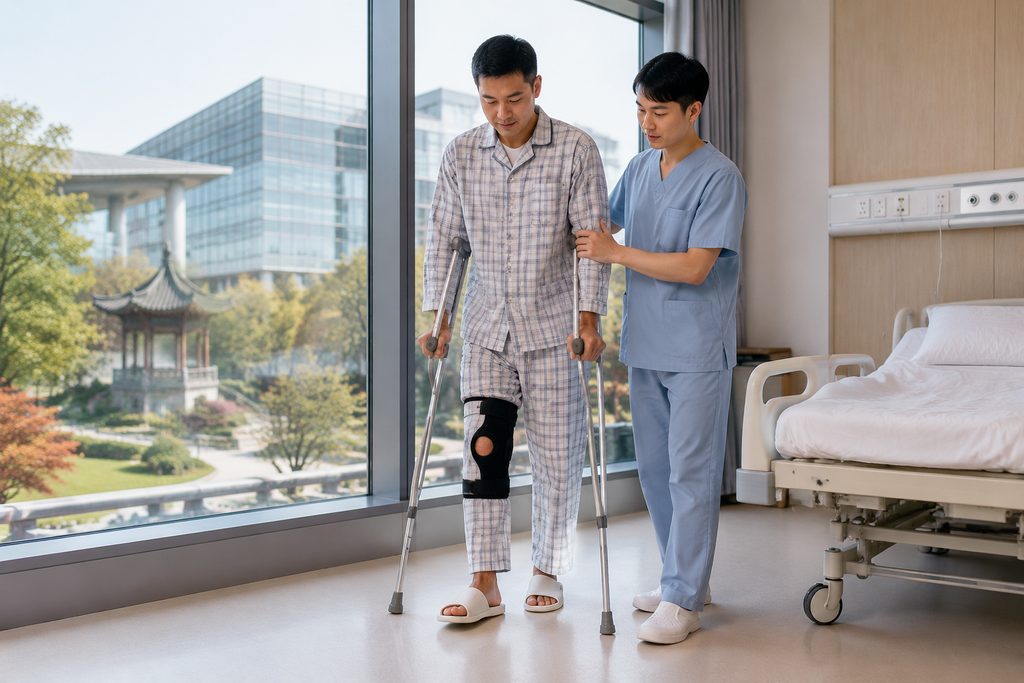
When 54-year-old Daniel from Manchester tore his meniscus and developed early osteoarthritis, his consultant told him he’d likely need a knee replacement within five years. The NHS waitlist stretched past eighteen months. Daniel started searching “how long after knee replacement can I walk” at 2 a.m., phone in hand, pain in every step. He found forums full of conflicting answers. Some people claimed they were strolling unaided at two weeks. Others described months on crutches. What Daniel actually needed was a realistic walking timeline after knee surgery abroad, tied to specific procedures and specific hospital protocols. That’s what this article provides. We’ll walk through what determines your mobility, when you can expect each milestone, and how China Medical Services helps international patients evaluate options, including the knee surgery cost China offers compared to Western prices.
How This Actually Works, Step by Step
Before any timeline, you need to understand the sequence that gets you onto an operating table in China. It starts with records. You send your existing MRI, X-rays, and surgeon’s notes. Our team translates them into Chinese and submits them to the orthopedic department at a hospital you’ve selected — often from our database of 340+ top-ranked hospitals across 37 cities. A specialist reviews your case and provides a written second opinion, typically within 5 to 10 business days. That opinion includes whether surgery is actually indicated, which procedure fits, and what the expected walking progression looks like for your specific knee.
If you proceed, the next step is a video consultation. You speak directly with the surgical team. They ask about your pain patterns, your activity goals, your medical history. You ask about their volume — how many knee replacements they perform annually. Top Chinese orthopedic centers routinely handle volumes that dwarf most Western hospitals. That volume matters for your walking timeline. Surgeons who perform 500 knee replacements a year refine their protocols differently than those who perform 50.
After the video consult, you decide. If you move forward, we coordinate the S2 visa paperwork, hospital admission scheduling, and on-ground logistics. You fly to China. You meet the surgeon in person for a pre-operative assessment. Surgery happens. Then the walking clock starts. That clock is not the same for everyone, and the next section explains why.
What Actually Determines How Soon You Walk
The honest answer to “can I walk immediately after knee replacement surgery China” is: not immediately, but sooner than most people expect. Chinese orthopedic protocols, particularly in high-volume public hospitals and JCI-accredited private facilities, emphasize early mobilization. Most patients stand with assistance within 24 hours. But standing is not walking. Walking independently down a hallway is a different milestone entirely.
Three factors dominate your walking timeline. First, the procedure type. A total knee replacement is more invasive than a partial knee replacement, which is more invasive than an arthroscopic meniscus repair. A meniscus repair might allow weight-bearing within days. A total knee replacement typically requires a walker for 2 to 4 weeks. Second, your pre-operative condition. Patients who did quadriceps strengthening before surgery walk earlier. Patients who arrived with severe muscle atrophy walk later. Third, the hospital’s rehabilitation protocol. Chinese hospitals increasingly adopt enhanced recovery after surgery (ERAS) pathways, which compress the timeline through early feeding, early catheter removal, and aggressive physiotherapy starting on post-operative day one.
Your age matters too. A 55-year-old with good baseline fitness often progresses faster than a 75-year-old with diabetes and hypertension. But we’ve seen 70-year-olds outpace 50-year-olds because they prepared better. Preparation beats age.
A Realistic Timeline
Here’s what the walking timeline after knee surgery abroad typically looks like when the procedure is a total knee replacement at a top Chinese orthopedic hospital. Ranges account for individual variation and surgical complexity.
| Stage | Timeframe | Walking Milestone | What You’ll Use |
|---|---|---|---|
| Day 0 — Surgery day | Hours after waking | Bed rest, ankle pumps, no walking | Hospital bed, compression devices |
| Day 1 | Within 24 hours | Stand at bedside, transfer to chair | Walker, two physiotherapists |
| Days 2–4 | Inpatient | Walk 10–50 meters in room and hallway | Walker, one physiotherapist |
| Week 1 | Discharge window | Walk 100–200 meters, climb 2–3 stairs | Walker or crutches |
| Weeks 2–4 | At home or hotel | Transition from walker to cane | Cane, daily physiotherapy |
| Weeks 4–6 | Outpatient rehab | Walk unaided for 10–15 minutes | No device indoors |
| Months 2–3 | Continued rehab | Walk 30+ minutes, return to light work | None |
| Months 3–6 | Full recovery phase | Walk 60+ minutes, stairs normally | None |
People forget the waiting steps. Document translation takes 3 to 5 business days. Written second opinion from a top orthopedic department: 5 to 10 business days. S2 visa processing: 1 to 4 weeks depending on your consulate. Surgical scheduling at a high-demand hospital: 2 to 6 weeks after your video consultation. So from first inquiry to walking out of a Chinese hospital, plan for 8 to 14 weeks total. Some patients compress this to 6 weeks. Others stretch it to 5 months. The bottleneck is rarely the surgery itself — it’s the preparation chain.
What Can Go Wrong — and What Happens Then
Knee surgery is not a software update. Complications happen. The most common obstacle to early walking is excessive swelling and stiffness. If your knee balloons, the physiotherapist slows your mobilization. That’s not failure — it’s physiology. The fix is elevation, ice, compression, and patience. Your walking timeline shifts by days, not months.
More serious complications include deep vein thrombosis (DVT), infection, and prosthetic instability. DVT risk in knee replacement without prophylaxis runs 40–60%. With modern protocols — early mobilization, compression devices, and anticoagulation — that risk drops below 2%. Chinese hospitals follow the same international thromboprophylaxis guidelines as Western centers. But you should ask about their specific protocol during your video consultation. If a DVT occurs, treatment is anticoagulation therapy, and your walking progression pauses while the clot resolves. Infection is rarer — around 1% in high-volume centers — but it’s the complication surgeons fear most. If a deep infection develops, treatment may require surgical washout or implant exchange, and your timeline resets substantially. This is why hospital selection matters. Our database includes only the top 5% of China’s 35,000+ hospitals, ranked by the Fudan University hospital rankings and JCI accreditation. Those centers publish lower infection rates because they perform high volumes with standardized protocols.
Stiffness that doesn’t improve by week 6 may require manipulation under anesthesia — a brief procedure where the surgeon bends your knee forcefully while you’re asleep to break up scar tissue. It sounds brutal. It works. Patients typically walk better within days afterward.
How to Choose the Right Hospital for Your Knee
The phrase “best orthopedic hospital Shanghai knee surgery price” combines two searches: quality and cost. They’re related. Shanghai hosts several hospitals ranked among China’s top 10 for orthopedics in the Fudan specialty reputation rankings. These are high-volume public hospitals where a single orthopedic department might perform over 3,000 joint replacements annually. That volume produces efficiency, and efficiency produces lower prices. But there’s a trade-off: public hospital wards are busy, nurses may not speak English, and the experience can feel overwhelming without support.
Private international hospitals in Shanghai — several are JCI-accredited — offer English-speaking staff, Western-style rooms, and direct insurance billing. Their knee surgery cost China runs higher, typically 1.5 to 2 times the public hospital price. But still far below American or British private rates. The decision framework is simple: if your priority is lowest cost and you have a bilingual companion, choose a top public orthopedic center. If your priority is comfort and language, choose a private international hospital. If you want both, a public hospital’s international VIP department bridges the gap — senior surgeons, English coordination, private rooms, at roughly 1.5 times standard public pricing.
One common mistake: choosing a hospital based on a single online review. Orthopedic outcomes vary more by surgeon volume than by hospital brand. Ask during your video consultation: how many knee replacements does this specific surgeon perform per year? A surgeon performing 300+ annually is in a different league than one performing 50. The Fudan rankings tell you which departments are strong. The surgeon’s personal volume tells you who will actually operate on you. Both matter.
Practical Considerations: Records, Visa, Payment, and Follow-Up
Bring everything. Complete medical records: MRI images on CD or cloud link, X-rays, surgical history, medication list, allergy list, and your primary physician’s contact information. Incomplete records delay your written second opinion and force another round of document requests.
Visa category is S2, not M. The S2 visa covers short-term private affairs, including medical treatment, and requires supporting documents from the receiving hospital. Our team provides the hospital invitation letter and guidance on what your local Chinese consulate needs. Processing times vary by country. Plan for 2 to 4 weeks. Family members accompanying you also apply for S2 visas.
Payment: Chinese public hospitals require pre-payment for surgery. You deposit funds at admission, and the hospital deducts as services are rendered. Insurance reimbursement happens after discharge — Chinese hospitals do not typically bill Western insurers directly. Private international hospitals in our network often do direct billing with major insurers. Confirm before you fly. For reference, a total knee replacement at a top Chinese public hospital typically ranges from $8,000 to $15,000. The same procedure in the United States averages $35,000 to $70,000. In the UK privately, £14,000 to £20,000. The knee surgery cost China offers is one-fifth to one-third of Western prices, even at premium international facilities.
Follow-up care at home: your Chinese surgeon will provide a discharge summary in English and a rehabilitation protocol. You’ll need a local physiotherapist to continue the program. Some patients schedule a video follow-up with their Chinese surgeon at week 6 and month 3. That continuity matters — your surgeon knows your knee better than anyone.
Frequently Asked Questions
Most patients walk unaided indoors between weeks 4 and 6. Outdoors without a cane typically comes at weeks 6 to 10. Full confidence on stairs and uneven ground takes 3 to 6 months. Your pre-operative strength is the strongest predictor of hitting the early end of those ranges.
No. You will stand within 24 hours and take your first steps with a walker on day 1 or 2. “Immediately” in surgical terms means within the first day, not the first hour. Walking independently down a hallway takes days, not hours.
Packages vary. Most include hospital fees, surgeon fees, implant costs, and a standard hospital stay. Some add airport transfer, hotel accommodation for family, bilingual interpretation, and post-operative physiotherapy sessions. Read the fine print: does the package include the implant brand you want? Does it cover complications? Does it include your pre-operative consultation or is that billed separately? We help patients compare packages across hospitals so the numbers are actually comparable.
Long-haul flights increase DVT risk after any lower-limb surgery. Most surgeons recommend waiting 10 to 14 days after a knee replacement before flying. If your flight exceeds 4 hours, wear compression stockings, take prescribed anticoagulation, and walk the aisle every hour. Some patients choose to stay in China for 3 to 4 weeks post-surgery to complete early rehabilitation before flying home. That’s often the smarter choice.
A total knee replacement at a top Chinese public hospital typically costs $8,000 to $15,000. At a private international hospital in Shanghai or Beijing, expect $20,000 to $35,000. The same procedure in the US averages $35,000 to $70,000 before insurance. Even at Chinese private rates, you’re often paying half the American price for comparable implant quality and surgeon experience. Prices vary by hospital, implant brand, and case complexity.
Your Next Step
The walking timeline after knee surgery is not a mystery — it’s a protocol. The right hospital, the right surgeon, and the right preparation compress it. The wrong combination stretches it. We help you sort through the variables: which of China’s top orthopedic centers fits your case, what the realistic cost looks like, and how to navigate the logistics from visa to discharge. We are not doctors. We are the coordination layer between you and China’s best orthopedic teams. If you’re considering knee surgery abroad, start with a free consultation — send your records, tell us your situation, and we’ll map out what’s possible.
Walking again is the goal. Everything else is just the path to get there.
For more medical information and treatment options in China, visit chinamedservices.com (China Medical Services).
