Malaysian Patient Medical Service to China: Kuala Lumpur Treatment Coordination
Key Takeaways
- Top-tier surgery in China typically costs 70-80% less than private hospitals in Malaysia, with cardiac bypass ranging from $12,000-20,000 USD compared to $25,000-40,000 at home.
- China’s Fudan-ranked hospitals perform case volumes that surpass most ASEAN centers—Fuwai Hospital alone completes over 14,000 cardiac surgeries annually, driving clinical consistency few institutions can match.
- Public hospital registration cannot be secured from abroad without going through official international departments; walk-in attempts without Mandarin fluency and local payment tools routinely fail.
- Every patient traveling from Kuala Lumpur must hold an S2 visa with a formal hospital-issued invitation letter—tourist visas do not cover medical treatment and risk entry denial at the border.
When 42-year-old Aisyah from Petaling Jaya received her breast cancer diagnosis in late 2024, the oncologist laid out a clear path: surgery within six weeks, followed by targeted therapy. The private hospital quote came back at RM 85,000 for the surgical component alone. Her insurance covered 60%. The remaining RM 34,000 out-of-pocket sat heavy on her spreadsheet. She started searching. That search led her to a question many Malaysian patients are now asking: what would the same procedure cost in China, and can it be arranged safely from Kuala Lumpur?
The short answer is yes—with coordination. The longer answer involves understanding exactly how the numbers break down, which hospitals deliver outcomes worth traveling for, and what the visa and appointment logistics actually require. This article walks through each layer, drawing on data from China’s hospital ranking systems, published surgical volume reports, and the operational realities our team navigates daily when coordinating treatment for patients flying in from KLIA.
Who We Are
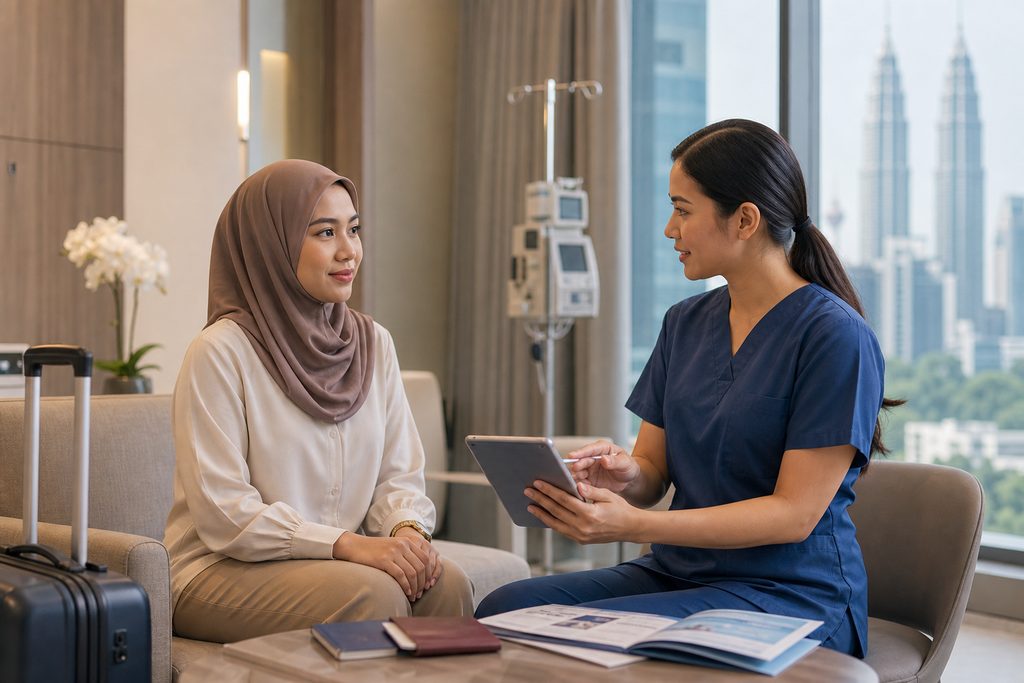
We are not a hospital. We do not provide medical treatment, clinical diagnoses, or post-surgical prescriptions. Our team functions as a logistical bridge between patients in Malaysia and 340+ top-ranked hospitals across 37 cities in China. That means we handle hospital matching based on your actual medical records, coordinate appointments through official international patient channels, arrange bilingual medical companions who physically accompany you through registration, consultation, and payment, and guide the S2 visa application process. The clinical decisions remain entirely between you and the Chinese medical team. We make sure you get to the right specialist without getting lost—literally or bureaucratically—along the way.
The Problem: Private Healthcare Costs in Malaysia Keep Rising
Malaysia’s private healthcare sector has seen consistent year-on-year cost inflation. According to Bank Negara Malaysia’s 2023 annual report, medical inflation in the country reached 12.6%, more than double the global average of 5.6%. For patients facing major procedures—cancer resections, orthopedic implants, cardiac interventions—the out-of-pocket burden even with insurance can easily exceed RM 50,000. Wait times in Malaysia’s public system tell a different but equally difficult story. A non-urgent orthopedic surgery at a government hospital can stretch beyond 12 months. Private care solves the wait time problem but creates a financial one. Neither path feels good when you are sitting on a diagnosis that demands action.
This squeeze is why an increasing number of Malaysian patients look north. Not to Singapore, where costs run even higher, but to mainland China, where the economics are fundamentally different. A total knee replacement that costs RM 45,000 in Kuala Lumpur’s private hospitals runs approximately $8,000-15,000 USD in a top-tier Chinese orthopedic center. That is not a promotional rate. It is the standard price when you access care through official international patient channels.
Why China Delivers Comparable Outcomes at a Fraction of the Cost
Lower cost does not mean lower quality. It means a different cost structure. Chinese public hospitals operate at enormous scale with state-subsidized infrastructure, and surgeon compensation is not tied to procedure billing the way it is in private Malaysian hospitals. The result is a system where clinical teams perform high volumes of the same procedures repeatedly, driving down per-case costs while building deep subspecialty expertise. Let us break down the three advantages that matter most for patients traveling from Kuala Lumpur.
Clinical Volume Drives Pattern Recognition
Surgeons get better at what they do repeatedly. This is not controversial—it is documented across surgical literature. A 2013 study in the New England Journal of Medicine examining over 600,000 surgical cases found a direct inverse relationship between hospital procedure volume and patient mortality. China’s top hospitals operate at a scale that is difficult to comprehend until you see it. Fuwai Hospital in Beijing performs over 14,000 cardiac surgeries annually—the highest volume of any cardiac center globally. The orthopedic department at Peking University Third Hospital handles a surgical caseload that dwarfs most ASEAN private hospitals. For a Malaysian patient needing a complex procedure, this volume matters. Pattern recognition in rare presentations, refined surgical workflows, and anesthesia teams accustomed to high-risk cases all flow from doing the same thing thousands of times per year.
Technology Deployment at Speed
Chinese hospitals adopt surgical robotics, intraoperative imaging, and AI-assisted diagnostic tools aggressively. The da Vinci surgical system, for example, is installed in over 300 hospitals across mainland China. Many top-tier oncology departments now routinely use intraoperative frozen section analysis with turnaround times under 20 minutes—enabling surgeons to confirm clear margins before closing. For a cancer patient, that single capability can mean the difference between one surgery and two. These technologies exist in Malaysian private hospitals too, but the density of deployment across China’s Fudan-ranked top 100 institutions means you are far more likely to access the latest-generation equipment at the specific hospital matched to your condition.
The Medical Treatment Cost China from Malaysia Equation
Let us put numbers on the table. The following comparison reflects published price ranges from hospital international departments and patient coordination data, with all figures in USD. Actual quotes vary by hospital tier, case complexity, and length of stay.
| Procedure | Malaysia Private (USD) | China Top-Tier Public (USD) | Savings |
|---|---|---|---|
| Coronary Artery Bypass Graft | $25,000 – 40,000 | $12,000 – 20,000 | 50-70% |
| Total Knee Replacement | $12,000 – 18,000 | $8,000 – 15,000 | 30-50% |
| Breast Cancer Surgery + Reconstruction | $15,000 – 25,000 | $8,000 – 18,000 | 30-55% |
| Liver Cancer Resection | $20,000 – 35,000 | $10,000 – 22,000 | 40-60% |
These are not theoretical numbers. They reflect the price bands our team sees when booking through official international patient channels at hospitals like Fudan University Zhongshan Hospital, Peking Union Medical College Hospital, and West China Hospital. The range accounts for ward class, surgeon seniority, and whether the patient requires an interpreter throughout the stay.
What You Need to Know Before Going Alone
We need to be direct here. Attempting to arrange treatment independently—booking a flight from KLIA, walking into a public hospital in Shanghai or Beijing, and expecting to see a top specialist—will almost certainly fail. The Chinese public hospital system operates on rules that make sense internally but are opaque to outsiders. Here are the three barriers that stop independent attempts cold.
- Registration Requires Physical Presence or an Official Channel: Public hospital outpatient departments do not accept international phone bookings. The standard pathway requires a patient to appear in person at the registration counter, often before 7:00 AM, with a local ID or passport and a local payment method. Specialist slots for renowned surgeons fill within minutes of release. Without a coordinator physically queuing or an international department pre-arranging the appointment, you may spend days in a city without seeing the doctor you traveled for. The international VIP channel is the only route that allows pre-booking from Kuala Lumpur—and it is not publicly listed on hospital websites.
- S2 Visa Requirements Are Specific and Non-Negotiable: Malaysian passport holders enjoy visa-free entry to China for tourism (15-30 days depending on current policy). Tourist entry does not cover medical treatment. The China medical visa for Malaysian patients is the S2 visa, annotated for medical purposes. To apply, you need an invitation letter from the Chinese hospital confirming your treatment appointment, stamped by the hospital’s international affairs office. No letter, no visa. Applying under the wrong category risks denial at the border or complications with insurance claims later. M visas are for business. They do not apply here.
- Payment Systems Are Closed Loops: Chinese public hospitals require prepayment—typically a deposit at admission covering estimated procedure costs, settled daily. International credit cards are not accepted at most public hospital counters. WeChat Pay and Alipay dominate, but linking a Malaysian bank card to these platforms from abroad is inconsistent. Cash in RMB works but carries obvious practical limits for a $15,000 surgery deposit. Without a local payment intermediary or an international department that handles invoicing in a compatible format, the financial logistics alone can derail a planned treatment trip.
How to Arrange Medical Travel from Kuala Lumpur to China
So the barriers are real. But they are also solvable with the right coordination. Here is the step-by-step reality of how to arrange medical travel from Kuala Lumpur to China when you work through a service that handles the logistical layer.
The process starts with your medical records—not your travel dates. Our team requests your full diagnostic file: pathology reports, imaging (DICOM format preferred), current medication list, and the treating physician’s summary in English. We translate these documents into clinical Chinese and submit them to the international patient departments of hospitals matched to your specific condition. This matching draws on the Fudan Hospital Ranking system, which categorizes China’s top 100 hospitals into tiers (A++++ through A) and publishes separate reputation rankings for 45 clinical specialties. If you need oncology care, we reference the specialty-specific rankings to identify which hospitals rank in the top 10 nationally for your cancer type.
Once a hospital accepts your case and confirms an appointment window, we secure the official invitation letter. You take that letter to the Chinese Visa Application Service Centre in Kuala Lumpur. The S2 application requires the letter, your passport with at least six months validity, a completed visa form, and a recent passport photo. Processing typically takes four to seven working days. We guide this step but do not submit on your behalf—visa applications must be lodged personally or through an authorized agent with your original passport.
Then comes travel. Flights from KLIA to Beijing, Shanghai, Guangzhou, and Chengdu operate daily on multiple carriers. We recommend arriving at least one full day before your first consultation. The bilingual medical companion meets you at the hospital entrance on appointment day—handling registration, payment deposits, queue navigation, and real-time translation during the consultation. If the specialist orders additional imaging or lab work, the companion stays with you through each station. This is not a luxury. In a hospital seeing 10,000 outpatient visits daily, it is the difference between a coherent experience and a disorienting one.
After the consultation, the surgical or treatment schedule is set. Inpatient admission follows the hospital’s protocol. The companion remains available throughout your stay, translating ward rounds, medication instructions, and discharge summaries. Post-discharge, we coordinate follow-up appointments and, if needed, remote video consultations with the same specialist once you are back in Kuala Lumpur.
Is It Safe to Go to China for Surgery from Malaysia?
This question deserves a straight answer. The clinical safety of undergoing surgery at a Fudan-ranked Chinese hospital is high—comparable to accredited private hospitals in Malaysia and, in certain high-volume specialties like cardiac surgery and liver resection, arguably superior due to case volume. Infection control protocols at JCI-accredited Chinese institutions (and several top public hospitals have earned JCI accreditation alongside their domestic rankings) meet international benchmarks. The top-tier hospitals we coordinate with maintain mortality and complication rates that they report internally and, increasingly, publish in international journals.
But safety is not only about the operating theater. It is also about what happens when something goes wrong outside the clinical setting—a medication reaction after discharge, a need for urgent follow-up, a miscommunication about post-operative instructions. This is where traveling alone creates risk. Having a bilingual coordinator who can reach the surgical team directly, translate an emergency department visit, or clarify a discharge instruction at 9:00 PM removes the isolation that turns a manageable complication into a crisis. The hospitals are safe. The gap is the support layer around them. That layer is what coordination services provide.
For Malaysian patients specifically, the cultural and dietary comfort level also matters. Chinese hospital food is not Malaysian hospital food. Halal meal availability varies by hospital and city—Guangzhou and Shanghai have more established halal catering options than smaller cities. We flag dietary requirements during the hospital matching phase so the international department can confirm whether halal meals are available in-house or whether you will need to arrange external catering. Small details. But they compound over a two-week inpatient stay.
Finding the Best Hospital in China for Cancer Treatment Price and Quality Balance
Cancer is the most common reason Malaysian patients contact us. The question is almost always a variation of: which is the best hospital in China for cancer treatment price that still delivers outcomes I can trust? The answer depends on the cancer type. China’s Fudan specialty reputation rankings break oncology down into subspecialties—thoracic oncology, gynecologic oncology, hepatobiliary oncology, and so on. A hospital that ranks top 10 for liver cancer may not appear in the top 10 for breast cancer. The matching is granular.
For breast cancer, Fudan University Shanghai Cancer Center consistently ranks at the top of the specialty reputation list, with surgical volumes exceeding 7,000 breast cancer operations annually. For liver cancer, Zhongshan Hospital Fudan University and West China Hospital in Chengdu both rank among the top three nationally, drawing on China’s unfortunately high hepatocellular carcinoma incidence to build deep surgical experience. For nasopharyngeal carcinoma—a cancer with higher prevalence in Southeast Asian populations including Malaysians—Sun Yat-sen University Cancer Center in Guangzhou has published outcomes data that rivals any center globally.
Price varies by hospital tier and treatment complexity. A course of radiation therapy at a top cancer center runs approximately $5,000-12,000 USD. Surgical oncology procedures fall in the $8,000-22,000 range depending on the resection complexity and reconstruction requirements. Chemotherapy protocols are priced per cycle, with many standard regimens costing $500-2,000 per cycle—substantially below private Malaysian oncology center pricing. These figures do not include accommodation or coordination fees, but even fully loaded, the total cost of a multi-modal cancer treatment course in China often undercuts the surgical component alone in a Malaysian private hospital.
One note on the book hospital appointment China from Malaysia process for cancer specifically: oncologists in Chinese public hospitals will want to conduct their own diagnostic review before confirming a treatment plan. Even if you arrive with a complete PET-CT, biopsy, and genetic panel from a Malaysian lab, expect the Chinese team to repeat key imaging and possibly re-biopsy. This is not inefficiency. It is standard practice at top-tier oncology centers globally—the surgical and medical oncology teams want tissue and imaging from their own pathology and radiology departments before committing to a treatment pathway. Budget an extra three to five days for this diagnostic confirmation phase.
Frequently Asked Questions
Most Malaysian private health insurance policies include a geographical coverage clause. Standard domestic plans typically cover treatment within Malaysia only. International or expatriate plans may include China, but you must confirm with your insurer before traveling. Chinese public hospitals require upfront payment—they do not direct-bill Malaysian insurers. You pay the hospital deposit, complete treatment, receive the official invoice and discharge summary, and submit the claim to your insurer for reimbursement. Our team provides the translated medical documentation and itemized billing that Malaysian insurers require for claims processing. Some international insurers like Cigna, Bupa, and Allianz have direct billing arrangements with specific private international hospitals in China, such as United Family Healthcare and Jiahui Health. If your policy includes these networks, we can route your care through those institutions instead.
This happens frequently, and it is not necessarily a red flag. Different medical systems develop different treatment norms. A Chinese oncologist may recommend a surgical approach where a Malaysian oncologist suggested neoadjuvant chemotherapy first, or vice versa. When we encounter conflicting recommendations, we facilitate a structured comparison: we ask the Chinese specialist to explain their rationale in writing, referencing the clinical evidence they are relying on, and we provide that documentation to you for discussion with your Malaysian physician. If you want a third perspective, we can arrange a written second opinion from a different Chinese hospital for $300-500 USD. The final treatment decision is always yours. No one should pressure you into a procedure you do not fully understand.
How long do I need to stay in China for a major surgery?
Plan for a minimum of two to three
For more medical information and treatment options in China, visit chinamedservices.com (China Medical Services).
