Sleep Apnea Screening in China: The Basics for International Patients
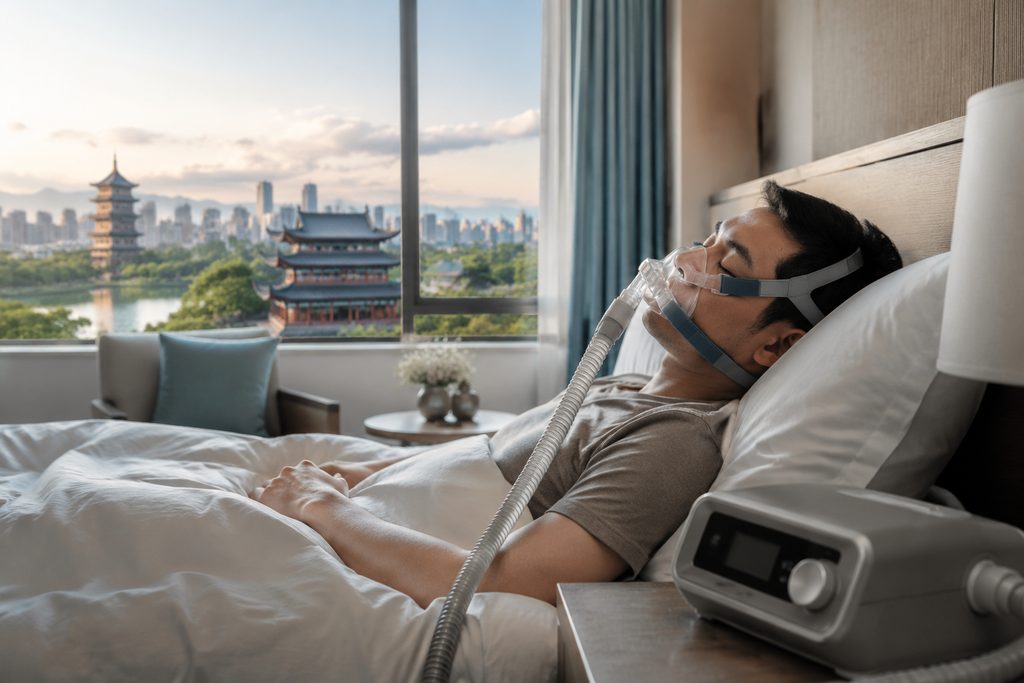
Sleep Apnea Screening in China: The Basics
Obstructive sleep apnea affects roughly 1 billion people worldwide, and the American Academy of Sleep Medicine estimates that up to 80% of moderate-to-severe cases remain undiagnosed. If you have searched for the sleep apnea test cost China offers, you are already ahead of most people. The question is whether traveling to China for a sleep study makes sense, what it actually involves, and how to arrange it without wasting a week on logistics. This guide covers the practical basics: what screening looks like, what it costs, where to go, and how the process works for a foreign patient.
How This Actually Works, Step by Step
Sleep medicine in China operates differently from most Western systems. Understanding the sequence saves time and confusion.
Step 1: You send your existing records. Before anything else, you share what you already have. A home sleep test result, a referral note, a symptom diary, a list of medications, an Epworth Sleepiness Scale score, even a partner’s description of your snoring and breathing pauses. Our team translates these into Chinese and routes them to the sleep medicine department at an appropriate hospital.
Step 2: A specialist reviews the file. Sleep medicine sits under respiratory medicine or neurology at most Chinese tertiary hospitals. The reviewing physician determines whether you need a full overnight polysomnography (PSG), a home sleep apnea test (HSAT), or something else entirely. You receive a written opinion with a recommended pathway.
Step 3: You decide on a consult format. A written second opinion is the lightest option. A video consultation lets you speak directly with the specialty team. If you want an in-person assessment before committing to travel, a proxy consultation sends our staff to the hospital with your materials to register and meet the doctor on your behalf.
Step 4: The study itself. An overnight PSG in China typically means one night in a sleep monitoring room. Sensors record brain activity, eye movement, muscle tone, airflow, blood oxygen, heart rhythm, and limb movement. A technician monitors you throughout. You leave the next morning.
Step 5: Results and interpretation. Scoring and physician interpretation usually take two to five working days. You receive an apnea-hypopnea index (AHI), oxygen desaturation data, and a treatment recommendation — CPAP titration, oral appliance, positional therapy, or surgical evaluation in selected cases.
That is the whole arc. Nothing exotic. The friction is logistical, not clinical.
What a Sleep Study in China Actually Costs
Price is the reason most international patients start looking at China. A full overnight polysomnography at a top-tier Chinese public hospital generally runs $300 to $800, depending on the hospital’s tier, the city, and whether you use the standard or international department. A home sleep apnea test is cheaper, often $100 to $300.
Compare that with the United States, where an in-lab sleep study commonly bills between $1,000 and $3,000 before insurance, and the gap becomes obvious. Even private international hospitals in Shanghai and Beijing — the ones with English-speaking staff and JCI accreditation — usually land well below U.S. cash prices.
| Study Type | Typical China Cost | Typical U.S. Cost |
|---|---|---|
| Home sleep apnea test (HSAT) | $100–$300 | $300–$800 |
| Overnight polysomnography (standard ward) | $300–$600 | $1,000–$2,500 |
| Overnight polysomnography (international/VIP) | $500–$800 | $2,500–$3,500 |
| CPAP titration night | $200–$500 | $800–$2,000 |
| Specialist consultation | $30–$150 | $200–$500 |
These are ranges. Final pricing varies by hospital and case complexity, and a hospital will always confirm its own quote after reviewing your file. Anyone who gives you a flat number before seeing your records is guessing.
A Realistic Timeline
People underestimate this part. Screening itself takes one night. Everything around it takes weeks.
| Stage | Realistic Duration |
|---|---|
| Records collection and translation | 3–7 days |
| Specialist file review and written opinion | 3–10 days |
| Appointment coordination at chosen hospital | 1–3 weeks |
| Visa (S2 short-stay, medical purpose) | 1–3 weeks after documents are ready |
| Travel and arrival | 1–2 days |
| Pre-study consultation | Same day or next day |
| Overnight polysomnography | 1 night |
| Scoring and physician report | 2–5 working days |
| Treatment discussion and fitting (if CPAP) | 1–3 days |
Total, from first email to finished report: roughly four to eight weeks. If you are combining the sleep study with a broader health checkup, add a few days. If you need a specific specialist’s clinic slot, add more — senior physicians at major hospitals often book two to four weeks out.
What Can Go Wrong — and What Happens Then
Honest failure modes matter more than brochures.
The study comes back normal. It happens. Some patients have upper airway resistance syndrome, insomnia, or a non-respiratory sleep disorder that a standard AHI-focused study does not capture well. The recourse is a follow-up discussion with the sleep physician and, sometimes, a repeat study with extended montage or a multiple sleep latency test.
You cannot tolerate the sensors. Roughly a minority of first-time patients sleep poorly in the lab. Chinese sleep centers generally allow a repeat night at reduced or no additional cost if the recording is technically inadequate — but confirm this policy before booking, because it varies.
The hospital cannot fit you in during your travel window. This is the most common real-world problem. Sleep labs at top hospitals run near capacity. If your dates are tight, consider a private international hospital, where scheduling is more flexible but prices are higher.
Language breakdown at the lab. Technicians in standard wards rarely speak English. This is not a small issue at 2 a.m. when a sensor slips. Bilingual accompaniment exists precisely for this.
CPAP titration is recommended but you fly home the next day. You can complete titration in China and travel with a machine, or have the prescription sent to a provider at home. Both work. Plan which one before you book flights.
Choosing a Sleep Clinic: What Actually Matters
For most international patients, the practical question is not “which hospital is best in China” but “which hospital is right for my case and my logistics.”
Three factors dominate.
Accreditation and volume. Sleep centers attached to major tertiary hospitals — the kind listed in the Fudan Hospital Rankings — generally run high study volumes, which correlates with technician experience and reliable scoring. You can browse ranked institutions by city on our directory of top-ranked Chinese hospitals.
English capability. A handful of private international hospitals in Shanghai and Beijing offer fully English-speaking sleep services with direct insurance billing. If you are searching for the best sleep clinic Shanghai has for foreigners, that category is where you will find the smoothest experience. Public hospital international departments are a middle path: senior specialists, English coordination, roughly 1.5 to 2 times standard-ward pricing.
Whether you need more than a study. If your case involves complex cardiology, bariatric evaluation, or ENT surgery, choose a hospital with strength in that adjacent specialty. A sleep study is rarely the endpoint.
A common mistake: patients book the study first and think about treatment logistics later. Reverse that. Decide whether you would accept CPAP, an oral appliance, or surgery before you commit to a city and a hospital.
Practical Considerations: Records, Visa, Payment, Follow-Up
Records. Bring everything. Previous sleep studies, medication lists, cardiac history, thyroid results, and any imaging. Chinese specialists work from documents, and missing records cause delays.
Visa. Medical travel to China uses the S2 visa, annotated for medical treatment purposes, with accompanying family members applying under the same category. Stays beyond 180 days fall under S1. Note that the M visa is for commercial and trade activity and is not the correct category for medical treatment. Requirements change, so verify current rules with the nearest Chinese embassy or consulate and confirm the supporting hospital documents they expect.
Payment. Public hospitals require prepayment; insurance reimbursement happens afterward, in your home country. Private international hospitals often bill insurers directly. Bring a card that works internationally and expect a deposit at registration.
Language. A major Chinese hospital can see tens of thousands of outpatient visits in a single day. Signage, registration kiosks, and lab queues are in Chinese. Our bilingual medical companion service exists for exactly this reason.
Follow-up at home. Ask for a full English-language report with raw data, not just a summary. Your home physician will want the AHI breakdown, oxygen desaturation index, and arousal data. Request it before you leave the hospital.
Insurance. Sleep studies are frequently excluded or heavily restricted by international policies. Check coverage before assuming reimbursement.
Frequently Asked Questions
At a top public hospital, an overnight polysomnography in Beijing typically runs $300 to $600, with international department pricing at $500 to $800. Home sleep tests are cheaper, usually $100 to $300. Final quotes depend on the hospital and the complexity of your case.
Yes. Polysomnography is a non-invasive, passive recording — no radiation, no needles, no sedation. The main risks are practical rather than medical: a poor night’s sleep in an unfamiliar bed, sensor displacement, and communication gaps if you do not speak Chinese. Those are manageable with preparation and, where needed, language support.
Generally, no — standard outpatient slots at public hospitals cannot be reserved from abroad in advance. What can be arranged ahead of time is a file review, a written second opinion, and coordination through a hospital’s international department, which does allow advance scheduling. That is the practical route for most foreign patients.
It depends on your situation. If you are paying cash in a country where an in-lab study costs $2,000 or more, the savings are real. If you already have insurance covering a local study, the math changes. Screening combined with a broader checkup or an existing treatment plan tends to make the trip more worthwhile than a single overnight test alone.
Your physician may recommend a repeat night, an extended montage, or a multiple sleep latency test. Some hospitals absorb the cost of a technically failed recording; others do not. Ask about this policy at booking, not afterward.
Your Next Step
A sleep study is a one-night test with a multi-week runway around it. Get the sequencing right and the whole thing is straightforward. Get it wrong and you lose a month to logistics.
We are China Medical Services. We maintain a database of more than 340 top-ranked hospitals across 37 cities and coordinate written second opinions, video consultations, and on-the-ground support for international patients. We are not physicians and we do not diagnose or treat anyone — the medical decisions belong entirely to you and your doctors.
If you have existing records and want to know whether screening in China makes sense for your case, start with a written second opinion. It is the lowest-commitment way to get a real specialist’s read before you book a flight.
This article is for general information only and does not constitute medical advice. Sleep disorders require evaluation by a qualified physician. Costs cited are typical ranges and vary by hospital and case complexity.
For more medical information and treatment options in China, visit chinamedservices.com (China Medical Services).
