Yemeni Patient Medical Service to China: Crisis-Zone Priority Treatment Coordination
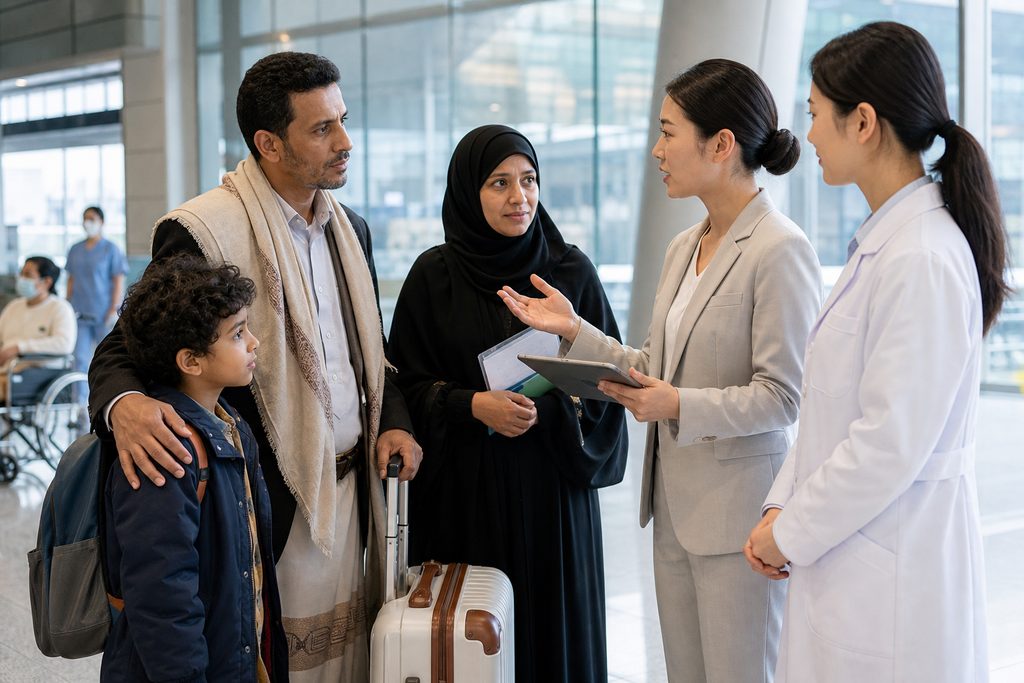
What happens when you need a heart valve replacement, but the only cardiac surgeon in your city hasn’t performed the procedure in six months due to fuel shortages and equipment failures?
For thousands of Yemeni families, this is not a hypothetical question. It is Wednesday.
The collapse of Yemen’s healthcare infrastructure has been documented extensively — the World Health Organization reports that only 51% of health facilities remain fully functional as of 2024, and those that operate face severe shortages of specialists, medicines, and electricity. Patients with conditions that are treatable elsewhere — cancer, cardiac disease, orthopedic trauma — face a narrowing window. Waiting is not a neutral choice. It is a clinical deterioration.
Our team has coordinated medical travel for patients from active conflict zones for years. We know the specific friction points: the visa uncertainty, the hospital matching problem, the language barrier that turns a consultation into a guessing game. We also know what works. The path exists. It requires precision, not hope.
Key Takeaways
- Top-tier Chinese hospitals perform cardiac surgeries at volumes unmatched globally — Fuwai Hospital alone completes over 14,000 cardiac operations annually, compared to roughly 1,500 at a high-volume US center.
- The medical treatment cost China for Yemenis typically runs one-fifth to one-tenth of equivalent US pricing, with a heart bypass ranging from $12,000 to $20,000 versus $120,000+ in America.
- Yemeni nationals face specific visa hurdles — the S2 medical visa requires hospital invitation letters and documented treatment plans that are nearly impossible to assemble without on-the-ground coordination.
- No reputable service can guarantee a specific surgery date before an in-person consultation. Anyone who promises otherwise is not being honest about how Chinese public hospitals operate.
The Problem: When Your Country’s Hospitals Cannot Treat You
Yemen’s health system has been shattered by years of conflict. The damage is not abstract. The United Nations Office for the Coordination of Humanitarian Affairs estimates that 19.7 million people lack access to basic healthcare. Dialysis machines sit idle because spare parts cannot clear customs. Oncology drugs expire in warehouses cut off by roadblocks. Surgeons with decades of training leave — for Amman, for Cairo, for anywhere with a functioning operating theater.
For a Yemeni patient with a treatable condition, the question shifts from “which hospital?” to “which country?” Medical travel becomes not a luxury but a survival strategy.
China occupies a specific niche in this calculation. It offers high surgical volumes, technology investments that rival any Western system, and costs that make treatment accessible without bankrupting a family. But the gap between knowing China is an option and actually receiving treatment in Beijing or Shanghai is wide. That gap is where patients get stuck.
Who We Are
We are not a hospital. We do not provide medical treatment or clinical diagnoses. We are your logistical architects — we bridge the gap between you and China’s top-tier medical expertise. Our database covers over 340 top-ranked hospitals across 37 Chinese cities. We handle hospital matching, appointment coordination, visa invitation letters, bilingual medical companions, and post-operative recovery logistics. We connect Yemeni patients with the right department, the right surgeon, and the right pathway — then we make sure you actually get through the door.
Why Chinese Hospitals Deliver Results for Crisis-Zone Patients
Clinical Volume That Changes Outcomes
Surgical proficiency correlates with repetition. A study published in the New England Journal of Medicine in 2019 found that hospitals performing more than 200 pancreatic resections annually had mortality rates below 2%, while low-volume centers exceeded 8%. This pattern holds across specialties.
Chinese top-tier hospitals operate at scales that create this proficiency by default. Fuwai Hospital in Beijing performs more cardiac surgeries annually than any center worldwide — over 14,000 cases per year. A surgeon there might complete more valve replacements in a month than a Yemeni surgeon could perform in two years under current conditions. For patients considering how to book heart surgery in Beijing for Yemeni citizens, this volume translates directly into lower complication rates and shorter recovery times.
The same pattern appears in oncology. Cancer hospitals in Shanghai and Guangzhou treat caseloads that generate deep subspecialty expertise — thoracic surgeons who only handle esophageal cancer, gynecologic oncologists who perform hundreds of radical hysterectomies annually. When you arrange cancer treatment in Shanghai from Yemen, you access this focused proficiency.
Technology Infrastructure Built at Scale
Chinese hospitals invested heavily in diagnostic and surgical technology during the past decade. It is common for a top-tier public hospital to operate multiple da Vinci surgical robots, PET-CT scanners, and linear accelerators for radiotherapy — equipment that might exist in only a handful of centers across the entire Middle East.
This matters for crisis-zone patients because it compresses the diagnostic-to-treatment timeline. A Yemeni patient arriving in Shanghai can complete imaging, biopsy, molecular pathology, and treatment planning within days — not the weeks or months that fragmented systems produce. Speed matters when you are traveling on a fixed-duration visa with a condition that is advancing.
The Cost Structure: Why Medical Treatment Cost China for Yemenis Is Viable
Let us address the obvious concern directly. Lower cost does not mean lower quality. The structural reasons for China’s pricing advantage are straightforward: lower labor costs across the healthcare workforce, hospital-owned equipment without the debt-service burdens that drive up US pricing, and procedural efficiency from extreme volumes.
A coronary artery bypass graft at a top Chinese public hospital ranges from $12,000 to $20,000. The same procedure in the United States averages over $120,000. Knee replacement: $8,000 to $15,000 in China versus $35,000 to $50,000 in the US. Cancer chemotherapy protocols that cost $80,000 annually in Western Europe can run $20,000 to $30,000 in China for equivalent drug regimens.
These are not discount procedures performed in substandard facilities. We are talking about hospitals ranked in the top 5% of China’s 35,000+ hospitals, measured by the Fudan University hospital rankings and JCI accreditation standards. The value proposition is real.
What You Need to Know Before Going Alone
The barriers are significant. Anyone who tells you otherwise is selling something.
- Visa Requirements Are Specific and Unforgiving: Yemeni citizens traveling to China for medical treatment require an S2 visa with a medical purpose annotation. This visa demands an official invitation letter from the Chinese hospital confirming your treatment arrangement. Obtaining that letter independently — from outside China, without a local contact, in a language you may not speak — is extraordinarily difficult. Many Yemeni patients wonder: can Yemeni patients get emergency visa for surgery in China? The answer is yes, but only with proper documentation. The visa itself is not the bottleneck. The paperwork pipeline is.
- Public Hospital Registration Does Not Work Like Western Systems: Chinese public hospitals do not allow overseas patients to book surgeries remotely. You cannot email a hospital, send your medical records, and receive a surgery date. The system requires an in-person consultation first. A doctor must examine you, review your imaging, and determine the treatment plan before any procedure is scheduled. This is non-negotiable. Our role is to ensure that when you arrive, the right specialist is expecting you — not to promise a surgery date that no ethical hospital would schedule sight-unseen.
- Language Barriers Are Total: A top-tier Chinese hospital might see 10,000 outpatient visits in a single day. The registration counters, pharmacy queues, payment windows, and examination rooms operate entirely in Mandarin. Signs may have English translations. Staff generally do not. Without a bilingual companion who understands both the language and the hospital workflow, a Yemeni patient will spend hours lost in corridors — missing appointments, misunderstanding instructions, and accumulating costs from extended stays.
- Payment Systems Require Upfront Settlement: Chinese public hospitals operate on a prepaid model. You deposit funds, treatment is deducted from your balance, and you settle the remainder upon discharge. International insurance is rarely accepted for direct billing at public institutions. Patients pay first and seek reimbursement later. This means you need sufficient liquid funds to cover the estimated treatment cost before you arrive — not a reimbursement promise from an insurer.
How We Help You Navigate This
Our process starts with your medical records. You send us what you have — diagnostic reports, imaging files, pathology results, treatment history. We translate these documents into clinical Chinese and submit them to the international departments of hospitals that match your condition. We do not guess at which hospital fits. We reference the Fudan University specialty rankings, which evaluate 45 clinical departments and name the top 10 hospitals in each. A patient needing liver cancer surgery goes to a different institution than one needing a hip replacement.
Once a hospital confirms they can treat your condition, we secure the official invitation letter required for your S2 visa application. This document is the linchpin. Without it, the visa process stalls. We have handled this coordination for patients from Sana’a, Aden, and the diaspora communities in Cairo and Amman who serve as transit points.
When you land in China, a bilingual medical companion meets you. This person handles registration, payment queues, pharmacy runs, and real-time translation during consultations. They know the hospital layout — where imaging is on the third floor, where the international department billing office is, which window processes prepaid deposits. They do not provide medical advice. They ensure you receive the advice your doctor is giving.
For patients seeking priority medical care packages China Yemen, we coordinate the full pathway: airport transfer, hospital escort, accommodation near the facility, follow-up appointment scheduling, and medication procurement before departure. Our VIP end-to-end coordination, starting from $5,000, covers the entire journey for patients who need comprehensive support.
After treatment, we arrange post-operative recovery logistics — extended-stay accommodations, follow-up imaging, and communication with your home-country physician to ensure continuity of care. Your case does not close when you board the return flight.
Frequently Asked Questions
What if I cannot afford the treatment even at Chinese prices?
This is a hard reality. Chinese treatment costs, while significantly lower than Western equivalents, are still substantial for many Yemeni families. We encourage patients to explore medical crowdfunding platforms, diaspora community support networks, and humanitarian medical grants before committing to travel. Our initial consultation is free — we help you understand the cost range for your specific condition so you can make an informed decision about whether to proceed. We never pressure a patient to commit beyond their means.
How long does the entire process take — from first contact to surgery?
It depends heavily on the hospital, the specialist’s availability, and the complexity of your case. A typical timeline: one to two weeks for medical record translation and hospital matching, one to three weeks for the hospital to review and issue an invitation letter, two to four weeks for visa processing at the Chinese embassy or consulate, and then variable time after arrival for consultation, preoperative testing, and surgery scheduling. Realistically, plan for six to twelve weeks from initial contact to procedure. Emergency cases can sometimes move faster, but no one should expect to arrive in China and enter surgery the next day.
What happens if I arrive for my consultation and the doctor determines I am not a surgical candidate?
This happens. A surgeon reviewing your case in person may find contraindications that were not apparent from imaging alone — poor cardiac function, disease progression beyond operable limits, comorbidities that make anesthesia too risky. If surgery is declined, we pivot. We coordinate a second opinion with another specialist, explore non-surgical treatment options at the same hospital, or help you understand the clinical reasoning so you can make decisions about next steps. Our coordination fee covers this scenario. You are not abandoned because the initial plan changed.
Are Chinese hospitals safe for patients from the Middle East — will I face discrimination?
Chinese top-tier hospitals in major cities like Beijing, Shanghai, and Guangzhou treat thousands of international patients annually. The international departments are staffed by professionals accustomed to patients from the Middle East, Southeast Asia, Africa, and Russia. Language barriers exist, but discrimination is not a pattern we observe. The bigger challenge is cultural — dietary preferences, prayer space availability, gender preferences for examinations. We address these during pre-arrival planning so you know what to expect and what accommodations are possible.
Can my family member accompany me on the same visa?
Yes. Accompanying family members apply for S2 visas with the same medical purpose annotation, using the same hospital invitation letter as supporting documentation. We assist with the family member’s visa application as part of our coordination service. Your companion needs the same paperwork trail you do.
Your Next Step
The decision to seek medical treatment abroad is never easy. For Yemeni patients, it carries additional weight — the separation from family, the financial exposure, the uncertainty of traveling from a conflict zone. But when the alternative is no treatment at all, the calculation changes.
We exist to make this pathway navigable. Our team has coordinated care at hospitals that appear on the Fudan University Top 100 ranking and at JCI-accredited private international hospitals with English-speaking staff and direct insurance billing. We know which institutions excel in which specialties. We know the visa process, the payment systems, and the clinical workflow. We handle the logistics so you can focus on recovery.
If you are considering treatment in China, start with a conversation. Tell us your diagnosis, share your records, and let us map the options. There is no cost for the initial consultation and no obligation to proceed. The goal is clarity — understanding what is possible, what it costs, and what the path looks like. From there, the decision is yours.
Medical disclaimer: This article is for informational purposes only and does not constitute medical advice. Always consult a qualified healthcare provider about your specific condition and treatment options. China Medical Services does not provide clinical diagnoses or treatment recommendations.
For more medical information and treatment options in China, visit chinamedservices.com (China Medical Services).
