Airport Pickup in China, Step by Step: What Medical Travelers Must Know
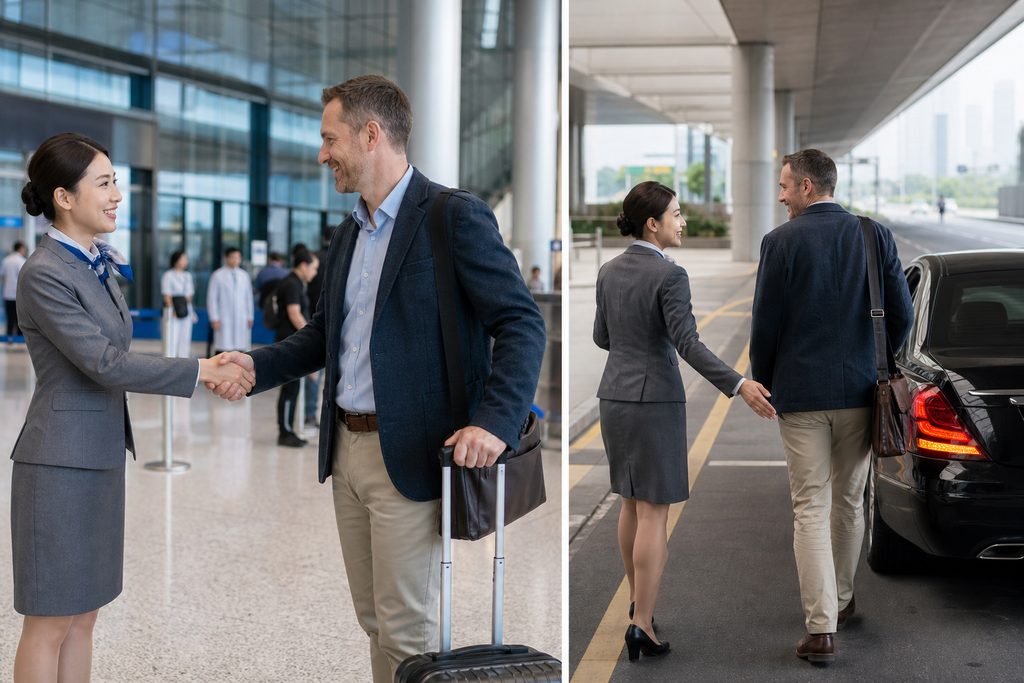
You have probably heard that navigating a Chinese airport is chaotic. That belief is only half true. The reality is that Beijing Capital, Shanghai Pudong, and Guangzhou Baiyun move over 70 million international passengers a year. The chaos is manageable — if you know the sequence. And for a patient arriving for surgery or a complex consultation, the stakes are not about convenience. They are about not missing a pre-operative window, not getting stranded with medication that needs refrigeration, and not burning energy you do not have. This article breaks down the China airport pickup service for patients price, what actually happens on arrival, and how to arrange the transfer without getting overcharged or lost in translation.
Key Takeaways
- Airport pickup in China for medical travelers costs between $100 and $200 per trip, with round-trip transfers from $200 — but the real value is in arrival coordination, not just the ride.
- China’s major airports process international arrivals through a fixed sequence: health declaration, immigration, baggage, customs. A medical pickup service meets you after customs, not before.
- Public hospitals in China do not include airport pickup in treatment packages. Private international hospitals sometimes bundle a basic transfer. You need to verify this before booking surgery.
- Language support at the arrivals hall is thin. Chinese airports use bilingual signage, but staff at taxi queues and information desks rarely speak medical English.
The Problem: Landing in a Foreign Medical System Without Ground Support
Each year, an estimated 500,000 foreign patients travel to China for medical treatment, according to industry data from the China International Medical Tourism Association. That number has grown steadily since 2016. But here is what the brochures do not tell you: the first 90 minutes after landing are the most disorienting part of the entire trip.
You are tired. You may be in pain. You may be carrying imaging CDs, referral letters, and a list of medications that cannot go into checked luggage. The arrivals hall at Shanghai Pudong Terminal 2 is over 800,000 square meters. If you do not know exactly where the pickup point is, you will walk. A lot. And if your phone does not connect to a Chinese network immediately, you cannot call anyone.
This is not a hypothetical problem. It is the most common complaint we hear from patients who tried to self-navigate on their first visit. The medical care itself was not the issue. The arrival was.
Why a Structured Airport Pickup Changes the Entire Arrival Experience
Medical travel is not tourism. A tourist can afford to get lost for an hour. A patient arriving for a cardiac evaluation at Fuwai Hospital or an oncology consultation at Peking Union Medical College Hospital cannot. The transfer from airport to hospital or hotel is a clinical logistics step, not a travel perk.
Predictability Reduces Physiological Stress
There is a measurable relationship between travel-related stress and clinical outcomes. A 2019 study published in the Journal of Travel Medicine found that patients who experienced unplanned delays or navigational confusion before a medical appointment showed elevated blood pressure and heart rate at intake. For a patient with hypertension or a cardiac condition, that elevation can distort baseline readings and complicate the first consultation.
A pre-arranged pickup removes variables. The driver knows your flight number. They track the arrival time. They wait at the correct exit. You do not negotiate, explain, or search.
Language Friction Is Highest at the Airport
Chinese airports have English signage. That is true. But the moment you need to ask a question — where is exit B, which taxi queue serves the medical district, how do I get a receipt — you hit a wall. Airport staff in Shanghai and Beijing are trained for basic English. They are not trained for medical English. Terms like “hospital admission letter” or “pre-operative fasting” mean nothing at an information desk.
This is why how to arrange airport transfer for medical treatment China is not just about booking a car. It is about having a bilingual contact point from the moment you clear customs.
Cost Transparency Is Better Than Airport Negotiation
An unofficial taxi from Pudong airport to downtown Shanghai costs anywhere from 200 to 400 RMB depending on traffic and the driver’s mood. That is $28 to $56. A pre-booked medical transfer costs more — $100 to $200 per trip — but it includes a fixed price, a driver who knows the hospital entrance, and a contact person who speaks English. The premium buys certainty. For a patient, certainty is the product.
China Airport Pickup Service for Patients Price: What You Actually Pay
The China airport pickup service for patients price varies by city, vehicle type, and whether you need a medical escort in the vehicle. Here is a realistic breakdown based on current market rates for international patient services in Beijing, Shanghai, and Guangzhou.
| Service Type | Beijing | Shanghai | Guangzhou | What Is Included |
|---|---|---|---|---|
| Standard airport pickup | $80–120 | $90–130 | $70–110 | Driver, flight tracking, 1-hour waiting, basic English sign with your name |
| Medical transfer with bilingual escort | $150–200 | $160–220 | $140–190 | English-speaking escort, wheelchair assistance if needed, hospital check-in support |
| Round-trip package | $200–280 | $220–300 | $190–260 | Arrival and departure transfers, flight tracking both ways |
| Private ambulance transfer | $300–500 | $350–550 | $280–450 | Medical staff onboard, oxygen, stretcher or wheelchair, direct hospital admission support |
These numbers reflect coordination fees for international patient services, not public taxi rates. They vary by hospital and case complexity. A patient arriving for a minor consultation needs a standard pickup. A patient arriving post-surgery or with mobility limitations needs the escorted option. The price difference is not about luxury — it is about whether you can physically manage the walk from the arrivals hall to the parking garage.
Is Airport Pickup Included in Medical Tourism Packages China?
This is one of the most common questions we receive. Is airport pickup included in medical tourism packages China? The honest answer: sometimes, but rarely with the level of coordination a patient actually needs.
Private international hospitals in Shanghai and Beijing — United Family, Jiahui, Raffles — often include a basic airport transfer in their premium health check packages or surgical bundles. The transfer is typically a standard sedan with a driver. The driver holds a sign with your name. That is it. No medical escort, no hospital admission support, no help with luggage if you are post-operative.
Public hospitals — including the top-ranked institutions on the Fudan Hospital Rankings — do not include airport pickup at all. Their international departments may recommend a transfer service, but it is not bundled into the treatment cost. You arrange it separately.
The practical implication: do not assume your medical package covers arrival logistics. Ask the hospital or your coordination service directly. Get the answer in writing. A missing pickup is not a minor inconvenience — it is a failed start to a treatment journey.
What Happens After Landing for Surgery in China: The Step-by-Step Sequence
After the aircraft doors open, you follow the signs for international arrivals. Since 2023, China has relaxed most COVID-era health declaration requirements, but you should still complete the digital health declaration form on the China Customs app or website before departure. The form asks about recent symptoms and travel history. It generates a QR code that you scan at a kiosk in the arrivals hall. The process takes under five minutes if you complete it in advance.
Then comes immigration. You need your passport with a valid S2 visa. The S2 visa is the correct category for short-term medical treatment and private affairs in China. It is not the M visa — that one is for commercial and trade activities. If your treatment requires a stay longer than 180 days, you need an S1 visa. The immigration officer may ask for your purpose of visit. Have your hospital invitation letter or admission confirmation printed and ready. Digital copies on your phone are usually acceptable, but paper is faster.
Step 2: Baggage Claim and Customs
After immigration, you collect your checked luggage. If you are carrying prescription medications, keep them in your carry-on. China allows personal-use medication, but you should carry a doctor’s letter listing each drug, the dosage, and the condition it treats. For controlled substances, the rules are stricter. Check with the Chinese embassy in your home country before departure — do not discover a problem at the customs checkpoint.
Customs is usually a walk-through channel. If you have nothing to declare, you use the green channel. If you are carrying medical equipment or a large quantity of medication, use the red channel and declare it. The customs officer may ask questions. Answer simply and honestly.
Step 3: The Pickup Point
This is where a pre-arranged service pays for itself. After customs, you enter the arrivals hall. The pickup point is different at every airport. At Shanghai Pudong Terminal 2, international arrivals exit through two doors — one leads to the taxi queue, the other to the private pickup area. Your driver should be waiting at the private pickup area with a sign bearing your name and, ideally, the hospital logo or your coordination service’s name.
If you did not arrange a pickup, you now face the taxi queue. At peak hours, the wait can exceed 45 minutes. You will need to show the driver the hospital address in Chinese characters. Many drivers do not read English. You can use a translation app, but if your phone has no data connection, you are stuck.
Step 4: The Drive to the Hospital or Hotel
From Pudong airport to the main medical district in Shanghai takes 50 to 70 minutes in normal traffic. From Beijing Capital airport to the central hospital area takes 40 to 60 minutes. From Guangzhou Baiyun to the medical district takes 45 to 65 minutes. These are real times, not optimistic estimates. If your surgery requires fasting, plan your arrival time backward from the admission deadline, not forward from the flight landing time.
Practical tip: If you are arriving for surgery, schedule your flight to land at least 24 hours before your hospital admission time. This gives you a buffer for flight delays, immigration queues, and one night of rest before pre-operative checks. Arriving the same day as surgery is a mistake.
Best Medical Airport Transfer Service Beijing Cost and How to Choose
Patients often ask us about the best medical airport transfer service Beijing cost. The answer depends on what “best” means for your situation.
If you are mobile, traveling light, and confident navigating a foreign airport, a standard pre-booked pickup at $80 to $120 is sufficient. The driver meets you, loads your bags, and drives you to the hospital or hotel. You do not need more than that.
If you are arriving after a long-haul flight, in pain, or with limited mobility, the escorted transfer at $150 to $220 is the better choice. The bilingual escort meets you at the arrivals gate — not at the curb — and walks you through the entire sequence. They handle the luggage, communicate with the driver, and make sure you reach the hospital’s international department without wandering through the wrong building.
For post-operative arrivals or patients with serious mobility issues, a private ambulance transfer is the only appropriate option. The cost is higher — $300 to $500 in Beijing — but it includes medical staff, oxygen if needed, and direct admission support at the hospital. This is not a luxury. It is a clinical necessity for certain patients.
One more consideration: book hospital airport pickup Shanghai services are not standardized. Some hospitals have their own transfer desks. Others work with third-party vendors. The quality varies widely. Before you book, ask three questions: Who exactly meets me at the airport? What is their English level? What happens if my flight is delayed by more than two hours? The answers tell you whether you are dealing with a professional service or a dispatch platform.
Practical Considerations: Documentation, Payment, and Communication
Arrival logistics are not just about the ride. They are about having the right documents, the right payment method, and a working communication plan.
Documents. Keep your passport, visa, hospital invitation letter, and medication list in a single folder in your carry-on. Do not pack them in checked luggage. If your luggage is lost — and it happens on about 1 in 200 international flights — you still have everything you need to proceed with your medical appointment.
Payment. Chinese airports and taxis operate on a cash-plus-digital system. International credit cards are accepted at airport counters but often not in taxis. WeChat Pay and Alipay dominate, but they require a Chinese bank account or an international card linked to the app. For a pre-booked transfer, payment is usually handled in advance or by invoice. That removes the payment friction entirely.
Communication. Your home mobile plan may not work in China. Many international roaming plans do, but data speeds can be slow. The more reliable approach is to buy a local SIM card at the airport or arrange an eSIM before departure. A working phone is not optional — it is how you reach your driver, your hospital contact, and your family back home.
Insurance. Most international health insurance plans do not cover airport transfer costs. Some premium medical travel policies include a transportation rider. Check your policy before departure. If the transfer is not covered, it is an out-of-pocket expense. The good news: it is a small one relative to the treatment cost.
Frequently Asked Questions
Do I need to arrange airport pickup before I arrive in China?
No, but you should. You can find a taxi at the airport, but you will face language barriers, possible long queues, and uncertainty about the final cost. A pre-arranged pickup removes all three variables. For a patient, the predictability is worth the premium.
What if my flight is delayed?
A professional pickup service tracks your flight number and adjusts the pickup time automatically. You do not need to call or notify anyone. If the delay is more than a few hours, the escort or driver will still be there when you land. Confirm this policy when you book.
Can the pickup service take me directly to the hospital for admission?
Yes. The driver should know the exact hospital entrance for the international department or the specific building where your admission is processed. This matters more than you might think — large Chinese hospitals have multiple gates, and the wrong entrance can add 20 minutes of walking.
Is the airport pickup price negotiable?
For pre-booked services, no. The price is fixed when you book. For taxis at the airport, the meter sets the price, but some drivers may attempt to negotiate a flat rate. Avoid this — insist on the meter or use a pre-booked service.
Your Next Step
Arriving in China for medical treatment is a sequence, not a single event. The pickup is one part of that sequence, but it sets the tone for everything that follows. Our team at China Medical Services coordinates airport transfers, bilingual escorts, and hospital admission support for international patients across 37 cities. We are not a hospital and we do not provide diagnoses — we handle the logistics so you can focus on your treatment. If you are planning a medical trip, start with a clear arrival plan. That is the step most patients skip, and the one they most often regret.
For more medical information and treatment options in China, visit chinamedservices.com (China Medical Services).
