Medical Translation in China: Actually Understanding What Your Doctor Said
Have you ever held a medical report in your hands and realized you understood maybe three words? Now imagine that report determines whether you get surgery, switch medications, or fly home. That knot in your stomach is exactly what thousands of international patients feel when they receive a diagnosis in China. The good news: medical translation is a solved problem. The bad news: doing it wrong can cost you more than money. This guide walks through how translation actually works inside Chinese hospitals, what it costs alongside a cancer treatment cost China estimate, and how to make sure you leave the consultation knowing precisely what the doctor said.
How This Actually Works, Step by Step
The process starts before you ever sit down with a specialist. You send your existing records — scans, blood work, pathology slides, discharge summaries from your home country. Our team reviews them for completeness. Missing pages? Illegible handwriting? We flag that now, not later. Then a medically trained translator converts everything into Simplified Chinese, preserving drug names, lab values, and anatomical terms with zero guesswork. A physician-level reviewer checks the translation against the original. Only after that does your file go to the hospital’s international department or a specific specialist for review.
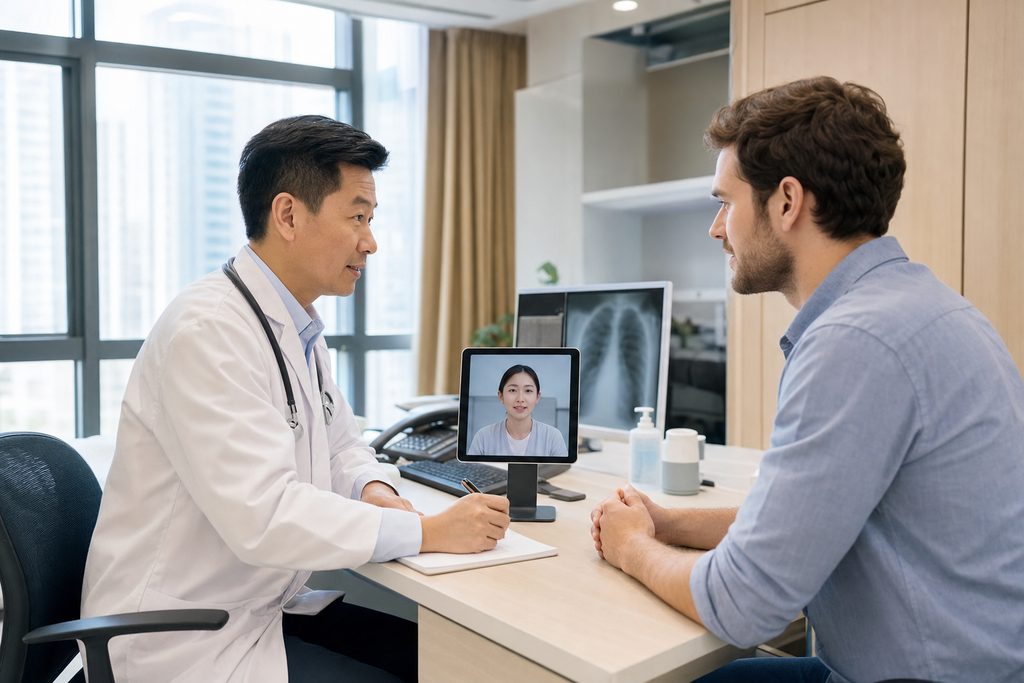
What comes back depends on the service tier. A written second opinion returns a structured document: what the Chinese specialist thinks, what they recommend, what they would do differently. A video consultation adds a live conversation where you ask questions through a professional interpreter. The interpreter is not a random bilingual staffer. They know the specialty. They know when to ask the doctor to slow down, repeat a dose, or draw a diagram. That matters more than most patients expect.
After the consultation, you get a written summary in English. Not a word-for-word transcript — a clinical summary organized by diagnosis, treatment options, risks, and next steps. If you decide to proceed with treatment in China, that summary becomes the foundation for scheduling, admission, and follow-up care. Nothing gets lost between languages.
Why Standard Translation Fails in a Hospital Setting
Yes. Most top hospitals in Beijing have international departments that provide bilingual reports or can direct you to an affiliated translation service. For anything that affects treatment decisions, request a physician-level review of the translation, not just a word-for-word conversion. Machine translation is not acceptable for medical documents.
Request a corrected translation immediately and confirm the correction with the treating physician before proceeding. Reputable services review disputed translations at no additional charge. If you discover the error after returning home, contact the hospital’s international department directly. Keep both the original Chinese document and the English translation — you will need both to resolve the discrepancy.
For second opinions and treatment planning, yes. The specialist reviews your records in advance, and a professional interpreter facilitates the live conversation. What video cannot replace is a physical examination. If the specialist recommends in-person evaluation before surgery, that recommendation should not be skipped.
Shanghai’s Zhongshan Hospital Fudan University is among China’s most respected cardiac centers, with a long track record in complex procedures. Fuwai Hospital in Beijing performs more cardiac surgeries annually than any hospital globally — over 14,000 per year. The right choice depends on your specific condition, not just rankings. A specialty consultation can help clarify which institution fits your case.
Your Next Step
Understanding what a Chinese doctor said should never depend on luck or a free translation app. The process works when records are complete, translators are medically trained, and coordination happens before you travel. Our team at China Medical Services handles record translation, specialist matching, and bilingual accompaniment through 340+ top-ranked hospitals across 37 cities. We do not provide medical advice or guarantee clinical outcomes — we make sure you understand what the doctors are telling you, in writing and in person. If you’re weighing treatment options and need clarity on what your records actually say, explore how our consultation process works and start with a conversation.
You don’t have to guess. And you shouldn’t.
Frequently Asked Questions
Yes. The hospitals used for international patients are JCI-accredited and follow the same international safety standards as top hospitals in the US and Europe. Surgical teams perform high volumes of procedures — often more than their Western counterparts — which studies show leads to better outcomes.
Costs vary by procedure and hospital, but international patients typically save 40-80% compared to US prices — even when factoring in travel and accommodation. A consultation with our team will give you an exact, all-inclusive quote with no hidden fees.
Send us your existing medical reports to get started. We handle everything from hospital selection and appointment scheduling to visa assistance and post-operative recovery planning. Your medical records are reviewed by the specialist before you even book a flight.
For more medical information and treatment options in China, visit chinamedservices.com (China Medical Services).
