Luxury Family Suite During Medical Stay China: Premium Accommodation for Accompanying Family
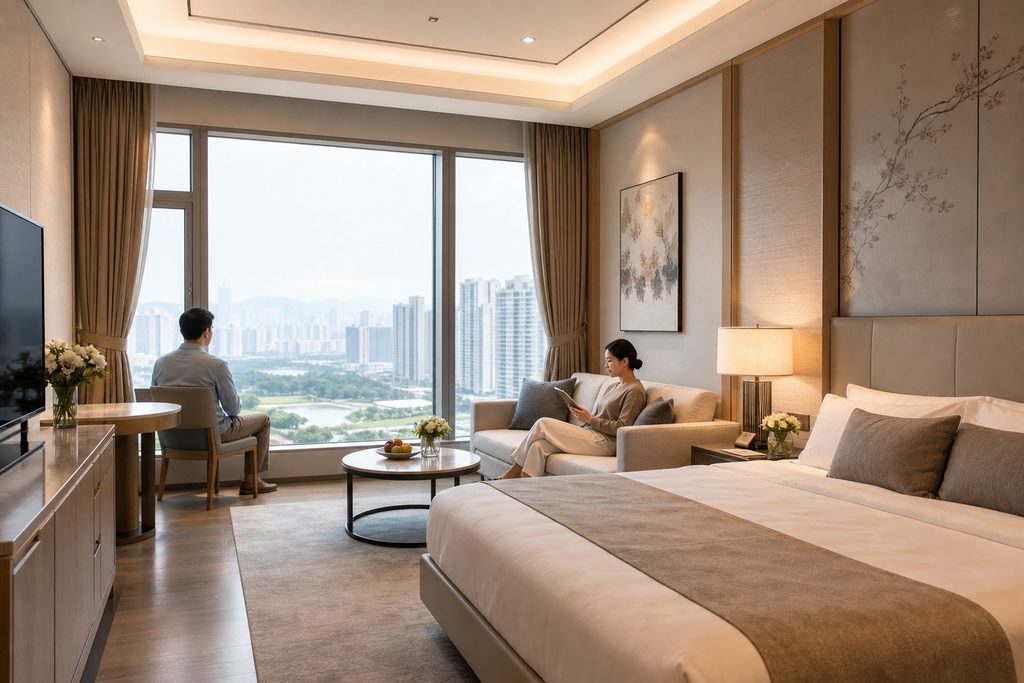
Have you ever wondered whether bringing your family to China for your surgery means cramming them into a cramped hotel room miles from the hospital, or if there is a better way? There is. And understanding the landscape of premium on-site and near-site accommodation changes the entire experience.
Key Takeaways
- The family suite hospital China price ranges from approximately $150 per night for a VIP single room to over $800 per night for a full luxury suite in Shanghai or Beijing, a fraction of comparable US hospital accommodation costs.
- China’s top-tier public hospitals now offer dedicated international VIP wings with family lodging, but they are not bookable through standard online platforms—access requires coordination through the hospital’s official international department.
- Many families make the mistake of booking a hotel 40 minutes from the hospital, only to discover that post-operative visiting hours are rigid and traffic erodes meaningful time with the patient.
- Before you commit to any accommodation, verify whether the hospital allows 24-hour family presence in the room, because policies vary wildly even within the same city.
The Problem: Surgery Abroad Is Never Just About the Patient
When a patient travels to China for a complex procedure—a cardiac bypass at Fuwai Hospital, a spinal fusion at Peking Union Medical College Hospital, or an oncology protocol at Fudan University Shanghai Cancer Center—the family does not simply vanish into thin air. A spouse, a parent, an adult child. Someone is coming. And that person needs a place to sleep, shower, and decompress. The logistics are brutal if you get them wrong. A 2023 survey by Patients Beyond Borders noted that accommodation-related stress was cited by 41% of medical travelers as a major detractor from their overall treatment experience. That number spikes when the patient is a child or an elderly parent and the accompanying family member is also the primary caregiver.
In Western hospitals, the solution is often a pull-out cot in the corner of the patient’s room or a nearby Ronald McDonald House. In China, the infrastructure is different. The scale is different. A major public hospital like West China Hospital in Chengdu handles over 20,000 outpatient visits daily. The sheer volume means that standard inpatient wards are not designed with family stays in mind. But the international and VIP wings? Those are a different world entirely. And that is where the conversation about a luxury family suite during a medical stay in China begins.
Who We Are
We are China Medical Services. We are not a hospital. We do not provide medical treatment, clinical diagnoses, or make promises about surgical outcomes. Our team functions as your logistical architects on the ground in China. We bridge the gap between you—a family facing a serious medical decision—and the 340+ top-ranked hospitals across 37 Chinese cities that may hold the solution. We handle hospital matching, appointment coordination through official international departments, bilingual medical companion services, and yes, the accommodation puzzle that keeps families intact during treatment. We speak the language, we know the hospital layouts, and we know which VIP wing actually delivers on its promises and which one is just a renovated floor with a nicer bedspread.
What a Luxury Family Suite During Medical Stay China Actually Looks Like
The term “luxury” gets thrown around loosely. In the context of Chinese hospital accommodation, it is not about gold-plated faucets. It is about space, privacy, and proximity. It is about a room where a family member can actually sleep without listening to three other patients and their visitors. It is about having a door that closes.
The VIP International Ward: On-Site Family Suites
Most top-tier public hospitals in Beijing, Shanghai, and Guangzhou now operate a dedicated international or VIP wing. These are not just translated signage and English-speaking nurses—though those are present. They are physically separate floors or adjacent buildings with hotel-style rooms. A standard VIP single room at a hospital like Ruijin Hospital in Shanghai or Peking Union Medical College Hospital runs between $150 and $300 per night. These rooms typically include a patient bed, a private bathroom, a sofa that converts to a bed for one family member, a small refrigerator, and often a safe for valuables. The family suite hospital China price jumps when you need a proper two-room configuration.
A true luxury family suite—one with a separate living area, a dedicated family sleeping space with a real bed, and sometimes a kitchenette—ranges from $400 to over $800 per night depending on the hospital and city. At United Family Healthcare facilities, which are private international hospitals with JCI accreditation, the family suite concept is baked into their Western-style care model from the start. Their postpartum and surgical recovery suites in Shanghai and Beijing are designed for a family member to stay comfortably. But you pay for it. The family suite hospital China price at a top private facility can easily reach $600 to $1,000 per night.
Why the wide range? Three factors drive cost: the city, the hospital tier, and the specific suite configuration. A luxury medical accommodation for family Shanghai at a private hospital in Pudong will cost more than a VIP suite at a public hospital in Nanjing. But the public hospital VIP suite in Shanghai often delivers better clinical outcomes for complex procedures because the surgical teams simply have higher case volumes. This is the trade-off we help families navigate.
Premium Serviced Apartments: The Near-Hospital Alternative
Not every family needs to sleep inside the hospital. In fact, for longer stays—cancer treatment cycles, rehabilitation after orthopedic surgery, or traditional Chinese medicine protocols—a serviced apartment within walking distance is often the better solution. A premium serviced apartment near Zhongshan Hospital in Shanghai or Fuwai Hospital in Beijing costs between $120 and $250 per night for a one-bedroom unit with a proper kitchen, weekly housekeeping, and a concierge desk that can handle logistics. This is not a random Airbnb. These are buildings that cater specifically to medical travelers and expatriate families, often with direct relationships to the hospital’s international department.
The best hospital with family suites Beijing cost comparison is not just about the room rate. It is about the total burden. A family suite inside the hospital eliminates transportation costs, saves hours of commuting time, and allows for spontaneous visits when the patient is awake and alert at odd hours—which happens constantly after major surgery. A serviced apartment saves money on the room but costs time and energy. For a patient recovering from a Whipple procedure or a cardiac bypass, the family’s ability to be present within five minutes, not 45 minutes, matters.
How to Bring Family During Surgery in China: The Logistics Nobody Tells You
The question of how to bring family during surgery in China starts with the visa. This is where many families trip. The patient applies for an S2 visa, which is specifically for medical treatment purposes. Accompanying family members—spouses, parents, children—also apply for S2 visas, noting their role as an accompanying relative. The S2 visa can be issued for up to 180 days. For treatment protocols extending beyond that, an S1 visa is required. We have seen families attempt to enter on L tourist visas and then scramble when the hospital’s international department requires proper documentation. Do not do that. The visa category matters for hospital registration, for insurance claims, and for any extension requests while in-country.
Once the visa is sorted, the accommodation question becomes urgent. Can my family stay with me after surgery China? The answer depends entirely on the hospital and the ward. In a standard public ward with three to six beds per room, overnight family stays are generally not permitted. Visiting hours are strict—often 3:00 PM to 7:00 PM—and enforced. In a VIP international suite, the answer is almost always yes. One family member can stay overnight in the room. Some suites allow two. This is not a small detail. It is the difference between a spouse sleeping in the room, able to help with meals and communication, and that same spouse sitting alone in a hotel room at 10:00 PM with no information.
Medical Travel China Premium Suite for Relatives: What You Are Actually Buying
When you book a medical travel China premium suite for relatives, you are not just paying for square footage. You are paying for access infrastructure that did not exist in Chinese public hospitals 15 years ago. The international wings were built specifically because China’s top hospitals recognized that medical travelers from the Middle East, Southeast Asia, Russia, and increasingly North America and Europe would not come without family accommodation. The investment has been significant. At Huashan Hospital in Shanghai, the international wing includes dedicated family lounges, bilingual nursing staff on every shift, and direct scheduling access to senior specialists.
But here is the part that frustrates families who try to book independently: these suites are not on Booking.com. They are not on the hospital’s Chinese-language website. They are managed through the hospital’s international department, which often has limited English-language capacity and no online booking portal for overseas patients. You cannot simply email the general hospital address and expect a response. The international department handles a high volume of inquiries from all over the world, and priority goes to patients who have already been accepted for treatment and who have a coordinator on the ground. This is not gatekeeping. It is triage. And it is why having a local coordination team changes the timeline from weeks of silence to a confirmed suite within days.
Comparing Real Costs: Hospital Suite vs. Nearby Hotel vs. Serviced Apartment
| Accommodation Type | Nightly Rate (USD) | Distance to Patient | Family Overnight Allowed | Kitchen Access | Best For |
|---|---|---|---|---|---|
| Public Hospital VIP Single Room | $150–$300 | Same floor | Yes, 1 person | No | Short stays, post-op recovery |
| Public Hospital Luxury Family Suite | $400–$800 | Same floor | Yes, 1–2 people | Sometimes | Complex surgery, pediatric cases |
| Private International Hospital Suite | $600–$1,000 | Same room | Yes, 1–2 people | Often included | Western-style care experience |
| Near-Hospital Serviced Apartment | $120–$250 | 5–15 min walk | N/A (separate unit) | Full kitchen | Extended treatment, rehabilitation |
| International Chain Hotel | $100–$200 | 15–45 min by car | N/A | No | Budget-conscious, short visits |
Rates vary by hospital and case complexity. The figures above reflect current pricing from our coordination work with hospitals in Beijing, Shanghai, Guangzhou, and Chengdu. The family suite hospital China price at a public hospital VIP wing is typically 40-60% lower than a comparable setup at a private international hospital, but the clinical teams at the public hospital often have dramatically higher procedure volumes. For a cardiac surgery patient, that volume difference translates to measurable outcome differences. The choice is not just financial. It is clinical.
What You Need to Know Before Booking Anything
Three barriers hit families who try to arrange this independently. We see the same pattern every month.
- Visa documentation for family accommodation: The S2 visa application requires an invitation letter from the Chinese hospital. That letter must specify the treatment plan and the accompanying family members. If the hospital has not formally accepted the patient, the letter does not exist. And getting that acceptance without a coordinator who can present your medical records in Chinese, through the correct channel, is a slow process. We have seen families wait six weeks for a response that should take five days.
- Suite availability is tied to treatment scheduling: The international department will not reserve a family suite until the patient has a confirmed admission date and a deposit on file. You cannot book the suite first and then figure out the surgery date. The two move together. This means families trying to plan independently often end up with a surgery date but no suite, or a tentative suite hold that evaporates because the deposit did not arrive in time.
- Payment methods and deposit requirements: Chinese hospital international departments typically require a deposit of $5,000 to $20,000 upfront, paid via wire transfer or in person. Credit card systems that work seamlessly in the US or Europe often fail or trigger fraud alerts when processed by a Chinese hospital’s payment gateway. We have seen families arrive in Beijing with a credit card that the hospital cannot process, and the solution is a frantic series of international wire transfers that take 48 hours to clear. Cash deposits in RMB are accepted but subject to currency import limits.
How We Navigate This for You
Our team sits between you and these barriers. When a family contacts us about bringing a spouse or parent for a surgical stay, the first thing we do is confirm the hospital’s specific family accommodation policy for the exact procedure and surgeon under consideration. Not the general policy. The specific one. Because a VIP suite that allows overnight family for a knee replacement patient may have different rules for a neurosurgery patient requiring ICU step-down.
We then coordinate the visa invitation letter, the suite reservation, and the deposit payment in a single sequence so that the surgery date, the suite, and the family member’s travel all align. The suite is reserved under the patient’s hospital registration number. The deposit is wired with correct documentation so the hospital’s finance department can reconcile it immediately. And when the family arrives, our bilingual medical companion meets them at the airport, handles the hospital check-in, and ensures the suite is ready before the patient is admitted. The companion stays through the admission process, translating every conversation, and remains on call throughout the stay.
For families who prefer a serviced apartment near the hospital, we have working relationships with buildings that cater to medical travelers. We can arrange a unit that is a seven-minute walk from the hospital’s international wing, with a kitchen configured for preparing the specific foods a post-surgical patient can tolerate. These are small things that become enormous when you are in a foreign country, exhausted, and responsible for someone’s recovery.
Our coordination fee for accommodation arrangement is included in the broader hospital appointment coordination service, which starts from $300. The suite or apartment cost is paid directly to the hospital or property. We do not mark up accommodation. We make sure it is actually available, actually appropriate, and actually reserved under the correct name with the correct dates. That is the value.
Frequently Asked Questions
In standard multi-bed wards, overnight family stays are generally not permitted and visiting hours are strictly enforced. In the VIP international wings of top public hospitals—and in private international hospitals—one family member can usually stay overnight in the patient’s room. Luxury family suites often accommodate two relatives. This must be confirmed for the specific ward before admission. We verify this during coordination.
For a public hospital VIP luxury family suite, expect $400 to $800 per night. For a private international hospital suite, $600 to $1,000 per night. These rates typically include the room, nursing care on the international floor, and meals for the patient. Family meals are sometimes included, sometimes extra. The price varies significantly by city—Beijing and Shanghai are at the high end, while Chengdu, Nanjing, and Wuhan are 20-30% lower. Always confirm what is included before paying the deposit.
You cannot book these suites through hotel platforms or the hospital’s public website. The suite must be reserved through the hospital’s international department, and that department requires a confirmed treatment plan and deposit before releasing the reservation. We handle this as part of our coordination service: we present your case to the international department, secure the treatment confirmation, and reserve the suite simultaneously. Without a local coordinator, the process often takes weeks of email back-and-forth.
For surgical recovery stays under two weeks, the hospital suite is almost always the better choice. Proximity to nursing staff, immediate access to the patient, and elimination of transportation friction outweigh the higher nightly rate. For treatment protocols lasting a month or more—chemotherapy cycles, rehabilitation, TCM protocols—a serviced apartment within walking distance offers more space, a kitchen, and a more sustainable living situation. The best hospital with family suites Beijing cost comparison should factor in total stay duration, not just the nightly rate.
What happens if the suite is not available when we arrive, despite a reservation?
This happens occasionally, usually because a
For more medical information and treatment options in China, visit chinamedservices.com (China Medical Services).
