Rehabilitation Duration in China: Realistic Timelines for Surgery Recovery
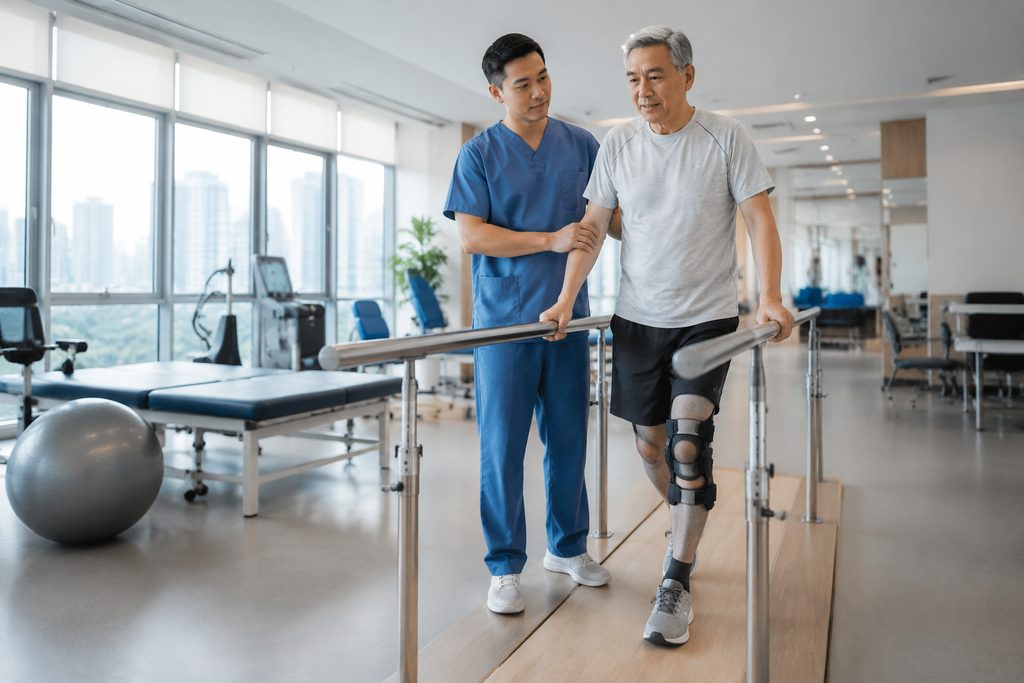
While patients in Canada wait a median 28.6 weeks for orthopedic surgery, surgeons at Beijing Jishuitan Hospital routinely perform over 300 joint replacements per month — with clinical outcomes that match or exceed Western benchmarks. The surgery is only half the story though. What happens in the weeks and months after the operation determines whether that procedure actually changes a life. And that’s where most international patients have no idea what to expect.
Rehabilitation duration varies enormously by procedure, age, baseline fitness, and where you recover. In China, structured inpatient rehab programs often run shorter than Western equivalents because of how hospitals integrate early mobilization into the post-operative ward routine. But outpatient recovery still takes months. This article breaks down what a realistic timeline looks like for the procedures that most often bring international patients to China — and what the rehabilitation cost after surgery in China actually involves.
How This Actually Works, Step by Step
You don’t fly to China, get surgery, and then figure out rehab on your own. The sequence matters. Here’s how it works when you go through a medical coordination service like ours.
First, you send your existing imaging, surgical reports, and physician notes. Our team translates them into Chinese and routes them to the relevant specialty department at one of our partner hospitals. A senior specialist reviews your file and tells you whether you’re a candidate for surgery in China — and what the expected recovery trajectory would look like for someone with your specific presentation. This written second opinion typically costs $300–500 and takes 3 to 7 business days.
If the specialist confirms you’re a candidate, we coordinate a video consultation so you can speak directly with the surgical team. You discuss the procedure, the hospital stay, and the rehabilitation plan. The team explains what they expect you to be able to do at discharge, at 6 weeks, at 3 months, and at 6 months. This is where realistic expectations get set — not by a website, but by the people who will operate on you.
Once you decide to proceed, we handle the S2 visa documentation, hospital registration, and admission scheduling. You arrive, have your pre-operative assessment, and undergo surgery. Then the structured rehabilitation begins — often starting the same day or the day after the procedure, depending on what was done.
Rehabilitation Duration After Hip Replacement in Shanghai
How long is rehab after hip replacement in Shanghai? The short answer: you’ll be walking with assistance within 24 hours, discharged from the hospital in 3 to 5 days, and back to most daily activities by 6 to 8 weeks. But full recovery — where you stop thinking about the hip — takes 6 to 12 months.
Shanghai’s top orthopedic hospitals, including Shanghai Sixth People’s Hospital and Zhongshan Hospital Fudan University, follow enhanced recovery after surgery (ERAS) protocols. That means spinal anesthesia instead of general where possible, multimodal pain control, and early weight-bearing. Patients are out of bed on post-op day 1. By day 3, most can walk 50 meters with a walker. By discharge, they can climb stairs.
| Milestone | Typical Timeline | What It Looks Like |
|---|---|---|
| First stand with assistance | Day 0–1 | Nurse and physiotherapist help you stand at bedside |
| Walking with walker | Day 1–2 | 50–100 meters on the ward |
| Independent walking with cane | Week 2–4 | Around the house, short outdoor walks |
| Return to driving | Week 4–6 | Right hip: often sooner. Left hip: once off narcotics |
| Return to work (desk job) | Week 4–8 | Depends on commute and workplace setup |
| Full bone integration | Month 3–6 | Implant fully stable; restrictions lifted |
| Complete soft tissue recovery | Month 6–12 | No residual stiffness or swelling |
The inpatient rehab phase in Shanghai typically lasts 3 to 5 days. After discharge, you have two options: stay in China for outpatient physical therapy, or return home with a structured home exercise program. Many patients choose to stay 2 to 3 weeks post-discharge for daily supervised therapy before flying home. That extended stay is part of what makes medical tourism rehab packages China attractive — you get the critical early mobilization phase under professional supervision, not left to YouTube videos in your living room.
A Realistic Timeline
Here’s the timeline most international patients actually experience, including the waiting steps that never show up in brochures.
| Stage | Duration | What Happens |
|---|---|---|
| Document collection and translation | 3–7 days | You gather imaging CDs, reports, lab work. We translate and format for Chinese hospital review. |
| Written second opinion | 3–7 business days | Specialist reviews your file, confirms candidacy, outlines expected rehab trajectory. |
| Video consultation scheduling | 5–10 days | Top specialists have packed schedules. This is the step people underestimate. |
| S2 visa processing | 1–4 weeks | Varies by country and embassy. Hospital invitation letter helps. |
| Arrival and pre-op assessment | 2–3 days | Blood work, cardiac clearance, anesthesia consult, final surgical planning. |
| Surgery and inpatient stay | 3–10 days | Procedure-specific. Hip: 3–5 days. Cardiac bypass: 7–10 days. Knee: 3–5 days. |
| Early outpatient rehab in China | 1–4 weeks | Daily or near-daily physical therapy at the hospital or a partner clinic. |
| Return home and continued rehab | 2–6 months | Home exercise program, local PT, follow-up video consultations with your Chinese team. |
Cardiac rehab duration after bypass abroad follows a different rhythm. After coronary artery bypass grafting at a center like Fuwai Hospital, you’ll spend 7 to 10 days in the hospital. Monitored cardiac rehabilitation — supervised exercise on telemetry — starts before discharge and continues for 4 to 12 weeks. Fuwai’s cardiac rehab program runs 3 sessions per week for the first month, then tapers. Many international patients complete the first month in Beijing, then transition to a home program with monthly video check-ins.
What Can Go Wrong — and What Happens Then
Rehabilitation doesn’t always follow the textbook curve. Stiffness after knee replacement is the most common complication international patients hit. If range of motion stalls at 90 degrees instead of progressing to 110–120, the fix is usually more aggressive physical therapy, not another surgery. But that therapy needs to happen fast — ideally within the first 6 to 8 weeks before scar tissue matures.
Wound complications happen too. Superficial infections occur in roughly 1–2% of joint replacements. If you’re back home and notice redness, warmth, or drainage, you send photos to your Chinese team through the same coordination channel. They’ll assess and either prescribe topical or oral treatment or tell you to see a local specialist. The coordination service doesn’t end when you leave China. That’s the difference between a hospital that treats you and a team that manages your case.
Deep vein thrombosis is the risk everyone worries about. Chinese hospitals use mechanical compression and prophylactic anticoagulation as standard. If you develop calf pain or swelling after flying home, that’s an emergency — go to a local ER. Your Chinese team can provide your operative report and medication history to the local doctors within hours.
And sometimes the surgery goes perfectly but the patient’s expectations don’t match reality. That’s not a complication — it’s a failure of pre-operative education. Which is why the video consultation before you commit matters so much. The surgeon tells you directly: “At 6 weeks you’ll be walking, but you’ll still have swelling. At 3 months you’ll feel 70% normal. At 6 months you’ll stop thinking about the joint.” If you hear that before surgery, the recovery curve feels like progress, not failure.
Is Physical Therapy in China Good After Knee Surgery?
Is physical therapy in China good after knee surgery? The honest answer: it depends on where you go. At top-tier public hospitals and JCI-accredited private facilities, the standard matches or exceeds what you’d get in the US or Europe. At smaller community hospitals, it can be inconsistent.
The advantage of Chinese rehab for knee replacement is volume. Therapists at a hospital like Peking University Third Hospital see dozens of total knee patients every week. They know exactly what a stiff knee feels like at week 3 versus week 6. They know when to push and when to back off. That reps-based expertise is hard to replicate.
If you’re comparing rehab options, ask the hospital how many total knee replacements their therapy department handles per month. At top orthopedic centers, the answer is usually 50+. That volume matters more than the equipment in the gym.
The other factor is cost. A one-hour physical therapy session at a top Shanghai hospital’s international department typically runs $50–100. In the US, the same session bills at $150–300 before insurance. That differential is why some patients extend their stay in China specifically for the rehab phase — the savings on therapy alone can offset the cost of extra weeks of accommodation.
But there’s a tradeoff. Language matters in rehab. You need to understand exactly what the therapist is asking you to do. That’s where a bilingual medical companion earns their fee. They’re not just translating words — they’re making sure you understand the purpose of each exercise so you can replicate it correctly at home. Without that, you might do the movements wrong for weeks and wonder why you’re not progressing.
Practical Considerations: Records, Visa, Payment, Follow-Up
Let’s get concrete about the things that actually affect your rehab timeline.
Medical records. Bring everything on a USB drive and in paper form. Imaging CDs from Western hospitals sometimes don’t open on Chinese systems. We convert everything to DICOM format before you arrive. Your surgical team needs your full medication list — especially anticoagulants, which affect surgical planning and post-op rehab.
Visa timing. The S2 visa is what you’ll apply for, with supporting documents from the hospital confirming your treatment plan. Processing takes 1 to 4 weeks depending on your home country. Some patients need to stay beyond 180 days for extended rehab — that requires an S1 visa instead. We flag this early in the process so you don’t get stuck mid-recovery.
Payment. Public hospitals require pre-payment for the estimated treatment cost. International insurance usually reimburses after the fact. Private international hospitals like United Family or Jiahui offer direct billing with many global insurers. The private hospital option costs more but simplifies the payment and language logistics significantly.
Follow-up at home. Your Chinese team will schedule video follow-ups at 1 month, 3 months, and 6 months post-op. You’ll send photos of the incision, describe your range of motion, and report any concerns. If you need imaging, you get it done locally and upload the files. The coordination service includes translation so your Chinese team sees exactly what your local radiologist wrote.
If you want to book rehab program Beijing hospital services, the process starts with the same remote evaluation. You can’t just show up and expect a structured rehab bed. The hospital needs to review your surgical records, confirm the procedure was done at an accredited facility, and design a program specific to your recovery stage. That coordination takes 1 to 2 weeks.
Frequently Asked Questions
Inpatient rehab during your hospital stay is bundled into the surgical package at most public hospitals. Outpatient physical therapy runs $50–100 per session at top facilities. A structured 4-week post-discharge rehab program — including daily therapy, accommodation coordination, and bilingual support — typically ranges from $3,000 to $8,000 depending on intensity and hospital tier. That’s separate from the surgery itself.
For joint replacement, most international patients stay 2 to 4 weeks after discharge. That covers the critical early mobilization phase and the first follow-up appointment. For cardiac bypass, plan on 3 to 6 weeks. For spinal procedures, 4 to 8 weeks. You can leave sooner, but the first month of rehab determines a lot about the final outcome.
Yes, but the results are usually worse. The patients who do best are the ones who complete at least 2 to 3 weeks of supervised therapy before flying home. After that, a structured home program with video check-ins works well for most people. The decision depends on your baseline fitness, the procedure, and how much support you have at home.
Your coordination team stays involved. You send photos, describe symptoms, and get a response from your surgical team — usually within 24 to 48 hours. For emergencies, you go to a local hospital and we provide your records to the treating physicians. You’re never left to figure it out alone.
Most international insurers cover medically necessary rehabilitation as part of the surgical episode. You’ll need pre-authorization, which we help you obtain. Some policies have geographic restrictions or require treatment at JCI-accredited facilities. We review your policy before you commit to anything, so there are no surprises.
Your Next Step
Rehabilitation duration isn’t a fixed number — it’s a range that depends on the procedure, your baseline health, and where you recover. What we’ve laid out here reflects what our patients actually experience at top Chinese hospitals, not what a marketing brochure promises. If you’re considering surgery in China, the first step isn’t booking a flight. It’s getting your records in front of the right specialist and hearing what they expect your recovery to look like. Our team at China Medical Services coordinates that process — we’re not surgeons, and we don’t make medical promises. We handle the logistics, translation, and coordination so you can focus on getting better. When you’re ready, request a free consultation and we’ll help you figure out if this path makes sense for your specific situation.
For more medical information and treatment options in China, visit chinamedservices.com (China Medical Services).
