Cancer Treatment Cost in China: A Second Stay, A Companion Again
Key Takeaways
- Cancer treatment cost in China typically runs 70–85% below US private-pay rates, with top-tier surgical oncology priced from $12,000–$20,000 versus $100,000+ in America.
- Fudan-ranked oncology departments and JCI-accredited centers in Beijing and Shanghai match Western clinical protocols while handling patient volumes no single US hospital sees.
- Language barriers and unfamiliar hospital workflows are the two biggest friction points for foreign patients — not clinical quality.
- You cannot book surgery from overseas. A first outpatient visit, whether in person or by proxy, is mandatory before any admission or operation.
The Problem: Cancer Care Costs Are Forcing Impossible Choices
Have you ever wondered what happens when a treatment plan exists but the price tag makes it unreachable? That is the reality for roughly 1 in 4 cancer patients in the United States who report skipping or delaying care because of cost. A 2022 study in JAMA Oncology found that 42% of newly diagnosed cancer patients deplete their entire life savings within two years of starting treatment. The numbers are brutal. A full course of chemotherapy with immunotherapy for advanced lung cancer can exceed $200,000 in the US. Radiation therapy adds another $50,000–$80,000. Surgery, hospital stays, imaging, supportive medications — the total climbs fast.
For patients in the UK, Canada, or Australia, the problem is different but equally painful. Waiting lists. A 2023 report from the UK’s Royal College of Radiologists showed that nearly half of cancer centers missed the 62-day treatment target. Some patients wait 3–4 months just to start radiotherapy. Cancer does not wait for administrative queues.
So patients start looking elsewhere. They search for options in Germany, Turkey, Thailand, South Korea. But China remains oddly overlooked. That is changing. And for many, it should change faster.
Why China Delivers Results for International Cancer Patients
Clinical Volume Drives Better Outcomes
Chinese oncology departments operate at a scale that is hard to comprehend until you see it. Fuwai Hospital in Beijing performs over 14,000 cardiac surgeries annually — the highest volume of any heart center globally. Apply that same structural reality to oncology. A senior thoracic surgeon at a top Shanghai cancer hospital may complete 400–600 lung resections per year. The average US thoracic surgeon completes around 60–80. Volume matters. Studies consistently link higher surgical volume to lower complication rates and better long-term survival, particularly for esophageal, pancreatic, and liver cancers.
China’s top cancer hospitals — including those in the Fudan University hospital rankings — treat more esophageal and liver cancer cases than any Western center. These are cancers Western oncologists see relatively rarely. Chinese specialists see them daily. That depth of experience translates into refined surgical technique and nuanced treatment planning.
Technology and Efficiency at Scale
Walk into a top-tier Chinese oncology department and you will find the same equipment as any major US academic center. Da Vinci robotic surgical systems. Proton and heavy-ion therapy centers. PET-CT and PET-MRI. Next-generation sequencing for targeted therapy selection. The difference is throughput. A single Chinese hospital may run 20 operating rooms simultaneously, starting at 7:30 AM and finishing at 10 PM. Imaging centers process thousands of scans daily. Pathology labs return results in 2–3 days that might take 2 weeks elsewhere.
This efficiency is structural. Chinese public hospitals are designed for volume. They do not schedule surgery around surgeon convenience or operating-room availability the way many Western hospitals do. The system moves fast because it must — over 35,000 hospitals serve a population of 1.4 billion.
Cost Advantage Without Quality Compromise
The cancer treatment cost in China is not lower because care is worse. It is lower because labor costs are lower, hospital infrastructure is state-subsidized, and pharmaceutical pricing is negotiated nationally. A complex cancer surgery that costs $120,000 in the US might cost $15,000–$25,000 at a top Chinese hospital. Chemotherapy regimens run 60–80% cheaper. A PET-CT scan: $900–$1,500 in China versus $3,000–$6,000 in the US.
Does lower cost mean lower quality? Not at the institutions we work with. Many are JCI-accredited. Their oncology departments appear in the Fudan specialty rankings. Their physicians train internationally, publish in peer-reviewed journals, and follow NCCN or ESMO guidelines. The structural economics are different — that is the explanation, not a quality gap.
Best Oncology Hospital Shanghai Price: What You Actually Pay
If you are comparing options, Shanghai and Beijing are the two cities that matter most. Both host multiple top JCI accredited cancer centers in Beijing and Shanghai. The price difference between them is minimal. What differs is subspecialty strength and logistics.
Here is a realistic breakdown of self-pay prices for international patients at top-tier public hospital international departments in Shanghai and Beijing. These are 2024–2025 ranges, in USD, and they vary by hospital and case complexity.
| Service | China (Top Public, International Dept.) | United States (Private Pay) |
|---|---|---|
| Initial specialist consultation | $100–$300 | $400–$700 |
| PET-CT scan | $900–$1,500 | $3,500–$6,000 |
| Complex cancer surgery (e.g., colorectal, gastric) | $12,000–$20,000 | $80,000–$150,000 |
| Chemotherapy (per cycle, standard regimen) | $1,500–$4,000 | $8,000–$20,000 |
| Radiation therapy (full course) | $8,000–$15,000 | $50,000–$80,000 |
| Hospital stay (per day, private room) | $150–$400 | $2,000–$4,000 |
These figures explain why patients ask “how much does chemotherapy cost abroad” and end up booking flights. A full treatment course in China — surgery plus adjuvant chemotherapy plus radiation — often totals $30,000–$50,000. The same course in the US can hit $250,000. Even after adding flights, accommodation, and a bilingual medical companion, the math is decisive.
But price is only one variable. The harder question is whether the care is safe and whether you can navigate the system.
Is Cancer Care in China Safe for Foreigners? The Honest Answer
Yes — at the right hospitals. And no — if you walk into a random provincial facility without preparation. The distinction matters.
Top-tier Chinese oncology centers follow international protocols. Many participate in global clinical trials. Their pathologists, radiologists, and surgeons are board-certified by Chinese standards that are rigorous and competitive. Infection control at JCI-accredited facilities meets or exceeds Western benchmarks. Blood products are screened to international standards. Surgical complication rates at major centers are published and comparable to Western figures.
What is genuinely different is the patient experience outside the clinical core. Registration is chaotic. Queues are long. Most staff speak only Mandarin. Paperwork is unfamiliar. Payment is upfront. Family members are often expected to handle logistics that nurses handle in the West. That is where foreign patients struggle — not with the surgery, but with everything around it.
So the honest answer: the medicine is safe. The navigation is the hard part. Fix the navigation, and the experience changes entirely.
Book Medical Tourism Package for Cancer China: What That Actually Means
Search for “book medical tourism package for cancer China” and you will see glossy websites promising turnkey solutions. Some are legitimate. Some are not. Here is what a real, workable package looks like — and what to avoid.
A legitimate arrangement starts with medical records review, not with a deposit. You send existing scans, pathology reports, and treatment history. A Chinese oncology specialist reviews them and gives a written opinion: whether treatment in China is appropriate, what the recommended approach would be, and what the expected timeline looks like. This written second opinion costs $300–$500 through our coordination. It is the single most valuable step you can take before spending thousands on travel.
Only after that should anyone discuss scheduling. And here is the critical rule: no reputable Chinese public hospital will schedule surgery without an in-person outpatient visit first. That is non-negotiable. You either fly to China for that first consultation, or you use a proxy consultation service where a representative attends the outpatient visit with your complete medical records. Either way, the doctor must see you or your materials in person before any admission is arranged.
Watch for red flags: any agency that promises a specific surgery date before a doctor has reviewed your case, any “package” that guarantees admission, any price that seems too good to be true. Real coordination is case-based and transparent. It is never a fixed-price product.
How a Second Stay Changes the Equation
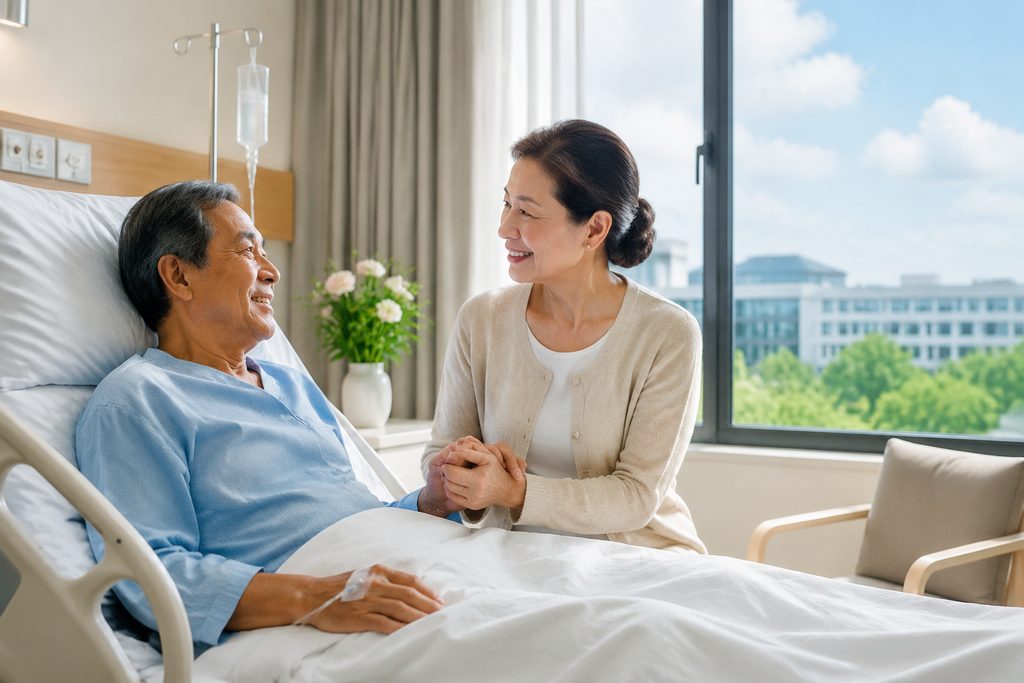
Many of our patients are not first-time visitors to China. They came once — perhaps for a consultation, a preliminary surgery, or an initial round of treatment. Now they are returning. A second stay. And this time, they want a companion again.
That phrase captures something real. A second stay means you already know the hospital, the city, the rhythm of treatment. You know what worked and what did not. You know that having someone fluent in Mandarin and familiar with the hospital’s internal workflows — where to queue, which window handles what, how to read the payment system — transforms the experience from exhausting to manageable.
For returning patients, the logistics are lighter. You know the visa process. You know the neighborhood around the hospital. You may even know your medical team. But you also know that the language barrier does not disappear between visits. The system is still the system. Having a bilingual medical companion again means you focus on treatment, not on figuring out where the pharmacy is or why the CT scanner moved to a different building.
That is the value of a second stay done right. Familiarity plus support. You are not starting from zero. You are continuing.
Practical Considerations: Visas, Payments, and Follow-Up
For medical treatment in China, the correct visa is the S2 visa, annotated for medical purposes. Accompanying family members also apply for S2. If your treatment will exceed 180 days of continuous stay, the S1 visa applies. You will need an invitation letter or supporting documents from the receiving hospital. Consulates may request additional materials depending on your nationality. Processing typically takes 1–2 weeks, so plan accordingly.
Payment is another practical reality. Chinese public hospitals require prepayment. You deposit funds at admission and the hospital draws down against that balance. International departments accept major credit cards and sometimes international wire transfers. Private international hospitals — United Family, Jiahui, Parkway, Raffles — often bill insurance directly. Public hospital international departments generally do not. You pay, then claim reimbursement from your insurer. Confirm your policy’s overseas coverage before committing.
Bring every medical record you have. Imaging on CD or USB. Pathology slides if available. A written summary of prior treatments, dates, dosages, and responses. The more complete your file, the faster the Chinese team can assess your case. Translation is helpful but not required at the international departments — physicians there typically read English. It is the nursing and administrative staff who may not.
After you return home, follow-up matters. Chinese hospitals are generally responsive to remote follow-up requests from international patients. Your treating physician will usually review post-treatment scans sent by email and provide written guidance. Coordinate this before you leave — get direct contact details for your doctor’s team, not just the hospital switchboard.
One more thing worth stating plainly: you can do much of this yourself. The visa form is online. The hospital has an international department with English-speaking staff. The question is not whether it is possible alone. It is whether you want to spend your energy on logistics while managing cancer. That is a personal call, and only you can make it.
Frequently Asked Questions
At top-tier hospitals, the clinical quality is comparable. Fudan-ranked oncology departments and JCI-accredited centers follow NCCN and ESMO guidelines, use the same equipment, and publish outcomes in international journals. The difference is operational: more patients, less hand-holding, more responsibility on the family. Clinical outcomes for common cancers at major centers are statistically in line with Western benchmarks.
A standard chemotherapy cycle in China costs $1,500–$4,000 at international department pricing. The same regimen in the US typically runs $8,000–$20,000 per cycle. The gap narrows for newer immunotherapies and targeted agents, but even those are usually 40–60% cheaper in China due to national drug price negotiations.
This is the question everyone asks, and it deserves a straight answer. Chinese hospitals have complication management protocols, ICU capacity, and emergency response systems. Top centers handle adverse events daily. Your risk is not a lack of medical capability — it is communication during a crisis. That is why having a bilingual companion present matters most when things get difficult, not when they are routine. You should also confirm your insurance covers emergency medical evacuation if you want that safety net.
No. No reputable Chinese public hospital will schedule surgery without a prior outpatient consultation. You either travel for that first visit, or you authorize a proxy consultation where a representative attends with your complete records. After the doctor reviews your case and agrees to treat, surgery can be scheduled. Anyone promising otherwise is not being honest with you.
At international departments of top hospitals, physicians usually speak English. Nurses and administrative staff often do not. You can manage without Mandarin if you are prepared for friction: longer queues, confusing signs, reliance on translation apps. A bilingual medical companion removes that friction. The choice depends on your energy, your budget, and how much support you want.
Your Next Step
The cancer treatment cost in China makes world-class care accessible to patients who would otherwise face financial ruin or unacceptable delays. That is the core message. Our team at China Medical Services helps international patients navigate Chinese healthcare — from hospital matching to appointment coordination to bilingual companionship during treatment. We are not a hospital, we do not diagnose, and we do not promise outcomes. We handle the logistics so you can focus on your health. If you are considering a second stay in China, start with a conversation.
For more medical information and treatment options in China, visit chinamedservices.com (China Medical Services).
