A Smooth Arrival, Handled: Navigating Your Medical Journey to China
Searching for the best hospital for liver transplant in China price often starts with a spreadsheet and ends with a headache. You are not just comparing numbers. You are comparing surgical volumes, immunosuppression protocols, and the terrifying logistics of landing in a foreign country while sick. In 2023, the waiting list for a liver transplant in the United States exceeded 10,000 patients, with median wait times stretching beyond 11 months in some regions. Meanwhile, the cash price for the procedure can exceed $800,000. That gap between need and access is exactly why patients look abroad.
Our team at China Medical Services coordinates medical travel for international patients every week. The clinical question is critical. But the operational question—how do you actually get from the airport to the hospital bed without a breakdown—is where journeys succeed or fail.
Key Takeaways
- China’s top transplant centers perform over 5,000 liver transplants annually, with survival rates comparable to Western benchmarks.
- Total procedure costs at high-volume public hospitals typically range from $50,000 to $120,000, a fraction of US pricing.
- Logistics—visa category, hospital pre-registration, and language—cause more failed trips than clinical complications.
- A structured arrival plan with a bilingual coordinator changes the entire risk profile of the trip.
The Problem: Medical Travel Logistics Break Patients Before Treatment Starts
According to the International Medical Travel Journal, roughly 1 in 4 medical travelers report significant logistical problems that delayed or derailed their treatment. Missed appointments. Wrong visa category. A hospital that cannot locate your records. These are not rare edge cases. They are the default experience for patients navigating a system where they do not speak the language.
Now add liver failure to that picture. Fatigue, ascites, encephalopathy. You are not traveling as a tourist. You are traveling as a patient with reduced mobility, dietary restrictions, and a narrow therapeutic window. Every hour spent lost in a taxi or waiting in the wrong registration line is an hour of clinical risk. The question is not whether you need help. The question is what kind of help actually works.
Why a Structured Arrival in China Delivers Results
China’s medical system is not built for walk-in international patients. Public hospitals operate at enormous scale—Fuwai Hospital performs over 14,000 cardiac surgeries a year, and top-tier general hospitals see 10,000 outpatient visits daily. That volume drives clinical excellence. It also creates chaos for anyone who does not speak Mandarin or understand the registration flow.
Clinical Volume Creates Surgical Competence
A surgeon who performs 200 liver transplants a year sees complications that a surgeon performing 20 a year reads about in journals. That is not a criticism of Western medicine. It is arithmetic. Chinese transplant centers are among the highest-volume in the world. The China Organ Transplantation Development Foundation reports that certified centers perform over 5,000 deceased-donor liver transplants annually. For patients researching the best hospital for liver transplant in China price, volume is a proxy for experience. Experience is a proxy for survival.
Operational Precision Prevents Clinical Deterioration
You can have the best surgeon in the world. If you arrive at the wrong campus, or your records are in a format the hospital cannot read, or your visa category triggers a hold at immigration, the surgery does not happen. A structured arrival plan means your documents are pre-translated. Your hospital card is created before you land. Your first consultation is scheduled for the morning after you arrive. This is not luxury. This is risk management.
Cost Advantage Without Cutting Corners
The cost of a liver transplant in the United States routinely exceeds $500,000. In China, high-volume public hospitals typically quote between $50,000 and $120,000 for the full procedure, depending on case complexity and hospital tier. The gap exists because of labor economics and hospital efficiency, not because of inferior equipment or training. Many Chinese transplant centers use the same immunosuppression protocols and surgical techniques published in international journals.
How Does Medical Visa for China Work for Patients: A Step-by-Step Timeline
This is the section where most articles get it wrong. There is no “medical visa” in China. The correct category for short-term medical treatment is the S2 visa, issued for private affairs including medical treatment. Accompanying family members also apply for S2. If your treatment requires a stay longer than 180 days, you apply for S1. The M visa is for commercial trade. Using the wrong category can result in denial at the airport.
The timeline matters more than the category. Here is what a realistic 6-week preparation window looks like:
- Week 1: Submit medical records for remote review. A written second opinion from a top specialist costs $300–500 and confirms whether your case is appropriate for treatment in China.
- Week 2: Hospital confirms acceptance and issues an official invitation letter. This document is required for the S2 visa application.
- Week 3: Submit visa application to the Chinese embassy or consulate. Processing typically takes 4–7 business days, but delays happen.
- Week 4: Book flights and accommodation. Arrange airport pickup if mobility is limited.
- Week 5: Pre-admission bloodwork and imaging, either locally or upon arrival.
- Week 6: Fly to China. First in-person consultation within 24–48 hours of landing.
This timeline assumes everything goes right. It often does not. That is why patients ask can I bring a companion for surgery in China—and the answer is yes, and you should.
Can I Bring a Companion for Surgery in China: The Reality of Solo Medical Travel
A companion changes everything. Not just emotionally. Practically. After a liver transplant, you will spend 2–4 weeks in the hospital, then another 2–4 weeks in a nearby apartment for follow-up monitoring. You will not be able to cook, shop, or navigate public transit. You will need someone to speak to nurses, manage medications, and advocate for you when you are too weak to advocate for yourself.
Family members apply for the same S2 visa category. The hospital will not provide a caregiver. A bilingual medical companion from our team costs from $300 per day and handles registration, translation, and daily logistics. A family member handles emotional support. Ideally, you bring both.
Cost of Heart Valve Replacement in Beijing Hospital: A Reference Point for Surgical Pricing
Liver transplant pricing is difficult to compare because case complexity varies so widely. Heart valve replacement offers a cleaner benchmark. In Beijing, a minimally invasive aortic valve replacement at a top-tier public hospital typically ranges from $20,000 to $35,000. The same procedure in the United States averages $150,000 to $200,000. That is a 5-to-1 gap.
The table below shows how pricing breaks down across three common procedures, using public hospital international department rates. These are reference points, not quotes. Final pricing always depends on the specific hospital, the surgeon’s assessment, and the patient’s condition.
| Procedure | China (USD) | United States (USD) | Multiple |
|---|---|---|---|
| Liver transplant | $50,000 – $120,000 | $500,000 – $800,000 | 5–10x |
| Heart valve replacement | $20,000 – $35,000 | $150,000 – $200,000 | 5–7x |
| Total knee replacement | $8,000 – $15,000 | $35,000 – $50,000 | 3–4x |
These numbers are not secret. They are published in academic literature and medical tourism reports. What is harder to find is the truth about what happens when you arrive. That is where the real cost—and the real risk—lives.
All Inclusive Cancer Treatment Package Shanghai: What “All-Inclusive” Actually Means
Patients searching for an all inclusive cancer treatment package Shanghai often imagine a flat fee that covers everything from chemotherapy to hotel to meals. That model exists, but it is rare in China’s public system. What actually happens is more modular.
A typical cancer treatment coordination in Shanghai includes hospital registration, scheduling of consultations and imaging, interpretation during appointments, and assistance with pharmacy and payment. The coordination fee starts at $300 for basic appointment arrangement. A full VIP end-to-end coordination package ranges from $5,000 to $8,000. Treatment costs—chemotherapy, surgery, radiation—are billed separately by the hospital. No legitimate service bundles clinical treatment into a flat package price, because clinical costs depend entirely on the patient’s stage, regimen, and response.
Be wary of any provider that promises a single price for “cancer treatment.” That is a red flag, not a convenience.
Book Orthopedic Surgery China with Airport Pickup: The Mechanics of a Smooth Landing
Orthopedic patients are different from transplant patients. They are often mobile. They travel with family. They are planning surgery, not emergency intervention. But the arrival logistics are similar. You land at Shanghai Pudong or Beijing Capital, exhausted from a 12-hour flight, and you need to get to a hospital campus that may be 40 kilometers from the airport.
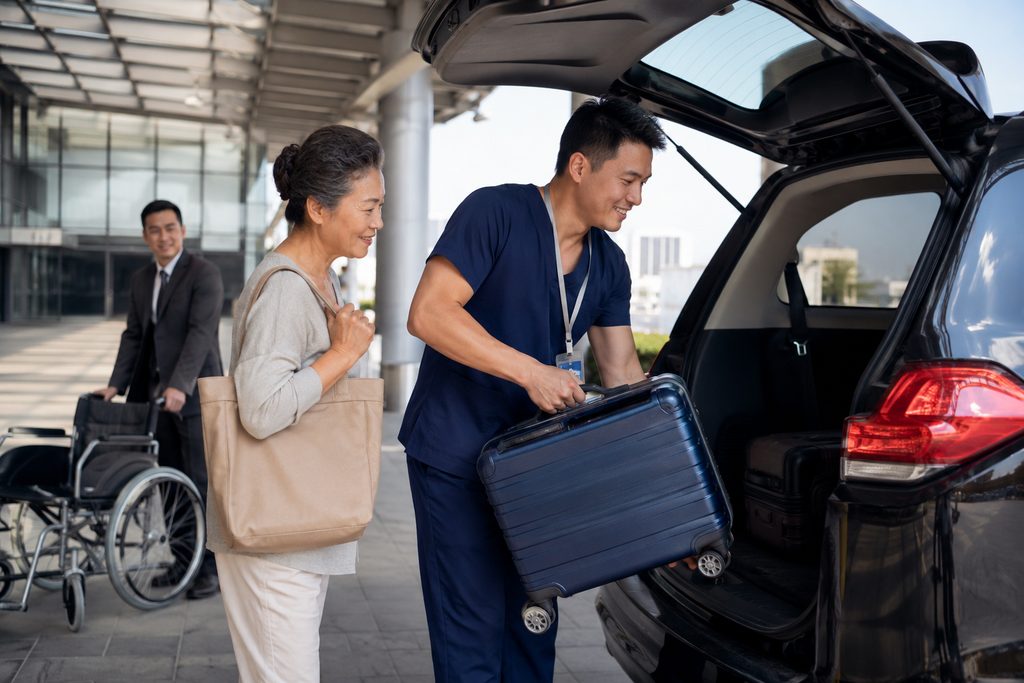
Airport pickup is not a luxury. It is $200 round-trip and it removes the single most common point of failure in the entire journey. The driver knows the hospital entrance. The coordinator knows which building to go to. The patient does not have to navigate a foreign metro system with a knee that needs replacing.
Patients who want to book orthopedic surgery China with airport pickup are not asking for a chauffeur. They are asking for certainty. The pickup is the first test of whether the entire coordination system works. If the car is not there, what else was not handled?
Practical Considerations: Documents, Payments, and the Unspoken Rules
Here is what actually matters on the ground.
Medical records. Hospitals in China require translated copies of all relevant records—imaging, pathology reports, surgical history. Translation must be done by a certified medical translator, not Google Translate. A poorly translated report can lead to a wrong diagnosis or a delayed procedure.
Payment methods. Public hospitals require pre-payment. Cash deposits are often required at admission, with additional payments as treatment progresses. International credit cards are not universally accepted. Many patients transfer funds in advance or carry UnionPay cards. Private international hospitals like United Family and Jiahui accept direct insurance billing, but their prices are higher.
Insurance. Most international insurance plans do not cover treatment in Chinese public hospitals. You pay out of pocket and seek reimbursement afterward. Get written confirmation from your insurer before you travel. Do not assume.
Language. Even at top hospitals, English proficiency among nurses and administrative staff is limited. Doctors may speak English. The people who draw your blood and schedule your CT scan often do not. A bilingual companion is not a convenience. It is a safety measure.
Follow-up. After you return home, your Chinese medical team will expect follow-up communication. This usually happens through the international department or your coordinator. Establish this channel before you leave.
Frequently Asked Questions
Check whether the hospital is on the official list of certified transplant centers published by China’s National Health Commission. Cross-reference with the Fudan University hospital rankings, which evaluate clinical reputation and research output. Our database covers 340+ top-ranked hospitals across 37 cities, including transplant centers with documented volumes.
This is why remote evaluation matters. Before you book a flight, submit your records for a written second opinion. A specialist reviews your case and confirms whether treatment is appropriate. If the answer is no, you have spent $300–500 instead of $10,000 on flights and hotels. If the answer is yes, you have a documented basis for admission.
At public hospitals, almost certainly not. You will need to pay out of pocket and file for reimbursement. At private international hospitals like United Family, direct billing is more common. Check with your insurer before you commit to a hospital.
Plan for at least 8–12 weeks. That includes 2–4 weeks in the hospital, followed by 4–8 weeks of outpatient monitoring. Your transplant team will want to see you regularly during the highest-risk rejection window. Leaving early is dangerous.
Your Next Step
You came here searching for the best hospital for liver transplant in China price. What you actually need is a plan that survives contact with reality. We are not a hospital. We do not diagnose or treat. We coordinate the logistics—hospital matching, document translation, visa guidance, bilingual companionship—so that your clinical team can focus on medicine. If you are considering treatment in China, start with a conversation. Tell us your diagnosis, your records, and your timeline. We will tell you what is realistic, what it costs, and whether this path makes sense for you. That conversation costs nothing.
Start with a free consultation at our patient coordination page.
For more medical information and treatment options in China, visit chinamedservices.com (China Medical Services).
