Top Heart Valve Surgery Hospital: Zhongshan Hospital Fudan University
Key Takeaways
- Zhongshan Hospital Fudan University in Shanghai performs over 2,000 heart valve procedures annually, ranking it among China’s highest-volume cardiac surgery centers.
- Heart valve replacement cost China typically ranges from $25,000 to $45,000 at top public hospitals — roughly one-fifth to one-third of the $150,000+ charged by major US centers.
- The main trade-off is logistics: public hospital outpatient clinics cannot be pre-booked from overseas, so international patients must use the hospital’s international department or a coordination service.
- Recovery after valve replacement follows a predictable timeline — 7–10 days in hospital, 4–6 weeks before most daily activities resume, and 3 months before full cardiac rehabilitation completion.
The Problem: Waiting Lists and Six-Figure Bills at Home
You have probably been told that flying to another country for open-heart surgery is a reckless gamble. The reality is more complicated — and for many patients, far more favorable. Heart valve disease affects approximately 2.5% of adults over 65 in the United States, and that number climbs steeply with age. When aortic stenosis becomes severe, the average survival without intervention is under 3 years.
So patients face a brutal equation. In Canada, the median wait time for elective valve replacement surgery is 13 weeks from specialist referral to operating table, according to the Fraser Institute’s 2023 report. In the UK, NHS data shows over 30% of cardiac surgery patients wait longer than the 18-week target. In the United States, the problem is not time — it is money. The average total cost for a surgical aortic valve replacement at a US hospital runs between $150,000 and $200,000. Even with insurance, out-of-pocket maximums, deductibles, and non-covered charges routinely leave patients owing $10,000 to $30,000.
Meanwhile, the disease does not pause. Every month of delay means a measurable decline in left ventricular function and a higher risk of permanent heart damage. This is the gap that has pushed thousands of patients to research alternatives they would never have considered a decade ago.
Why Zhongshan Hospital Fudan University Delivers Results
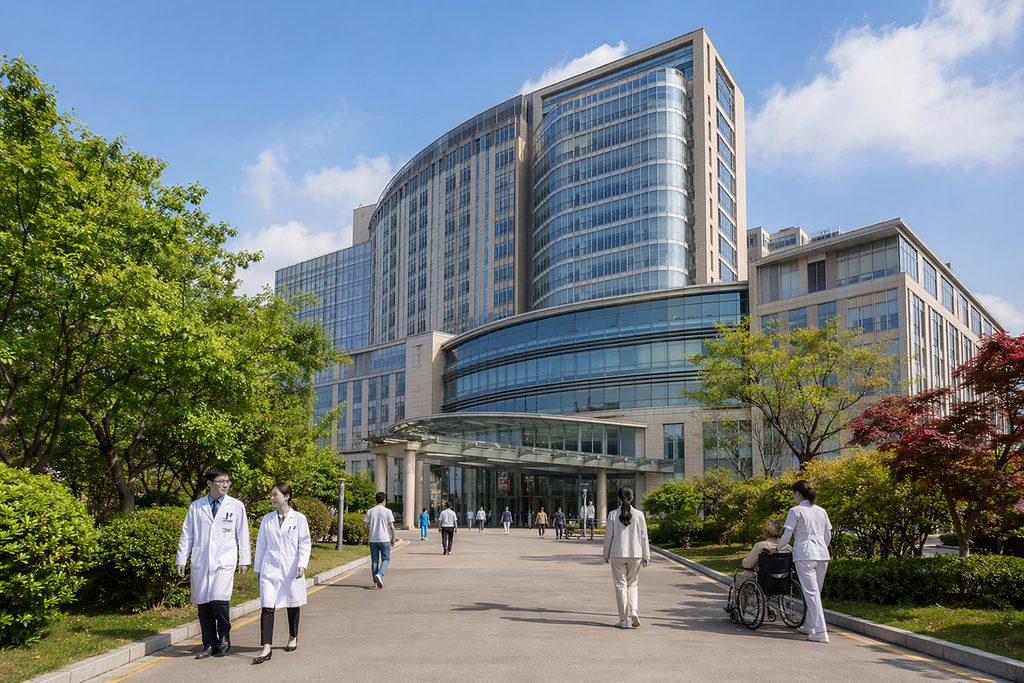
Zhongshan Hospital sits in central Shanghai, affiliated with Fudan University. It is not a boutique clinic. It is a 2,000-bed academic medical center with a cardiac surgery department that has been operating for over 70 years. The hospital is consistently ranked among China’s top 5 for cardiac surgery in the Fudan University Hospital Rankings — the country’s most authoritative independent hospital evaluation.
Clinical Volume Drives Better Outcomes
What does volume mean for a valve patient? In cardiac surgery, the relationship between hospital procedure volume and mortality is one of the most replicated findings in the medical literature. A 2017 study in the New England Journal of Medicine found that patients undergoing aortic valve replacement at low-volume US hospitals had a 30-day mortality rate nearly 50% higher than those at high-volume centers.
Zhongshan’s cardiac surgery team completes over 2,000 valve procedures each year. By comparison, the average US cardiac surgery program performs roughly 100–200 valve operations annually. The surgeons here have seen every anatomical variation, every complication, every edge case. That repetition is not just a number — it is the difference between a surgeon who has done this 50 times and one who has done it 5,000 times.
Technology and Efficiency at Scale
What makes a Chinese top-tier hospital structurally different from a Western one is the concentration of resources. Zhongshan operates 10 dedicated cardiac operating rooms. Pre-operative workup — echocardiography, coronary angiography, CT, and lab panels — can be completed in 2–3 days, not 2–3 weeks. The hospital adopted minimally invasive valve techniques, including mini-thoracotomy approaches and transcatheter aortic valve replacement (TAVR), as standard options where clinically appropriate.
This is not a claim about futuristic technology. It is about operational design. When a hospital treats cardiac surgery as its core mission rather than one of forty service lines, everything from ICU bed allocation to rehabilitation scheduling moves faster.
Heart Valve Replacement Cost China: Why Lower Price Does Not Mean Lower Quality
The most common question we hear is blunt: “How can it cost so much less? What is being cut?” The answer is structural, not clinical. Chinese public hospitals do not carry the administrative overhead of US insurance billing systems, which consume an estimated 15–25% of US hospital revenue. Malpractice insurance costs are a fraction of US levels. Physician salaries, while rising, remain far below US equivalents. And the sheer patient volume means fixed costs are spread across many more procedures.
None of these factors touch the quality of the valve itself. Zhongshan uses the same mechanical and bioprosthetic valves — Edwards Lifesciences, Medtronic, St. Jude Medical — that you would receive in Boston or London. The difference is the price tag attached to the room, the staff, and the system around the surgery, not the surgery itself.
Zhongshan Hospital Heart Valve Surgery Price: A Realistic Breakdown
Let us put concrete numbers on the table. The figures below reflect typical charges for international patients at top-tier Chinese public hospitals, including the international department pathway. They are ranges, not quotes — final pricing depends on valve type (mechanical vs. bioprosthetic), surgical approach (open vs. minimally invasive vs. TAVR), and case complexity.
| Procedure Component | Zhongshan Hospital (International Dept.) | Average US Hospital |
|---|---|---|
| Pre-operative workup (echo, cath, labs, imaging) | $1,500 – $3,000 | $8,000 – $15,000 |
| Surgical valve replacement (aortic or mitral) | $25,000 – $45,000 | $150,000 – $200,000 |
| Hospital stay (7–10 days, incl. ICU) | Included in surgical fee | $30,000 – $60,000 |
| Valve prosthesis (mechanical or tissue) | $3,000 – $8,000 | $10,000 – $25,000 |
| Total estimated range | $30,000 – $55,000 | $180,000 – $260,000 |
Even accounting for international flights, accommodation, and a companion’s travel, the total out-of-pocket figure for a patient paying cash at Zhongshan typically lands between $35,000 and $60,000. That is a fraction of the US self-pay price — and often competitive with US insurance deductibles and co-insurance when you factor in the full episode cost.
Is Heart Valve Surgery Safe in China? What the Data Shows
Safety is the question that keeps people awake at night. And the honest answer is that safety varies enormously by hospital. A random provincial hospital in a third-tier city is not the same as a Fudan-ranked academic center in Shanghai. The key distinction is where you go, not which country you are in.
At China’s top cardiac centers, published outcomes are comparable to international benchmarks. A 2021 study in the Journal of Thoracic Disease analyzing over 4,000 valve replacement cases at a major Chinese cardiac center reported a 30-day mortality rate of 1.8% for isolated aortic valve replacement — in line with the 1.5–2.5% range reported by the Society of Thoracic Surgeons for US centers. Zhongshan’s own published series show similar figures.
What does this mean for you? It means that if you select a hospital with a documented high-volume cardiac surgery program, a dedicated cardiac ICU, and experience treating international patients, the clinical risk profile is not meaningfully different from what you would face at a good US or European center. The risk is in choosing poorly, not in choosing China.
How Long Is Recovery After Heart Valve Replacement China?
Recovery after valve surgery follows a biological timeline that does not change much based on geography. What changes is how the system supports you through it.
The first 24–48 hours are spent in the cardiac ICU, where you will be extubated as soon as your breathing is stable — typically within 6–12 hours after surgery. By day 3 or 4, most patients are walking short distances with assistance. Discharge from Zhongshan usually happens between day 7 and day 10, assuming no complications.
Once home — or back in your home country — the real work begins. Weeks 1–2: restricted activity, walking as tolerated, no lifting over 5 kg. Weeks 3–6: gradual return to light daily activities, driving usually permitted after 4 weeks if sternal healing is on track. Month 3: most patients are cleared for normal activity, including work and moderate exercise. Full cardiac rehabilitation, including structured exercise programs, continues through month 6.
The critical variable is anticoagulation management if you receive a mechanical valve. You will need INR monitoring weekly at first, then monthly. This is the same protocol worldwide — the difference is that in China, you will have completed the initial stabilization phase before you leave, with a clear medication plan and a summary letter for your home cardiologist.
Book Heart Valve Surgery Zhongshan Hospital International Patient: The Real Process
Here is the part most articles gloss over: you cannot simply email the hospital and reserve a surgery date. Chinese public hospitals operate on a system that assumes local patients will show up in person. For international patients, the pathway is different.
The standard route for foreigners is through the hospital’s international medical department or VIP clinic. This is not a luxury add-on — it is the structural mechanism that allows pre-arranged appointments, English-speaking coordination, and scheduled admission. The process typically works like this:
First, you submit your complete medical records: echocardiogram reports, coronary angiogram images, recent labs, and a summary letter from your current cardiologist. These are reviewed by the cardiac surgery team, who will confirm whether you are a surgical candidate and what approach they recommend. This review step is essential — it prevents you from flying to Shanghai only to discover that your case requires a different procedure than you expected.
Second, once the team accepts your case, a treatment plan and cost estimate are issued. You will be asked to pay a deposit — typically 30–50% of the estimated total — before a surgery date is confirmed. Public hospitals in China require pre-payment; this is standard practice and not a red flag.
Third, you apply for an S2 visa with a letter from the hospital confirming your treatment arrangement. The S2 is the correct visa category for short-term medical treatment in China, not the M visa, which is strictly for commercial activity. Your accompanying family member applies for the same S2 category.
Finally, you arrive, complete your pre-operative workup (usually 2–3 days), undergo surgery, and recover in the hospital for 7–10 days before being discharged to a nearby hotel or serviced apartment for continued monitoring before flying home.
Can you do this alone? Technically, yes. Practically, the language barrier, hospital navigation, and documentation requirements make it extremely difficult without Chinese-language capability. This is why many patients work with a coordination service — not to gain special access, but to handle the translation, paperwork, and logistics that would otherwise consume weeks of your time and create real risk of miscommunication.
Practical Considerations: Documentation, Visas, and Payment
Before you book anything, get your paperwork in order. You will need your complete cardiac imaging on CD or via secure file transfer — not just the written reports. Chinese cardiac surgeons will want to review the actual echocardiogram loops and angiogram images themselves. Request these from your home hospital before you leave.
For the visa, the S2 category is what applies to medical treatment stays under 180 days. The hospital’s international department will issue an invitation letter and treatment confirmation, which you submit with your application to the Chinese embassy or consulate in your home country. Processing time is typically 5–10 business days, but apply at least 3–4 weeks ahead to allow for complications.
Payment is another practical hurdle. Chinese public hospitals require payment in Chinese yuan, typically via international bank transfer, UnionPay card, or in some cases major credit cards with high foreign transaction limits. Wire transfers can take 3–5 business days to clear, so the deposit must be sent well before your arrival date. Insurance reimbursement is your responsibility — most Chinese public hospitals will provide itemized invoices and medical records in English upon request, but they will not bill your insurer directly.
After discharge, plan to stay in Shanghai for at least one additional week. Your surgeon will want to see you for a wound check and early post-operative echo before you fly. Long-haul flights immediately after cardiac surgery carry a small but real risk of deep vein thrombosis, so most surgeons recommend waiting 10–14 days after surgery before flying.
Frequently Asked Questions
At the level of top Chinese academic centers, yes. Zhongshan’s cardiac surgery volume exceeds nearly all Western programs, and published outcome data for valve replacement falls within international norms. The valve prostheses used are the same brands implanted in US and European hospitals. The key is choosing a high-volume, Fudan-ranked center — not assuming all Chinese hospitals are equivalent.
Expect a total range of $30,000 to $55,000 for the complete episode at a top public hospital’s international department, including pre-operative workup, surgery, valve prosthesis, and hospital stay. This compares to $180,000–$260,000 at a typical US hospital. Final pricing varies by valve type, surgical approach, and case complexity.
Zhongshan has a dedicated cardiac ICU with 24/7 intensivist coverage and the full range of rescue capabilities — ECMO, intra-aortic balloon pump, and emergency re-operation capacity. Complication rates for valve surgery at this center are published and within accepted international ranges. You should still understand that no surgery is risk-free, and you should discuss your individual risk profile with the surgical team during the remote evaluation.
You can contact the hospital’s international department directly, but be prepared for significant language and process barriers. The department’s English capability varies, and the documentation requirements are strict. Many patients find that a bilingual coordinator saves weeks of back-and-forth and reduces the risk of critical miscommunication about medical history or surgical planning.
Your Next Step
If you are weighing heart valve surgery options and want to understand whether Zhongshan Hospital is a realistic fit for your case, start with a remote evaluation. Our team at China Medical Services helps international patients navigate hospital selection, record translation, and treatment coordination across China’s top-ranked cardiac centers. We are not a hospital and do not provide medical advice or diagnoses — we connect you with the specialists who do. Request a free consultation and we will help you map out the path forward, one step at a time.
For more medical information and treatment options in China, visit chinamedservices.com (China Medical Services).
