Medical Interpretation in Action: What Foreign Patients Actually Experience in Chinese Hospitals
While a patient in the United States might spend $120,000 and wait weeks for cardiac bypass surgery, the same procedure at Fuwai Hospital in Beijing — which performs over 14,000 cardiac surgeries annually, the highest volume of any heart center on earth — typically costs between $12,000 and $20,000. The clinical outcomes are comparable. The bottleneck is not the surgery. It is the language. Every form, every nurse’s instruction, every consent discussion happens in Mandarin. This is where medical interpreter services for foreign patients in China stop being a convenience and become the difference between a successful treatment journey and a failed one.
How This Actually Works, Step by Step
You do not simply land in Shanghai and walk into a hospital. The sequence matters. Here is the real flow, based on what our coordination team handles every week.
First, you send us your existing medical records — imaging reports, lab results, discharge summaries, pathology slides if relevant. These get translated into Simplified Chinese by medical translators, not general linguists. A cardiology report mistranslated as “chest pain” versus “angina pectoris” changes how a Chinese specialist triages you. Translation typically takes 3 to 5 business days depending on volume.
Next, the translated records go to the international department of your target hospital. A specialist reviews them and decides whether your case is appropriate for remote consultation or requires an in-person visit. This review takes anywhere from 2 days to 2 weeks. Public hospital international departments are busy. There is no way around this wait.
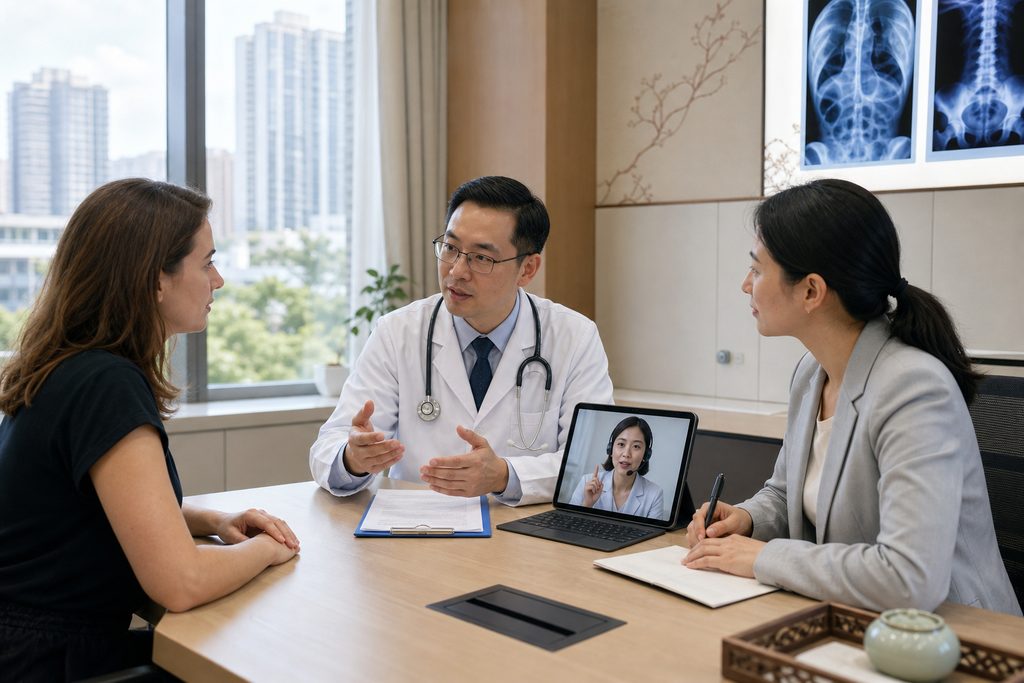
Then comes the consultation itself — either video or written. You speak with the specialist through a bilingual medical interpreter. You ask your questions. You hear the proposed treatment plan, the expected hospital stay, the risks. If you agree to proceed, the hospital issues a treatment plan document and a cost estimate.
Only after that do you apply for your S2 visa, which is the correct category for short-term medical treatment in China. Your accompanying family member applies for the same S2 visa. Processing time varies by embassy, but budget 1 to 4 weeks.
When you arrive, a bilingual medical companion meets you at the airport, takes you to your accommodation, and on treatment day, walks you through registration, payment, pre-operative testing, and admission. Without this person, you are navigating a hospital that may see 10,000 outpatient visits in a single day, entirely in Chinese.
Medical Interpretation in Action: What Actually Happens at Each Touchpoint
Independent medical interpreters in Shanghai typically charge $50 to $100 per hour. Coordinated bilingual companion services start from $300 per day for a full 8-hour hospital day. Hospital-provided interpretation through an international department may be included in your consultation fee or billed separately, depending on the institution.
For reading a menu or asking for directions, yes. For medical consultations, informed consent, and discharge instructions, no. Translation apps do not handle medical terminology reliably, do not understand context, and cannot advocate for you when a doctor is rushing through rounds. The cost of a mistranslation in a medical setting is too high to risk.
During the actual surgical procedure, no interpreter is present in the operating room regardless of who hired them. For pre-operative consent, post-operative recovery, and inpatient ward rounds, policies vary. Some hospitals require their own staff for consent discussions. Ask the hospital’s international department directly before you travel.
Chinese hospital emergency departments operate 24/7, but they are crowded and primarily Mandarin-speaking. If you have a medical emergency, go to the nearest hospital emergency department immediately — do not wait for an interpreter. Your bilingual companion can meet you there and help with registration and communication once you are stable. For non-emergency urgent issues, contact your coordinator first.
Your Next Step
Medical interpretation in action is not a translation service bolted onto a hospital visit. It is the connective tissue that holds the entire treatment journey together — from the first translated record to the final discharge summary. At China Medical Services, we coordinate bilingual medical companions, hospital appointments, and the logistics in between. We do not practice medicine, and we do not promise outcomes. What we do is make sure you understand every word, every form, and every decision along the way. If you are considering treatment in China, start with a conversation. Tell us your situation. We will tell you honestly what is feasible, what it costs, and what the path looks like. Request a free consultation and we will map out your options together.
Language should never be the reason you cannot access the care you need. With the right interpreter at your side, it will not be.
Frequently Asked Questions
Yes. The hospitals used for international patients are JCI-accredited and follow the same international safety standards as top hospitals in the US and Europe. Surgical teams perform high volumes of procedures — often more than their Western counterparts — which studies show leads to better outcomes.
Costs vary by procedure and hospital, but international patients typically save 40-80% compared to US prices — even when factoring in travel and accommodation. A consultation with our team will give you an exact, all-inclusive quote with no hidden fees.
Send us your existing medical reports to get started. We handle everything from hospital selection and appointment scheduling to visa assistance and post-operative recovery planning. Your medical records are reviewed by the specialist before you even book a flight.
For more medical information and treatment options in China, visit chinamedservices.com (China Medical Services).
