Airport Transfer in China: Understanding the Fare for Medical Travelers
Key Takeaways
- A private airport transfer from Beijing Capital Airport to a downtown hospital typically costs $60–120, while a public taxi runs $25–45.
- Shanghai Pudong Airport to JCI-accredited hospitals like Jiahui or United Family costs $50–90 by private car, $20–35 by metered taxi.
- Language barriers and post-flight fatigue make pre-booked transfers the safest choice for international patients, not a luxury.
- No Chinese medical visa category includes airport transfer. The S2 visa covers your treatment stay; ground transport is always a separate arrangement.
The Problem: Landing in a Foreign Country Already Exhausted
You have just stepped off a 12-hour flight. Your body aches. You are carrying medical documents, maybe a cane or a wheelchair. And now you need to navigate a sprawling Chinese airport, find a taxi queue, show a driver an address in a language you cannot read, and hope the fare is not inflated because you look lost. This is the reality for thousands of international patients arriving in China every year.
Beijing Capital International Airport handled over 100 million passengers in 2019. Shanghai Pudong handled 76 million. For a first-time visitor, both airports are overwhelming. The signage is bilingual, but the taxi system is not designed for someone who cannot speak Mandarin. Drivers rarely speak English. Metered fares are fair, but only if you know the route and can communicate your destination precisely.
What happens if nothing changes? You might stand in the wrong queue for 40 minutes. You might get into an unlicensed car. You might pay triple the real fare. None of this is catastrophic. But when you are traveling for surgery, a cardiac evaluation, or cancer treatment, the last thing you need is a stressful arrival.
Why a Pre-Arranged Airport Transfer Changes Everything
The airport transfer hospital China price question is not just about money. It is about control. When you book a transfer in advance, you lock in the fare, the vehicle type, and the meeting point. You remove the three biggest variables: language, route uncertainty, and post-flight decision fatigue.
A Fixed Fare Removes the Haggling Variable
Metered taxis in Beijing and Shanghai are regulated and generally honest. But the meter does not help you if the driver takes a longer route because he misunderstood your destination. A pre-booked transfer quotes a fixed price before you land. That price does not change based on traffic, route, or the driver’s mood. For a patient arriving for a hospital appointment, that predictability is valuable.
Our team recently coordinated a transfer for a patient flying into Beijing Capital Airport bound for Peking Union Medical College Hospital. The quoted private car fare was $65, fixed. The same trip by metered taxi would have cost roughly $30–40, but the patient would have needed to find the official taxi stand, show a printed address, and manage the payment himself after a 14-hour flight from Frankfurt. He chose the car. Most patients do.
Meet-and-Greet Removes the Language Barrier
A standard airport pickup for patients in China costs more than a taxi because it includes a person, not just a vehicle. That person waits in the arrivals hall with a sign bearing your name. They help with luggage. They know which exit leads to the correct pickup zone. And they speak enough English to confirm the hospital name and address with the driver.
This is not a concierge frill. It is a functional service for someone who cannot read Chinese characters on a hospital admission form. The driver gets clear instructions. You get a quiet ride. The hospital gets a patient who arrives calm instead of frazzled.
Vehicle Type Matters for Medical Travelers
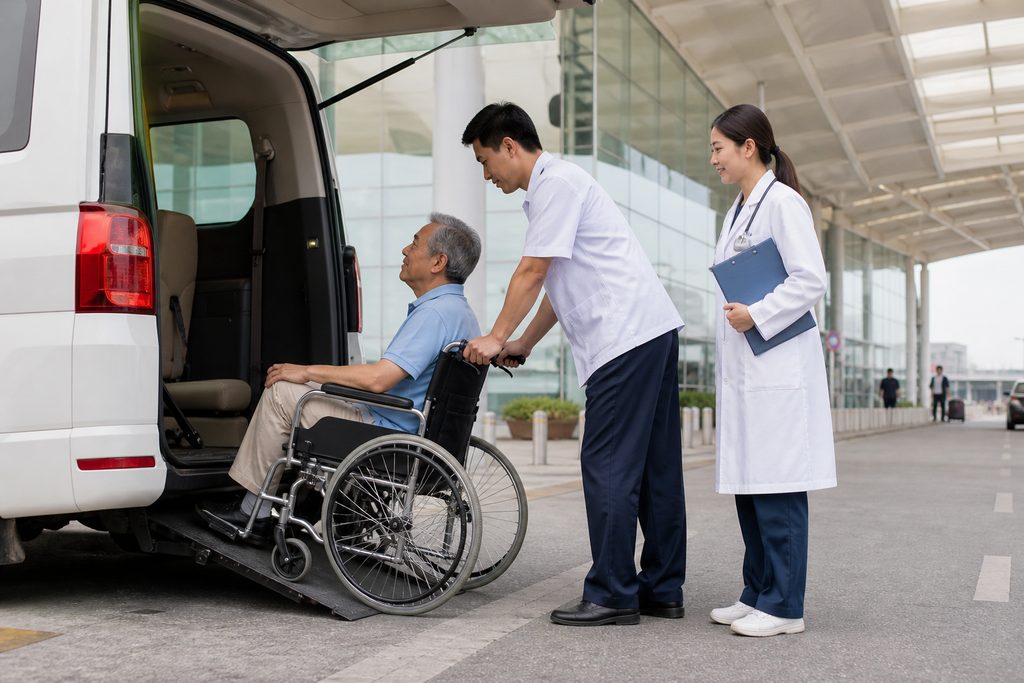
A standard sedan works for most patients. But if you are traveling with a wheelchair, a walker, or large medical equipment, you need a van or an SUV. Pre-booking lets you specify this. A metered taxi queue does not. You take what comes, and if your wheelchair does not fit in the trunk, you wait for the next one.
Some private transfer services in Shanghai and Beijing offer vehicles with higher roofs, rear-door ramps, or extra cargo space. These cost more — typically $90–150 for an airport-to-hospital run — but they solve a real problem. The best way to get from airport to JCI hospital Shanghai when you have mobility equipment is not a standard taxi. It is a pre-arranged van with a driver who knows the hospital’s drop-off point.
Airport Transfer Fares: A Realistic Breakdown by City
The airport transfer hospital China price varies by city, airport, distance, and vehicle type. Here is what you should expect to pay for the most common medical travel routes.
| Route | Distance | Metered Taxi (USD) | Pre-Booked Private Car (USD) | Meet-and-Greet Service (USD) |
|---|---|---|---|---|
| Beijing Capital Airport → Peking Union Medical College Hospital | ~28 km | $25–35 | $55–75 | $70–100 |
| Beijing Capital Airport → United Family Hospital (Lido) | ~18 km | $20–28 | $45–60 | $60–85 |
| Shanghai Pudong Airport → Jiahui International Hospital | ~45 km | $30–45 | $60–85 | $80–110 |
| Shanghai Pudong Airport → Ruijin Hospital | ~48 km | $32–48 | $65–90 | $85–120 |
| Shanghai Hongqiao Airport → Zhongshan Hospital Fudan University | ~15 km | $15–22 | $35–50 | $50–70 |
| Guangzhou Baiyun Airport → Sun Yat-sen University Cancer Center | ~35 km | $25–35 | $50–70 | $65–90 |
These ranges reflect 2024–2025 market rates. They vary by time of day, fuel prices, and the specific transfer company. The round-trip airport transfer price on our platform is $200, which covers both pickup and drop-off and includes meet-and-greet at the arrivals gate. That is not the cheapest option. It is the option that removes the most variables.
How Much Is a Taxi from Beijing Airport to Hospital? The Honest Answer
A metered taxi from Beijing Capital Airport to a downtown hospital costs between $25 and $45, depending on traffic and the exact hospital location. The meter is government-regulated. The driver must use it. If a driver refuses the meter and quotes a flat price, walk away and find the official taxi stand.
But here is what the fare does not include. It does not include help with luggage. It does not include a driver who speaks English. It does not include a guarantee that the driver knows which entrance of a massive hospital campus to use. Peking Union Medical College Hospital has multiple gates. So does Ruijin Hospital in Shanghai. Getting dropped at the wrong gate can mean a 15-minute walk with your bags.
For a healthy tourist, a metered taxi is fine. For a patient arriving for a medical procedure, the calculus changes. The $20–30 you save is often not worth the stress and uncertainty.
Private Car Service Shanghai Medical Tourism: What You Are Actually Paying For
Private car services in Shanghai charge more than taxis because they sell a different product. A private car service Shanghai medical tourism booking typically includes a licensed driver, a clean late-model vehicle, a fixed fare agreed in advance, and a phone number you can call if your flight is delayed. Some services include 60–90 minutes of free waiting time after your flight lands.
The driver meets you at a designated point — usually the arrivals exit or a specific pillar number in the terminal. You do not queue. You do not negotiate. You do not worry about whether the driver understands “Jiahui Hospital, Xuhui District.”
That last point matters more than most travelers realize. Shanghai has multiple hospitals with similar English names. Jiahui has several campuses. United Family has more than one location. A driver who mishears “Ruijin” as “Renji” takes you to the wrong hospital entirely. Both are prestigious. They are not interchangeable.
Does the Medical Visa China Airport Transfer Include Ground Transport?
No. This is a common misunderstanding. The S2 visa — the short-stay visa used by foreigners traveling to China for medical treatment — covers your legal right to enter and stay in the country for the purpose of receiving care. It does not include airport pickup, hospital transfers, or any other ground service. The visa fee goes to the Chinese consulate. Your transport costs are paid separately, out of pocket, to the driver or transfer company.
Some hospitals with international departments offer complimentary airport pickup for high-value patients or those booking through their VIP channels. But this is not a visa benefit. It is a hospital marketing decision, and it is rare. Most patients arrange their own transport or ask a service provider like China Medical Services to coordinate it alongside their hospital appointment.
How to Book an Airport Pickup for Patients in China Without Getting Burned
The airport pickup for patients in China cost is only one part of the equation. The other part is reliability. Here is how to evaluate any transfer service before you pay.
First, confirm the meeting protocol. A legitimate service will tell you exactly where to go after you clear customs — “Exit B, pillar 12” or “the Starbucks near Gate 3.” Vague instructions like “the driver will find you” are a red flag. Drivers cannot enter the secure arrivals area. You must walk to them.
Second, ask about flight tracking. Good services monitor your flight number and adjust pickup time if you land early or late. Bad services show up at the scheduled time and leave if you are not there. Confirm the waiting policy in writing before you pay.
Third, clarify the vehicle. If you need space for a wheelchair or medical equipment, say so explicitly. A standard sedan will not fit a folded wheelchair plus two large suitcases plus a carry-on. You need a van or an SUV. The price difference is usually $20–40. It is worth it.
Fourth, pay attention to the payment method. Most pre-booked transfers accept credit card or PayPal. Some drivers only take cash in RMB. Confirm this in advance so you are not stranded at the hospital drop-off point without yuan.
Practical tip: Screenshot your driver’s phone number and the hospital address in Chinese characters before you leave the airport Wi-Fi zone. If you get separated, you can show the screenshot to any airport staff member and they will help you.
Practical Considerations: Payment, Timing, and What to Bring
Airport transfers in China are straightforward once you understand the mechanics. Here is what actually matters on the day of arrival.
Payment: Most international patients pay for pre-booked transfers by card before they fly. If you choose a metered taxi instead, you need cash in RMB. Taxis in Beijing and Shanghai do not reliably accept foreign credit cards. ATMs are available in the arrivals hall, but withdrawal limits apply — typically 3,000–5,000 RMB per transaction for foreign cards. A taxi to a downtown hospital costs 150–300 RMB. You will have enough.
Timing: From the moment your plane touches down to the moment you exit customs takes 45–90 minutes at Beijing Capital and 60–120 minutes at Shanghai Pudong, depending on the immigration queue. A good transfer service builds this buffer into their pickup time. If you book a driver for 10:00 AM and your flight lands at 9:30 AM, you will be rushing.
Documentation: Bring a printed copy of your hospital appointment letter and the hospital’s Chinese address. Even if you have a meet-and-greet service, having these on paper helps if there is any confusion. The driver may need to show the address at a hospital gate security checkpoint.
Language: Assume the driver speaks no English. Even with a pre-booked service, the driver’s job is to drive, not to translate. If you need interpretation during the ride — for example, to call the hospital and confirm your admission time — arrange that separately. A bilingual medical companion can ride with you, but that is a different service from a basic airport transfer.
Frequently Asked Questions
Yes, official metered taxis from designated airport stands are safe and regulated. The risk is not safety but communication. If you cannot speak Mandarin and do not have the hospital address in Chinese characters, you may struggle to communicate your destination. For patients arriving for medical care, a pre-booked transfer removes that risk.
Because you are paying for more than the ride. A private transfer includes a fixed fare agreed in advance, a driver who knows your flight number and waits if you are delayed, a vehicle type matched to your needs, and usually some English-language coordination. A taxi is cheaper but offers none of those guarantees.
Most reputable transfer services track your flight and adjust the pickup time automatically. Confirm this policy before booking. If the service does not track flights, you risk losing your booking or paying a waiting fee. Always ask about the flight-delay policy in writing.
Yes, but you must request it in advance. Standard sedans cannot accommodate most wheelchairs. Vans and SUVs with larger cargo areas are available in Beijing and Shanghai for an additional $20–40 per trip. Specify your equipment dimensions when booking so the right vehicle is dispatched.
Your Next Step
Arriving in a foreign country for medical treatment is stressful enough without adding transport uncertainty. The airport transfer hospital China price question has a clear answer: you can pay $25 for a taxi and manage everything yourself, or you can pay $60–120 for a pre-arranged car and arrive at the hospital calm, oriented, and on time. Neither option is wrong. One is simply better suited to a patient who has already spent enough energy on the medical side of the journey.
Our team at China Medical Services coordinates airport transfers alongside hospital appointments, bilingual companions, and visa guidance for international patients across 37 cities. We are not a hospital and we do not provide medical advice. We handle the logistics so you can focus on your treatment. If you are planning a trip and want to understand your transport options, request a free consultation and we will walk you through the details.
For more medical information and treatment options in China, visit chinamedservices.com (China Medical Services).
