Airport to Hospital Transfer: How It Works for Medical Travelers
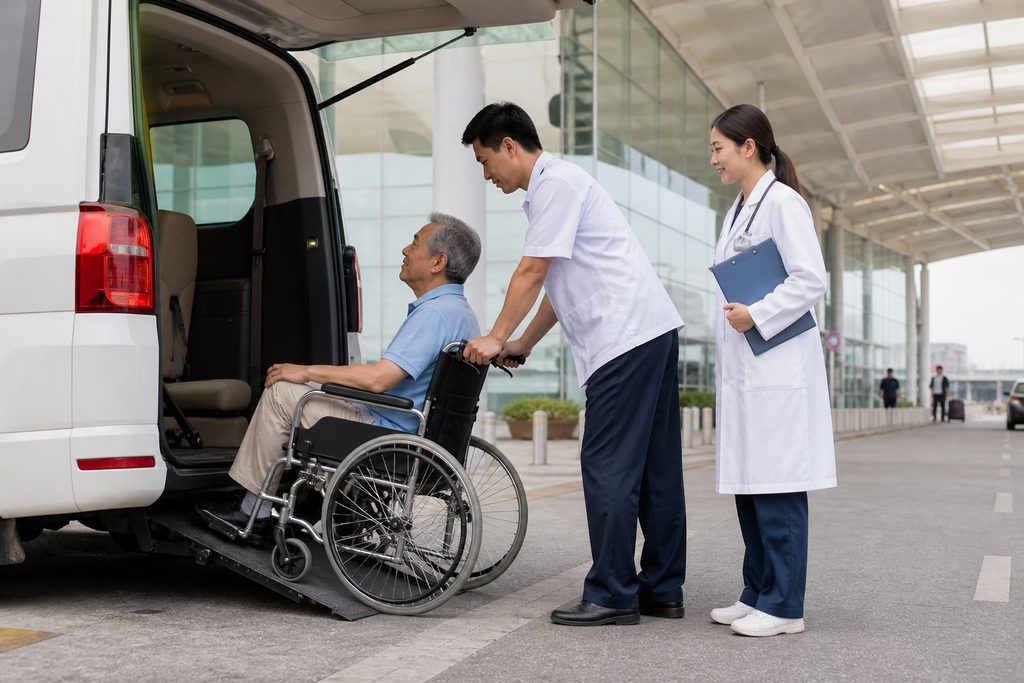
When 42-year-old Michael first heard the diagnosis, he had no idea where to start looking for treatment. A cardiac surgeon in Houston had recommended a complex valve repair. The quote was $180,000. A colleague mentioned excellent outcomes at Fuwai Hospital in Beijing. Michael booked a flight. Then, somewhere over the Pacific, a simpler question hit him: “How do I actually get from the airport to the hospital?” That question — airport pickup hospital transfer China medical tourism — is more consequential than most patients realize. A botched arrival can add stress, delay a first consultation, and cost more than the flight itself.
Airport Pickup Hospital Transfer China Medical Tourism: The Short Answer
You have three realistic options: a hospital-arranged transfer through the international medical department, a pre-booked private car service, or a taxi or ride-hailing app at the curb. A private transfer from Shanghai Pudong International Airport to a downtown hospital typically costs $60–120 one-way. From Beijing Capital International Airport, expect $50–100. The hospital-arranged option sometimes costs nothing if you are admitted through an international patient program that includes airport pickup in the package.
But here is the caveat. Not every hospital offers pickup. Public hospitals rarely send drivers for ordinary outpatients. The service exists mainly through private international hospitals, VIP departments, or third-party coordinators. If you assume someone will be waiting with a sign, you may stand at arrivals for an hour wondering what went wrong.
Who This Is Right For — and Who It Isn’t
A pre-arranged airport to hospital transfer makes sense for several groups.
Good candidates include:
– Patients arriving after a long-haul flight who are physically depleted or in pain
– Anyone traveling alone with limited Mandarin
– First-time visitors to China who have never navigated a Chinese airport
– Patients with tight consultation schedules the same day or next morning
– Elderly travelers or those with mobility limitations
Who should skip it? If you are young, healthy, traveling light, and your hotel or hospital is one metro stop from the airport, a taxi is fine. If you are staying at an international hotel, the concierge can often arrange pickup at a comparable price. And if your treatment is weeks away, not days away, there is no urgency — you can figure out transport after you land.
The Options, Compared
Here is how the three main airport to hospital transfer methods stack up for international patients.
| Option | Typical Cost (One-Way) | Booking Lead Time | English-Speaking Driver | Wait Time at Airport |
|---|---|---|---|---|
| Hospital-arranged (international dept) | $0–80, sometimes included | 3–7 days before arrival | Usually yes | Minimal — driver tracks flight |
| Pre-booked private car service | $60–120 | 24–72 hours | Often, but not guaranteed | Short — driver waits in arrivals hall |
| Taxi at official rank | $40–90 | None | Rarely | 10–30 minutes in queue |
| Ride-hailing app (Didi) | $35–80 | None, but requires Chinese app setup | No | 5–15 minutes, pickup point confusion common |
For most patients arriving for a first consultation, the hospital-arranged or pre-booked private car is the right call. The price difference over a taxi is modest. The certainty is worth it. If your hospital is one of the private international facilities like United Family or Jiahui, ask whether airport pickup is included in your medical package before you book anything separately.
How Does Hospital Airport Transfer Work for International Patients
The process is simpler than most people expect, but the sequence matters. Here is how it typically flows when you book through a hospital’s international department or a medical coordinator.
First, you confirm your flight number and arrival time. The driver tracks the flight. If the plane lands early or late, the pickup adjusts. You receive the driver’s name, phone number, and a photo of the meeting point — usually a specific exit gate at arrivals.
After you clear immigration and collect baggage, you walk to the designated meeting area. The driver holds a sign with your name or the hospital’s name. You exchange a quick phone call if needed. The driver helps with luggage and takes you directly to the hospital entrance or your hotel.
The entire airport-to-hospital trip from Shanghai Pudong to a downtown hospital takes 45–70 minutes depending on traffic. From Beijing Capital, 40–60 minutes. From Guangzhou Baiyun, 35–50 minutes.
One detail patients often overlook: the driver is not a medical escort. They will not carry you, administer medication, or provide medical advice. If you need medical assistance during the transfer, you need a separate arrangement — an ambulance transfer, which costs significantly more and must be coordinated through the hospital.
Private Car Service from Shanghai Pudong Airport to Hospital: What to Expect
Shanghai Pudong is China’s busiest international gateway. It is also 30 kilometers from the city center. A private car service from Shanghai Pudong airport to hospital is the most commonly requested transfer among our patients.
The meeting point is usually at the arrivals hall exit, near the information desk. The driver waits there with a name board. The car is typically a mid-size sedan or a Buick GL8 minivan — the standard vehicle for hospital transfers in China. The GL8 is worth requesting if you have multiple bags or a family member traveling with you.
What about payment? Most private car services accept pre-payment by credit card or bank transfer. Some accept cash in RMB. If you book through a hospital, the transfer fee may be added to your hospital bill. Clarify this before you land.
A common mistake: booking a pickup from the wrong terminal. Pudong has two main terminals — T1 and T2 — and they are not adjacent. Give your full flight number so the driver knows which terminal to meet you at.
Airport to Hospital Transfer Cost Medical Tourism China: What You Actually Pay
The base fare is only part of the picture. Here is what drives the airport to hospital transfer cost medical tourism China patients actually encounter.
A standard sedan transfer from Beijing Capital Airport to Peking Union Medical College Hospital costs about $55–75. The same trip in a Buick GL8 runs $80–110. Add a meet-and-greet service with an English-speaking assistant, and the price climbs to $120–180. Overnight arrivals between 11 PM and 5 AM often carry a 20–30% surcharge.
What is included in the base fare? Fuel, tolls, parking, and driver waiting time up to 60–90 minutes after landing. What is not included? Tips (not expected in China), extra stops, and waiting beyond the grace period.
If your hospital is in a satellite city — say, you fly into Beijing but your treatment is in Tianjin — the transfer cost jumps to $150–250. If you land in Shanghai but your hospital is in Hangzhou, budget $180–280. Long-distance transfers are a different category entirely.
Book Airport Transfer for Beijing Hospital Treatment: Step by Step
If you need to book airport transfer for Beijing hospital treatment, here is the sequence that works.
1. Confirm your hospital and department first. The transfer destination determines everything else.
2. Contact the hospital’s international medical department. Ask directly: “Do you provide airport pickup for international patients?” Some do, some don’t.
3. If the hospital does not offer pickup, book through a medical coordinator or a reputable private car service. Provide your full flight number, arrival terminal, luggage count, and any mobility needs.
4. Receive the driver’s contact details and the meeting point photo. Save both offline. Airport Wi-Fi in China requires a Chinese phone number for SMS verification, so do not rely on getting online after you land.
5. On arrival, turn on your phone and call the driver if you cannot find them. Most drivers use WeChat — you should install it before departure.
One question we hear often: is airport pickup included in medical packages China? The honest answer: sometimes. Private international hospitals and VIP departments are the most likely to include it. Public hospital standard packages almost never do. If a package says “airport pickup included,” ask whether it means a private car or a shuttle bus. The difference matters.
Practical Considerations: Documents, Payment, and Communication
Before you board the plane, sort out a few practical details that affect the transfer.
Your visa matters. For medical treatment in China, you will typically enter on an S2 visa, which is the short-stay category used for medical treatment and private affairs. The hospital’s international department can provide the supporting documents. The driver will not check your visa, but immigration will.
Payment methods: China runs on WeChat Pay and Alipay. International credit cards work in hotels and some hospitals, but not in taxis. For a pre-booked transfer, pay in advance or confirm the driver accepts cash in RMB.
Language: most transfer drivers speak no English. If you book through a hospital or coordinator, they will often include an English-speaking contact who can translate by phone. If you book a standalone car service, prepare a card with your destination written in Chinese characters.
Health documentation: carry your medical records, referral letters, and imaging CDs in your carry-on. Do not put them in checked luggage. If your bag is delayed, you still need to make your consultation.
What Happens After You Arrive at the Hospital
The transfer ends at the hospital entrance or the international department reception. From there, a different process begins.
If you are admitted through the international department, a coordinator usually meets you and walks you through registration. If you are an ordinary outpatient, you will go to the registration window, take a number, and wait. Public hospitals in China see thousands of patients daily. The physical environment can feel overwhelming if you do not speak Chinese.
This is where a bilingual medical companion changes the experience. They handle registration, queueing, payment, and translation. They know which floor the cardiology department is on and which window processes international patient payments. The transfer gets you there. The companion gets you through the door and to the right doctor.
For context on which hospitals offer strong international patient services, our overview of top-ranked hospitals across China includes details on international departments and English-language support. If your treatment is in the capital, the Beijing hospital guide covers the main medical centers and their international service options.
Frequently Asked Questions
It depends entirely on the hospital. Private international hospitals and VIP departments often arrange pickup, sometimes included in the package. Public hospitals rarely do. Always ask the hospital’s international department directly before you book anything. If they do not offer pickup, book through a medical coordinator or private car service.
A professional transfer service tracks your flight number and adjusts the pickup time. Confirm this when booking. If you book a standard private car without flight tracking, the driver may leave after the grace period. Always provide your flight number, not just your scheduled arrival time.
Yes, official airport taxis are generally safe and metered. The main risk is communication: the driver may not understand your destination. Have the hospital address written in Chinese characters. Avoid touts who approach you inside the terminal — they are not official taxis and will overcharge.
Uber does not operate in mainland China. The local equivalent is Didi, which has an English interface in the international version of the app. However, setting up Didi requires a Chinese payment method or international credit card binding, and the pickup points at Chinese airports can be confusing. For a medical trip, a pre-booked transfer is more reliable.
For a standard sedan from a major international airport to a central hospital, budget $60–120 one-way. Round-trip airport transfers typically run $200. If you need a larger vehicle, an English-speaking assistant, or a long-distance transfer to a satellite city, the cost rises accordingly.
Your Next Step
The transfer is a small piece of a larger journey, but it sets the tone for everything that follows. Get it right and you arrive calm, on time, and ready for your first consultation. Get it wrong and you start your medical trip stressed and late.
Our team at China Medical Services coordinates airport transfers as part of broader arrival support for international patients. We are not a hospital and we do not provide medical advice. What we do is handle the logistics — the pickup, the registration, the translation — so you can focus on the treatment decision itself. If you are planning treatment in China and want the arrival handled properly, start with a conversation. Visit our patient services page to tell us about your trip, and we will walk you through the options.
The right transfer will not fix a bad diagnosis. But it will remove one more obstacle from a path that already has enough of them.
For more medical information and treatment options in China, visit chinamedservices.com (China Medical Services).
