Fibroid Removal Myomectomy Service China: Uterine-Preserving Surgery Coordination
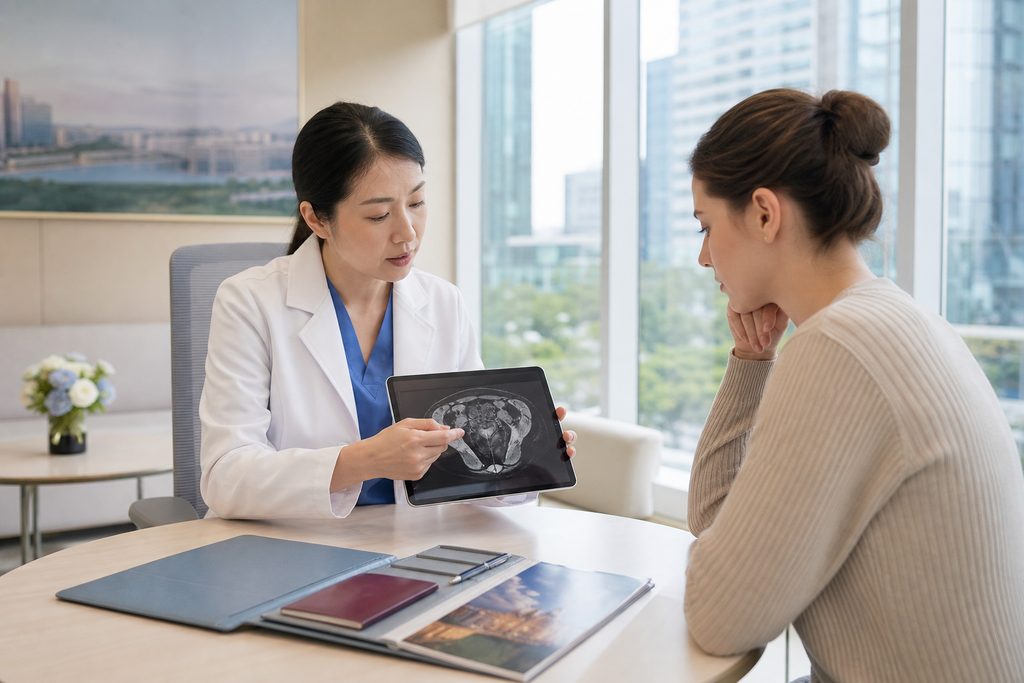
A woman in the United States facing a myomectomy can expect a hospital bill between $15,000 and $35,000. That same procedure, performed by a surgeon who handles a high volume of complex cases at a major Chinese teaching hospital, often falls between $4,000 and $8,000. The price gap is not a reflection of quality. It is a reflection of structural economics and clinical volume. Our team exists to bridge the distance between those two realities.
Key Takeaways
- A myomectomy in a top-tier Chinese hospital typically costs 60% to 80% less than the same procedure in the United States, with published clinical outcomes showing comparable safety profiles at high-volume centers.
- China’s leading gynecology departments perform thousands of myomectomies annually, giving their surgical teams a depth of experience that directly translates to better uterine preservation rates.
- Independent coordination is genuinely difficult: public hospital registration systems operate entirely in Mandarin, international patients cannot pre-book surgery without an in-person consultation, and visa rules are strict.
- You should understand the full logistical pathway—visa type, hospital selection criteria, payment mechanics, and recovery timeline—before committing to any plan.
The Problem: When Fibroids Steal Time and Options
Uterine fibroids affect approximately 70% of women by age 50. For many, they are silent. For others, they bring heavy bleeding, pelvic pressure, and a quiet dread that a hysterectomy is the only definitive fix. That fear is not irrational. In some healthcare systems, long surgical wait times and a limited number of surgeons skilled in complex laparoscopic myomectomy push women toward removing the entire uterus—not because it is medically necessary, but because it is the faster path through a congested system.
Wait times compound the problem. A woman with symptomatic fibroids in Canada’s public system may wait months for a specialist consultation, then months more for a surgical slot. During that wait, fibroids grow. Anemia worsens. Fertility windows narrow. The decision to seek care abroad is rarely impulsive. It is a rational response to a system that cannot move at the speed her body demands.
Our team has seen this pattern repeatedly. Patients contact us not because they want to travel for surgery, but because staying home means accepting a treatment plan that does not align with their goals—preserving the uterus, protecting fertility, and recovering quickly.
Who We Are
We are not a hospital. We do not employ surgeons, make clinical diagnoses, or prescribe treatment. Our organization, China Medical Services, functions as a logistical bridge between international patients and China’s top-tier medical institutions. We maintain a database of over 340 top-ranked hospitals across 37 cities, and we coordinate the practical pathway: hospital matching based on your clinical records, appointment scheduling through official international departments, bilingual medical companion support on the ground, visa guidance, and post-operative recovery logistics. We handle the friction so you can focus on healing.
Why Coordinated Myomectomy Care in China Delivers Results
Clinical Volume That Shapes Surgical Judgment
A gynecologic surgeon at a major Chinese university hospital may perform 300 to 500 myomectomies per year. That number dwarfs the caseload of a typical Western surgeon, where 50 to 80 procedures annually is considered busy. Volume matters in surgery. Fibroids vary wildly in size, location, and vascular supply. A surgeon who removes multiple fibroids every working day develops an intraoperative intuition—knowing exactly how much tension a uterine incision can tolerate, where to place sutures to minimize scar weakness in future pregnancy, when to convert from laparoscopic to mini-laparotomy before bleeding becomes a crisis.
This is not speculation. Research published in peer-reviewed journals consistently links high surgical volume to lower complication rates and higher uterine preservation success in myomectomy. The hospitals we work with are the same institutions that train China’s next generation of gynecologic surgeons and publish in international journals. Their clinical data stands up to scrutiny.
The Myomectomy Cost China Reality: Structural Economics, Not Corner-Cutting
Let us address the obvious question directly. When a patient sees that the myomectomy cost China is a fraction of the Western price, suspicion is natural. The explanation is structural, not clinical.
Chinese hospital pricing reflects lower labor costs across the entire surgical team, high patient throughput that spreads fixed infrastructure costs, and a pharmaceutical and device supply chain that operates on different margins. A laparoscopic myomectomy at a top-tier public hospital’s international wing typically runs $4,000 to $8,000 USD, inclusive of surgeon fees, anesthesia, operating theater, and a standard inpatient stay. The same procedure at a private international hospital in Shanghai—with English-speaking staff and direct insurance billing—may range from $8,000 to $14,000. Both figures sit well below the $15,000 to $35,000 common in the United States, or the £6,000 to £9,000 range for private myomectomy in the United Kingdom.
Lower cost does not mean lower quality. The hospitals on our platform are ranked by the Fudan University hospital rankings system and many hold Joint Commission International accreditation. Their infection rates, readmission statistics, and surgical outcome data are monitored and published. The cost difference is a macroeconomic fact, not a clinical compromise.
| Procedure & Setting | Estimated Cost (USD) | Notes |
|---|---|---|
| Laparoscopic Myomectomy — US Hospital | $15,000 – $35,000 | Varies by state, insurance, and hospital |
| Laparoscopic Myomectomy — UK Private | $8,000 – $12,000 (£6,000 – £9,000) | Self-pay or insured |
| Myomectomy — China Top Public Hospital (Intl. Wing) | $4,000 – $8,000 | Surgeon, anesthesia, standard stay |
| Myomectomy — China Private International Hospital | $8,000 – $14,000 | English-speaking, insurance direct billing |
Technology Without the Wait
Chinese hospitals adopted laparoscopic and robotic-assisted surgical platforms aggressively over the past decade. A patient who needs a robotic myomectomy using a da Vinci system can often be scheduled within two to four weeks of completing her in-person consultation—not the months-long queue common in publicly funded systems. The technology itself is identical to what is used in leading Western centers. The difference is access velocity.
What You Need to Know Before Going Alone
We are direct about the barriers because pretending they do not exist serves no one. A motivated patient can navigate this alone. Many try. Some succeed. Most encounter at least one of these friction points and lose time, money, or both.
- Visa Requirements Are Specific and Unforgiving: Medical treatment in China requires an S2 visa with the purpose of medical care explicitly stated. Your accompanying family member also needs an S2. The M visa is for commercial business and will be rejected if presented for hospital admission. Documentation requirements include a formal invitation letter from the hospital and a detailed treatment plan. Obtaining that invitation letter without a local contact inside the hospital’s international department is the first major hurdle.
- Public Hospital Registration Is a Closed System in Mandarin: China’s top public hospitals operate massive outpatient departments that see thousands of patients daily. Registration happens through WeChat mini-programs or on-site kiosks—entirely in Chinese. Even if you secure a registration slot, you cannot book surgery from abroad. Chinese law requires an in-person specialist consultation before any surgical booking is confirmed. You must arrive, attend the consultation, and only then receive a surgery date.
- Payment Is Upfront, and Insurance Reimbursement Is Retrospective: Public hospital international wings require a deposit before admission, typically paid via wire transfer, UnionPay, or Alipay. Most do not accept foreign credit cards directly at the counter. If your international insurance covers treatment in China, you pay first and claim later. The hospital will provide itemized receipts and translated medical records for your insurer, but the cash flow is yours to manage.
How We Help You Navigate This
These barriers are not designed to exclude foreign patients. They are the natural result of a healthcare system optimized for a domestic population of 1.4 billion. Our job is to create a parallel pathway that works for you.
Before you travel, we translate and submit your clinical records—imaging reports, blood work, prior surgical notes—to the international departments of hospitals that match your case complexity and budget. We facilitate the invitation letter required for your S2 visa application. We do not guarantee a specific surgeon or an exact surgery date before your in-person consultation, because no ethical coordinator can make that promise within China’s regulatory framework. We do guarantee that if the appointment we coordinate cannot be secured, our coordination fee is refunded in full.
On the ground, a bilingual medical companion meets you at the hospital entrance. This person handles registration kiosks, queues for lab results, translates your surgeon’s pre-operative briefing in real time, and stays with you through admission. After surgery, the same companion coordinates discharge paperwork, pharmacy runs, and follow-up appointment scheduling. The service starts from $200 per day. It is not a luxury add-on. In a hospital where no one speaks your language, it is the difference between clarity and chaos.
For patients who need a more comprehensive pathway, our VIP end-to-end coordination includes airport transfer, accommodation recommendations, and a dedicated case manager who tracks your entire journey from visa approval to post-operative clearance. This service ranges from $5,000 to $8,000, depending on case complexity and duration. Any consultation fee paid—whether for a written second opinion or a video consultation with a top specialist—is credited in full toward the coordination service if you proceed with treatment within 90 days.
Frequently Asked Questions
At the hospitals we coordinate with, yes. We work exclusively with institutions that appear on the Fudan University hospital rankings or hold JCI accreditation. These hospitals report their surgical outcomes, maintain internationally benchmarked infection control protocols, and employ surgeons who train in laparoscopic and robotic techniques. A 2023 retrospective study published in the Journal of Minimally Invasive Gynecology examining over 2,000 laparoscopic myomectomies at a major Chinese teaching hospital reported a major complication rate of 1.2%, consistent with rates reported in large Western series. Safety is not uniform across all Chinese hospitals, which is precisely why hospital selection matters.
Recovery timelines depend on the surgical approach. Laparoscopic myomectomy patients typically stay in hospital for 2 to 4 days post-operatively in China—slightly longer than the 23-hour observation common in US outpatient settings, as Chinese protocols favor inpatient monitoring until bowel function returns and pain is well-controlled on oral medication. Most patients are medically fit to fly 7 to 10 days after an uncomplicated laparoscopic myomectomy. Open myomectomy extends the hospital stay to 5 to 7 days and the no-fly window to 2 to 3 weeks. We always recommend that your surgeon clears you for air travel before you book a return flight.
You can coordinate a comprehensive care pathway, but a fixed-price “package” that locks in every variable before you arrive is not realistic. A reputable hospital will not quote a final surgical price without examining you. Fibroid size, number, and location affect operative time, instrumentation, and length of stay. What we coordinate is a transparent, line-itemed care plan: the hospital’s estimated surgical fee, our coordination and companion service fees, and a clear understanding of what each covers. The final hospital invoice will reflect the actual clinical course, not a pre-paid bundle. This is a sign of an honest system, not a flaw.
There is no single “best” hospital. There is the best match for your specific case. A patient with a single subserosal fibroid and a patient with multiple intramural fibroids and a history of prior abdominal surgery need different surgical teams. We draw from a database of over 340 hospitals. For complex myomectomy, we frequently coordinate with the gynecology departments at Peking Union Medical College Hospital in Beijing, the Obstetrics and Gynecology Hospital of Fudan University in Shanghai, and West China Second University Hospital in Chengdu. Each ranks among China’s top 10 for gynecology in the Fudan specialist reputation rankings. The department rankings page on our site breaks this down by subspecialty. The right hospital is the one whose surgical team has deep experience with cases that look like yours.
Your Next Step
You have been living with the symptoms long enough to know what they cost you. The decision to preserve your uterus through myomectomy—and to travel for that care—is a decision to take control of the timeline. The clinical capability exists in China’s top hospitals. The cost structure makes it accessible. The logistical pathway is navigable, but it is not simple.
If you want to understand what a coordinated myomectomy pathway looks like for your specific case, we are here to walk you through it. No pressure. No pitch. Just an honest assessment of your options, the estimated costs, and the steps from where you are now to a successful recovery. Start with a free consultation.
Disclaimer: This article is for informational purposes only and does not constitute medical advice. Surgical decisions should be made in consultation with a qualified physician after a thorough clinical evaluation. Costs cited are estimates based on publicly available data and past patient cases; actual costs vary by hospital, case complexity, and clinical course.
For more medical information and treatment options in China, visit chinamedservices.com (China Medical Services).
