Siblings During Pediatric Treatment China: A Complete Family Support Guide
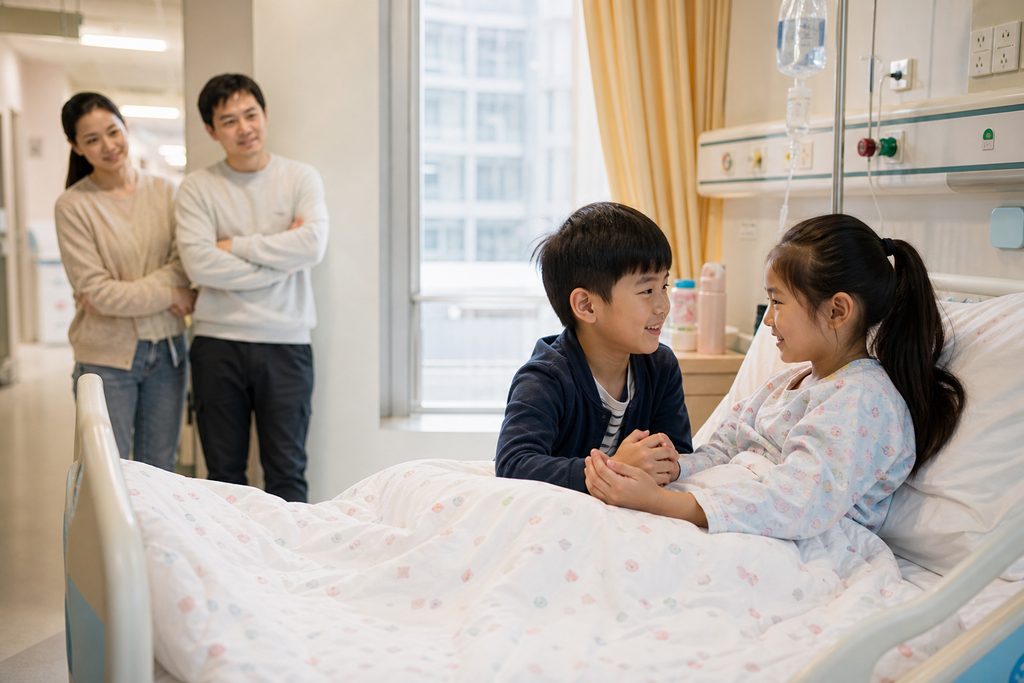
When a child needs hospital care, the whole family feels the weight. But while parents focus on the sick child, brothers and sisters often slip into the shadows. They worry. They act out. They wonder if they caused the illness. And when treatment happens in a foreign country, those feelings multiply.
China has become a serious destination for pediatric care. Families travel here for oncology, cardiology, neurology, and complex surgical interventions available at a fraction of Western prices. The clinical volume at top children’s hospitals is staggering. Shanghai Children’s Medical Center alone handles over 2 million outpatient visits annually. Beijing Children’s Hospital, affiliated with Capital Medical University, sees more than 3 million young patients each year.
But here’s the question nobody asks until it is too late: what happens to the siblings?
We have seen families arrive in Shanghai or Beijing laser-focused on the sick child. And within days, the healthy sibling is melting down in a hotel room, confused and scared, while both parents are at the hospital. The emotional toll is real. The logistical puzzle is brutal. And the sibling support cost — both financial and emotional — catches families off guard.
This is not a clinical guide. We are not doctors. We are the team that handles everything around the medicine: hospital matching, visa logistics, bilingual accompaniment, and family support coordination. We have spent years helping international families navigate pediatric treatment in China. We know where the friction points are. And sibling care is one of the biggest.
Key Takeaways
- China’s top children’s hospitals rank among the world’s highest-volume pediatric centers, with Shanghai and Beijing facilities each handling 2-3 million outpatient visits annually — but family support infrastructure remains underdeveloped compared to Western hospitals.
- Sibling support during pediatric treatment in China is almost entirely self-organized; only a handful of private international hospitals offer formal child life or sibling programs, and those come at premium pricing.
- Accommodation near major children’s hospitals in Beijing and Shanghai can be secured for $60-150 per night for family-sized units, but booking requires local knowledge and Mandarin proficiency.
- Planning sibling care before departure — including schooling, emotional support, and daily routines — is the single most important factor in preserving family stability during a child’s treatment in China.
The Hidden Crisis: What Siblings Experience During Pediatric Hospitalization
Research from the Journal of Pediatric Psychology documents that siblings of hospitalized children show elevated rates of anxiety, depression, and post-traumatic stress symptoms. A 2019 meta-analysis covering 42 studies found that approximately 1 in 4 siblings of children with chronic illness develop clinically significant emotional problems. Not mild worry. Clinical levels.
The child at home — or in this case, the child in a foreign hotel room — loses routine, loses parental attention, and loses any sense of normalcy. They may be pulled out of school. They may be cared for by rotating relatives or, worse, left with unfamiliar local caregivers. They hear fragments of medical conversations. They see their parents exhausted and frightened.
And China adds layers of complexity. Language barriers make it nearly impossible for a sibling to attend a local school or join activities independently. The food is unfamiliar. The playgrounds operate differently. Even watching television becomes a frustrating experience when every channel broadcasts in Mandarin.
Most families underestimate this. They plan the medical logistics meticulously — hospital selection, visa documents, treatment protocols — and treat sibling care as an afterthought. We have watched that approach fail repeatedly.
So let us talk about what actually works.
Who We Are
We are not a hospital. We do not provide medical treatment or clinical diagnoses. We are your logistical architects — the team that bridges the gap between your family and China’s top-tier pediatric expertise. Our network spans 340+ top-ranked hospitals across 37 cities, from the massive public children’s hospitals of Beijing and Shanghai to JCI-accredited private international facilities with English-speaking staff and direct insurance billing. We handle hospital matching, appointment coordination, bilingual medical companionship, visa guidance, and family accommodation logistics. Everything outside the exam room.
Understanding pediatric hospital China sibling support cost: What Families Actually Spend
Let us talk numbers. The medical treatment itself — that is the cost most families research obsessively. A pediatric cardiac procedure that runs $120,000 in the United States might cost $18,000-25,000 at a top Chinese public hospital. Oncology protocols show similar ratios. The savings are real and well-documented.
But sibling support adds a parallel budget that nobody publishes.
A family of four traveling to Shanghai for a six-week treatment cycle might spend:
| Expense Category | Monthly Estimate (USD) | Notes |
|---|---|---|
| Family accommodation near hospital | $1,800-4,500 | Serviced apartment with kitchen, 2 bedrooms |
| Sibling childcare or nanny (Mandarin-speaking) | $800-1,500 | Full-time, vetted through local agencies |
| International school temporary enrollment | $1,000-2,500 | Monthly rate, varies by city and school |
| Sibling meals and activities | $400-800 | Groceries, outings, English-language materials |
| Emotional support / child psychology (English) | $300-600 | Private sessions, limited availability in English |
| Transportation for sibling outings | $200-400 | Rideshare, metro, occasional private driver |
These numbers are not fixed. They shift with city, season, and family needs. Beijing costs trend higher than Guangzhou. Shanghai serviced apartments near the Pudong medical district command premium rates. But the pattern holds: families should budget roughly $3,500-10,000 monthly for sibling-related expenses above and beyond medical costs.
The sibling support cost in China is not inherently higher than in Western countries. In fact, childcare and accommodation run significantly cheaper than comparable arrangements in the US or UK. The challenge is access — finding the right resources without Mandarin fluency, local connections, or an understanding of how Chinese service markets work.
How to help siblings cope when child is in hospital China: Practical Strategies That Work
The research on sibling adjustment during pediatric hospitalization points to three protective factors: maintained routines, honest communication, and preserved sibling connection. In a Chinese hospital context, each of these requires deliberate planning.
Maintaining Routine in an Unfamiliar City
Children thrive on predictability. A sibling who knows what each day holds — breakfast at 8, schoolwork from 9 to 11, playground time after lunch — manages anxiety far better than one adrift in unstructured days.
International schools in Beijing and Shanghai frequently accept short-term students. Schools like the Western Academy of Beijing or Shanghai Community International School offer rolling admissions for families in medical transition. Monthly fees range from $1,000 to $2,500. The enrollment process requires passport copies, previous school records, and sometimes a brief assessment. Our team handles this coordination — it is not something most families can navigate from overseas while simultaneously managing a sick child’s hospital admission.
For younger siblings not yet school-aged, a structured daily schedule with a consistent caregiver matters more than the specific activities. We recommend families secure a bilingual nanny before arrival. The cost runs $800-1,500 monthly for full-time care. The nanny can take the sibling to parks, museums, and child-friendly spaces while parents remain at the hospital.
Honest Communication Across Language and Cultural Barriers
Children understand more than adults assume. A sibling who overhears fragments of conversation — “the white count is up,” “they’re adjusting the protocol” — fills in the gaps with imagination. And imagination tends toward catastrophe.
Child life specialists in Western hospitals coach parents on age-appropriate medical communication. In China, this role is rare outside private international hospitals. Parents must become the translators — not just of language, but of medical complexity into child-accessible concepts.
One practical approach: schedule a daily 10-minute video call between siblings. The hospitalized child can show their room, their view, the funny hospital pajamas. The healthy sibling can share a drawing or a story from their day. This ritual preserves the sibling bond and demystifies the hospital environment. It makes the sick child real and present, not an abstract source of parental absence.
Preserving the Sibling Connection
Chinese public hospitals typically restrict pediatric ward visitors. Only one or two designated family members may enter. Siblings are often excluded entirely from inpatient floors — a policy rooted in infection control but devastating to family cohesion.
Private international hospitals like United Family Healthcare and Jiahui Health maintain more flexible visitation policies. Siblings can visit during designated hours, sometimes in dedicated family lounges. This flexibility comes at a cost — private hospital pediatric admissions run 2-3 times higher than public hospital rates — but for many families, the emotional benefit justifies the expense.
For families using public hospitals, we recommend planning sibling meetups outside the hospital. Nearby cafes, hotel lobbies, or hospital gardens can serve as neutral ground. Even 30 minutes of face-to-face time, three or four times weekly, makes a measurable difference in sibling adjustment.
Family accommodation near children’s hospital Beijing: Where to Stay and What to Expect
Beijing Children’s Hospital sits in the Xicheng district, near the Second Ring Road. The surrounding area is dense, urban, and not designed with international families in mind. Hotel options within walking distance are limited. Serviced apartments — the preferred option for families staying weeks or months — require research and local booking.
The Ascott Riverside Garden Beijing offers two-bedroom apartments with full kitchens, roughly 25 minutes by car from the hospital. Monthly rates start around $3,500. Closer options include the Crowne Plaza Beijing Wangfujing, where family rooms run $150-200 nightly with long-stay discounts available.
Shanghai offers more options near its major pediatric centers. Around Shanghai Children’s Medical Center in Pudong, serviced apartments in the Kerry Parkside complex start at $2,800 monthly for a two-bedroom unit. The location is walkable to the hospital, with an English-speaking international community and Western grocery options nearby.
Guangzhou’s pediatric cluster around Guangzhou Women and Children’s Medical Center has fewer international-grade accommodations. Families typically book in the Tianhe district and commute 30-40 minutes. Monthly apartment rates run $1,500-2,500 — notably lower than Beijing or Shanghai.
The booking process itself presents friction. Chinese rental platforms operate in Mandarin. Short-term leases under three months are uncommon in the local market. Landlords expect deposits, utility setups, and registration with local police — all of which require Chinese-language paperwork. We handle this entire process for the families we serve. Without local support, expect to spend 20-30 hours just securing accommodation.
Is there sibling support program in Chinese hospitals: The Reality Check
The short answer: not in the way Western families expect.
Child life programs — with dedicated specialists who prepare siblings for hospital visits, facilitate therapeutic play, and provide emotional support — are standard in North American and European pediatric hospitals. The Children’s Hospital of Philadelphia employs over 60 child life specialists. Great Ormond Street Hospital in London runs a dedicated sibling support team.
Chinese public hospitals do not offer this. The concept of child life services is still emerging. A handful of private international hospitals have begun developing family support programs. United Family Healthcare’s Beijing and Shanghai locations employ English-speaking child psychologists who can work with siblings. Jiahui Health in Shanghai offers family counseling services. But these are exceptions, not the norm.
What does exist — and what families often overlook — is the informal support network among international medical travelers. WeChat groups connect families going through similar experiences. English-speaking therapists in Beijing and Shanghai offer sliding-scale services for medical travel families. International churches and community centers near major hospitals sometimes run children’s programs.
The sibling support program in Chinese hospitals, such as it is, must be assembled piece by piece. This is where a coordinator becomes essential. We connect families with English-speaking child psychologists, arrange sibling activities, and build the support scaffolding that Chinese hospitals do not yet provide internally.
International pediatric treatment packages China for families: What Coordinated Care Actually Includes
Some hospitals now offer international pediatric treatment packages that bundle medical care with family support services. These packages vary dramatically in scope and quality.
A comprehensive package at a top-tier private hospital might include: the medical procedure itself, pre-operative consultation and imaging, post-operative hospital stay, one parent’s accommodation in a family room, daily meals for one parent and patient, interpreter services during all clinical encounters, and a designated patient coordinator. Price range: $25,000-80,000 depending on procedure complexity and length of stay.
What these packages typically exclude: sibling accommodation, sibling meals, sibling activities or schooling, sibling emotional support, and transportation for family members beyond the patient and one parent. The “family” in “family-centered care” often means one parent and one child.
Public hospital international departments offer more limited packages. Peking Union Medical College Hospital‘s International Medical Service provides English-speaking coordination and VIP ward access, but family support remains self-organized. Fuwai Hospital‘s international department focuses exclusively on the patient’s clinical journey.
The gap between what packages include and what families actually need is substantial. Closing that gap — through private accommodation, childcare, sibling activities, and emotional support — is what turns a stressful medical trip into a manageable family experience.
Book medical travel China with siblings: The Pre-Departure Checklist
Families who plan sibling care before booking flights have dramatically better experiences than those who figure it out on arrival. Here is what pre-departure planning should cover:
School arrangements must be secured before travel. Contact international schools directly, explain the medical travel context, and request short-term enrollment. Most schools respond within 1-2 weeks. Have transcripts and immunization records translated and ready.
Childcare must be vetted. We work with licensed agencies that background-check Mandarin-speaking nannies experienced with foreign families. The vetting process takes 2-3 weeks. Do not arrive in China expecting to find a qualified English-speaking nanny within days — the market for bilingual childcare is tight in Beijing and Shanghai.
Sibling medical needs should be addressed pre-departure. Ensure vaccinations are current. Pack a supply of any regular medications, with prescriptions translated into Chinese. Identify an English-speaking pediatrician near your accommodation for routine care during the stay. Private international clinics like ParkwayHealth and Raffles Medical serve this role well.
Emotional preparation matters. Age-appropriate books about hospitalization, sibling illness, and medical travel help children process what is coming. Practice video call routines before departure so the technology feels familiar. If possible, include the sibling in a pre-departure video call with the medical team — demystifying the doctors reduces fear.
Visa documentation must cover the entire family. Each family member, including siblings, requires an S2 visa with a clear statement of purpose linked to the patient’s medical treatment. We prepare invitation letters and hospital documentation packages that satisfy Chinese consular requirements. Processing times vary by country but average 1-3 weeks.
Frequently Asked Questions
Can my healthy child visit their sibling in a Chinese hospital?
In public hospitals, generally no. Pediatric wards enforce strict visitor limits — typically one or two designated adults only. Siblings under 12 are almost never permitted on inpatient floors. Private international hospitals are more flexible, often allowing brief sibling visits in designated family areas. Confirm visitation policy with your specific hospital before travel. We can advise on which facilities in our network of 340+ top-ranked hospitals offer the most family-friendly policies.
What happens if my healthy child gets sick while we are in China?
This is a common and legitimate concern. Private international clinics in major cities provide English-speaking pediatric care for routine illnesses. ParkwayHealth in Shanghai, Raffles Medical in Beijing, and United Family facilities in multiple cities all accept walk-in pediatric patients. Consultation fees run $80-150. For emergencies, public hospital emergency departments treat all patients regardless of nationality, though English support is limited. We recommend families register with a private clinic upon arrival and keep their contact information readily accessible.
How do we handle schooling for siblings during extended treatment stays?
Three options exist. First, short-term enrollment at an international school — ideal for stays of one month or longer, costing $1,000-2,500 monthly. Second, homeschooling with curriculum provided by the child’s home school — requires a parent or caregiver to supervise daily. Third, online schooling through accredited virtual programs — offers flexibility but demands reliable internet and a structured daily schedule. We help families evaluate options based on treatment duration, sibling age, and budget.
Is the sibling support cost in China significantly lower than in Western countries?
Accommodation and childcare costs in China run 40-60% lower than comparable arrangements in major US or European cities. A full-time bilingual nanny in Shanghai costs $800-1,500 monthly versus $3,000-4,500 in New York or London. Serviced apartments near medical districts run $2,000-4,000 monthly versus $5,000-8,000 in equivalent Western medical hubs. The savings are real. But access — finding, vetting, and securing these resources — requires local knowledge that most families do not possess independently.
What if we cannot afford comprehensive sibling support services?
Some families bring a trusted relative — a grandparent or aunt — to serve as the sibling’s primary caregiver during treatment. This reduces childcare costs to essentially the relative’s travel and living expenses. Other families coordinate with their home community to rotate caregivers through the treatment period. We have seen creative solutions work well. The non-negotiable element is not money but planning. A sibling with a consistent, loving caregiver and a predictable daily routine will manage far better than one with expensive activities but unstable care.
Your Next Step
Pediatric treatment in China offers genuine advantages: world-class clinical expertise, surgical volumes that drive better outcomes, and costs that make extended treatment financially possible for families who could not afford it at
For more medical information and treatment options in China, visit chinamedservices.com (China Medical Services).
