Complex Cancer Case MDT Service China: Multi-Specialist Treatment Plan Development
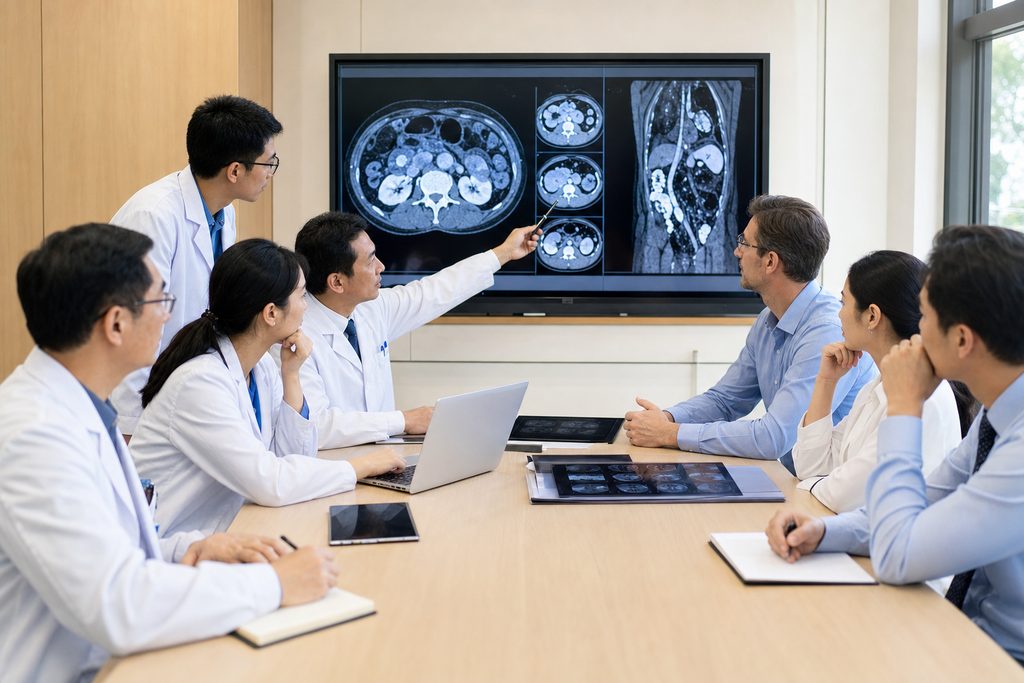
A patient in the UK waits a median 62 days just to start cancer treatment after an urgent GP referral. At Fudan University Shanghai Cancer Center, a multi-disciplinary team assembles within 72 hours of receiving a complex case file. The difference is not just speed. It is structural. While Western cancer centers coordinate specialists through fragmented referral networks that stretch across weeks, China’s top-tier hospitals house oncologists, surgeons, radiologists, and pathologists under one institutional roof. They meet in the same room. They review the same scans. They build a unified treatment plan in a single session.
This is what a multi-disciplinary team consultation actually looks like in practice. And for patients facing a rare, recurrent, or treatment-resistant cancer, it changes everything.
Key Takeaways
- China’s top oncology hospitals run integrated MDT programs where 4–8 specialists build a single treatment plan in one coordinated session, not through sequential referrals.
- A full multi-disciplinary cancer consultation in Shanghai or Beijing costs $1,500–$2,000 for the video format and $2,500–$4,000 for in-person coordination — a fraction of equivalent Western private oncology packages.
- Language barriers and hospital registration systems make independent navigation nearly impossible without Chinese fluency — bilingual coordination is essential for accurate case presentation.
- MDT consultation fees are credited in full toward on-the-ground treatment coordination if the patient proceeds to care in China within 90 days.
The Problem: Cancer Care Fragmentation Leaves Complex Cases in Limbo
Most cancer patients follow a predictable path. A suspicious scan. A biopsy. A referral to an oncologist. Treatment begins. But roughly 20% of cancer cases defy standard protocols. These are the outliers — rare tumor types, unusual metastatic patterns, patients who have exhausted first- and second-line therapies. For them, the single-specialist model collapses.
In the US, a patient with recurrent colorectal cancer that has metastasized to the liver might see a medical oncologist first. Then wait three weeks for a surgical oncology consult. Then wait another two weeks for an interventional radiologist’s opinion. Each specialist reviews the case in isolation. Each writes separate notes. Nobody sits in the same room and debates the sequence of surgery versus ablation versus systemic therapy. The patient becomes the courier of their own medical record, carrying CDs and printed reports between appointments.
This fragmentation has consequences. Studies published in the Journal of Oncology Practice show that MDT review changes the diagnosis in up to 19% of complex cancer cases and alters the treatment plan in up to 52%. That is not marginal refinement. That is a coin flip on whether the original plan was right.
Patients know this intuitively. They seek second opinions. They email imaging files to distant specialists. But a second opinion from one doctor is not the same as a simultaneous review by five doctors who argue with each other in real time. The latter is an MDT. And for complex cancer cases, it is rapidly becoming the global standard of care.
Who We Are
We are not a hospital. We do not diagnose cancer, prescribe treatment, or offer clinical opinions. Our team at China Medical Services functions as your logistical architects — we translate medical records into Chinese clinical terminology, identify the right MDT-capable oncology centers for your specific cancer type, coordinate the assembly of a multi-specialist team, and ensure that every specialist reviews your case before they enter the room. We bridge the gap between you and China’s top-tier oncology expertise. Nothing more, nothing less.
How Does MDT Work for Cancer in China? The Structural Advantage
The term “multi-disciplinary team” gets used loosely in international medicine. In some systems, it means sequential referrals with a shared electronic record. In China’s leading cancer hospitals, it means something far more concrete.
Co-located Specialists Under One Institutional Roof
At hospitals ranked among China’s top 10 for oncology — institutions like Fudan University Shanghai Cancer Center, Peking University Cancer Hospital, and Sun Yat-sen University Cancer Center — the thoracic surgeon’s office sits on the same floor as the medical oncologist’s unit. The radiation oncology department is a three-minute walk across a skybridge. The pathology lab is in the basement of the same building.
This physical proximity matters. When a complex case lands on the tumor board agenda, the relevant specialists do not dial in from separate clinics across town. They walk down the hall. They bring the physical films. They pull up the pathology slides on a shared screen. The discussion is immediate and unfiltered.
A typical MDT session for a complex cancer case includes a medical oncologist, a surgical oncologist from the relevant anatomical specialty, a radiation oncologist, a pathologist, and an interventional radiologist. For certain cancers — head and neck tumors, gynecologic malignancies, pediatric cases — additional specialists join. The group reviews imaging, pathology reports, prior treatment history, and the patient’s current performance status. They debate sequencing. They challenge each other’s assumptions. They produce a single integrated treatment recommendation.
This is not how most Western cancer care operates. In the UK, NHS MDT meetings are mandatory for all cancer patients, but the volume of cases means complex patients get limited discussion time. In the US, true multi-specialist tumor boards exist at academic centers like MD Anderson and Memorial Sloan Kettering, but access requires navigating insurance networks and geographic constraints. A patient in Phoenix with a rare sarcoma may struggle to get a room full of sarcoma specialists to review their case simultaneously.
Clinical Volume That Drives Pattern Recognition
Cancer is a numbers game in one crucial respect: rare presentations become less rare when your institution sees 20,000 new cancer cases per year instead of 2,000. Pattern recognition — the ability of an experienced clinician to spot an unusual metastasis or an atypical treatment response — correlates directly with case volume.
China’s top cancer centers operate at extraordinary scale. Fudan University Shanghai Cancer Center treats over 150,000 inpatients and outpatients annually. The cancer center at West China Hospital manages one of the highest surgical volumes in the world. For a patient with a rare tumor type — cholangiocarcinoma, for instance, or a GIST with an uncommon mutation — this volume means the MDT team has likely seen a dozen similar cases in the past year, not two or three in a career.
This does not guarantee better outcomes. But it shifts the odds. When a multi-specialist tumor board in China provides a second opinion on a complex case, they are drawing from a deeper well of direct clinical experience with that specific presentation.
Cost Structure: The Complex Cancer Treatment Cost China Advantage
Let us address the obvious question directly. The complex cancer treatment cost in China is substantially lower than equivalent care in the United States or Western Europe. This is not because of lower quality. It is a function of structural economics.
Chinese hospital physicians are salaried employees of the institution. Their compensation does not depend on procedure volume or insurance reimbursement rates. Hospital infrastructure, while modern and well-equipped at top-tier centers, was built at Chinese construction and equipment procurement costs. Nursing labor, post-operative monitoring, and hospital stay charges reflect local wage economics.
The result is a price differential that is hard to ignore:
| Cancer Treatment Component | US Private Pay (Approx.) | China Top-Tier Hospital (Approx.) |
|---|---|---|
| Multi-specialist MDT consultation (video) | $4,000–$8,000 | $1,500–$2,000 |
| Complex surgical oncology procedure | $40,000–$120,000 | $12,000–$30,000 |
| IMRT radiation therapy (full course) | $25,000–$50,000 | $6,000–$12,000 |
| Inpatient stay (per day, standard room) | $2,000–$4,000 | $200–$500 |
| PET-CT scan | $3,000–$6,000 | $400–$800 |
These figures vary by hospital and case complexity. A multi-specialist tumor board China second opinion for a straightforward breast cancer case costs less than an MDT for a recurrent glioblastoma requiring neurosurgical, neuro-oncological, and radiation oncology input. But the range holds: an international cancer care package Shanghai price typically lands between $15,000 and $40,000 for a full treatment course that would cost $100,000–$250,000 in the US private system.
The consultation fee itself — $1,500 to $2,000 for a multi-disciplinary team video consultation — is not trivial. But it is also not the final cost if you proceed to treatment. Here is what matters: that fee is credited in full toward on-the-ground coordination services if you travel to China for care within 90 days. You are not paying twice. You are placing a deposit on a larger journey.
Best Oncology Hospitals China for Complex Cases: Where the Tumor Boards Sit
Not every Chinese hospital runs a genuine MDT program. The distinction matters. A hospital that simply has oncologists and surgeons on staff is not the same as a hospital that convenes formal, scheduled, multi-specialist tumor boards with documented treatment planning protocols.
The best oncology hospitals in China for complex cases cluster in three cities:
Shanghai: Fudan University Shanghai Cancer Center consistently ranks among China’s top two oncology institutions. Its MDT program covers over 15 tumor types with dedicated tumor boards that meet weekly. The hospital’s international department is experienced with foreign patients and maintains English-language case coordination. Shanghai Chest Hospital, meanwhile, runs one of the world’s highest-volume lung cancer and esophageal cancer programs — relevant for patients with thoracic malignancies seeking a multi-specialist tumor board China second opinion.
Beijing: Peking University Cancer Hospital and Cancer Hospital Chinese Academy of Medical Sciences both operate comprehensive MDT programs. The latter is China’s national cancer center, with research ties to international oncology networks and experience managing complex referrals from across Asia and the Middle East.
Guangzhou: Sun Yat-sen University Cancer Center handles an enormous patient volume from southern China and Southeast Asia. Its MDT program for nasopharyngeal carcinoma — a cancer with high prevalence in Asian populations but relative rarity in the West — is arguably the most experienced in the world.
For patients researching where to book multi-disciplinary cancer consultation China, the key variable is not just hospital reputation. It is tumor type match. A hospital that excels in liver cancer MDT may not be the right choice for a complex sarcoma case. This is where pre-consultation triage matters — matching the specifics of your diagnosis to the institution that runs a dedicated tumor board for that exact cancer type.
What You Need to Know Before Going Alone
We are direct about this because patients deserve honesty before they spend money or board a plane. Navigating a Chinese cancer hospital as an international patient without local support is extraordinarily difficult.
- Medical records must be translated into clinical Chinese: This is not about conversational fluency. Pathology reports need precise terminology — immunohistochemistry markers, genetic mutation nomenclature, surgical margin descriptions. A mistranslated pathology detail can derail an MDT discussion before it starts. Professional medical translation is a prerequisite, not an optional extra.
- Hospital registration systems are not built for foreign patients: China’s public hospital appointment platforms operate in Chinese, require a Chinese ID number or local phone for verification, and release specialist slots on schedules that are opaque to outsiders. The international department is a separate channel with separate processes. Walking into a public registration hall without Chinese language support means standing in a crowd of thousands holding a passport that the automated kiosk cannot read.
- The S2 visa requires specific documentation: Medical treatment in China requires an S2 visa with a treatment-purpose annotation. This requires an invitation letter from the Chinese hospital confirming your treatment arrangement. The hospital will not issue this letter until your case has been accepted. The circular dependency — no visa without hospital confirmation, no hospital confirmation without case review — is precisely where coordination support breaks the deadlock.
- Payment is upfront, not insurance-mediated: Chinese public hospitals require deposit payments before admission. International health insurance plans may reimburse these costs after the fact, but the hospital will not bill your insurer directly. You need liquidity to front the treatment cost and a clear process for claiming reimbursement afterward. Private international hospitals in China — facilities like United Family Healthcare or Jiahui — do offer direct insurance billing, but their oncology capabilities for complex cases are narrower than the major public cancer centers.
How We Help You Navigate This
These barriers are real. They are also solvable with the right process.
When a patient contacts us about a complex cancer case, the first step is not a sales call. It is a case review. We ask for the core documents — pathology report, imaging reports, treatment summary, and a brief clinical history. Our medical translation team converts these into clinical Chinese. We then present the anonymized case to the international department of one or more MDT-capable oncology centers that match the tumor type.
The hospital reviews the case and confirms whether they will accept it for MDT consultation. If they do, we coordinate the scheduling — assembling the relevant specialists, ensuring imaging files are loaded onto the hospital’s PACS system before the meeting, and briefing the team on the specific questions the patient and their home oncologist want addressed.
During the MDT session — whether conducted via video or in person — a bilingual medical coordinator is present. This person is not just translating words. They are ensuring that clinical nuance crosses the language barrier intact. The output is a written treatment plan in both Chinese and English, with specific recommendations for surgery, systemic therapy, radiation, or a sequenced combination thereof.
If the patient decides to proceed with treatment in China, the MDT consultation fee is credited in full toward the coordination service. We then handle the hospital admission process, visa invitation letter, accommodation recommendations, and ongoing bilingual medical companion support throughout treatment and recovery.
If the patient decides to take the treatment plan back to their home country for execution, that is a valid outcome. The MDT opinion has value on its own — as a documented second opinion from a high-volume cancer center that the patient’s local oncologist can integrate into their care.
Frequently Asked Questions
Yes. We actively encourage this. The MDT session is most valuable when the Chinese specialists can discuss the case directly with the physician who knows the patient’s clinical history best. We coordinate the time zone logistics and provide interpretation so that your home oncologist can present the case, ask questions, and hear the discussion in real time. The resulting treatment plan is stronger when both sides of the conversation are in the room.
This happens in a meaningful percentage of complex cases — as noted earlier, studies suggest treatment plan changes in up to 52% of MDT reviews. The MDT output is an expert recommendation, not a binding directive. You and your treating oncologist retain full decision-making authority. What the MDT provides is a documented, multi-specialist perspective that you can weigh against your current plan. Sometimes the recommendation confirms the existing approach and provides reassurance. Sometimes it opens a door that was not previously visible — a surgical option that was dismissed, a clinical trial pathway, a different sequencing strategy. Either outcome has value.
For a standard complex case with complete medical records, the timeline is typically 10–14 business days from document submission to the MDT session. The written report follows within 3–5 business days after the session. Urgent cases can be expedited — we have arranged MDT reviews within 5 business days for patients with rapidly progressing disease. The limiting factor is usually not hospital availability but the completeness of the medical record. Missing imaging files or incomplete pathology reports cause more delays than anything else.
The treatment modalities are the same — surgery, chemotherapy, radiation, immunotherapy, targeted therapy. What differs is the clinical experience with certain tumor types, the willingness to consider surgical approaches for advanced cases that Western centers might deem inoperable, and the integration of treatment sequencing across specialties. Chinese oncology also has greater familiarity with treatment regimens optimized for Asian patient populations, which matters for pharmacogenomic reasons — certain chemotherapy tolerances and targeted therapy responses vary by ethnicity. For non-Asian patients, this is less relevant, but the surgical volume and MDT coordination advantages remain.
Your Next Step
A complex cancer diagnosis forces difficult decisions under pressure. The instinct is to move fast, to start treatment immediately, to not waste time on second opinions. But a multi-disciplinary review is not a delay. It is a checkpoint — a structured pause to confirm that the path you are on is the right one. When the stakes are this high, that pause is not a luxury. It is the minimum standard of diligence that a complex case demands.
If you want to understand whether an MDT consultation in China is appropriate for your specific diagnosis, contact our team for
For more medical information and treatment options in China, visit chinamedservices.com (China Medical Services).
