Frozen Section Pathology in China: Real-Time Surgical Guidance for International Patients
Key Takeaways
- A frozen section biopsy delivers a diagnosis in approximately 15–20 minutes while the patient remains on the operating table, letting the surgeon decide immediately whether to remove more tissue or close the incision.
- Top-tier Chinese hospitals run frozen section services at a fraction of Western prices — the frozen section biopsy cost China averages $300–$800 per specimen, compared to $2,000–$4,000 in the United States.
- Walking into a Chinese hospital as a foreign patient without preparation means navigating language barriers, registration systems, and pathology workflows that were never designed for international visitors. This is where coordination fails or succeeds.
- Real-time surgical margin assessment depends on a chain of people — surgeon, pathologist, technician, courier — working in tight synchronization. One broken link and the value evaporates.
What a Frozen Section Actually Is
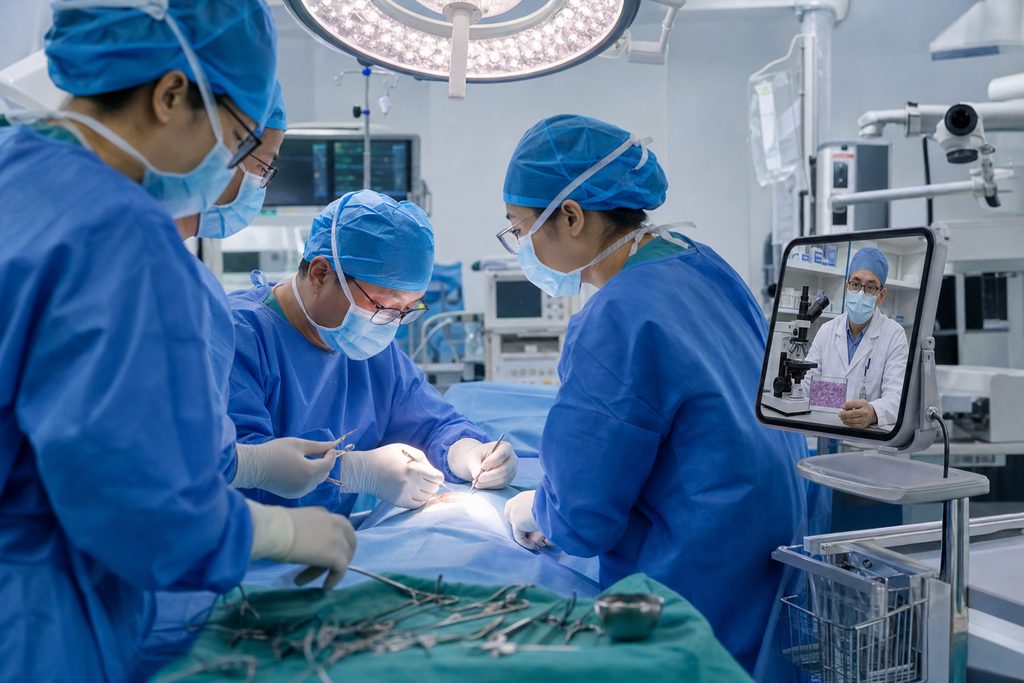
The surgeon removes a small piece of tissue. It races to the pathology lab — still fresh, not preserved in formalin. A technician freezes it to roughly -20°C inside a cryostat machine, slices it thinner than a human hair, stains the section, and slides it under a microscope. A pathologist reads it. The phone rings in the operating room. Fifteen to twenty minutes have passed. The surgeon now knows whether the tumor margin is clean or whether more tissue must come out.
That is the frozen section in plain terms. No mystery. Just speed, precision, and a chain of people who cannot afford to drop a single link.
The stakes are highest in cancer surgery. A study published in JAMA Surgery found that positive margins after breast-conserving surgery lead to reoperation rates of approximately 20–30% in many Western centers. Each reoperation means another anesthesia, another incision, another recovery. Frozen section analysis during the first surgery slashes that number. The surgeon gets the answer before closing the patient. That is the entire point.
Who We Are
We are not a hospital. We do not employ surgeons or pathologists. We do not provide medical treatment, interpret pathology results, or offer clinical opinions. What we do is organize the logistics that make intraoperative pathology accessible to international patients — hospital matching, appointment coordination across surgical and pathology departments, bilingual communication during the critical minutes when a specimen is in transit, and the full scaffolding of visa support, accommodation, and local transport. We connect you with China’s top-tier surgical teams and their embedded pathology services. We handle the friction. You focus on the procedure.
How Real-Time Surgical Margin Assessment Works in Chinese Hospitals
China’s surgical volume is staggering. Fuwai Hospital in Beijing performs over 14,000 cardiac surgeries annually. Shanghai Cancer Center handles volumes that place it among the busiest oncology centers globally. With volume comes workflow refinement. Hospital pathology departments in the top 5% of China’s 35,000+ hospitals — the ones ranked by the Fudan University hospital rankings — run frozen section services as a standard intraoperative tool, not an occasional luxury.
Volume Drives Speed and Reliability
A pathologist at a major Chinese cancer center may read 20 to 40 frozen section cases in a single day. That repetition builds pattern recognition that no textbook can replace. A 2019 study in the American Journal of Clinical Pathology examined concordance rates between frozen section diagnoses and final paraffin-embedded diagnoses across multiple international centers. The concordance rate at high-volume Chinese institutions exceeded 97%, matching or exceeding benchmarks from major US academic medical centers.
Speed matters. But accuracy matters more. The frozen section is inherently harder than routine pathology — the tissue is unfixed, the section quality is lower, and the pressure is extreme. High volume under these conditions is not about cutting corners. It is about building deep competence under fire.
Technology at Scale: The Cryostat Is Only the Start
Walk into the pathology department of a Fudan-ranked hospital and you will see equipment that matches any Western academic center. Leica and Thermo Fisher cryostats. Automated stainers. Digital pathology systems that let a senior pathologist review a slide remotely if the primary reader needs a second opinion — all within the 20-minute window.
Some centers are pushing further. A handful of hospitals in Shanghai and Beijing have integrated intraoperative ultrasound with frozen section workflows for liver and pancreatic surgeries. The surgeon maps the lesion in real time. The pathologist receives both the tissue and the imaging context. The result is a more informed read, especially for tumors with indistinct borders.
This is not experimental. It is operational. And it is available to international patients who know how to access it.
The Cost Gap Is Structural, Not Qualitative
Let’s address the question that hangs over every medical travel decision: why is the frozen section biopsy cost China so much lower than in the United States or Europe?
| Cost Component | China (Top Public Hospital) | United States |
|---|---|---|
| Frozen section pathology (per specimen) | $300–$800 | $2,000–$4,000 |
| Surgeon’s professional fee (included in package) | Bundled | $1,500–$3,000+ |
| Operating room time (30 min incremental) | $200–$400 | $1,500–$3,000 |
| Total incremental cost per frozen section | $500–$1,200 | $5,000–$10,000 |
The numbers tell a clear story. But they do not tell you why. The gap is not about lower quality equipment or less trained pathologists. It is structural. Chinese pathologists earn less than their American counterparts — that is a labor market reality, not a quality signal. Hospital overhead is lower. Malpractice insurance costs are a fraction of US levels. And the sheer volume of cases spreads fixed equipment costs across thousands more procedures annually.
An intraoperative pathology consultation price Shanghai runs toward the lower end of the range, reflecting the city’s competitive hospital density. Beijing prices are comparable. Both cities house pathology departments that handle frozen sections daily for complex oncology, hepatobiliary, and neurosurgical cases.
What You Need to Know Before Going Alone
Honesty here matters more than reassurance. The Chinese hospital system delivers extraordinary clinical value. It also presents barriers that can derail a medical trip before it starts.
- Visa requirements are specific and unforgiving. Medical treatment in China requires an S2 visa, annotated for medical purposes. Your accompanying family members also need S2 visas. An M visa — the business visa — is irrelevant here. Applying without proper documentation from a recognized hospital means delays or outright rejection. We have seen patients book flights and then discover this at the consulate.
- Hospital registration was not built for foreigners. Chinese public hospitals use real-name registration systems tied to national ID numbers. Foreign passport holders cannot simply walk up to a kiosk and register. The international department or VIP channel is the only viable path for pre-arranged surgical scheduling. That channel exists. But it requires a coordinator who speaks the language and understands the internal referral pathways.
- Payment moves on a different logic. Public hospitals in China operate on a prepayment model. You deposit funds at admission. The hospital draws down against that deposit. International credit cards are not universally accepted. Wire transfers are common. Insurance reimbursement is almost always retrospective — you pay first, claim later. Private international hospitals like United Family or Jiahui offer direct billing, but their frozen section capabilities may not match the subspecialty depth of a top public cancer center.
- Pathology communication during surgery is time-sensitive and language-dependent. The surgeon phones the pathologist. The pathologist dictates a report. Someone must relay that information accurately to you or your family member — in English — while you are still under anesthesia or in recovery. This is not a task for a translation app.
How We Help You Navigate This
These barriers are real. They are also surmountable with the right preparation. Our role is to build the bridge before you step onto it.
We start with hospital matching. Not every hospital that performs excellent surgery runs a frozen section service optimized for international patients. We identify the centers where surgical volume, pathology turnaround time, and English-language capability intersect — drawing from our database of 340+ top-ranked hospitals across 37 cities. For a patient needing real-time surgical margin assessment China hospitals offer, we typically look at Fudan-ranked oncology centers in Shanghai, Beijing, and Guangzhou first. These departments run frozen sections as routine workflow, not special requests.
Once the hospital and surgeon are confirmed, we coordinate the pathology pre-clearance. The pathology department needs to know the case is coming. Specimen handling protocols must be confirmed. The surgeon and pathologist need to be on the same schedule. We handle these conversations in Mandarin, with clinical precision, so nothing is lost in translation.
On the day of surgery, a bilingual medical companion from our team is on site. This person is not a pathologist. They are a logistics professional who ensures the specimen gets where it needs to go, the report gets relayed accurately, and you or your family understand what is happening in real time. This service starts from $200 per day. When you consider what is at stake during the 20 minutes a frozen section is being processed, that cost is a rounding error.
After surgery, we remain engaged. Pathology reports — both frozen and final paraffin — are translated and explained in plain English. Follow-up appointments are scheduled. If additional treatment is needed, we coordinate that too. Our video consultation services start at $100–$300 for standard international department consultations and range to $500–$800 for top-specialist video consults. Any consultation fees paid are credited in full toward on-the-ground coordination services if you proceed with treatment within 90 days.
Frequently Asked Questions
The frozen section biopsy cost China ranges from $300 to $800 per specimen, depending on the hospital tier and case complexity. This is the pathology fee only. Operating room time, surgeon fees, and coordination services are separate. The total incremental cost of adding a frozen section to a surgical procedure typically falls between $500 and $1,200 — roughly one-tenth of the equivalent US cost.
The workflow mirrors international standards. The surgeon excises the tissue. A courier or pneumatic tube system delivers it to the pathology lab immediately. A technician freezes, sections, and stains the specimen. A pathologist reads it under a microscope and calls the operating room — all within 15 to 20 minutes. The surgeon then decides whether to excise additional tissue or close. The key difference in China is volume: pathologists at major centers perform this process dozens of times daily, which drives speed and diagnostic accuracy.
Yes, but not as a standalone service. Frozen section analysis is an intraoperative procedure — it must be coordinated as part of a surgical booking. You cannot independently schedule a frozen section without a scheduled surgery. Our team handles the integrated booking: surgeon, operating room, and pathology department are confirmed together. Hospital appointment coordination starts from $300. If we cannot secure the booking as specified, the coordination fee is refunded in full.
Shanghai houses multiple Fudan-ranked hospitals with high-volume frozen section services. Fudan University Shanghai Cancer Center, Zhongshan Hospital, and Ruijin Hospital all run pathology departments that process frozen sections daily across oncology, hepatobiliary, and neurosurgical specialties. The intraoperative pathology consultation price Shanghai hospitals charge falls in the $300–$600 range per specimen for international patients using the VIP/international channel. Private international hospitals in Shanghai may offer the service at higher price points but with more limited subspecialty depth.
Frozen section diagnosis carries an inherent error rate of approximately 2–3% even at top centers, primarily because the technique is technically more challenging than permanent section pathology. The final paraffin-embedded diagnosis — available 3 to 7 days later — is considered definitive. Surgeons understand this limitation and use frozen section results as intraoperative guidance, not final diagnosis. If a discrepancy arises, it is managed according to standard oncologic protocols. This risk exists in every country. The concordance rates at major Chinese centers exceed 97%, comparable to leading Western institutions.
Your Next Step
A frozen section turns a two-stage surgical process into one. It replaces uncertainty with information while the incision is still open. China’s top hospitals perform this procedure thousands of times weekly with accuracy rates that match global benchmarks — at a cost structure that makes it accessible to patients who would otherwise face impossible bills.
The logistics are complex. The language barrier is real. But the clinical value is undeniable. If you are considering cancer surgery and want intraoperative pathology guidance as part of your procedure, let us help you navigate the system. Reach out for a free consultation. We will discuss your case, identify suitable hospitals, and map out what coordination would actually look like — no pressure, no commitment, just clarity.
Get a free consultation to discuss your surgical needs and intraoperative pathology options at China’s top-ranked hospitals.
For more medical information and treatment options in China, visit chinamedservices.com (China Medical Services).
