Spinal Cord Injury Rehab in China: Intensive Inpatient Coordination & Real Costs
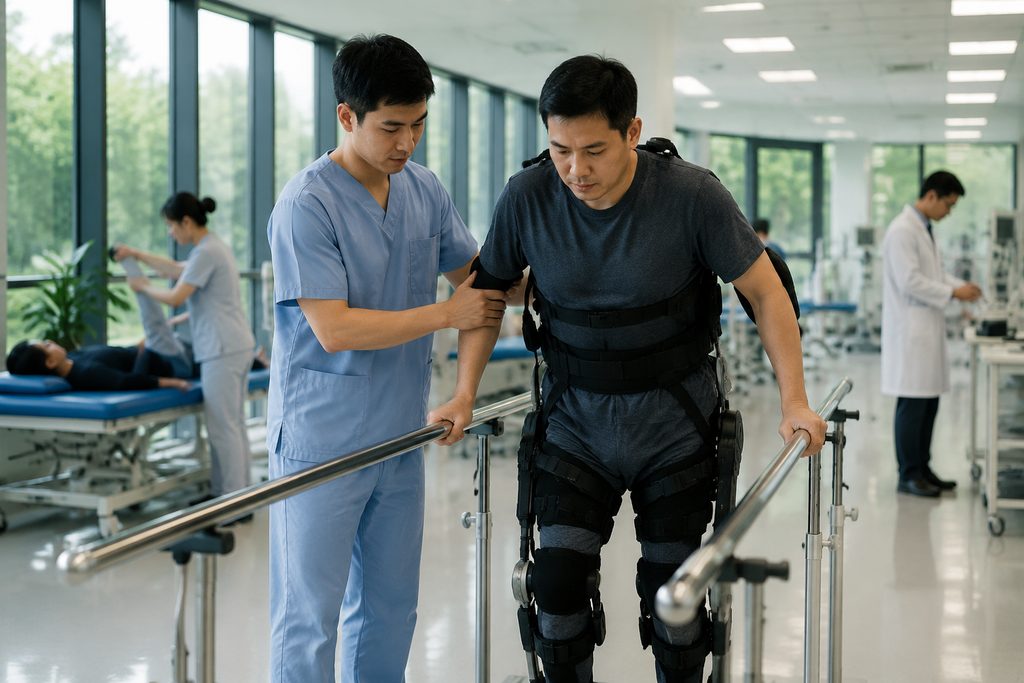
A patient in the United States can expect to pay upwards of $80,000 to $120,000 for a single month of intensive inpatient spinal cord injury rehabilitation. In Germany, the figure hovers around €45,000. In China, equivalent programs at top-tier university hospitals start at approximately $15,000 per month. The numbers are jarring. They create immediate cognitive dissonance for anyone who equates lower cost with lower quality. But volume is the silent variable that changes the math. A rehabilitation department at a major Chinese center like China Rehabilitation Research Center in Beijing manages a patient volume that dwarfs most Western facilities, creating a clinical density that breeds deep, specialized expertise.
Key Takeaways
- Intensive inpatient spinal cord injury rehab in China costs between $15,000 and $25,000 per month, roughly 20% of typical US program fees, with no clinical compromise.
- China’s top rehabilitation hospitals, like those in the Beijing medical cluster, operate at a scale that yields specialized expertise in complex spinal cord injuries.
- Navigating the system alone is genuinely difficult: language barriers, the S2 visa requirement, and the absence of direct insurance billing in public hospitals are real hurdles.
- A coordinated pathway through a hospital’s official international department is the only reliable way to secure a pre-booked inpatient bed and a structured rehab program from overseas.
The Problem: Rehabilitation Delays Are Neurological Theft
Time is not just money after a spinal cord injury. Time is neurological function. The window of maximal neuroplasticity—the period when the central nervous system is most capable of reorganizing and forming new connections—is finite and unforgiving. Sitting on a waiting list for three months for a public rehabilitation bed in Canada or the UK is not a mere inconvenience. It is the active loss of potential motor recovery. A 2022 study in the Journal of Neurotrauma reinforced what clinicians have long observed: patients who begin intensive, task-specific rehabilitation within the first 90 days post-injury demonstrate significantly greater functional independence measure (FIM) gains than those whose rehab start is delayed.
The bottleneck in many Western systems is structural. There are simply not enough specialized inpatient beds. A patient with a C5 incomplete injury in a suburban London hospital might find themselves waiting 8 to 12 weeks for a slot at a specialized spinal unit. Meanwhile, the muscles atrophy. Spasticity patterns set in. The psychological toll of waiting compounds the physical one. This is the pain point that forces families to look beyond their borders. Not for a miracle cure. For a system that can say “yes” immediately. That structural capacity exists in China’s top rehabilitation centers, where massive investment has created high-throughput, high-expertise departments designed to absorb complex cases without delay.
Who We Are
We are not a hospital. We do not provide medical treatment, clinical diagnoses, or rehabilitation therapy. We are your logistical architects. Our team at China Medical Services bridges the gap between you and China’s top-tier medical expertise. We handle the heavy lifting that makes international rehabilitation feasible: translating and presenting your medical records to the right department, coordinating a pre-arranged admission through official hospital international channels, securing your S2 medical visa invitation, and placing a bilingual medical companion at your side throughout the inpatient stay. We solve the structural problems so your clinical team can focus entirely on your recovery.
Why China’s Rehabilitation Model Delivers Results for Spinal Cord Injury
The model is different. It is not simply a cheaper version of Western rehab. It is a high-volume, high-intensity system built on a foundation of concentrated clinical exposure. A senior physiatrist at a top-ranked Chinese rehabilitation hospital will see more complex spinal cord injury presentations in one year than many Western counterparts see in five. That volume translates into pattern recognition—the ability to spot subtle autonomic dysreflexia triggers or to fine-tune a body-weight-supported treadmill training protocol based on a vast internal database of similar cases.
The Volume-Expertise Link in Complex Cases
Consider the numbers. China Rehabilitation Research Center (CRRC) in Beijing, one of the country’s leading facilities, operates over 1,000 beds dedicated to rehabilitation. The spinal cord injury division alone manages a caseload that keeps its therapists deeply immersed in the nuances of injury classification—from ASIA A complete lesions to the more ambiguous ASIA C and D incomplete injuries. This is not theoretical knowledge. This is daily, hands-on repetition with the full spectrum of spinal cord pathology. A 2018 analysis published in Spinal Cord highlighted that rehabilitation centers treating higher volumes of traumatic spinal cord injury patients achieved lower rates of pressure ulcer development and urinary tract infections—two complications that can derail progress for weeks. The mechanism is simple. More patients means more refined protocols and tighter vigilance.
Technology Integration Without the Markup
Walk into a modern inpatient spinal rehab unit in a top Chinese hospital and you will see the same equipment found in leading US or Swiss facilities: Lokomat robotic gait trainers, exoskeletons, functional electrical stimulation (FES) bikes, and virtual reality balance systems. The difference is the operational efficiency around them. A single Lokomat unit in a busy Chinese department might run sessions from 8:00 AM to 6:00 PM with minimal gaps, thanks to a dedicated technician team and streamlined scheduling. The capital cost of the machine is spread across a far larger patient base, which keeps per-session costs low. You are not paying a premium for access to the technology. You are paying for the therapist’s time and the hospital bed.
The Real Cost of Spinal Cord Injury Rehab in China
Let us address the financial question directly, because it is usually the first one asked. The spinal cord injury rehab cost China for a comprehensive inpatient program—including daily physiotherapy, occupational therapy, nursing care, and accommodation in a private or semi-private room—typically ranges from $15,000 to $25,000 per month. This is the figure for programs at top-tier public hospital international departments or VIP wings in cities like Beijing and Shanghai. The exact intensive inpatient spinal rehab China price varies by hospital and case complexity. A patient requiring more one-on-one therapy hours or specialized interventions like respiratory muscle training will fall toward the higher end. A medically stable patient on a standard protocol will be closer to the lower bound. Either way, the structural cost advantage is stark. The same month of intensive rehab in the US routinely exceeds $60,000, and can hit $100,000 at major academic medical centers.
| Rehab Component | Estimated Cost in China (per month) | Typical US Cost (per month) |
|---|---|---|
| Inpatient Bed & Nursing (private room) | $5,000 – $8,000 | $25,000 – $40,000 |
| Daily Physiotherapy (2-3 hours) | $4,000 – $6,000 | $15,000 – $25,000 |
| Occupational Therapy | $2,000 – $3,500 | $8,000 – $12,000 |
| Robotic-Assisted Gait Training (per session) | $80 – $120 | $350 – $500 |
| Physiatrist Consultations & Medical Management | $1,500 – $2,500 | $5,000 – $8,000 |
These numbers are not marketing estimates. They reflect the actual economics of China’s healthcare labor market and hospital operational models. A senior physiotherapist’s salary in Beijing, while competitive locally, is a fraction of a US-based therapist’s compensation. The hospital’s overhead for a private room is lower. These are structural cost differences, not corners cut on care quality. The outcome data, where it exists in comparable metrics, does not show inferior results. A 2021 comparative study in the Archives of Physical Medicine and Rehabilitation found that patients who traveled to specialized international centers for spinal cord rehab achieved functional outcomes comparable to those treated in their home countries, provided the program was of sufficient intensity and duration.
What You Need to Know Before Going Alone
We are direct about the difficulties because encountering them unprepared can ruin a carefully planned rehab journey. The barriers are real and they are structural. Here is what stands between you and a bed at the best spinal injury rehabilitation hospital Beijing has to offer.
- Visa Requirements Are Specific and Unforgiving: You cannot come to China for medical rehabilitation on a tourist visa (L) or a business visa (M). The correct visa is an S2 visa, specifically endorsed for medical treatment purposes. To get it, you need an official invitation letter from the Chinese hospital that has accepted you as a patient. Obtaining that letter independently—without a local contact who knows the international department’s documentation protocol—is where most solo attempts stall. The hospital needs your translated medical records, a treatment plan outline, and a deposit commitment before they issue the letter. We handle this sequence daily.
- Payment Systems Do Not Work Like Home: Public Chinese hospitals, even their international VIP wings, do not bill your US or European health insurance directly. You pay upfront. A deposit is required at admission, typically covering the estimated first month of care. Payment is made via bank transfer, UnionPay card, or sometimes international credit card with high limits. After discharge, you receive itemized receipts and a translated medical summary that you submit to your insurer for reimbursement. This cash-flow reality surprises families who are used to presenting a card and walking in. We prepare you for the exact deposit amount and payment method before you fly.
- Language Is a Clinical Barrier, Not Just a Social One: A rehabilitation session involves constant, nuanced communication. “Does this stretch feel like a stretch or a tear?” “Rate your neuropathic pain on a scale from one to ten, and describe its quality—burning, electric, aching?” These distinctions matter. Relying on a translation app during a therapy session is unsafe and ineffective. Even in international departments, not every therapist is fluent in medical English. A bilingual medical companion who understands both the clinical terminology and the therapy context is not a luxury. It is a safety requirement.
How We Help You Navigate This
These barriers exist for structural reasons. They are not designed to exclude international patients; the system simply was not built with them in mind. Our job is to build the bridge. The process begins with your medical records. You send us the discharge summary, the MRI report, the physiatry assessment, and the current functional status. Our team translates these documents with clinical precision—not just the words, but the medical meaning. We present them to the international department of the rehabilitation hospital best matched to your injury level and goals. For a C4 ASIA B injury with ventilator weaning potential, that might be a center with a dedicated respiratory rehab unit. For a T10 ASIA C incomplete injury focused on gait restoration, it might be a hospital with the most intensive Lokomat and exoskeleton programming.
Once the hospital reviews and accepts the case, they issue the official invitation letter. We courier the original to you. With that letter, your passport, and the visa application, the S2 visa is processed. Our team guides you through the exact consular requirements for your country. Before you travel, we confirm the admission date, the deposit amount, and the private room availability. On the day you land, a bilingual medical companion meets you at the airport. This same companion stays with you through admission, through every therapy session, through the difficult days when progress feels invisible. They translate, advocate, and navigate the hospital’s systems so your energy goes entirely into the work of recovery. If your stay extends beyond the initial plan—and spinal cord rehab often does—we handle the visa extension and the hospital’s internal administrative process to keep your bed secured.
How Long Is Spinal Cord Injury Rehab in China?
There is no single answer. The duration is dictated by injury level, completeness, medical stability, and functional goals. But the programs we coordinate are structured in intensive blocks. A typical initial inpatient stay is 4 to 8 weeks. That is the period of maximum therapy density—often 3 to 4 hours of active therapy daily, six days a week. For a patient with an incomplete cervical injury, the initial block might focus on respiratory strengthening, upper limb function, and sitting balance. A second block, after a short break or a transition to a step-down unit, might target standing and gait. Some patients stay for 12 weeks or more. The question of how long is spinal cord injury rehab in China is ultimately answered by your neurological progress and your tolerance for the intensity. The system is designed to accommodate extended stays when the clinical justification is clear. We coordinate the administrative side so a longer program does not become a bureaucratic crisis.
Can Spinal Cord Injury Patients Recover in China?
The word “recover” needs a careful definition. A complete spinal cord injury, by current medical understanding, does not reverse. But recovery is a broader concept. It means maximizing function below the level of lesion. It means achieving independence in wheelchair mobility, in pressure relief, in bladder and bowel management. It means preventing the secondary complications—contractures, pressure sores, depression—that steal quality of life. For incomplete injuries, the gains can be more dramatic. The question can spinal cord injury patients recover in China is better reframed: can a high-intensity, high-volume rehabilitation program in a specialized center produce functional outcomes that equal or exceed what is available at home? The evidence says yes, with the critical caveat that intensity and early timing are the active ingredients. China’s top centers deliver that intensity. They have the patient volume to justify the staffing ratios and the equipment investment. Recovery is not guaranteed anywhere. But the conditions for maximizing recovery are met here.
How to Book a Spinal Cord Injury Rehab Program in China
The pathway is not a website booking form. You cannot browse dates and click “reserve.” The process is medical coordination. To book spinal cord injury rehab program China, the sequence is: medical record review, hospital matching, case acceptance by the international department, invitation letter issuance, visa processing, deposit payment, and admission scheduling. This sequence takes time. A realistic timeline from first contact to admission is 3 to 5 weeks. Rushing it leads to errors. An incomplete visa application or a poorly translated MRI report can cause delays that cascade. Our team manages the timeline actively. We know which hospitals have bed availability. We know the documentation quirks of each international department. We compress the administrative timeline as much as is safely possible, because we understand that every week of delay carries a neurological cost.
Frequently Asked Questions
At the top-tier hospitals we work with, yes. These are university-affiliated centers with physiatrists trained in international protocols, including those from the International Spinal Cord Society (ISCoS). The equipment is modern, the therapy techniques are evidence-based, and the clinical leadership often has international fellowship training. The difference is operational—higher patient volume and a more intensive daily schedule—not a difference in clinical knowledge. We only coordinate with hospitals ranked in the top tier of China’s national rehabilitation hospital assessments, which ensures a baseline of quality that meets international expectations.
This is a legitimate concern for any spinal cord injury patient traveling abroad. Autonomic dysreflexia, urinary tract infections, and pressure ulcers are real risks. The rehabilitation hospitals we work with are full-service general hospitals, not standalone rehab facilities. They have emergency departments, internal medicine consult services, and ICU capacity on-site. If a complication arises, you are not transferred to another facility. You are managed within the same hospital system, often on the same floor. Your bilingual companion stays with you through any acute medical event, ensuring communication with the medical team remains clear. We also maintain contact with your family back home and can facilitate direct communication between the treating Chinese physician and your home physiatrist if needed.
Most US and European health insurers do not have direct billing agreements with Chinese public hospitals. You will pay upfront and seek reimbursement. The key is pre-authorization. Before you travel, we provide a detailed treatment plan and cost estimate from the hospital that you can submit to your insurer for pre-approval. Some international insurance plans, particularly those with global coverage provisions, will reimburse a significant portion of the costs. The hospital provides itemized receipts and a translated discharge summary that meets international insurance documentation standards. We cannot guarantee your insurer will pay, but we ensure you have the paperwork to make the strongest possible claim.
Yes. Private rooms in the international VIP wards are designed to accommodate one family member. A companion bed or fold-out sofa is standard. Your family member applies for an S2 visa alongside you, using the same hospital invitation letter as supporting documentation. Having a family member present is encouraged—they participate in caregiver training sessions so that discharge planning starts from day one. The bilingual medical companion handles the logistical and translation tasks, freeing your family member to focus on emotional support and learning the care skills they will need at home.
