Radiology Second Opinion China Cost: Why Imaging Review Must Be Specific
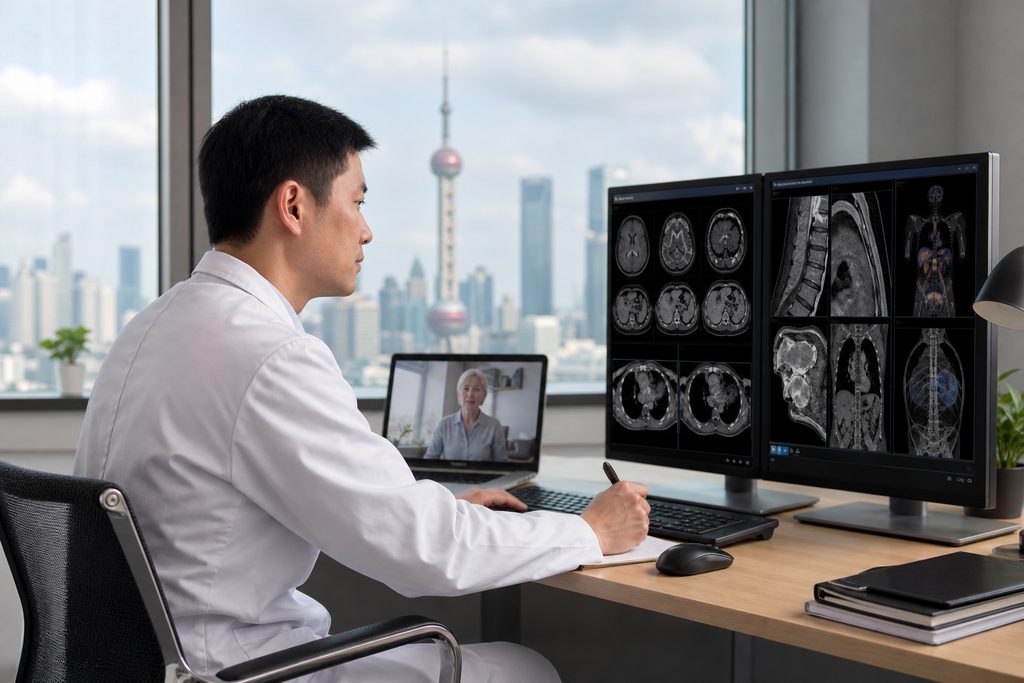
When 47-year-old Daniel from Manchester received his abdominal CT report, the phrase “nonspecific 6mm hypodense lesion in segment VII” sat on the page like a riddle. His local radiologist shrugged. “Probably a cyst. We’ll rescan in six months.” Daniel wasn’t satisfied. He started searching for a radiology second opinion — and quickly discovered that not all imaging reviews are created equal. Some services simply re-read the same images and confirm the original wording. Others dig into the actual DICOM data, reconstruct the slices, and ask questions the first report never addressed. The difference matters. And the radiology second opinion China cost is often a fraction of what patients expect, which makes the decision easier than most assume.
But here’s the thing most patients don’t realize until they’re deep in the process: a second opinion is only valuable if the review is specific. “Specific” means the reviewing radiologist identifies the exact sequence, slice number, and measurement they’re questioning. It means they compare against prior imaging if available. It means they state what they can and cannot rule out. A vague second opinion — “the findings appear consistent with the original interpretation” — is worse than useless. It costs money and buys false reassurance.
This article explains how a specific imaging review works, what it costs in China, which hospitals do it well, and where the process can go sideways. We coordinate these reviews regularly for international patients, and we’ve seen both the excellent outcomes and the frustrating ones.
How This Actually Works, Step by Step
Let’s walk through the real sequence. Not the idealized version — the actual one.
First, you gather your existing imaging. That means the original DICOM files, not just the printed report or a JPEG of one slice. Most hospitals in the US, UK, and Europe will release DICOM data on a CD or via a secure download link. You need those raw files because a meaningful second opinion requires the reviewing radiologist to manipulate the images — windowing, measuring, reconstructing in different planes. A static image is not enough.
Second, you send the files along with any prior reports, lab results, and a brief clinical summary. The clinical context matters enormously. A lung nodule means something different in a 55-year-old with a 30-pack-year smoking history than in a 30-year-old nonsmoker. The reviewing radiologist needs to know who they’re looking at.
Third, the Chinese radiology team reviews the case. In top hospitals, this is typically done by a subspecialist — a chest radiologist for lung imaging, a neuroradiologist for brain scans, a musculoskeletal radiologist for joint and spine cases. They examine the DICOM data directly, not just the report. They measure lesions themselves. They check for findings the first report may have missed or dismissed.
Fourth, you receive a written report. The best reports are structured: they state what was imaged, what was found, what was not found, and what remains uncertain. They include specific measurements and reference the exact image series and slice numbers. They end with clear recommendations — rescan in three months, consider biopsy, or no further action needed.
Fifth, if you want more than the written report, you can request a video consultation with the reviewing radiologist. This is where you ask the questions that a written document can’t answer: “How confident are you in this finding?” “What would you do if this were your own scan?” “Is there any finding here that should prompt urgent action?”
Why a Specific Imaging Review Catches What the First Report Missed
Radiology is not a perfect science. Studies consistently show significant inter-reader variability. A 2022 study in European Radiology found that in abdominal CT interpretation, clinically significant discrepancies between radiologists occur in roughly 26–32% of cases. That’s not a typo. Nearly one in three scans has a finding that another subspecialist reads differently.
Why does this happen? Several reasons. General radiologists read everything — chest, abdomen, brain, spine, joints. Subspecialists read one area all day, every day. They see patterns that generalists may not recognize. Volume matters too. A radiologist at a major Chinese hospital may read hundreds of cases per week in their subspecialty. That repetition builds pattern recognition that no textbook can replicate.
Also, time pressure. In many Western healthcare systems, radiologists are expected to read a CT scan every 10–15 minutes. In China’s top hospitals, the volume is even higher — but the subspecialization is deeper. A dedicated chest radiologist at a hospital like Zhongshan Hospital Fudan University or Peking Union Medical College Hospital reads only chest cases. That focus produces a different level of scrutiny.
What does “specific” look like in practice? Consider Daniel’s case. His original report said “nonspecific 6mm hypodense lesion.” The Chinese second opinion report said: “On portal venous phase, series 4, image 87, there is a 6.2mm lesion in segment VII with Hounsfield units of 18, no enhancement on arterial phase, sharp margins. Features most consistent with a simple cyst. However, given the patient’s history of colorectal cancer, a metastasis cannot be entirely excluded based on imaging alone. Recommend follow-up MRI with hepatobiliary contrast in 3 months.” That’s specific. It names the sequence, the slice, the density, the enhancement pattern, and the clinical caveat. It gives Daniel something actionable.
That difference — between “probably fine” and “here’s exactly what we see, here’s what we can’t rule out, here’s what to do next” — is what patients are actually paying for.
Radiology Second Opinion China Cost: What You’ll Actually Pay
Let’s talk numbers. The radiology second opinion China cost spans a wide range depending on the hospital tier, the radiologist’s seniority, and whether you want a written report only or a live video consultation.
Here’s a realistic breakdown based on current market rates across Chinese hospitals that offer international second-opinion services:
| Service Type | Typical Cost (USD) | What You Get | Turnaround |
|---|---|---|---|
| Written second opinion — standard radiologist | $100–300 | Structured written report reviewing your DICOM files | 3–7 business days |
| Written second opinion — subspecialist / senior radiologist | $300–500 | Detailed report from a radiologist who reads only your body area | 5–10 business days |
| Video consultation with radiologist | $150–300 | Live 20–30 minute discussion of findings, Q&A | Scheduled within 1–2 weeks of report |
| Combined written + video package | $400–800 | Full written report plus live consultation | 7–14 business days |
| Multidisciplinary review (radiologist + clinician) | $1,500–2,000 | Imaging review plus a treating specialist’s interpretation and treatment recommendations | 2–3 weeks |
Prices vary by hospital and case complexity. A complex neuro-oncology case with multiple prior scans will cost more than a single knee MRI. The hospital’s international department sets the final quote after reviewing what you’ve sent.
For comparison, a radiology second opinion in the United States typically runs $250–750 for a written report and $500–1,200 for a consultation with a subspecialist. The medical imaging second opinion abroad price in China is generally 30–50% lower for equivalent expertise. That’s a meaningful difference when you’re already paying for treatment.
And here’s a structural advantage: many Chinese hospitals process second opinions through their formal international patient departments. That means your case is assigned to a named radiologist, tracked with a case number, and delivered with a hospital letterhead. You’re not emailing images into a void.
A Realistic Timeline
Patients often underestimate how long a proper imaging review takes. Here’s what actually happens, week by week:
| Stage | What Happens | Realistic Duration |
|---|---|---|
| Day 1–3 | You request DICOM files from your original imaging center. Some hospitals take 24 hours; others take a week. You fill out the intake form and send clinical history. | 2–7 days |
| Day 4–10 | File transfer. Large DICOM sets (a full chest CT can be 500MB–1GB) require secure upload portals. If files are corrupted or incomplete, this stage repeats. | 1–5 days |
| Week 2 | Case triage and radiologist assignment. The hospital’s international department reviews your materials, confirms completeness, and assigns the appropriate subspecialist. If they need additional sequences or prior scans, they’ll ask now. | 2–5 days |
| Week 2–4 | Radiologist review and report writing. This is the core work. The radiologist reads your scan, compares with priors if available, and drafts the report. Senior radiologists often review the subspecialist’s work before release. | 5–14 days |
| Week 4–6 | Report delivery and optional video consultation. If you booked a live discussion, it’s scheduled after you’ve had time to read the written report. | 3–7 days after report |
Total: realistically 3–6 weeks from first request to final consultation. Can it be faster? Yes, for urgent cases. Some hospitals offer expedited review within 48–72 hours for an additional fee, typically 50–100% surcharge. That’s worth considering if you’re facing a treatment decision deadline.
The steps people forget: getting the actual DICOM files (not just the report), ensuring the files aren’t corrupted during transfer, and providing enough clinical context. A one-sentence summary — “I have a lung nodule” — is not enough. The reviewing radiologist needs to know your age, smoking history, symptoms, any prior cancers, and what prompted the scan in the first place.
What Can Go Wrong — and What Happens Then
Let’s be honest about failure modes. A second opinion is not a guarantee of a better answer. Sometimes it confirms the first report. Sometimes it raises new questions without resolving the old ones. Sometimes the images themselves are the problem.
Incomplete DICOM data. If the original imaging center only provides a portion of the series — say, the axial images but not the coronal or sagittal reconstructions — the reviewing radiologist is working with incomplete information. They’ll tell you. The report will state: “Review limited by absence of [sequence]. Recommend obtaining complete dataset.” That’s not a failed review; it’s an honest one. But it means you may need to go back to your original provider and request the full set.
Disagreement without resolution. Sometimes two excellent radiologists look at the same scan and reach different conclusions. A 7mm lung nodule: one says “likely benign, follow up in 12 months.” The other says “indeterminate, recommend PET-CT now.” What do you do? This is where the video consultation becomes critical. You can ask the reviewing radiologist directly: “What’s the risk of waiting? What’s the downside of scanning now?” A good radiologist will quantify their uncertainty and help you weigh the tradeoffs.
Language and terminology gaps. Chinese radiology reports use standardized terminology, but the phrasing can differ from what you’re used to. “Suggest clinical correlation” means the same thing in Shanghai as in Boston. But some descriptive terms — “mild inflammatory changes,” “borderline enlarged lymph node” — carry different weight depending on the author. Our team reviews the English translation to ensure the nuance survives. A literal translation can flatten important distinctions.
No prior imaging available. If this is your first scan and there’s nothing to compare against, the radiologist can only describe what they see now. They can’t tell you if a lesion is stable, growing, or shrinking. That’s not a failure of the review — it’s a limitation of the data. The report will say so explicitly.
What happens if the report is genuinely unhelpful? You contact the hospital’s international department. Reputable programs will offer a clarification call or, in some cases, a re-review by a different radiologist at no additional charge. This is rare, but it happens. The key is to work through a coordinator who can advocate on your behalf — not to email a generic hospital address and hope for the best.
Is Teleradiology Reliable for Cancer Diagnosis?
This is the question underneath the question. Patients searching for an imaging second opinion are often asking something deeper: is teleradiology reliable for cancer diagnosis? Can a radiologist in Shanghai really evaluate my scan as well as one in London or New York?
The short answer: yes, with caveats. Radiology is one of the most teleradiology-friendly specialties in medicine. The images are digital. They can be transmitted losslessly. A radiologist in Beijing viewing your DICOM files on a high-resolution monitor sees exactly what a radiologist in Chicago sees — assuming the files are complete and the monitor is adequate. The physical location of the radiologist is irrelevant to the quality of the read.
What matters is the radiologist’s training, subspecialty, and volume. A chest radiologist who reads 8,000 chest CTs per year will generally outperform a general radiologist who reads 800. That’s true whether they’re sitting in Shanghai or San Francisco. China’s top hospitals produce some of the highest imaging volumes in the world. Fuwai Hospital alone performs over 140,000 cardiac imaging studies annually. That volume creates expertise.
But there are real caveats. The quality of the original scan matters. A low-dose CT performed on older equipment with thick slices (5mm or more) limits what any reviewer can see. A 1mm thin-slice high-resolution scan gives far more information. The reviewing radiologist can’t fix a poor-quality original scan.
Also, teleradiology works best when the clinical question is well-defined. “Is this lung nodule concerning?” is a question a remote radiologist can answer well. “Why do I have chronic abdominal pain?” is not — that requires clinical examination, lab work, and possibly additional imaging. A remote imaging review can contribute to that workup but can’t replace an in-person evaluation.
For cancer specifically, the reliability of teleradiology depends on what you’re asking. If you want to know whether a lesion looks malignant, whether staging appears accurate, or whether a subtle finding was missed — a subspecialist second opinion can be extremely valuable. If you want a definitive diagnosis, that requires biopsy and pathology, not imaging alone. No radiologist, in any country, can diagnose cancer from a scan with 100% certainty. They can say “features highly suspicious for malignancy” or “findings consistent with benign etiology.” The specificity of their language matters.
Best Hospital for MRI Second Opinion Beijing: Where to Send Your Scans
If you’re specifically looking for the best hospital for MRI second opinion Beijing, the answer depends on what body part was imaged. Beijing has several institutions with world-class radiology departments, but they have different strengths.
Peking Union Medical College Hospital (PUMCH) is the most prestigious general hospital in China. Its radiology department is strong across the board, but particularly for complex and rare cases. If your MRI shows something unusual — a lesion that doesn’t fit a standard pattern — PUMCH is a strong choice. The hospital’s international department has extensive experience with foreign patients and English-language reporting.
Beijing Tiantan Hospital is China’s top center for neurology and neurosurgery. If your MRI is of the brain or spine — especially if it shows a tumor, vascular malformation, or demyelinating disease — Tiantan’s neuroradiologists see more of these cases than almost any center in the world. For neuroimaging second opinions, this is arguably the strongest option in Beijing.
Beijing Cancer Hospital focuses exclusively on oncology. If your MRI is part of a cancer workup — staging, treatment response assessment, or recurrence surveillance — a dedicated cancer radiologist here will read your scan with an oncologist’s eye. They’re specifically trained to evaluate tumor margins, lymph node involvement, and treatment-related changes.
For musculoskeletal MRI — knee, shoulder, spine, hip — Beijing Jishuitan Hospital is the reference center. It’s China’s top orthopedic hospital, and its MSK radiologists read joint and spine imaging all day.
What about Shanghai? If you’re asking what does a CT scan cost in Shanghai for a second opinion
Frequently Asked Questions
Yes. The hospitals used for international patients are JCI-accredited and follow the same international safety standards as top hospitals in the US and Europe. Surgical teams perform high volumes of procedures — often more than their Western counterparts — which studies show leads to better outcomes.
Costs vary by procedure and hospital, but international patients typically save 40-80% compared to US prices — even when factoring in travel and accommodation. A consultation with our team will give you an exact, all-inclusive quote with no hidden fees.
Send us your existing medical reports to get started. We handle everything from hospital selection and appointment scheduling to visa assistance and post-operative recovery planning. Your medical records are reviewed by the specialist before you even book a flight.
For more medical information and treatment options in China, visit chinamedservices.com (China Medical Services).
