Nanjing Drum Tower Hospital: Sports Medicine for Visitors
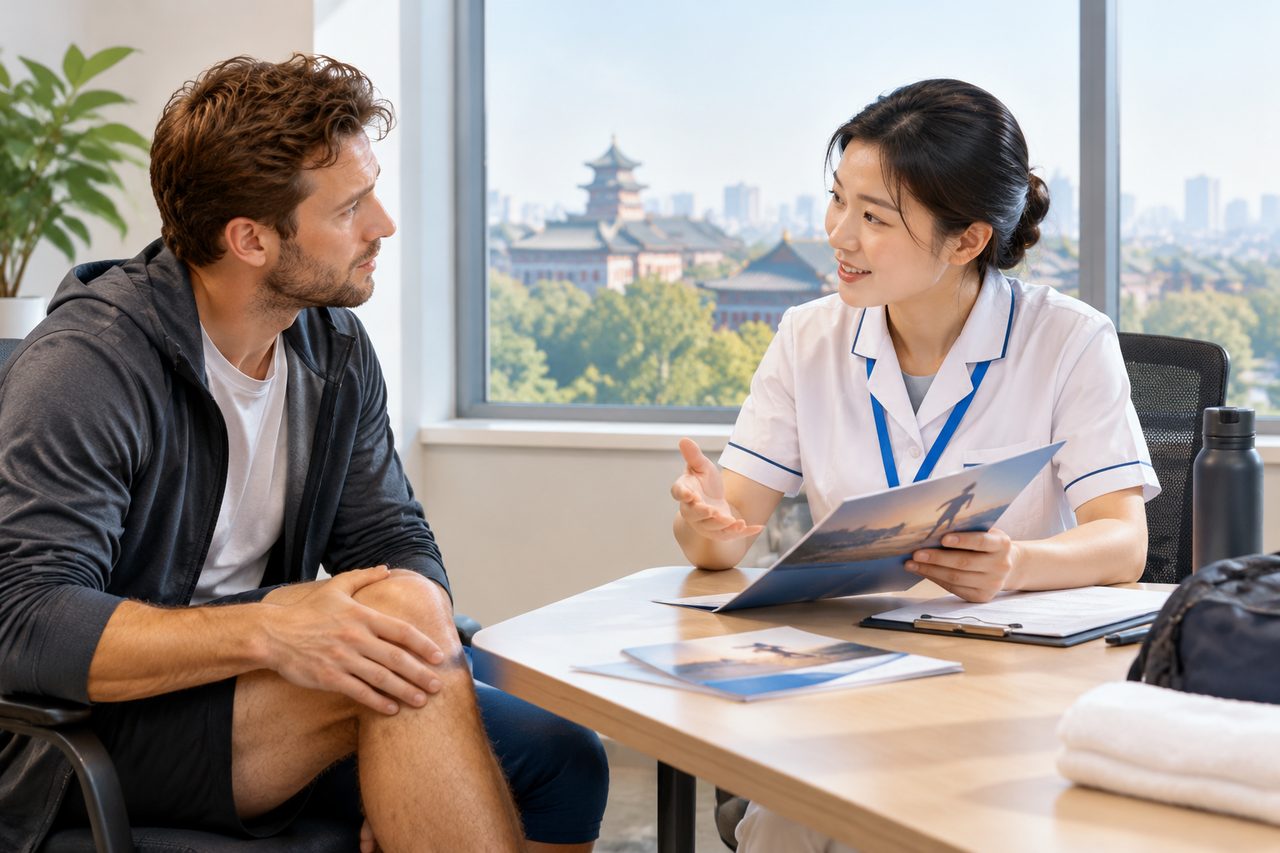
Sports medicine is the branch of orthopedics that deals with injuries from movement — a torn ACL from football, a rotator cuff damaged in the gym, an ankle that never recovered from a bad landing, a meniscus that locks the knee. It covers diagnosis, imaging, surgery when it is genuinely needed, and the rehabilitation that determines whether you return to sport at all. For an international patient, the practical question is rarely “what is sports medicine?” It is narrower: can I get a credible assessment and, if necessary, surgery at a major Chinese hospital, what will it cost, how long will I be away, and how do I arrange any of it without speaking Chinese?
Nanjing Drum Tower Hospital (Nanjing Gulou Hospital) is one of the best-known academic medical centers in eastern China, and its orthopedics department is a common destination for joint, spine and sports-injury cases. This guide explains what a visiting athlete or active patient can realistically expect there, how the Nanjing Drum Tower Hospital sports medicine cost is actually built up, and where the friction points are. It is written to help you plan, not to replace advice from a qualified clinician who has examined you.
How This Actually Works, Step by Step
Most international patients imagine booking a surgeon the way they book a flight. In Chinese public hospitals, the sequence is different, and understanding it early saves weeks.
Step 1 — Gather your existing records. You start with what you already have: MRI or CT images (the actual DICOM files or films, not just the radiologist’s report), X-rays, ultrasound reports, any previous operative notes, and a short written history of how the injury happened and what treatment you have already tried. Physiotherapy notes matter more than most patients expect, because they show whether conservative management has been given a fair trial.
Step 2 — Get a written review before you travel. A Chinese specialty team can review translated records and return a written opinion on the likely diagnosis, whether surgery is indicated, which procedure is being considered, and what further imaging would be needed. This is the single most useful step for a visitor, because it prevents a long flight for a problem that could be managed at home, or reveals that you need a different department entirely.
Step 3 — Decide on a video or in-person route. A video consultation lets you speak with the specialty team directly, ask about the proposed procedure and hear their recommendations. If you prefer to have someone attend the hospital on your behalf first, a proxy visit can be arranged using your materials, with registration and a medical card created in your name.
Step 4 — Confirm the plan and the appointment. Only after a feasible plan is agreed does travel make sense. At that point, appointment coordination through the hospital’s international or VIP channel becomes relevant, because ordinary outpatient registration in a large public hospital is generally same-day queueing and cannot be reserved from abroad in advance.
Step 5 — Arrive, be seen, and plan rehabilitation. In-person assessment, any additional imaging, the decision on surgery, and then the post-operative program. Discharge planning and a written rehabilitation protocol you can continue at home should be discussed before you leave China.
What Sports Medicine at Nanjing Drum Tower Hospital Covers
Sports medicine in a large Chinese academic hospital sits within orthopedics and is usually organized around joints and soft tissue rather than around “sport” as a category. In practice, the case mix a visiting patient is likely to encounter includes:
- Knee injuries — ACL and other ligament reconstruction, meniscus repair or trimming, cartilage procedures, patellar instability
- Shoulder conditions — rotator cuff repair, instability and labral surgery, impingement
- Ankle and foot problems — ligament repair, Achilles tendon issues, cartilage lesions
- Hip and elbow arthroscopy in selected cases
- Overuse and tendon injuries where imaging and injection therapy are being considered
Arthroscopic (keyhole) techniques are standard at major Chinese centers, and high-volume hospitals see a large number of ligament and meniscus cases each year. That volume is relevant to you as a patient for one reason: experienced teams tend to have well-developed post-operative protocols. It is not a guarantee about your individual outcome, and no responsible provider should present it as one.
One distinction worth understanding before you search further: Chinese hospitals separate sports medicine from rehabilitation medicine. The surgeon may perform the reconstruction, but the structured physiotherapy that follows is often delivered by a rehabilitation department, sometimes in a different building or on a different schedule. For a visitor, the handover between the two is exactly where plans fall apart, so ask explicitly who manages rehabilitation and where.
A Realistic Timeline
The table below sets out a typical sequence for a visitor considering sports-injury surgery in Nanjing. Ranges are wide on purpose — they depend on how complete your records are, which hospital channel you use, visa processing in your country, and clinical findings.
| Stage | Typical duration | What is happening |
|---|---|---|
| Record collection and translation | 3–10 days | Gathering imaging files, reports and history; medical translation into Chinese |
| Written second opinion | 3–7 days after records arrive | Specialty team reviews materials and returns written analysis and direction |
| Video consultation (if chosen) | Scheduled within roughly 1–2 weeks | Direct discussion of diagnosis, procedure options and questions |
| Visa preparation | 2–4 weeks, varies by country | S2 visa application with hospital supporting documents; timing set by the embassy or consulate |
| Travel and in-person consultation | Arrival plus 1–3 days | Examination, any additional imaging, surgical decision |
| Surgery and inpatient stay | Typically a few days for arthroscopic procedures; longer for complex reconstruction | Procedure, wound care, early mobilization |
| Early rehabilitation in China | 2–6 weeks, depending on procedure and plan | Supervised physiotherapy before flying home |
| Continued rehabilitation at home | 3–9 months | Structured program; return-to-sport timelines are set by your treating clinician |
Two waiting steps catch people out. First, imaging files often need to be transferred in a usable format, and a radiology report alone is not enough for a surgeon to plan. Second, appointment lead time at busy departments is real; a plan built on “we will sort it when we arrive” usually costs more days than a plan built on a confirmed date.
What Can Go Wrong — and What Happens Then
Major orthopedic procedures in China’s leading public hospitals are generally far less expensive than equivalent US list prices, though the gap varies by procedure and by hospital channel. International departments typically charge around 1.5 to 2 times the standard channel. A meaningful figure requires a review of your imaging and a written quote from the hospital; treat any pre-assessment number as indicative only.
Large academic hospitals have substantial orthopedic volume and follow national accreditation standards, and arthroscopic surgery is routine at this level. The main risks specific to visitors are communication and continuity — an incomplete history, misunderstood consent, or unsupervised rehabilitation after you fly home. Addressing those three directly does more for your safety than comparing reputation rankings.
For arthroscopic procedures, many patients plan two to six weeks in China, covering admission, surgery, wound review and the start of supervised physiotherapy, with rehabilitation continuing at home for several months. Complex reconstruction or complications can extend this considerably. Build flexible dates rather than a fixed return flight.
Your Next Step
The takeaway is simple: get your imaging reviewed in writing before you commit to travel, and treat the appointment, the surgery and the rehabilitation as three separate things to plan. China Medical Services helps international patients navigate Chinese hospitals — matching departments, coordinating appointments through official channels, arranging bilingual accompaniment and explaining visa steps. We are not a medical provider and we do not diagnose, promise admission, or guarantee any clinical outcome. If you would like an initial conversation about whether a remote review at a Nanjing orthopedic department is worth pursuing, you can request a free consultation and we will tell you honestly what is and is not feasible for your case.
For more medical information and treatment options in China, visit chinamedservices.com (China Medical Services).
