Post-Treatment Reconditioning in China: Your Exercise Prescription Guide
When 52-year-old David from Manchester finished his knee replacement at a private London hospital, the surgeon handed him a single printed sheet. It had five stick-figure drawings and a note: “Physio twice a week for six weeks.” No supervised progression. No strength benchmarks. No answer when David asked when he could hike again. Six months later, he still limped on stairs. His story is not unusual. A 2023 systematic review in the *British Journal of Sports Medicine* found that unsupervised home exercise after joint surgery yields only about 40% adherence at the three-month mark. Half of patients simply stop. They stop because they are afraid of doing damage. They stop because no one is watching their form. They stop because recovery hurts and no one is there to tell them the hurt is normal.
David eventually found his way to a hospital-based rehabilitation program in Shanghai. Three weeks of daily supervised sessions. Real-time gait analysis. Progressive loading protocols adjusted every three days. He flew home walking without a cane. That program is what we help international patients access. It is called an exercise prescription — a structured, medically supervised fitness plan designed specifically for post-treatment reconditioning. And China’s top hospitals have built some of the most systematic, high-volume programs in the world.
Key Takeaways
- Hospital-based post surgery fitness training in China typically costs $200–500 per day for supervised sessions — roughly one-fifth of equivalent private rehab in the US or UK.
- China’s top orthopedic and cardiac centers run rehabilitation departments that see thousands of post-surgical patients monthly, creating clinical expertise that smaller Western clinics cannot match.
- Language barriers and hospital registration systems make independent access nearly impossible without a bilingual coordinator — this is the single biggest friction point for international patients.
- Exercise prescription in China is physician-led and hospital-integrated, not outsourced to a strip-mall physio clinic. That structural difference matters for complex cases.
The Problem: Recovery Is Where Outcomes Are Won or Lost
Surgery fixes structure. Rehabilitation rebuilds function. A technically perfect ACL reconstruction means nothing if the patient never regains full neuromuscular control. The data on this is sobering. Research published in the Journal of Orthopaedic & Sports Physical Therapy shows that only 55% of ACL reconstruction patients return to their pre-injury activity level — and the primary predictor is not surgical technique. It is the quality and consistency of post-operative rehabilitation.
Western healthcare systems know this. But they are not built to deliver it. In the UK, NHS physiotherapy after joint replacement typically offers six to eight sessions over three months. Each session lasts 30 minutes. The patient does the rest alone. In the US, insurance may cover 12 to 20 outpatient physical therapy visits — but copays of $40 to $75 per session add up fast. Private pay for one-on-one supervised exercise training at a US sports medicine clinic runs $150 to $350 per hour. A full three-week daily program? You are looking at $9,000 to $22,000. Most patients cannot afford it. Most insurance will not cover it. So they go home with a sheet of paper and hope.
That gap — between what recovery demands and what systems deliver — is exactly where medical travel to China becomes a rational, evidence-based choice. Not because it is exotic. Because it is structured.
Who We Are
We are not a hospital. We do not provide medical treatment, prescribe exercise protocols, or make clinical recommendations. Our team is the operational bridge between you and China’s top-tier rehabilitation hospitals. We handle hospital matching, appointment coordination, bilingual medical companion services, and all the logistical architecture that makes an international recovery journey possible. Think of us as your in-country logistics team — people who know which hospitals run the strongest post-cardiac surgery reconditioning programs, how to book a bed in a rehabilitation ward, and what to do when the registration desk only speaks Mandarin.
Why Hospital-Based Exercise Prescription in China Delivers Results
Volume Creates Clinical Pattern Recognition
China’s top rehabilitation hospitals operate at a scale that reshapes clinical expertise. The Rehabilitation Hospital of the National Research Center for Rehabilitation Technical Aids in Beijing runs over 400 beds dedicated solely to post-surgical and neurological rehabilitation. The rehabilitation department at Huashan Hospital in Shanghai — one of China’s premier orthopedic and sports medicine centers — manages more post-ACL reconstruction cases in a single month than a typical US outpatient clinic sees in a year.
What does volume mean for a patient? It means the physiotherapist adjusting your resistance band has seen your exact post-operative week fifty times before. They recognize subtle compensation patterns — the hip hike, the trunk lean — that a generalist might miss. A 2022 study in The Lancet examining surgical volume-outcome relationships found the pattern extends to rehabilitation: centers treating high volumes of a specific post-surgical population achieve measurably better functional outcomes at six months. The mechanism is straightforward. Pattern recognition cannot be taught in a textbook. It is built through repetition.
Physician-Led, Not Physio-Only
In most Western outpatient settings, a patient discharged from surgery sees a physical therapist. The surgeon signs off on a generic protocol. Communication between the two is minimal — maybe a progress note faxed once a month. In China’s hospital-based rehabilitation model, the exercise prescription is written by a rehabilitation physician — a medical doctor specializing in physical medicine and rehabilitation — in direct coordination with the operating surgeon. The physiotherapist executes the protocol but does not design it in isolation.
This structural difference matters for patients with comorbidities. A 58-year-old recovering from a cardiac bypass who also has type 2 diabetes needs an exercise prescription that accounts for glycemic response during aerobic training. A rehabilitation physician manages that intersection. A standalone physio clinic typically cannot. The integration is what makes supervised exercise programs after treatment in China fundamentally different from the outpatient model most Western patients know.
Cost Structure That Makes Intensive Rehab Accessible
Let us address the obvious question directly. If the care is this integrated and this supervised, why does it cost less? The answer is structural, not qualitative. China’s hospital-based rehabilitation pricing reflects three factors: lower labor costs for allied health professionals, high patient volumes that spread fixed costs, and a healthcare financing system that does not layer on the administrative overhead of US insurance billing. A day of supervised one-on-one exercise training at a top Shanghai rehabilitation hospital runs approximately $200 to $350. A comparable session in a US hospital-based outpatient rehab department bills at $400 to $600 — and that is before the facility fee.
For a three-week daily program, the math is stark. China: roughly $4,200 to $7,350. United States: $8,400 to $12,600, often with stricter session limits. The post surgery fitness training China price differential is not a signal of lower quality. It reflects a system built for volume and accessibility rather than margin maximization. We have written more about the broader cost landscape in our guide to China’s top-ranked hospitals.
| Rehabilitation Service | China (Hospital-Based) | US (Outpatient) | UK (Private) |
|---|---|---|---|
| Daily supervised exercise session (1 hour) | $200–350 | $400–600 | £150–250 |
| 3-week daily intensive program | $4,200–7,350 | $8,400–12,600 | £3,150–5,250 |
| Physician rehab consult (initial) | $80–150 | $250–400 | £180–300 |
| Gait analysis with force plate | $60–120 | $200–350 | £150–250 |
All prices are estimates in USD/GBP and vary by hospital, city, and case complexity. These figures reflect hospital-based rehabilitation departments in Tier 1 Chinese cities compared to private-pay rates in the US and UK.
How Does Supervised Reconditioning Work in Chinese Hospitals?
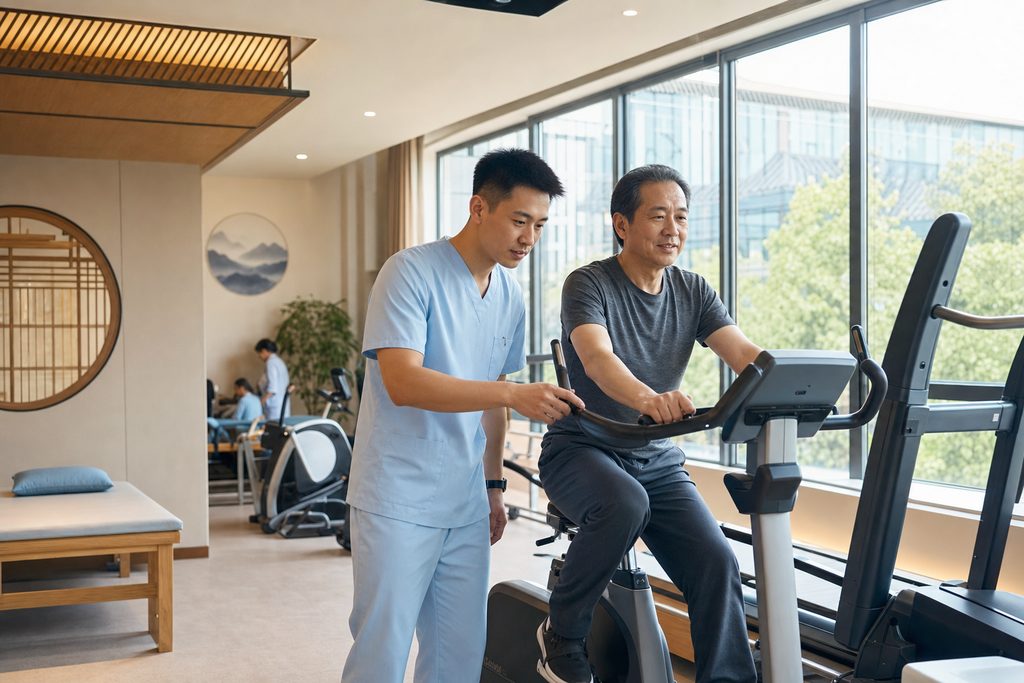
If you have never experienced a Chinese hospital rehabilitation department, the workflow may surprise you. It is not a quiet clinic with one therapist and a treatment table. It is a large, open-plan space — often an entire floor — with multiple stations running simultaneously. Patients rotate through stations. One corner has anti-gravity treadmills. Another has isokinetic dynamometers. A third area runs group balance training. The atmosphere is purposeful, almost industrial in its efficiency.
A typical day starts with a brief physician check — blood pressure, pain score, range-of-motion measurement. The exercise prescription for that day is adjusted based on the previous day’s response. Then the patient moves through a circuit: manual therapy if needed, followed by supervised resistance training, cardiovascular conditioning, and neuromuscular re-education. A physiotherapist or exercise physiologist is at each station. The ratio is usually one-to-one or one-to-two. Every repetition is watched.
This is what medical exercise therapy after surgery in China looks like in practice. It is not a suggestion to do three sets of leg raises at home. It is a structured, observed, daily-adjusted protocol delivered in a medical facility. For patients who have struggled with adherence at home — and that is most patients — the difference is transformative.
What You Need to Know Before Going Alone
We believe in telling patients the hard truths upfront. Accessing hospital-based rehabilitation in China independently is difficult. Not impossible — but genuinely difficult. Here is what you are up against:
- Registration systems are Mandarin-only and often require in-person queueing. Top rehabilitation departments do not accept international self-referrals through a website. You or someone on your behalf must physically go to the hospital, navigate the registration hall, and secure an appointment with a rehabilitation physician. The registration desk will not speak English. The forms are in Chinese characters. This is not hostility — it is a system built for a domestic patient population of 1.4 billion.
- Rehabilitation beds are not guaranteed without a local coordinator. Inpatient rehabilitation — where you stay in the hospital during your program — requires a bed. Shanghai’s top rehab hospitals run at near-full occupancy. A referral from a partner organization carries weight. A foreign patient walking in off the street does not.
- Medical records must be translated into Chinese for physician review. The rehabilitation physician needs your surgical notes, imaging reports, and any relevant lab work. These must be professionally translated. Google Translate will not suffice for a meniscus repair description or a cardiac catheterization report. Errors in translation create clinical risk.
These barriers exist for structural reasons. They are not insurmountable. But they are real.
How We Help You Navigate This
Our process starts with a conversation. You tell us your surgical history, your current functional status, and your recovery goals. We match you to a hospital with a rehabilitation department that specializes in your post-operative profile — cardiac, orthopedic, neurological, or oncological. We coordinate with the hospital’s international department to secure a physician consultation and a provisional rehabilitation bed if inpatient care is needed.
Before you travel, we handle medical record translation and submission. We confirm the rehabilitation physician has reviewed your case and accepted it. We provide visa guidance — rehabilitation falls under the S2 visa category for medical treatment. We arrange airport transfer and accommodation near the hospital if you are not staying in the rehab ward. During your program, a bilingual medical companion accompanies you to every session. They translate physician instructions in real time. They help you communicate pain levels, ask questions about exercise progression, and understand discharge instructions. After you return home, we can coordinate a remote follow-up consultation to bridge your transition back to local care.
This is case management. It is not a concierge fantasy where everything is effortless. There will still be early mornings, crowded hospital halls, and the physical discomfort of pushing through a hard rehab session. But you will not be alone in it. And you will not be guessing whether you are doing the right exercise the right way.
Frequently Asked Questions
An exercise prescription is a structured, medically supervised plan that specifies exercise type, intensity, frequency, duration, and progression — written by a rehabilitation physician based on your specific post-surgical status. Regular outpatient physiotherapy often focuses on manual therapy and generalized exercises. A true exercise prescription is more precise: it might specify that you do isometric quadriceps contractions at 60% maximal voluntary contraction for 10 seconds, 15 repetitions, three times daily, with progression criteria based on swelling and pain scores. It is a dosing protocol, not a suggestion.
For a three-week daily outpatient supervised program at a top Shanghai or Beijing rehabilitation hospital, expect to budget $6,000 to $12,000 including physician consults, daily exercise sessions, and basic accommodations nearby. Inpatient programs — where you stay in the hospital — run higher due to bed charges but offer more intensive monitoring. Our coordination services start from $300 for appointment arrangement, with full bilingual companion services from $200 per day. Every quote is case-specific. The supervised exercise program after treatment China cost varies significantly by hospital tier, city, and whether you need inpatient or outpatient care.
Yes, but with an important caveat. The rehabilitation physician must review your medical records and accept your case before a program can be provisionally booked. You cannot simply reserve a slot online like a hotel room. Our team facilitates this pre-approval process — we submit your translated records, obtain the physician’s acceptance, and then coordinate program dates with the hospital’s international department. Without this step, you risk arriving in China only to find the department has no availability or the physician determines you are not yet ready for intensive rehab.
Shanghai has several rehabilitation departments ranked among China’s best. Huashan Hospital’s rehabilitation medicine department is particularly strong for sports injuries and orthopedic post-surgical recovery. Shanghai Sixth People’s Hospital runs a high-volume rehabilitation program with a focus on limb trauma and joint replacement recovery. For cardiac rehabilitation, Zhongshan Hospital’s program is integrated with its cardiology department — one of China’s top two cardiac centers. We help match your specific post-surgical needs to the right department rather than defaulting to the most famous hospital name. The best program for a rotator cuff repair is not necessarily the best for a CABG recovery.
Safety depends on communication. Exercise prescription involves constant feedback — “Does this hurt? Where? What kind of pain? Sharp or dull?” If you cannot communicate these nuances to your physiotherapist, the risk of inappropriate exercise progression is real. This is precisely why a bilingual medical companion is not a luxury add-on — it is a safety essential. Our companions are trained in medical terminology and rehabilitation protocols. They do not just translate words. They translate clinical meaning. With that communication bridge in place, the safety profile of hospital-based rehab in China is comparable to any high-quality Western program.
Your Next Step
Recovery is not passive. It is not something a surgeon gives you. It is something you build, day by day, rep by rep, with the right guidance and the right structure. China’s hospital-based exercise prescription programs offer that structure at a level of intensity and integration that is difficult to find — or afford — elsewhere. The barriers to access are real, but they are navigable with the right support.
If you want to understand whether a supervised reconditioning program in China makes sense for your specific post-surgical situation, start with a free consultation. We will ask about your surgery, your current function, and your goals. We will tell you honestly whether we can help. No pressure. No pitch. Just a clear-eyed conversation about what is possible.
For more medical information and treatment options in China, visit chinamedservices.com (China Medical Services).
