Connected Blood Pressure and Glucose Monitor Service China: Data Straight to Your Surgeon
Key Takeaways
- Connected monitoring programs in China can stream your blood pressure and glucose data directly to your surgical team, closing the gap between a procedure abroad and recovery at home.
- This service is not a standalone app; it is a coordinated care pathway built into specific hospital international departments, combining hardware, software, and a human clinical coordinator.
- The biggest hurdle is not the technology—it is data compliance. Reputable programs must navigate HIPAA, GDPR, and China’s Personal Information Protection Law simultaneously, and not every hospital has this infrastructure in place.
- A true connected monitoring service should include a clear escalation protocol: who sees an abnormal reading, how fast they respond, and what happens at 3 a.m. your time.
The Problem: Fragmented Data After You Leave the Hospital
You fly home after a successful procedure in Shanghai. The surgical outcome is excellent. But three weeks later, your blood pressure creeps up. Your glucose readings become erratic. Your local physician has no context. Your surgeon in China has no data. You are stuck in the middle, trying to describe numbers over a grainy video call. This fragmentation affects patient outcomes measurably. A 2023 study in the Journal of Medical Internet Research found that continuous remote monitoring reduced hospital readmission rates by 38% in post-surgical cardiac patients compared to standard follow-up alone. The problem is not that the technology does not exist. It is that most international patients do not know how to access a program that connects the dots across borders.
Millions of people travel for medical care each year. They invest significant sums in a procedure. But the post-operative monitoring plan is often an afterthought—a handwritten log and a prayer. That is a dangerous gap. Blood pressure instability and glucose dysregulation are two of the most common complications after major surgery. Catching a trend on day two is infinitely better than treating a crisis on day ten. A connected blood pressure and glucose monitor service in China solves this by making your physiological data visible to the team that knows your case best, no matter where you recover.
Who We Are
We are not a hospital. We do not provide medical treatment or clinical diagnoses. Our team acts as your logistical architects—we bridge the gap between you and China’s top-tier medical expertise. We have built direct working relationships with international departments across China’s leading hospitals. When you ask us about a remote blood pressure monitor service China cost, we do not give you a generic price list. We map your specific clinical needs, your surgeon’s data requirements, and the regulatory landscape of your home country. Then we build a pathway that works. We handle the coordination. The hospital handles your care.
Why a Connected Monitoring Strategy Delivers Results
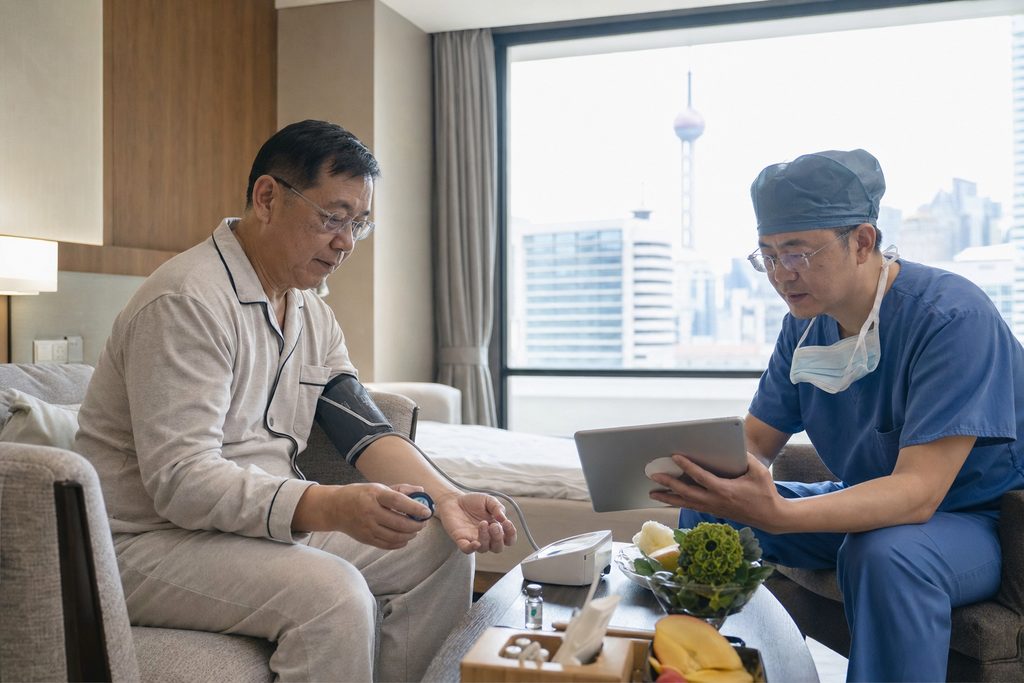
The core idea is simple: a device in your home transmits readings to a secure cloud platform. Your surgeon in China—or a designated nurse coordinator on their team—reviews the data on a dashboard. Thresholds are set. Alerts are triggered. But the execution is what separates a real clinical service from a consumer gadget. Here is what makes a hospital-integrated program different.
Clinical Volume Drives Better Protocols
Chinese hospitals manage patient volumes that are hard to comprehend from a Western perspective. A top cardiology department may perform over 14,000 cardiac surgeries annually. This scale forces the development of efficient, protocol-driven follow-up systems. When a hospital builds a connected glucose monitor data sharing surgeon abroad program, they are not inventing it for one patient. They are refining a system used by thousands. The algorithms that flag an abnormal blood pressure trend have been tuned against massive datasets. The response protocols have been stress-tested. You benefit from a system designed for scale, not a one-off arrangement.
Regulatory Rigor as a Trust Signal
Any hospital offering a legitimate connected blood pressure and glucose monitor service in China that transmits data internationally must comply with a complex web of regulations. China’s Personal Information Protection Law (PIPL) governs how health data is collected and transferred. If you are from the European Union, GDPR applies. If you are from the United States, HIPAA considerations come into play. A hospital that has invested in the legal and technical infrastructure to meet these overlapping requirements is signaling something important: they take data stewardship seriously. This is not a consumer wellness app. This is a regulated clinical data pipeline. Our team verifies this compliance before we ever recommend a program to you.
The Cost Structure Makes Continuous Monitoring Viable
Let us address the question directly. A remote blood pressure monitor service China cost is structured differently than in Western healthcare systems. The hardware—a validated Bluetooth blood pressure cuff and a continuous glucose monitor or connected glucometer—is often provided as part of the post-operative package. The monitoring service itself, including a nurse coordinator who reviews your data daily, typically ranges from $150 to $400 per month depending on the intensity of monitoring and the frequency of clinician review. This is possible because the clinical labor cost in China is lower, while the technological infrastructure is state-of-the-art. You are not paying for a less qualified team. You are paying for an equally qualified team operating within a different economic structure. The result is a service that would be prohibitively expensive in many home countries becoming accessible.
How the Technology Actually Works
Understanding the workflow removes the mystery. When you enroll in a medical tourism remote patient monitoring package in China, the process follows a clear sequence. First, your surgeon defines the clinical parameters: acceptable blood pressure ranges, glucose targets, and the specific data points they want to track. Second, you receive the monitoring kit before discharge. This includes devices that are clinically validated—not the consumer-grade wearables you buy online. Third, you complete a brief training session with a bilingual nurse who ensures you know how to take readings correctly. Fourth, the devices transmit data via cellular or Wi-Fi to a secure cloud server. Your surgeon accesses a dashboard. A nurse coordinator reviews your readings daily. If a reading falls outside the preset threshold, an escalation protocol activates. You receive a message. Your surgeon is notified. A plan is adjusted.
This is not passive data collection. It is an active clinical surveillance system. The question “can my surgeon receive blood pressure data from China” has a straightforward answer: yes, through hospital-grade remote monitoring platforms that are built for exactly this purpose. The data does not sit in a silo. It flows into the same electronic health record system that your surgeon used during your inpatient stay. Continuity is the entire point.
What You Need to Know Before Going Alone
Trying to piece together a connected monitoring solution independently is fraught with friction. We have seen patients attempt it. The obstacles are real and specific.
- Data Compliance and Cross-Border Transfer: A hospital cannot simply email your blood pressure readings to a foreign surgeon. Structured data transfer agreements must be in place. Consent forms must be bilingual and legally valid in both jurisdictions. If you try to arrange this yourself, you will likely hit a wall of institutional caution. Hospitals are rightly protective of patient data. Our team works with departments that have pre-established compliant pathways.
- Device Compatibility and Clinical Validation: The Bluetooth blood pressure monitor you buy on a consumer website may not integrate with the hospital’s monitoring platform. Hospital systems use specific, validated devices with proven accuracy. Using an unvalidated device introduces clinical risk. The surgeon cannot make medication adjustments based on data they do not trust. We ensure the devices you receive are part of the hospital’s approved ecosystem.
- Escalation Protocol Clarity: Who responds to an abnormal reading? How quickly? What is the backup if the primary contact is unavailable? Independent arrangements rarely have clear answers to these questions. A formal connected monitoring service has a written protocol. You know exactly what happens when your systolic pressure hits 160 at 11 p.m. This clarity is not a luxury. It is a safety requirement.
How We Help You Navigate This
A comprehensive post-operative monitoring package typically ranges from $150 to $400 per month. This includes the provision of clinically validated monitoring devices, the secure data platform, daily review by a nurse coordinator, and a defined number of clinician reviews per month. The exact cost depends on the intensity of monitoring required—a patient recovering from a complex cardiac procedure will need more frequent review than a patient on a stable medication regimen. The cost is separate from the surgical procedure itself and is quoted transparently before you commit. It varies by hospital and case complexity.
Yes. The monitoring platform is web-based and system-agnostic. Your surgeon does not need to be on the same hospital network. They receive secure login credentials and access the data through any standard browser. The platform displays trends, flags anomalies, and allows the surgeon to annotate readings. If your surgeon prefers to receive data in a specific format for integration into their local system, we can often accommodate that request. The technical interoperability is well-established.
This is the most important question to ask any monitoring service. The answer reveals whether the program is truly clinical or merely performative. In a properly structured service, a critically abnormal reading triggers an immediate alert. The alert goes to the on-call nurse coordinator. If the coordinator cannot reach you within a defined time window—usually 15 minutes—an escalation protocol activates. This may involve contacting your emergency contact, your local physician, or emergency services, depending on the protocol you agreed to during enrollment. You should never be left to interpret a dangerous reading alone. We only work with hospitals that have a documented, 24/7 escalation pathway.
They are most established for cardiac surgery, bariatric surgery, and diabetic care programs—specialties where blood pressure and glucose monitoring are clinically essential. Orthopedic and oncology programs are increasingly adopting connected monitoring for specific post-operative parameters. Not every department offers this service. We can tell you within one consultation whether a connected monitoring pathway exists for your specific procedure. If it does not, we will be honest about that and discuss alternative follow-up arrangements.
Your Next Step
A connected blood pressure and glucose monitor service in China closes the most dangerous gap in medical travel: the silence between discharge and your first follow-up. The technology exists. The protocols are mature. The cost is accessible. What remains is matching you with the right hospital and the right clinical team for your specific needs. That is what we do. If you are considering a procedure in China or have already scheduled one and want to understand your monitoring options, start with a free consultation. We will help you map the path from surgery to full recovery—with data guiding every step.
Medical travel should never mean medical disconnection. Your surgeon should see your numbers. We make sure they do.
Frequently Asked Questions
Yes. The hospitals used for international patients are JCI-accredited or major Grade 3A tertiary centres and follow the same international safety standards as top hospitals in the US and Europe. Surgical teams perform high volumes of procedures — often more than their Western counterparts — which studies show leads to better outcomes.
Costs vary by procedure and hospital, but international patients typically save 40-80% compared to US prices — even when factoring in travel and accommodation. A consultation with our team will give you an exact, all-inclusive quote with no hidden fees.
Send us your existing medical reports to get started. We handle everything from hospital selection and appointment scheduling to visa assistance and post-operative recovery planning. Your medical records are reviewed by the specialist before you even book a flight.
For more medical information and treatment options in China, visit chinamedservices.com (China Medical Services).
