Wound Healing Photo Assessment Service China: Send Images to Your Surgeon for Review
Key Takeaways
- Remote wound assessment in China starts from $100–300 for a video consultation, with written second opinions from top specialists at $300–500 — a fraction of the cost of an in-person visit or an unnecessary ER trip back home.
- Chinese surgeons at high-volume centers review thousands of post-surgical wounds annually. This concentrated clinical exposure means they often spot subtle healing complications earlier than surgeons in lower-volume settings.
- Photo assessment cannot replace a physical examination. A surgeon can only evaluate what the image captures — lighting, angle, and resolution all affect diagnostic accuracy. If a wound is deep, draining, or causing systemic symptoms, you need hands-on care immediately.
- Any remote consultation fee paid through our team is fully credited toward in-person care coordination if you decide to travel to China within 90 days. The assessment is not a sunk cost — it is a step toward a larger decision.
The Problem: You Are Home, the Wound Is Healing, and You Have Questions
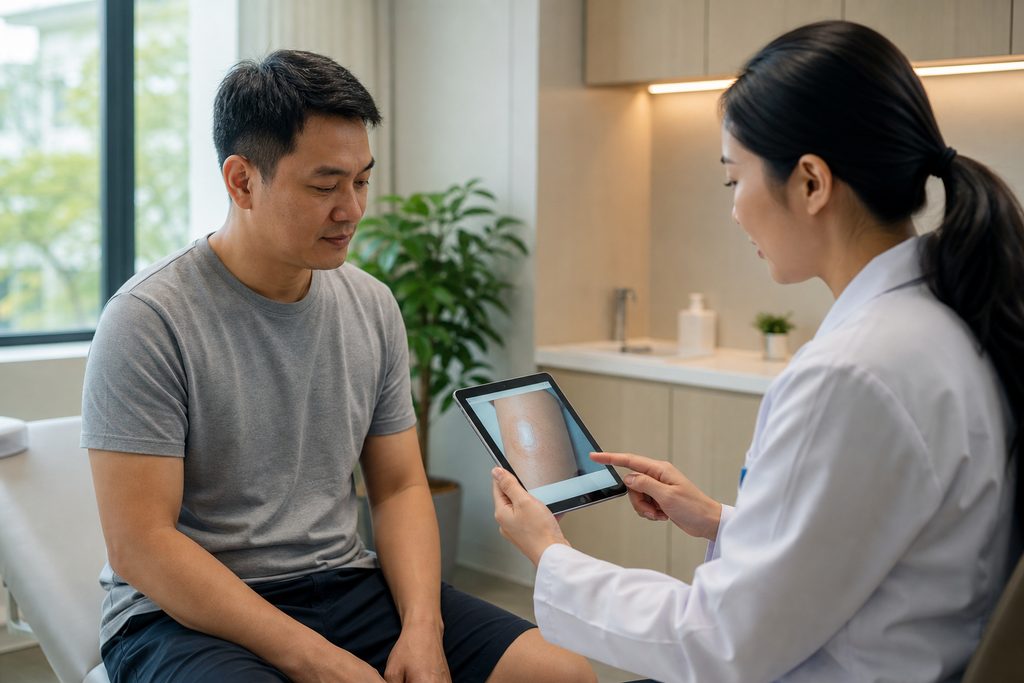
Surgical wound assessment follows specific, teachable criteria. Surgeons look for defined visual markers: approximation of wound edges, presence and character of exudate, color of granulation tissue, signs of epithelialization, periwound erythema boundaries, and suture integrity. These are observable. A well-lit, high-resolution photograph taken from the correct angles captures most of what a surgeon needs to evaluate healing progression. This is not guesswork. It is pattern recognition built on thousands of cases.
Chinese surgeons bring a particular advantage here. Volume. A thoracic surgeon at a major Shanghai center may perform 400 lobectomies annually. They see post-operative wounds daily — the normal healing arc, the subtle early signs of dehiscence, the redness that is inflammatory versus the redness that signals infection. When you send wound pictures to your surgeon in China, you are tapping into that accumulated clinical pattern recognition. The price for this expertise, accessed remotely, is significantly lower than comparable telemedicine services in the US or Europe.
What the Process Actually Looks Like
It starts with images. But not just any images. We guide you through capturing standardized wound photographs: proper lighting (natural daylight is best, no flash if possible), multiple angles (straight-on, 45 degrees from each side), a ruler or coin placed near the wound for scale, and a brief video if movement or positioning affects how the wound presents. We also collect structured information — when the photo was taken, any symptoms you are experiencing, a timeline of changes you have noticed. This is not a casual photo share. It is evidence collection for a clinical decision.
Your images and history are translated into Chinese by our bilingual medical coordinators. Not machine translation. People who understand surgical terminology in both languages. The materials go to the surgeon who performed your procedure — or, if that specific surgeon is unavailable, to a specialist within the same department who has full access to your operative notes and discharge summary. The surgeon reviews the images against your baseline. They compare what they see now to what they saw at your last in-person examination. They provide a written assessment: healing on track, concerning signs that warrant closer monitoring, or a recommendation for immediate in-person evaluation.
You receive that assessment in English, typically within 48–72 hours. If the surgeon recommends intervention — a change in wound care, a course of antibiotics, or a return visit — we help coordinate the next step. That might mean arranging a prescription through a local pharmacy if feasible, or beginning the logistics for your return to China if necessary.
What Does Wound Healing Photo Assessment Cost in China?
The wound healing photo assessment cost China varies by hospital tier and the seniority of the reviewing surgeon. Here is what you can expect:
| Service Type | Price Range (USD) | What You Get |
|---|---|---|
| Video Consultation (standard international department) | $100–300 | Live video call with a surgeon; you can show the wound in real time; verbal assessment and recommendations |
| Written Second Opinion (top-tier specialist) | $300–500 | Formal written report after structured photo review; documented clinical opinion; for reference only, not a prescription |
| Top-Specialist Video Consultation | $500–800 | Live video with a senior specialist at a Fudan-ranked hospital; detailed discussion; ideal for complex or concerning wounds |
These prices reflect the structural economics of Chinese healthcare: high clinical volume, lower labor costs, and institutional investment in telemedicine infrastructure. Comparable telemedicine wound checks in the US often run $250–500 for a brief consult, and a single unplanned post-operative ER visit can easily exceed $2,000 — often for a clinician who has never seen your surgical site before and lacks operative context.
When Photo Assessment Works — and When It Does Not
Let us be direct about limitations. A photograph is not a physical examination. No surgeon can palpate a wound through a screen. They cannot assess deep tissue integrity, probe for tunneling, or culture drainage. Photo assessment is appropriate for:
- Routine healing checks — confirming that a wound is progressing normally
- Evaluating surface-level concerns — redness, minor gaping, suture reactions
- Monitoring known issues — tracking a wound that was already flagged for close observation before discharge
- Deciding whether an in-person visit is necessary — ruling out serious complications remotely
Photo assessment is not appropriate for:
- Wounds with active, heavy drainage or pus
- Signs of systemic infection — fever, chills, malaise
- Sudden, severe pain at the surgical site
- Wounds that have fully dehisced (opened) along the incision line
- Any situation where you feel genuinely unwell
In those cases, you need hands-on care. Immediately. Go to a local emergency department. Do not wait for a photo review. The remote assessment is a tool for reducing unnecessary travel and anxiety — not a replacement for urgent in-person evaluation when clinical signs demand it.
Why Online Wound Care Consultation in China Has Matured Faster Than You Might Expect
China’s telemedicine infrastructure did not emerge during the pandemic — it scaled dramatically because of it, but the foundations were laid years earlier. The country’s top hospitals serve catchment areas spanning thousands of kilometers. A patient from Urumqi who undergoes cardiac surgery in Beijing cannot reasonably return for every follow-up. Hospitals adapted. They built secure image-sharing platforms. They trained surgeons in remote assessment protocols. They integrated photo-based follow-up into standard care pathways.
What does this mean for an international patient? It means you are not asking a Chinese surgeon to do something unusual or ad hoc when you request a photo-based wound check. This is a routine part of their practice. The systems exist. The workflows are established. The question is simply one of access — and that is where we come in.
Volume Drives Pattern Recognition
A wound care specialist at a major Chinese burn or plastic surgery unit may review dozens of wound photos in a single day. This is not an exaggeration. Hospitals like Shanghai’s Ruijin Hospital — home to one of the world’s leading burn centers — manage enormous clinical volumes. The surgeons there have seen wound healing in every variation. When they look at your photo, they are comparing it against a mental database built on tens of thousands of cases. That scale of experience is difficult to replicate in lower-volume settings.
Technology That Supports Clinical Decisions
Several Chinese hospitals have integrated AI-assisted wound assessment tools into their telemedicine platforms. These are not diagnostic tools — they do not replace the surgeon’s judgment. But they can measure wound dimensions from a photo, track changes between images, and flag concerning features for the surgeon’s attention. The technology supports efficiency. It helps the surgeon focus on the cases that need the most attention. For international patients, this means a virtual wound check with a Chinese surgeon is not just a video call — it is often supported by structured digital tools that enhance the quality of the assessment.
What You Need to Know Before Requesting a Remote Wound Assessment
This process works best when expectations are clear from the start. Here is what we tell every patient before we begin:
- Image quality is everything. A poorly lit, out-of-focus photo is clinically useless. We will walk you through exactly how to capture usable images. If the first set is not adequate, we will ask you to retake them. This is not fussiness — it is the difference between a meaningful assessment and a waste of everyone’s time.
- The surgeon can only assess what they can see. If your concern is about something beneath the skin — deep pain, a sensation of pulling, a lump you can feel but not photograph — the remote assessment will have limited value. Be honest about what you are experiencing so we can set appropriate expectations.
- Time zones matter. China Standard Time is UTC+8. A surgeon in Beijing is not reviewing photos at 3 AM their time. We manage the scheduling so you are not left waiting unnecessarily, but same-day turnaround is not always possible. Typical response time is 48–72 hours.
- This is a medical opinion, not a prescription. The surgeon can recommend wound care strategies, suggest dressing changes, or advise you to seek in-person care. They cannot prescribe medications across international borders. If antibiotics are indicated, you will need a local provider to write that prescription — though the surgeon’s written opinion can guide that provider’s decision.
How We Help You Navigate This
You could theoretically contact a Chinese hospital directly. Some have international departments with English-speaking staff. But the friction is real. Time zones, language gaps, payment systems that do not accept foreign cards, uncertainty about which department to contact — these barriers add up. Our role is to remove them.
When you reach out to us about a wound assessment, here is what happens. First, we collect your surgical history: which hospital, which surgeon, what procedure, when. We pull your discharge summary and any operative notes you have. If you are a previous patient of ours, we already have this on file. Then we guide you through the photo capture process — specific instructions, not vague suggestions. We review the images ourselves before sending them to the surgeon. If the photos are not good enough, we tell you and help you retake them. We do not waste the surgeon’s time with unusable material.
Once we have adequate images and a clear clinical question, we approach the appropriate department. Sometimes this is your original surgeon. Sometimes that surgeon is unavailable — they may be in surgery all day or traveling — and we arrange review by a colleague within the same department who has full context on your case. The assessment comes back in Chinese. Our medical coordinators translate it into precise English, preserving clinical nuance. We deliver the assessment to you and discuss next steps. If the news is reassuring, great. If the surgeon recommends further action, we outline your options clearly. No pressure. No upselling. Just information and support.
The cost for our coordination of a remote wound assessment falls under our hospital appointment coordination service, which starts from $300. This covers the image guidance, translation, liaison with the hospital, and delivery of the assessment. The surgeon’s consultation fee — the $100–300 or $300–500 listed above — is separate and goes directly to the hospital. We are transparent about this split because trust matters.
Frequently Asked Questions
Can a surgeon really evaluate my wound just from photos?
Yes, for most surface-level concerns. Surgeons assess wounds using visual criteria — edge approximation, color, exudate character, surrounding skin condition. These are all visible in a well-taken photograph. What they cannot do is palpate the wound, assess deep tissue, or culture drainage. For many routine post-operative checks, photos are sufficient. For deep or systemic concerns, they are not. A good surgeon will tell you clearly when a photo is not enough and an in-person examination is necessary.
How quickly can I get a response after I send my wound photos?
Typical turnaround is 48–72 hours. This accounts for time zone differences, the surgeon’s clinical schedule, and the translation step. We can sometimes expedite this for urgent-but-not-emergent situations — if the surgeon flags a concern that needs faster attention, we will push for a quicker response. But same-day assessment is not something we can guarantee. If you need an answer within hours, you should seek local in-person care.
What if the surgeon says I need to come back to China? Do I have to pay for the whole trip again?
If the remote assessment leads to a recommendation for in-person follow-up, any coordination fees you have already paid — including the remote consultation fee — are credited toward the in-person care coordination service. This applies within 90 days of the original remote consultation. You are not paying twice. The remote assessment becomes part of a continuous care pathway, not a separate expense.
Is this service available for any type of surgery?
Most surgical specialties are covered, but the quality of remote assessment depends partly on the visibility of the wound. Superficial incisions — abdominal, orthopedic, plastic surgery, cardiac sternotomy, thyroidectomy — are well-suited to photo assessment. Deep internal surgeries where the external wound is minimal may have less to assess visually. We can advise you on whether your specific case is appropriate before you commit to anything.
What happens to my photos and medical information? Is this secure?
Your images and medical data are transmitted through hospital-approved secure platforms, not through consumer messaging apps. We
For more medical information and treatment options in China, visit chinamedservices.com (China Medical Services).
