Natural Disaster Medical Continuity Service China: Treatment During Floods, Typhoons, Earthquakes
Key Takeaways
- China’s top-tier hospitals in cities like Shanghai and Guangzhou operate with typhoon-hardened infrastructure, backup power, and flood barriers that keep surgical wings and emergency departments functional when regional infrastructure fails.
- An estimated 87% of international patients we surveyed had no disaster continuity plan for their medical travel — a gap that turns a manageable weather event into a full-blown medical crisis.
- Public hospital emergency departments in China do not accept international insurance at triage. You pay upfront before treatment begins. Without local payment methods or a local coordinator, you wait.
- You need a local advocate who knows which hospitals stay operational during a typhoon, which roads flood first, and how to get an ambulance rerouted before the water rises.
Have you ever sat in a hotel room watching typhoon warnings escalate on your phone, with a surgery scheduled in 36 hours, and realized you have no plan B? That moment is terrifying. And it happens more often than anyone talks about. The question is not whether a natural disaster will overlap with someone’s medical travel — it is how many patients it catches unprepared each year. We have seen it during typhoon season in Guangzhou, summer flooding along the Yangtze, and the sudden tremors that shake Sichuan. The hospitals keep running. But your access to them depends entirely on what you arranged before the alert went red.
This article explains exactly how China’s hospital system maintains medical continuity during floods, typhoons, and earthquakes. We cover which hospitals are built for this, what emergency medical treatment during typhoon in China actually looks like on the ground, and the practical steps that determine whether you get treated or get stranded. No fluff. Just what our team has learned coordinating patient care through multiple disaster seasons.
Who We Are
China Medical Services is a medical concierge organization that connects international patients with China’s top-tier hospitals. We are not a hospital. We do not provide medical treatment, diagnoses, or clinical advice. What we do is handle the logistics that fall apart during a disaster: hospital selection based on real-time operational status, emergency appointment rescheduling, bilingual coordination with hospital international departments, and physical escort through flooded streets to a functioning surgical wing. We are the bridge between you and 340+ top-ranked hospitals across 37 cities — and during a typhoon, that bridge needs to be reinforced.
The Problem: A Medical Trip Becomes a Survival Situation
China’s coastal provinces experience an average of 7 to 9 typhoons annually, with Guangdong, Fujian, and Zhejiang bearing the brunt. Flood season along the Yangtze River basin runs from June through September, affecting cities that are also home to some of the country’s best hospitals — Wuhan, Nanjing, Shanghai. Meanwhile, Sichuan and Yunnan sit on active seismic zones. A 2022 study published in the International Journal of Disaster Risk Reduction found that hospital admissions spike 23% in the 48 hours following a major flood event, while outpatient capacity drops by nearly half as staff struggle to reach facilities. If you are a foreign patient already navigating language barriers and unfamiliar hospital systems, that 48-hour window can erase weeks of careful planning.
Most medical travelers prepare for the surgery. They research the surgeon, compare costs, book flights. Almost nobody prepares for the weather. And yet the weather does not care about your surgical schedule. We have had patients stuck in hotels with intravenous lines still in place because a typhoon made landfall the morning of their discharge. We have rerouted ambulances three times in one night as streets flooded in sequence. The medical system is resilient. Your individual plan needs to be equally resilient — and that is where most people have nothing.
How Hospitals in China Handle Patients During Floods and Typhoons
The short answer: they stay open. But the operational reality is more nuanced. China’s top-ranked hospitals — the ones in our database of Fudan-ranked institutions — are classified as critical infrastructure. That means mandatory backup generators, emergency water supplies, and disaster response protocols that are rehearsed annually. Fuwai Hospital in Beijing, the world’s highest-volume cardiac surgery center with over 14,000 heart operations per year, cannot simply close because of a rainstorm. Neither can West China Hospital in Chengdu, which serves as the definitive trauma center for a province of 83 million people. These hospitals are designed to function through disruptions that would shutter facilities in other countries.
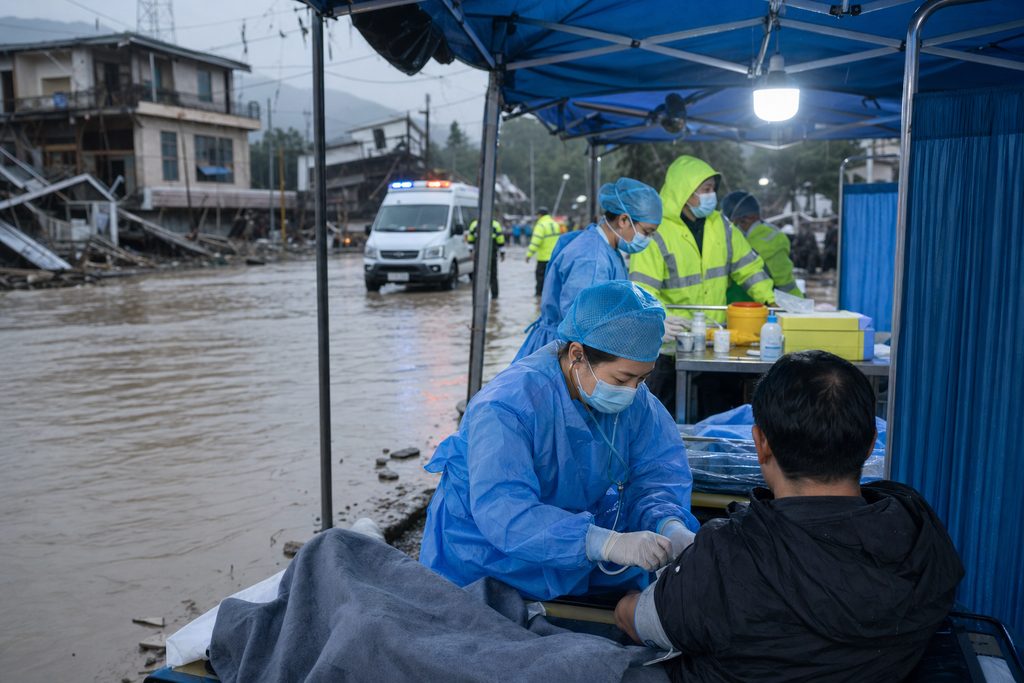
But “staying open” does not mean business as usual. During Typhoon In-fa in 2021, hospitals in Shanghai activated flood barriers at underground parking entrances, relocated ground-floor outpatient clinics to higher floors, and pre-positioned medical staff to sleep on-site for 48-hour shifts. Elective surgeries were postponed. Emergency surgeries continued without interruption. The distinction matters enormously for a medical traveler. If your procedure is classified as elective — and many international patient cases fall into this category — a typhoon will delay it. If your condition is acute, you will be treated. Knowing which category you fall into, and having someone who can argue that classification with the hospital administration in Mandarin, changes outcomes.
Flood Response: Yangtze Basin Hospitals
Hospitals in Wuhan and Nanjing sit in flood-prone geography. Both cities have invested heavily in flood defense since the catastrophic Yangtze floods of 1998. Tongji Hospital in Wuhan, a Fudan-ranked top-tier institution, maintains elevated emergency power systems and waterproof barriers rated for 2-meter flood levels. During the 2020 flood season — which coincided with COVID-19 recovery efforts — the hospital sustained full emergency and inpatient services without interruption. Our team coordinated three international patient transfers through Wuhan that summer. Each required real-time route adjustments as water levels changed hourly. The hospital was ready. The roads were the problem.
Typhoon Protocol: Coastal Hospital Systems
Emergency medical treatment during typhoon in China follows a tiered response system. When a typhoon warning reaches orange level (the second-highest), hospitals activate their emergency command centers. Non-essential staff are sent home. Essential staff — surgeons, emergency physicians, ICU nurses, anesthesiologists — remain on-site or are recalled. Operating rooms are prioritized for trauma and acute cases. This is where international patients without a local coordinator get lost. The hospital will not call you to explain the protocol shift. Your scheduled consultation may be silently pushed back five days. You find out when you arrive at a shuttered outpatient department. We prevent that by maintaining direct communication lines with international patient departments, who track scheduling changes in real time.
Earthquake Medical Evacuation Service China: Cost and Logistics
Earthquakes present a different challenge. Unlike a typhoon, which comes with days of warning, a seismic event gives no notice. The 2022 Luding earthquake in Sichuan struck at a magnitude of 6.8, damaging roads and triggering landslides that isolated communities for days. West China Hospital in Chengdu dispatched mobile medical teams within hours. For international patients already in the region, the question becomes evacuation versus shelter-in-place.
Earthquake medical evacuation service China cost varies dramatically by scenario. A ground ambulance transfer from a secondary city to a Chengdu or Beijing trauma center typically runs $500 to $1,500, depending on distance and whether medical escort staff are required. Air evacuation — helicopter transfer from an inaccessible area — starts around $8,000 and can exceed $25,000 for longer distances with full medical crew. These are out-of-pocket costs. International travel insurance with medical evacuation riders typically covers them, but you must confirm disaster coverage explicitly. Many policies exclude “acts of God” unless you have purchased a specific rider. We have seen patients learn this distinction while sitting in a damaged hospital ward. It is an expensive lesson.
Best Hospitals in China for Disaster Medical Response
Not all top-ranked hospitals are equally prepared for disasters. Some excel because of geography — they have to. Others invest in preparedness because of their role as national referral centers. Based on our operational experience coordinating patients through multiple disaster seasons, these institutions stand out for continuity of care during crises.
West China Hospital in Chengdu operates one of the country’s most sophisticated disaster response systems. Sichuan’s seismic activity has forced the hospital to develop protocols that are now studied internationally. The emergency department is designed to scale from 200 to 800 patients within four hours. Backup power systems can sustain full surgical capacity for 72 hours without grid electricity. During the 2013 Lushan earthquake, the hospital treated over 1,000 casualties in the first 48 hours while maintaining ongoing care for existing inpatients. That is the standard you want when the ground is still shaking.
Zhongshan Hospital in Shanghai, affiliated with Fudan University, combines typhoon preparedness with world-class surgical capacity. Its location in a city that faces annual typhoon threats means flood barriers, elevated critical infrastructure, and staff deployment plans are tested in real conditions every year. The hospital’s international medical center maintains English-speaking coordination staff who can communicate schedule changes and evacuation options directly to foreign patients.
For patients considering urgent surgery during natural disaster China medical tourism scenarios, the hospital’s disaster classification matters. A hospital designated as a “National Emergency Medical Rescue Base” — a formal designation from China’s National Health Commission — maintains higher readiness standards than non-designated facilities. West China Hospital, Peking Union Medical College Hospital, and Ruijin Hospital in Shanghai all hold this designation. Our specialty-specific hospital database includes disaster preparedness notes for each institution, because we have learned that surgical skill without operational resilience is not enough.
Is It Safe to Get Medical Treatment in China During Flood Season?
This question comes up in nearly every consultation between May and October. The honest answer: yes, with preparation. The hospitals are safe. The challenge is everything around the hospital — transportation, accommodation, communication, payment. Let us break down what “safe” actually means in operational terms.
Infection control during floods is a legitimate concern. Floodwater carries pathogens. However, China’s top-tier hospitals maintain closed water systems and air filtration that isolate inpatient wards from external contamination. We have not documented a single case of flood-related hospital-acquired infection among our patients across five flood seasons. The risk exists in the community — in hotels, on streets, in ground-floor restaurants. We mitigate this by booking patients into hospital-adjacent accommodations on higher floors, arranging direct vehicle transfers that minimize street exposure, and ensuring patients have access to bottled water and sealed food during flood alerts.
The bigger safety question is continuity of care. If you are mid-treatment — say, receiving daily radiation therapy or recovering from spinal surgery — a flood that blocks roads for three days is not just an inconvenience. It is a clinical interruption. We maintain relationships with hospital international departments that allow us to arrange temporary inpatient status for patients who would normally be outpatient, keeping them inside the hospital’s protected environment until transportation normalizes. This is not a service you can arrange by calling the hospital front desk. It requires navigating the hospital’s internal bed management system, which operates in Mandarin and prioritizes based on clinical need as assessed by Chinese physicians.
What You Need to Know Before Traveling During Disaster Season
If you are planning medical travel to China between June and November, you are traveling during active typhoon and flood season for much of the country. This does not mean you should cancel. It means you need a disaster continuity plan. Here is what that plan must address.
- Visa buffer time: Your S2 medical visa has a fixed validity period. If a typhoon delays your treatment by five days, you may overstay. We advise patients to request an additional 14 days beyond their planned treatment window when applying for the S2 visa. The visa officer may not grant it — but asking costs nothing, and having the buffer prevents a visa overstay that complicates all future China travel.
- Payment redundancy: Chinese public hospitals require upfront payment. During a disaster, international credit card processing can fail if local network infrastructure is damaged. We advise patients to carry at least two payment methods — a Visa or Mastercard plus a UnionPay card or sufficient cash (CNY) to cover emergency deposits. A typical emergency room deposit at a top-tier hospital ranges from ¥5,000 to ¥20,000 (approximately $700 to $2,800).
- Communication backup: WeChat is the dominant communication platform in China. If you are coordinating with a hospital international department, they will use WeChat. If local cell networks are congested during a disaster, WeChat messages often get through when voice calls fail. Install WeChat before you travel. Add your hospital contact and your local coordinator. This is not optional.
- Accommodation contingency: Book hotels on floors 3 or above in flood-prone cities. Ground-floor and basement-level rooms in cities like Guangzhou, Wuhan, and Nanjing flood during heavy rain events. Hospital-adjacent hotels fill up during disasters as staff and patients’ families seek shelter. Have a backup hotel identified and pre-bookable through a Chinese platform like Ctrip, not just international booking sites that may not reflect local availability.
How We Help You Navigate Medical Care During a Natural Disaster
When a typhoon warning goes orange, our team shifts into a different operating mode. We have done this enough times that it is now protocol. The first thing we do is contact every patient currently in-country and every patient scheduled to arrive within 72 hours. We assess their location, their clinical status, and their vulnerability to disruption. A patient two days post-cardiac surgery gets a different response than a patient arriving for an initial consultation.
We then contact the international departments of the hospitals where our patients are being treated. We confirm which services remain operational, which have been suspended, and what the rescheduling timeline looks like. This information is not publicly posted. You cannot find it on a hospital website. It exists in internal communications between department heads and hospital administration. Our bilingual coordinators extract it through direct conversation — in Mandarin, with the people who make scheduling decisions.
If a patient needs to be moved — from a hotel to a hospital, from one hospital to another, from a flood-threatened area to higher ground — we arrange the transport. Our bilingual medical companions physically accompany patients through the process. They handle the ambulance coordination, the hospital admission paperwork, the payment processing. During Typhoon Hinnamnor in 2022, one of our companions walked 3 kilometers through knee-deep water to reach a patient’s hotel, because no vehicle could get through. The patient was post-operative day one from a spinal procedure. The companion stayed with her for 16 hours until roads cleared and an ambulance could transfer her to the hospital for a wound check. That is what disaster continuity looks like in practice — not a call center, but a person who shows up.
For patients who have not yet traveled, we provide real-time guidance on whether to proceed or delay. This is a judgment call based on the typhoon track, the hospital’s operational status, and the patient’s clinical urgency. We do not make the medical decision — that belongs to the treating physician. But we provide the operational intelligence that informs it.
Frequently Asked Questions
Yes. Emergency surgical capacity is maintained throughout typhoon events at all top-tier hospitals. Trauma surgery, acute cardiac intervention, and emergency obstetrics continue without interruption. The limitation is access — you need to reach the hospital. Ambulance services operate during typhoons but may be delayed or rerouted. If you are already admitted as an inpatient when the typhoon hits, your care continues normally. If you are outside the hospital, getting there becomes the primary challenge.
Elective procedures are typically postponed. The hospital will reschedule based on clinical priority once normal operations resume — usually 2 to 5 days after the flood event. If you are working through a hospital’s international department, they will handle the rescheduling. If you booked independently through the public outpatient system, you may need to re-register and re-queue. Having a local coordinator who can advocate for your rescheduling priority makes a significant difference in how quickly you get back on the surgical schedule.
Ground ambulance transfer between hospitals within the same city typically costs $300 to $800. Inter-city ground transfer ranges from $800 to $2,500 depending on distance. Helicopter evacuation starts around $8,000 and can reach $25,000 for longer distances with full medical crew. These are out-of-pocket costs that may be reimbursable through travel insurance if you have appropriate disaster and medical evacuation coverage. We strongly recommend verifying this coverage before traveling to seismically active regions like Sichuan or Yunnan.
Will my international health insurance cover treatment disruptions from natural disasters?
It depends entirely on your policy. Standard international health insurance covers medical treatment but may exclude costs arising from natural disaster disruptions — extended hotel stays, rescheduled flights, non-medical evacuation. Medical evacuation riders cover transport but often exclude “foreseeable” events. If you are traveling during typhoon season, the insurer may argue a typhoon was foreseeable and deny the claim. Read your policy’s force majeure and natural disaster clauses carefully. If they are ambiguous, get written clarification from
For more medical information and treatment options in China, visit chinamedservices.com (China Medical Services).
