Proton Therapy in China: What to Know Before You Travel
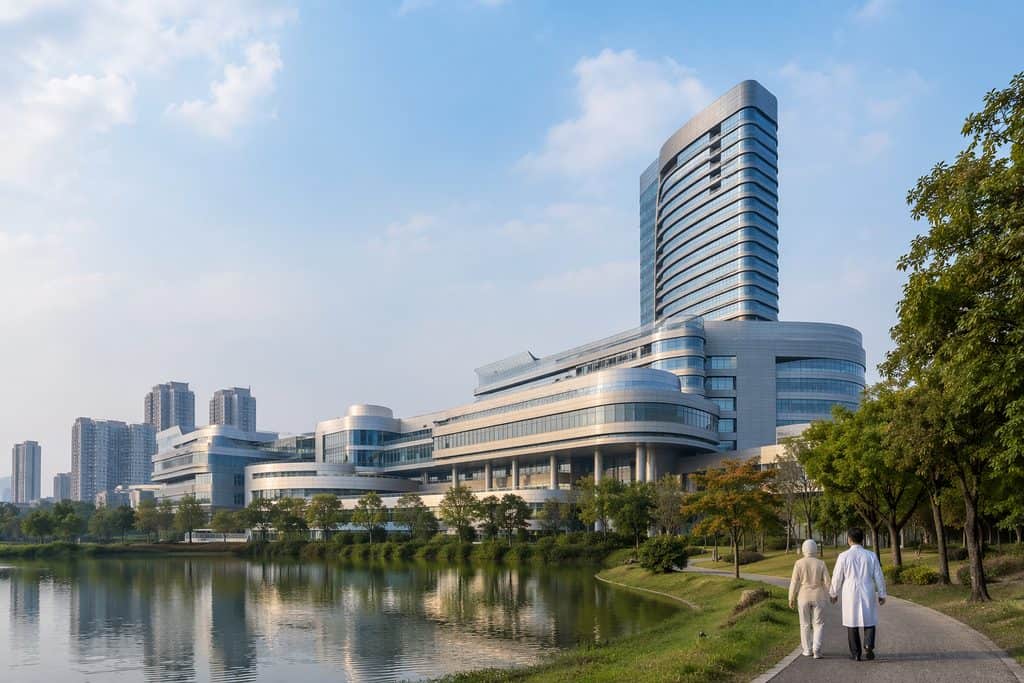
Proton Therapy in China: What to Know Before You Travel
Proton therapy is a form of radiation treatment that aims a beam of protons at a tumor. Unlike standard X-ray radiation, the proton beam deposits most of its energy at a precise depth and then stops. That means less dose to healthy tissue on the way in and almost none on the way out. For tumors sitting near the spinal cord, optic nerve, brainstem, or in a growing child, that difference matters a great deal. The first thing to understand about proton therapy cost China is that published figures are rare, and any number you see online needs a hospital quote attached to it.
China operates a small but growing number of proton centers. Most sit inside large public academic hospitals. A handful of private international hospitals now offer related particle treatments as well. Demand from overseas patients has risen steadily since the mid-2010s, partly because the price gap with the United States is wide.
Proton Therapy in China: The Short Answer
Yes, proton therapy is available in China for international patients, but access is narrower than many people assume. A typical course runs 20 to 35 sessions over four to seven weeks, and most centers will not confirm a slot until they have reviewed your imaging, pathology, and prior treatment history in writing.
Two practical realities shape everything else. First, Chinese public hospitals generally cannot be booked from abroad through the ordinary outpatient queue — you need the international or VIP channel, which carries roughly 1.5 to 2 times the standard price. Second, proton centers are concentrated in a few cities, so your choice of hospital often decides your choice of city for a month or more.
Our team works with a database of more than 340 top-ranked hospitals across 37 cities, but only a small subset operate proton or heavy-ion equipment. That shortlist is what matters here.
Who This Is Right For — and Who It Isn’t
Proton therapy is not a better version of radiation for everyone. It is a different tool with a specific shape of advantage. Whether it helps you depends on tumor type, location, size, and what treatment you have already had.
Usually a reasonable candidate:
- Pediatric patients with solid tumors, where sparing growing tissue is a long-term priority
- Skull base tumors, including chordoma and chondrosarcoma
- Brain and spine tumors sitting close to critical structures
- Prostate cancer, where dose escalation with less rectal and bladder exposure is often the goal
- Head and neck cancers near the optic nerve, salivary glands, or brainstem
- Patients who have already had conventional radiation and cannot safely receive more
Usually not the right path:
- Tumors that have already spread widely — protons treat a defined target, not the whole body
- Cancers where surgery or systemic therapy is the primary curative option
- Patients who cannot lie still for 20 to 40 minutes per session without sedation support
- Anyone whose case a radiation oncologist judges equally treatable with modern X-ray techniques
- Patients who need treatment within days — proton scheduling rarely moves that fast
Getting this wrong is expensive in both money and time. A written second opinion from a radiation oncology team costs far less than a wasted trip.
The Options, Compared
Cost is the reason most people search. Here is how the main routes stack up.
| Route | Typical cost range (USD) | Wait time to start | Language support | Insurance handling |
|---|---|---|---|---|
| Proton therapy, US academic center | $100,000 – $200,000+ | 4 – 12 weeks | Native English | In-network, pre-authorization common |
| Proton therapy, Western Europe | $60,000 – $120,000 | 4 – 10 weeks | Varies by country | Often private-pay for non-residents |
| Proton therapy, China public hospital (international channel) | $30,000 – $70,000 | 2 – 8 weeks | English coordinator at international department | Prepay, then claim reimbursement at home |
| Proton therapy, China private international hospital | $60,000 – $100,000 | 2 – 6 weeks | English-speaking staff throughout | Some direct billing arrangements |
| Conventional IMRT radiation, China public hospital | $8,000 – $20,000 | 1 – 3 weeks | Limited without a companion | Prepay, then claim |
These figures vary by hospital and case complexity, and they are planning ranges rather than quotes. The public-hospital international channel is the sweet spot for many patients: top-tier equipment and experienced teams at roughly half the private-hospital rate, in exchange for less hand-holding. If you want English at every step and direct insurance billing, the private route costs more but removes friction. If protons offer no clear advantage for your tumor, conventional radiation in China is dramatically cheaper — and sometimes the medically sounder choice.
Where the Centers Are, and What “Best” Actually Means
Search results often push the phrase best proton therapy center Shanghai, but the honest answer is that China’s proton capacity is not concentrated in Shanghai the way its general hospital rankings are. Shanghai hosts world-class oncology and radiation departments, and several of its top hospitals coordinate proton referrals. The dedicated proton and heavy-ion installations are spread across a handful of cities, and each center tends to specialize.
What should you actually look at?
- Case volume in your specific tumor type. A center that treats 200 prostate cases a year is not automatically the right place for a pediatric brainstem tumor.
- Whether the machine is pencil-beam scanning. Older passive-scattering systems are still in service and are less precise for irregular targets.
- Whether a pediatric anesthesia team is available, if the patient is a young child.
- Whether the hospital has a multidisciplinary tumor board. Proton decisions should not be made by one physician in isolation.
Our hospital directory groups facilities by city and specialty, and the oncology department rankings are a useful starting filter. From there, the proton question becomes a shortlist question rather than a nationwide search.
How Much Does Proton Therapy Cost in Beijing?
Beijing concentrates more top-ranked hospitals than any other Chinese city, and it is where many international patients begin. The proton therapy cost in Beijing typically falls somewhere between $30,000 and $70,000 for a full course at a public hospital’s international channel, depending on fraction count, whether chemotherapy runs alongside, and how much imaging and planning is required.
What drives the variance:
- Number of fractions. A 20-fraction course costs less than a 35-fraction course, obviously, but the per-fraction rate also changes with complexity.
- Immobilization and simulation. Custom masks, molds, and 4D CT planning add cost but are not optional.
- Concurrent therapy. If you receive chemotherapy during radiation, that is billed separately.
- Inpatient vs. outpatient. Some patients stay in hospital; others attend daily as outpatients. Accommodation near the hospital is a real line item — budget $1,500 to $4,000 per month for a serviced apartment near a major Beijing hospital.
- Complications. Any unplanned admission or additional procedure changes the total.
Practical Considerations for International Patients
The medical part is only half the project. The logistics decide whether the trip works.
Records and documentation. Proton centers need DICOM imaging files, pathology slides or reports, operative notes, and a treatment summary if you have had prior radiation. Send these before anything else. A written second opinion from a Chinese radiation oncology team costs from $300 to $500 and tells you whether you are a realistic candidate before you commit to travel.
Visa. Medical treatment in China falls under the S2 visa category for short stays, with S1 for stays exceeding 180 days. Accompanying family members apply under the same category. The M visa is for commercial and trade activity and is not the correct route for medical care. Requirements shift, so confirm current rules with the nearest Chinese embassy or consulate and prepare the hospital’s invitation or appointment documentation. Approval is never guaranteed.
Payment. Chinese public hospitals require prepayment. International insurance is typically reimbursed after the fact, not settled at the counter. Private international hospitals are more likely to have direct billing arrangements with major insurers, but confirm this in writing before you arrive.
Language. A top Chinese hospital may see more than 10,000 outpatients in a single day. Signage, forms, and queue systems are in Chinese. Even patients with basic Mandarin find the radiation oncology workflow difficult to navigate alone. A bilingual medical companion handles registration, queuing, payment, wayfinding, and interpretation — from $300 per day for a half or full day. That is a labor and coordination service, not a way to jump any queue.
Follow-up after you go home. Ask upfront how the treating team will hand off to your local oncologist. Request a full treatment summary, dose records, and imaging in a format your home hospital can open. This is the single most commonly neglected item, and it matters for years.
Frequently Asked Questions
Yes, at a limited number of centers, and mostly through hospital international departments. Availability depends on your tumor type and whether the center has capacity in your treatment window. No center can be booked on demand from overseas, and no one can promise a specific start date before your records are reviewed.
Planning ranges run from about $30,000 to $70,000 at public hospitals using the international channel, and $60,000 to $100,000 at private international hospitals. US pricing frequently exceeds $100,000 and can pass $200,000. Final figures vary by hospital and case complexity, so treat any published number as a starting point only.
Not the way you would book a hotel. Public hospital outpatient slots are generally not reservable from abroad, and proton treatment follows a consultation and planning process. What can be arranged in advance is a records review, a video consultation, and coordination through the hospital’s international or VIP channel. Admission and scheduling remain subject to hospital rules.
Be careful with any package that quotes a single all-in price before seeing your imaging. Treatment length, fraction count, and ancillary needs vary too much for that to be reliable. A staged approach — records first, written opinion second, cost estimate third, travel last — protects you far better than a bundled offer.
Proton therapy carries the same general risks as other radiation: fatigue, skin reactions, and site-specific side effects, plus a small risk of serious complications. Outcomes depend heavily on tumor type and stage. No provider, in China or anywhere else, can guarantee a result. Ask each center how it manages adverse events, what inpatient support exists, and who assumes responsibility for your care after you return home.
Your Next Step
Proton therapy in China is a genuine option for a defined set of patients, at a cost that is often a fraction of Western pricing — but it is a narrow door, not a wide one. The patients who do well are the ones who confirm candidacy before booking flights.
We are China Medical Services, a coordination service, not a hospital. We do not diagnose, and we do not promise admission or outcomes. What we do is review your records with the relevant Chinese specialty, arrange a written second opinion or video consultation, and coordinate hospital appointments through official international channels. If you are at the start of this process, a free consultation is the lowest-risk way to find out whether China is the right place for your treatment.
This article is for general information only and is not medical advice. Treatment decisions should be made with a qualified radiation oncologist who has reviewed your individual case.
For more medical information and treatment options in China, visit chinamedservices.com (China Medical Services).
