SMILE Surgery in Beijing: Vision Correction Companion Service
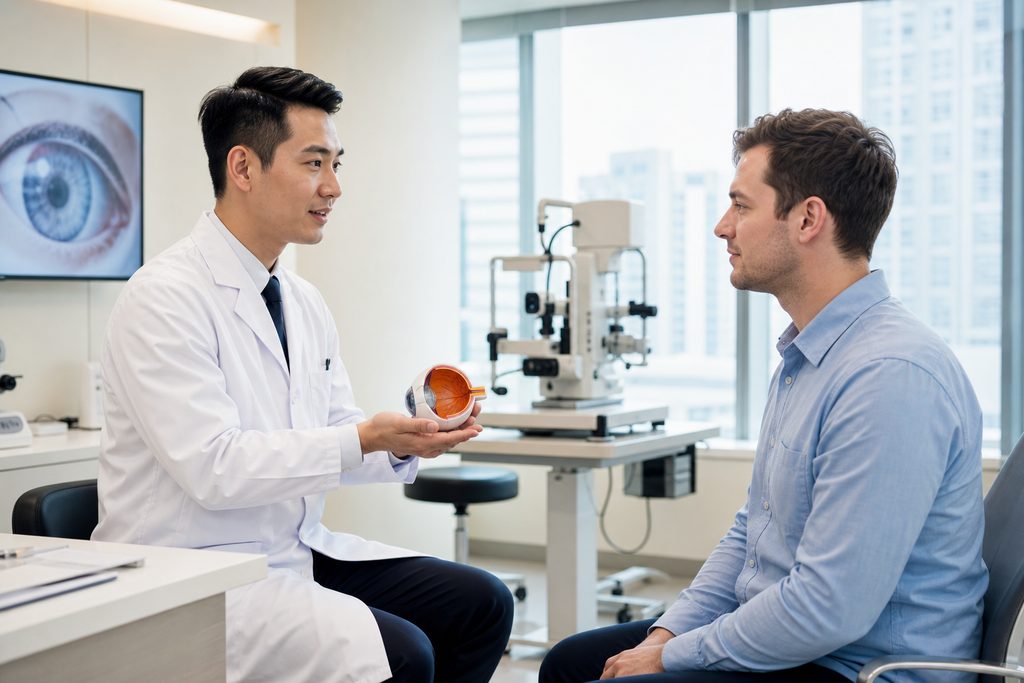
If you have been told you are not a candidate for LASIK because of thin corneas or dry eyes, SMILE might be the answer you have not heard about yet. The term sounds gentle, but the technology behind it is precise. SMILE stands for Small Incision Lenticule Extraction. A laser creates a tiny disc of tissue inside your cornea, and the surgeon removes it through an incision smaller than 3 millimeters. No flap. Less disruption to corneal nerves. Faster return to normal tear function. For many people, that means sharper vision with fewer of the dry-eye complaints that plague LASIK patients.
What does this have to do with Beijing? The city is home to some of the highest-volume refractive surgery centers in the world. The SMILE eye surgery cost Beijing patients pay is a fraction of what clinics in the United States, the United Kingdom, or Australia charge for the same procedure. But price alone is not the reason to fly across an ocean. The reason is access: to surgeons who have performed tens of thousands of these procedures, to the newest generation of laser platforms, and to a clinical pathway that has been optimized for volume without sacrificing caution. Our team at China Medical Services helps international patients navigate that pathway from the first inquiry to the final follow-up.
How This Actually Works, Step by Step
You do not book a flight and show up. The process starts with your existing eye exam records. You send us your most recent refraction, corneal topography, and pachymetry reports. If those are older than six months, you may need a fresh exam at home first. We translate the documents into Chinese and forward them to the ophthalmology department at a hospital on our shortlist. A refractive surgeon reviews the numbers. That review tells us whether you are even a preliminary candidate for SMILE, or whether another procedure makes more sense.
What comes back is not a surgery date. It is an assessment. The surgeon may say your corneal thickness looks adequate but your prescription is too high for SMILE, or that your astigmatism pattern is better suited to a different laser approach. That honesty matters. If the remote review is positive, we coordinate a consultation appointment. You travel to Beijing. The hospital runs its own complete preoperative workup — corneal mapping, tear film analysis, dilated exam. Only then does the surgeon confirm the plan. Surgery typically happens one to two days after that in-person evaluation. You rest for a day, attend a next-day checkup, and fly home with a written aftercare plan your local optometrist can follow.
SMILE Eye Surgery Cost Beijing: What the Numbers Actually Look Like
Let us talk about money, because that is usually the first question. The SMILE eye surgery cost Beijing hospitals quote for international patients typically ranges from $2,800 to $4,500 per eye, depending on the hospital tier, the surgeon’s seniority, and whether you go through the standard international department or a VIP channel. That range includes the preoperative workup, the laser fee, the surgeon’s fee, and the first few follow-up visits. It does not include your flight, hotel, or our coordination service.
Compare that to the United States, where SMILE typically costs $2,200 to $3,500 per eye at a private refractive center — and that is before you factor in the consultation fees, the topography scans, and the enhancement policy. In Australia, expect AUD $3,000 to $4,000 per eye. In the United Kingdom, £2,000 to £2,800 per eye is common. The gap narrows when you account for travel costs, but for patients who need both eyes treated, the savings can still reach several thousand dollars. And the equipment is the same. The Zeiss VisuMax platform used in Beijing is the identical machine your local clinic probably uses, because Zeiss sells the same hardware everywhere.
| Procedure | Beijing (per eye) | United States (per eye) | United Kingdom (per eye) |
|---|---|---|---|
| SMILE | $2,800 – $4,500 | $2,200 – $3,500 | £2,000 – £2,800 |
| LASIK (FS-LASIK) | $1,800 – $3,000 | $2,000 – $3,000 | £1,800 – £2,500 |
| PRK / TransPRK | $1,500 – $2,500 | $1,800 – $2,800 | £1,500 – £2,200 |
Prices vary by hospital and case complexity. The figures above are reference ranges, not quotes. Also worth knowing: some Beijing hospitals bundle both eyes into a single package price, which can lower the per-eye cost. Ask about that when you request a quote.
Is SMILE surgery safe in China? The question deserves a straight answer. The safety profile of SMILE is well documented in peer-reviewed literature, with a 2020 meta-analysis in the Journal of Refractive Surgery reporting comparable efficacy and safety outcomes to LASIK for myopia and myopic astigmatism. What varies by country is not the laser. It is the surgeon’s experience. In Beijing, the top refractive centers perform SMILE procedures in the thousands per year. A surgeon who does 2,000 SMILE cases annually has seen every corneal irregularity, every borderline candidate, every complication. That volume is the safety argument. It is not about Chinese medicine being different. It is about repetition.
A Realistic Timeline
People underestimate how long the non-surgical parts take. Here is an honest sequence, with ranges.
| Stage | What Happens | Duration |
|---|---|---|
| Week 1 | You gather eye exam records; we translate and submit them | 3–7 days |
| Week 2 | Surgeon reviews records; we relay the preliminary assessment | 5–10 days |
| Week 3–4 | Visa application (S2), flight booking, hotel arrangement | 10–20 days |
| Day 1 in Beijing | In-person consultation, full preoperative testing | 1 day |
| Day 2–3 | SMILE procedure; rest | 1 day |
| Day 4 | Post-op checkup; written discharge summary | 1 day |
| Month 1–3 | Follow-up with your local optometrist; remote review if needed | Ongoing |
The visa step catches people off guard. For medical treatment in China, you need an S2 visa, not an M visa. M is for commercial and trade activities. S2 is the short-stay category used for private affairs, including medical treatment. Your accompanying family member also applies for S2. Processing times vary by embassy, so start early. We provide the hospital invitation letter and supporting documents that the consulate typically requests.
What Can Go Wrong — and What Happens Then
The honest failure modes are not the ones you see in marketing brochures.
You are not a candidate. The remote review says yes, but the in-person topography reveals irregular astigmatism or borderline corneal thickness. This happens. The surgeon declines to operate. You lose the cost of the consultation and the trip. This is why we say the remote review reduces risk, not eliminates it. The recourse is to consider a different procedure — sometimes PRK is still an option — or to accept the outcome and go home. No reputable surgeon will operate on a borderline cornea to make a sale.
Your recovery is slower than expected. SMILE recovery is usually fast, but not always. Some patients have hazy vision for a week. Others develop temporary dry eye that takes months to settle. How long is recovery from SMILE? Most people see well enough to work on a computer within 2 to 3 days, and vision stabilizes over 1 to 3 months. But if you are the outlier, you are managing that from another country. The recourse is a written aftercare protocol and, if needed, a remote video consultation with the same surgeon. We coordinate that. It is not the same as being next door, and we tell patients that plainly.
The enhancement question. If your vision is undercorrected after SMILE, an enhancement procedure may be possible after the cornea stabilizes, usually at 3 to 6 months. But enhancements are typically performed with PRK, not a second SMILE. And flying back to Beijing for that is a real cost. Ask before surgery what the enhancement policy is and whether the hospital will perform it at reduced cost.
How to Choose the Best SMILE Surgery Clinic China Offers
Beijing has more than a dozen hospitals offering SMILE. Some are public tertiary hospitals with international departments. Others are private eye hospitals that cater heavily to medical tourists. The best SMILE surgery clinic China has is not a single institution — it depends on your prescription, your corneal profile, and your tolerance for different clinical environments.
Public hospitals like Peking Union Medical College Hospital and Beijing Tongren Hospital have enormous refractive surgery volumes and some of the country’s most experienced surgeons. Tongren in particular is widely regarded as a national leader in ophthalmology. The trade-off: public hospital workflows are built for volume, not comfort. Expect less hand-holding, more waiting, and clinical environments that feel busy. Private eye hospitals — Aier Eye Hospital and Beijing Bright Eye Hospital among them — offer more polished patient experiences, sometimes with English-speaking coordinators on staff, but the surgeon pool is more variable. The best surgeons at private hospitals are excellent. The average surgeon at a top public hospital is probably stronger than the average surgeon at a private one. That is the honest summary.
Compare SMILE vs LASIK price abroad and you will notice something odd: in China, SMILE is only moderately more expensive than LASIK, while in the United States the gap is often wider. That is because Chinese hospitals adopted SMILE quickly and compete on volume. For patients deciding between the two procedures, the clinical question matters more than the price difference. SMILE preserves more corneal biomechanical strength and corneal nerves, which translates to less dry eye and a lower theoretical risk of ectasia. LASIK has a longer track record and can treat a wider range of prescriptions. Your surgeon should explain which one fits your eyes — not which one fits their margin.
When evaluating a clinic, ask three questions. How many SMILE procedures has this specific surgeon performed? What is the clinic’s retreatment rate? What follow-up do they provide for international patients after you leave China? If the answers are vague, keep looking. You can also explore our overview of Beijing’s hospital landscape to understand the public versus private distinction before you shortlist anything.
Practical Considerations: Records, Visa, Payment, and Follow-Up
Most people return to screen work within 2 to 3 days and notice stable vision within 1 to 3 months. Some patients experience hazy vision for the first week or dry eye for several months. The range is wide, and your surgeon can give you a more specific estimate based on your prescription and corneal profile.
The laser equipment is the same — Zeiss VisuMax platforms are used worldwide. The difference is surgeon volume. Top Beijing refractive centers perform thousands of SMILE procedures annually, which means the surgeons have seen a wider range of anatomical variations and complications. Safety outcomes in peer-reviewed studies are comparable to LASIK when performed by experienced surgeons.
You cannot book the surgery itself remotely. Chinese hospitals require an in-person consultation and full preoperative testing before scheduling the procedure. What you can book in advance is the consultation, the testing, and the logistical support — visa documents, airport transfer, bilingual companion, and hospital coordination. Surgery is confirmed only after the surgeon examines you in person.
You need an S2 visa, which covers short stays for private affairs including medical treatment. M visas are for commercial and trade activities and are not appropriate for medical travel. Your accompanying family member also applies for S2. We provide the hospital documentation that consulates typically require.
Your Next Step
SMILE surgery in Beijing is a real option for patients who want experienced surgeons, modern equipment, and a lower bill — provided they understand the logistics and the limits. Our team at China Medical Services helps with hospital matching, record translation, visa documentation, and bilingual companions who stay with you through the consultation and procedure day. We do not perform surgery, and we do not guarantee outcomes. What we do is make the process legible for someone who does not speak Chinese and has never been to a Chinese hospital.
If you are considering SMILE and want to know whether your eyes are likely candidates before you spend money on a flight, send us your records. The remote review is the cheapest insurance you can buy against a wasted trip. Request a free consultation and we will tell you honestly what we think.
Frequently Asked Questions
Yes. The hospitals used for international patients are JCI-accredited and follow the same international safety standards as top hospitals in the US and Europe. Surgical teams perform high volumes of procedures — often more than their Western counterparts — which studies show leads to better outcomes.
Costs vary by procedure and hospital, but international patients typically save 40-80% compared to US prices — even when factoring in travel and accommodation. A consultation with our team will give you an exact, all-inclusive quote with no hidden fees.
Send us your existing medical reports to get started. We handle everything from hospital selection and appointment scheduling to visa assistance and post-operative recovery planning. Your medical records are reviewed by the specialist before you even book a flight.
For more medical information and treatment options in China, visit chinamedservices.com (China Medical Services).
