Does WeChat Have Maps in China? A Medical Traveler’s Navigation Guide
—
Does WeChat Have Maps in China? A Complete Navigation Guide for Medical Travelers
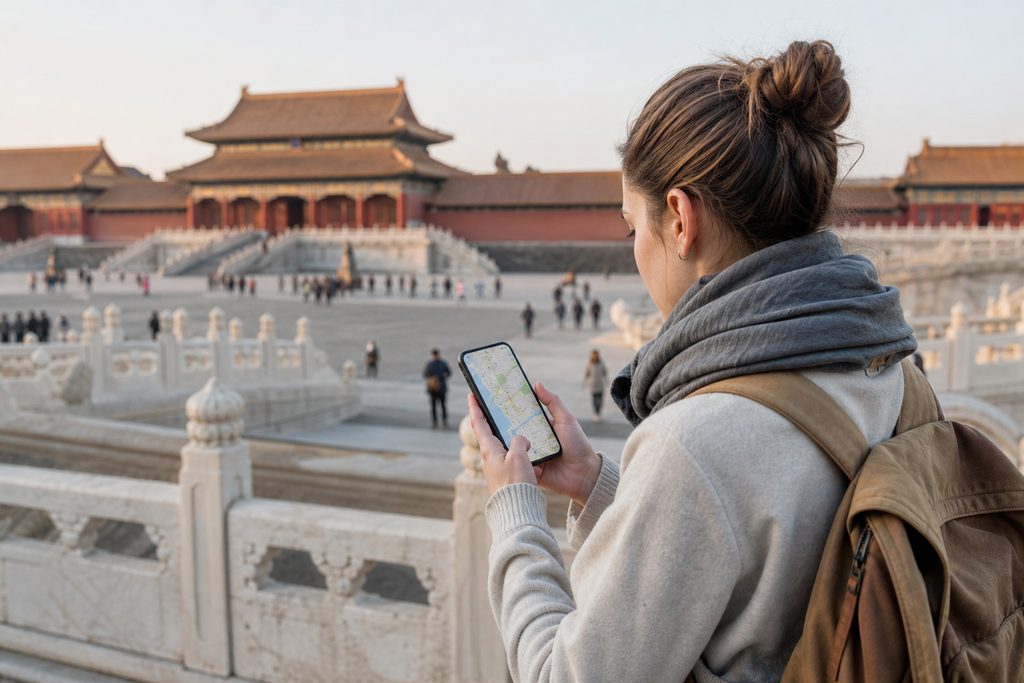
Does WeChat have maps in China? Yes — and for any international patient planning treatment at one of the best hospitals in China for international patients, this single feature may matter more than you expect. WeChat, China’s dominant messaging app with over 1.3 billion monthly users, includes a built-in mapping service powered by Tencent Maps. It handles walking directions, public transit routes, ride-hailing integration, and — crucially for medical travelers — indoor navigation inside major hospital complexes.
That last part is not a minor convenience. Some Chinese tertiary hospitals see more than 10,000 outpatient visits per day. Finding the right building, the right floor, the right registration window inside a facility that large is genuinely difficult. We have watched patients spend forty minutes wandering the wrong wing of a hospital in Beijing simply because they could not read the signage.
How WeChat Maps Actually Works for Foreigners
Here is the honest version. WeChat’s map function lives inside the app itself — you do not download a separate program. Open WeChat, tap “Discover,” then look for the map or location services option. The interface supports English to a degree, but street names, hospital department labels, and bus route descriptions often appear only in Chinese characters.
Can foreigners use WeChat maps for hospitals in China? Yes, with caveats. The app requires a phone number to register — international numbers work. You will need a data connection or Wi-Fi. And you will need to accept that roughly 60 to 70 percent of the map labels you encounter inside a hospital will be in Chinese.
That gap is where things get complicated.
Why Hospital Navigation in China Is Harder Than You Think
Peking Union Medical College Hospital, one of China’s most storied institutions, occupies a campus in central Beijing with multiple buildings connected by internal corridors, courtyards, and underground passages. Zhongshan Hospital in Shanghai operates across several distinct zones. West China Hospital in Chengdu — one of the largest single-site hospitals on earth — has its own internal bus system.
WeChat maps hospital navigation in China helps, but it was not designed as a medical wayfinding tool. The app shows you the hospital’s perimeter. It does not reliably show you that the cardiac surgery outpatient clinic is on the third floor of Building 6, accessed through a side entrance that closes at 4:30 PM.
This is not a criticism of the technology. It is simply the reality of navigating a system built primarily for Chinese-speaking patients who already understand how these hospitals work.
How This Actually Works, Step by Step
Say you are a patient in the United States or Germany or the UAE, and you have decided to explore treatment at a Chinese hospital. Here is the real sequence.
Step one: You gather your existing examination reports — imaging, lab results, pathology, discharge summaries. You send them to us. Our team translates the relevant documents into Chinese and identifies which hospitals and departments are the strongest match for your condition. This typically takes two to four business days.
Step two: The Chinese specialty team reviews your records. Depending on the service you choose, this may be a written second opinion (from $300–500) or a video consultation (from $500–800 for a top specialist, $100–300 for a standard international department consultation). You receive a written analysis with treatment suggestions and direction. This is not a prescription. It is expert guidance to help you decide whether traveling to China makes sense.
Step three: If the remote evaluation confirms a feasible plan and you agree to proceed, we coordinate the practical side — hospital appointment scheduling, arrival support, and bilingual medical companion services (from $300 per day). This is where WeChat maps enters the picture. Your companion uses it alongside their own knowledge of the hospital to get you to the right place at the right time.
Step four: You arrive. Your companion meets you, helps with registration, queue management, payment, and translation. Any admission or surgery remains subject to the hospital’s own rules and the treating physician’s assessment. We do not promise admission, priority access, or outcomes.
A Realistic Timeline
Patients consistently underestimate how long each stage takes. Here is a grounded view.
| Stage | Typical Duration | What Slows It Down |
|---|---|---|
| Record collection and translation | 3–7 days | Incomplete records, need for additional imaging |
| Written second opinion | 5–10 business days | Specialist availability, complexity of case |
| Video consultation scheduling | 1–2 weeks | Time zone coordination, specialist calendar |
| Visa application (S2 category) | 2–4 weeks | Embassy processing times vary by country |
| Hospital appointment coordination | 1–3 weeks | Department schedules, whether VIP/international channel is used |
| Travel and arrival | 1–3 days | Flight availability, jet lag recovery |
| In-person consultation and admission | 1–5 days | Whether surgery requires pre-operative testing |
Total realistic timeline from first contact to in-person consultation: six to twelve weeks for most non-emergency cases. Emergency situations follow entirely different pathways and should be handled through local emergency services.
What Can Go Wrong — and What Happens Then
WeChat maps fails you at the worst moment. The app crashes. Your data plan expires. The hospital has three buildings with similar names and you go to the wrong one. This happens more often than anyone admits.
The recourse: your bilingual companion knows the hospital layout. If you are navigating independently, go to the hospital’s international department or VIP channel — staff there typically speak some English and can redirect you. If you are completely lost, call your hospital’s international office. Most top-tier hospitals have one.
Your visa gets delayed. S2 visa processing times fluctuate. The applicable category for short-stay medical treatment is S2, subject to the latest embassy requirements and supporting hospital documents. Never book non-refundable flights before your visa is in hand. We have seen patients lose thousands of dollars this way.
The specialist you hoped to see is unavailable. Chinese hospitals do not guarantee specific physician appointments through standard channels. If you need a particular expert, the international department or VIP channel improves your odds — but no one can promise it. Our appointment coordination service (from $300) includes a full refund if we cannot secure the appointment shown in your order.
Your condition changes. You arrive, and the in-person examination reveals something the remote review could not detect. The treatment plan shifts. This is medicine. It is not a failure of the process.
Decision Criteria: When WeChat Maps Is Enough and When It Is Not
If you are visiting a private international hospital like United Family, Jiahui, or Parkway, WeChat maps plus basic English signage will probably suffice. These facilities are designed for foreign patients. Staff speak English. Signage is bilingual. Direct insurance billing is common.
If you are going to a public tertiary hospital — the kind ranked in the Fudan Top 100 — assume you need help. Not because the care is worse. Quite the opposite. Fuwai Hospital performs over 14,000 cardiac surgeries annually, more than any other heart center in the world. But these hospitals were built for volume, not for foreigner-friendly wayfinding.
Consider the numbers. China has over 35,000 hospitals. The top 5 percent — roughly 340 institutions across 37 cities — represent the tier where international patients typically seek care. Beijing alone has 21 Fudan Top 100 hospitals. Shanghai has 18. Guangzhou has 10. Each one has its own internal geography, its own registration system, its own rules about where foreigners go first.
WeChat maps gets you to the gate. It does not get you to the right desk.
Practical Considerations: Records, Visas, Payment, and Language
Records: Bring physical copies and digital backups of everything. Chinese hospitals may request imaging on disc or via specific formats. Your translated records should include a summary letter from your home physician if possible.
Visa: The S2 visa is the applicable short-stay category for medical treatment and private affairs, subject to the latest embassy or consulate requirements and supporting hospital documents. Accompanying family members also apply for S2. The M visa is for commercial and trade activities — it is not a medical visa. Do not let anyone tell you otherwise. For stays exceeding 180 days, S1 applies.
Payment: Public hospitals require prepayment. Insurance reimbursement happens after the fact, in your home country. Private international hospitals often bill insurance directly. Budget accordingly.
Language: Download a translation app. Also download WeChat. Also — and this is not a sales pitch — consider that a bilingual medical companion exists precisely because apps have limits. A human who knows that the CT scan department moved to a different floor last month is worth more than any map.
Follow-up: Plan how you will continue care when you return home. Ask your Chinese physician for a written summary in English before discharge. Request copies of all imaging and lab work.
Frequently Asked Questions
Partially. The app’s basic navigation works in English, but hospital-specific labels, department names, and internal directions are predominantly in Chinese. You can search for a hospital by its English name in some cases, but the results may still display Chinese characters. Having a translation tool or a Chinese-speaking companion makes a significant difference.
WeChat is the most integrated option because it combines messaging, maps, payment, and hospital appointment functions in one app. Alternatives like Amap (Gaode Maps) and Baidu Maps exist and are excellent, but they are almost entirely in Chinese. Apple Maps works in China for basic navigation but lacks the hospital-specific detail WeChat provides. For practical purposes, WeChat is the most accessible starting point for foreign visitors.
Assuming the hospital is one building. Many top-tier Chinese hospitals operate as sprawling campuses with multiple structures, disconnected entrances, and internal referral pathways that require you to visit different buildings for registration, examination, and treatment. Arriving without a plan — or without someone who knows the layout — routinely adds hours to what should be a straightforward visit.
For emergencies, call 120 (China’s medical emergency number) rather than navigating yourself. WeChat maps can help you locate the nearest hospital, but emergency response teams know the fastest routes and can coordinate with receiving facilities. Do not attempt to navigate a medical emergency on your own if you can avoid it.
Our bilingual medical companions accompany you through the entire hospital visit — registration, queue management, payment, finding the right department, and translating between you and staff. This service starts from $300 per day. We also coordinate appointments in advance so you are not navigating the system cold. You can learn more about how we support international patients at our consultation page.
Your Next Step
WeChat maps is a genuinely useful tool for getting around China, and for many hospital visits it will get you close enough. But “close enough” in a 10,000-patient-per-day hospital is not the same as “at the right window with the right paperwork at the right time.” The difference between a smooth visit and a frustrating one often comes down to whether someone who knows the system is standing next to you.
China Medical Services connects international patients with 340+ top-ranked hospitals across 37 cities. We are not doctors. We do not diagnose or treat. We handle the logistics, the language, and the navigation so your energy goes toward your health, not toward finding Building C. If you are considering treatment in China, start with a conversation — no pressure, no obligation. Visit our consultation page to tell us what you are facing.
This article is for informational purposes only and does not constitute medical advice. Always consult a qualified healthcare provider regarding any medical condition or treatment decision. Hospital policies, visa requirements, and pricing are subject to change.
For more medical information and treatment options in China, visit chinamedservices.com (China Medical Services).
