Personal Chef Service During Medical Stay in China: Customized Dietary Meal Preparation
When 42-year-old Michael finally booked his knee replacement at a Shanghai hospital, he had the surgery, the visa, and the flights sorted. What he had not planned for was food. His surgeon prescribed a high-protein, low-inflammatory diet for the first six weeks. Hospital meals were bland. Delivery apps were indecipherable. His wife could not cook in their serviced apartment‘s tiny kitchenette. Three days post-op, he was living on convenience store bananas and lukewarm congee. Recovery stalled.
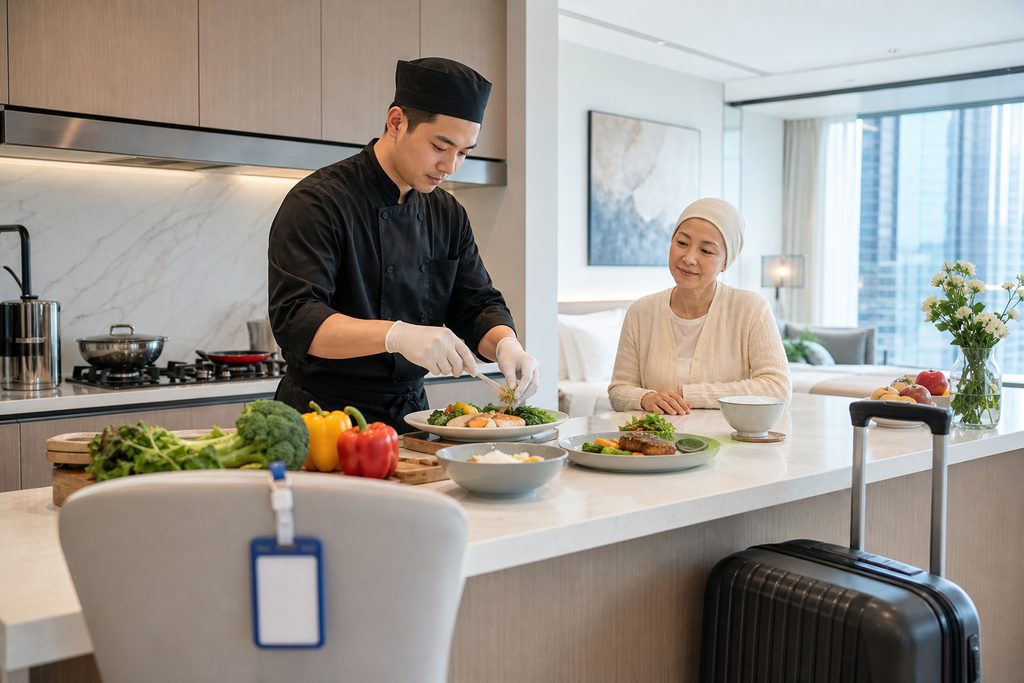
That scenario plays out more often than anyone talks about. Patients fly across the world for world-class surgery, then underestimate the role nutrition plays in getting back on their feet. A personal chef for medical recovery in China can bridge that gap. It is not a luxury. For many, it becomes a necessity.
Key Takeaways
- A private chef for post-surgery recovery in major Chinese cities costs from $80–150 per day, including ingredient sourcing and custom meal preparation tailored to your surgeon’s dietary protocol.
- Chinese hospitals rarely accommodate complex dietary restrictions in standard wards. International departments offer better options, but off-site customized meal services fill a critical gap, especially for halal, kosher, or anti-inflammatory diets.
- Language barriers make independent meal planning extremely difficult. Ingredient labels, delivery apps, and kitchen equipment instructions are almost exclusively in Mandarin.
- Not all personal chef services understand post-surgical nutrition. You need someone who can read a discharge summary, communicate with your care team, and adjust meals as your recovery progresses.
The Hidden Gap in Medical Tourism: Nutrition During Recovery
A 2021 study published in *Clinical Nutrition* found that surgical patients who received structured nutritional support had a 28% lower rate of post-operative complications compared to those who relied on standard hospital food or self-managed diets. That is not a marginal improvement. It is the difference between a smooth recovery and a wound infection that keeps you in China an extra three weeks.
Here is what most international patients do not realize until they are already here. Chinese hospital food is designed for the local palate. Breakfast might be steamed buns and pickled vegetables. Lunch could be a soy-braised meat over rice with stir-fried greens. It is nutritious by local standards. But if you are recovering from cardiac surgery and need low-sodium meals under 1,500mg per day? Or you are a cancer patient who needs calorie-dense, neutropenic-safe food during chemotherapy? The standard tray simply cannot accommodate you.
And delivery apps? They are a minefield. Didi and Meituan dominate the market. Menus are entirely in Chinese characters. There is no reliable way to filter for “no MSG,” “gluten-free,” or “low FODMAP.” Even if you manage to order, you have no control over cooking oils, sodium levels, or cross-contamination risks.
This is where the personal chef medical recovery China cost equation starts making sense. It is not about indulgence. It is about removing a massive, daily stressor during the most vulnerable weeks of your life.
Who We Are
Our team at China Medical Services is not a hospital. We do not provide medical treatment, clinical diagnoses, or dietary therapy. We are logistical coordinators who connect international patients with China’s top-ranked hospitals — and with the support services that make recovery here practical and safe. That includes vetted personal chefs who understand post-surgical nutrition protocols, dietary restrictions across cultures, and the specific demands of healing after major procedures. We bridge the gap between your surgeon’s instructions and what ends up on your plate.
What a Personal Chef for Medical Recovery Actually Provides
This is not a restaurant meal delivery service. A medical recovery chef does something fundamentally different.
Protocol-Driven Meal Planning
Your surgeon gives you dietary guidelines. Maybe it is “soft foods only for 10 days after gastric surgery.” Perhaps it is “minimum 1.5g of protein per kilogram of body weight daily for wound healing.” A recovery chef translates those clinical instructions into actual meals. They build a rotating menu that hits your macro and micronutrient targets without repetition fatigue. One patient we supported after bariatric surgery in Guangzhou needed six tiny, pureed meals per day, each under 200 calories but packing 15 grams of protein. That is not something you figure out on your own from a hotel room.
Ingredient Sourcing and Kitchen Setup
Supermarkets in China are not laid out like Whole Foods. Finding fresh turmeric root, quinoa, or unsweetened almond milk requires knowing exactly which store to visit — or which Chinese term to search on a delivery app. A local chef handles all of this. They shop at wet markets for fresh produce, import stores for specialty items, and know how to read Chinese nutrition labels for hidden sodium, sugar, and additives. If your serviced apartment has a two-burner induction cooktop and a rice cooker, they make it work. They bring their own knives, cutting boards, and storage containers.
Cultural and Religious Dietary Compliance
Halal meal preparation available in Chinese hospitals is limited. Some international hospital wings in Shanghai and Beijing offer halal-certified kitchens. Most public hospitals do not. If you keep kosher, the situation is more difficult — there are very few kosher-certified facilities in mainland China outside of Chabad centers in major cities. A private chef who understands these requirements is not a nice-to-have. It is the only way to maintain dietary observance while recovering from surgery.
We have coordinated halal meal services for patients from the Middle East and Southeast Asia across multiple Chinese cities. The chefs source from halal-certified butcheries, maintain separate cookware, and prepare meals in the patient’s residence to avoid cross-contamination. The same applies for Jain vegetarian requirements, Seventh-day Adventist dietary practices, or any other religious food code.
Adaptation as Recovery Progresses
Week one post-surgery is different from week four. A patient who starts on clear liquids after gastrointestinal surgery will advance to full liquids, then soft solids, then a maintenance diet. The chef adjusts daily based on tolerance, surgeon feedback, and the patient’s appetite. This is not a set-and-forget meal plan. It is responsive nutritional support that tracks clinical progress.
What Is the Personal Chef Medical Recovery China Cost?
Let us talk numbers directly. Hiring a private chef for post-surgery diet in Beijing, Shanghai, or Guangzhou costs between $80 and $150 per day. That range covers the chef’s labor, ingredient procurement, meal preparation, and kitchen cleanup. It typically includes two to three meals plus snacks, customized to your dietary protocol.
Here is how that breaks down across different service levels:
| Service Level | Daily Cost (USD) | What Is Included |
|---|---|---|
| Basic Meal Prep | $80–100 | 2 meals + 1 snack. Chef cooks off-site or in your kitchen. Standard dietary adjustments (low-sodium, diabetic-friendly, soft diet). Ingredient costs included. |
| Full-Day Chef | $120–150 | 3 meals + 2 snacks. Chef on-site for 6–8 hours. Complex dietary protocols (post-bariatric, neutropenic, multiple allergies). Grocery shopping included. |
| Specialized Protocol | $150–200 | Full-day service plus direct communication with your care team. Written meal logs for your surgeon. Halal, kosher, or TCM food therapy integration where appropriate. |
These figures are for major cities. Custom meal service after surgery Shanghai or Beijing commands the higher end of the range. Smaller cities like Hangzhou or Chengdu may come in slightly lower. The cost also depends on ingredient complexity — a neutropenic diet requiring all produce to be peeled and cooked, with no raw foods, demands more labor than a standard heart-healthy menu.
Compare this to the alternative. A single night of hospital readmission for dehydration or malnutrition can cost thousands of dollars out of pocket. A wound infection from poor nutritional status extends your stay by a week or more. Suddenly, $100 a day for guaranteed, protocol-compliant nutrition looks like a bargain.
What Food Can You Eat After Surgery in China? The Real Answer
This question comes up in nearly every initial consultation. Patients want a clear list. The honest answer is: it depends entirely on your procedure, your surgeon’s protocol, and your personal tolerance. But some patterns hold true.
After orthopedic surgery, surgeons typically push protein. Lean meats, eggs, tofu, and bone broths are staples. Chinese bone broth — simmered for hours with ginger and goji berries — is actually an excellent recovery food, rich in collagen and easily digestible. Many patients tolerate it well.
After abdominal surgery, the progression is more cautious. Clear liquids first: rice water, diluted broths, herbal teas. Then soft, bland foods: congee, steamed egg custard, mashed pumpkin. Nothing raw. Nothing fibrous. Nothing spicy. This is where a chef who understands post-surgical gut recovery is invaluable.
After cardiac procedures, sodium restriction dominates. The target is typically under 2,000mg per day, sometimes under 1,500mg. Soy sauce, oyster sauce, and fermented bean pastes — the backbone of Chinese cooking — are mostly off the table. A skilled chef rebuilds flavor using vinegar, fresh herbs, garlic, ginger, and Sichuan peppercorn without salt.
Cancer patients undergoing chemotherapy face a different challenge entirely. Appetite disappears. Taste changes. Food aversions develop overnight. The priority becomes calorie density and palatability. Small portions. Neutral temperatures. Nothing with a strong smell. Smoothies fortified with nut butters and protein powder. Soups that can be sipped slowly over an hour.
Medical Tourism Meal Planning Service in China: Price vs. Value
Some patients ask whether they can just hire any local cook. Technically, yes. You can find domestic helpers on Chinese classifieds for less. But a general cook does not understand that neutropenic means no fresh herbs as garnish. They do not know that a patient on anticoagulants must maintain consistent vitamin K intake — no sudden swings between high-kale days and no-kale days. They cannot read a discharge summary that says “advance diet as tolerated, monitor for dumping syndrome.”
A medical tourism meal planning service in China is not about cooking skill. It is about clinical literacy. The chefs we work with have experience across multiple surgical specialties. They understand food safety for immunocompromised patients. They know how to log meals for a dietitian’s review. They can spot when a patient is not eating enough and alert the care coordinator.
That expertise is what the price reflects. Not fancy plating. Not rare ingredients. Clinical safety delivered through food.
Is Halal Meal Preparation Available in Chinese Hospitals?
The short answer: sometimes, but do not count on it.
A few hospitals in China have dedicated halal kitchens. They are more common in cities with significant Muslim populations — Xi’an, Lanzhou, Urumqi. In Beijing and Shanghai, some international hospital wings offer halal-certified meal services. Public hospital wards generally do not. Even when halal options exist, they are often limited to a handful of repetitive dishes that may not align with your post-surgical dietary needs.
For patients who require strict halal compliance, the safest approach is a private chef who sources from certified halal suppliers and prepares all meals in your residence. This eliminates the uncertainty. It also gives you control over the nutritional composition of every meal.
We have arranged this for patients from Saudi Arabia, UAE, Indonesia, and Malaysia. The logistics are manageable in any major Chinese city with a Muslim community. Halal butcheries exist. Imported halal packaged goods are available online. The chef handles the sourcing. You focus on recovery.
Hiring a Private Chef for Post-Surgery Diet in Beijing: What to Expect
Beijing presents unique challenges and advantages. The city is enormous. Traffic can turn a 30-minute grocery run into a two-hour ordeal. But it also has the best international food supply chain in northern China. Imported goods that are hard to find in other cities are stocked in Beijing’s expatriate-oriented supermarkets.
A typical engagement works like this. Before you arrive, we collect your dietary requirements, surgeon’s protocol, food allergies, and religious restrictions. We match you with a chef who has relevant experience — someone who has cooked for post-cardiac patients, or post-oncology patients, or whatever your situation demands.
The chef visits your accommodation on day one. They assess the kitchen. They identify which supermarkets and specialty stores they will use. They present a draft menu for your approval. Once you sign off, they begin cooking. Meals are delivered fresh, not frozen. Portions are adjusted based on your actual intake. If you are not eating enough, the chef troubleshoots — different textures, different temperatures, different flavor profiles — until they find what works.
The engagement typically runs two to six weeks, depending on your recovery timeline. Some patients extend to eight weeks for major procedures like organ transplantation or complex orthopedic reconstructions.
Why Standard Hospital Food Falls Short for International Patients
Chinese hospitals feed thousands of patients daily. The food is safe, hygienic, and nutritionally adequate for the general population. But it is not designed for someone recovering from a Whipple procedure who needs pancreatic enzyme supplementation with every meal. It is not designed for a patient with celiac disease who cannot tolerate a trace of wheat-based soy sauce.
The hospital kitchen is a high-volume operation. Customization is minimal. Special requests go through nursing stations, get translated, get relayed to a kitchen that serves 2,000 meals per shift, and often get lost. The result is a tray that may or may not match what your surgeon ordered.
International department wards in top-tier hospitals do better. Peking Union Medical College Hospital‘s international wing, for instance, offers Western menu options and can accommodate common dietary restrictions. But even there, the range is limited. You might get a grilled chicken breast with steamed vegetables. You will not get a carefully calibrated anti-inflammatory meal plan with omega-3-rich fish, turmeric-infused quinoa, and fresh-pressed vegetable juices.
That level of customization requires a dedicated chef.
How We Coordinate Your Nutritional Support
The process starts before you leave home. During your initial consultation, we ask about dietary requirements alongside your medical history. This is not an afterthought. It is part of the treatment planning.
We identify whether your hospital can meet your needs in-house. If not, we present personal chef options with transparent pricing. We coordinate between your surgeon, the hospital dietitian if one is involved, and the chef. Everyone works from the same protocol.
Once you are in China and recovering, we check in regularly. Is the food meeting your needs? Are you eating enough? Has your surgeon updated your dietary restrictions? If something is not working, we adjust. The chef is not an isolated vendor. They are part of your recovery team, looped into communication through our coordination service.
This integrated approach is what distinguishes a medical concierge arrangement from simply hiring a cook off a website. The chef knows your clinical context. They are accountable to your care coordinator. They document what you eat. If your surgeon needs to know your daily protein intake for the past week, we can produce that data.
Frequently Asked Questions
You can, but with caveats. Chinese customs restricts certain food imports — fresh fruits, meats, and dairy products are generally prohibited. Packaged, shelf-stable items like protein powders, meal replacement shakes, and supplement capsules are usually fine. Declare them on arrival. Bring enough for your entire stay, as specific brands may not be available locally. Your chef can incorporate your supplements into meals if you provide them.
This requires careful planning. Chinese cuisine uses many common allergens — soy, wheat, peanuts, sesame, shellfish — as foundational ingredients. Cross-contamination risk in restaurant kitchens is high. A private chef who cooks exclusively for you in a controlled environment is the safest option. We document all allergies in Chinese and English, share them with the chef and hospital, and establish an emergency protocol before your first meal. If you carry an epinephrine auto-injector, bring two. They are not widely available in Chinese pharmacies.
Some do. Many do not. The chefs we work with have varying English levels, but all are paired with our bilingual coordination team. Your dietary protocol is translated into Chinese. Daily communication — menu changes, feedback, concerns — goes through us or through a translation app that both parties use. The chef does not need to discuss your surgical wound. They need to understand “patient cannot tolerate solids today, switch to pureed soups.” That level of communication is manageable even with a language barrier.
Yes, though the pool of available chefs shrinks in smaller cities. We have arranged personal chef services in Guangzhou, Shenzhen, Chengdu, Hangzhou, and several other cities where international patients seek treatment. In cities with very small expatriate populations, the chef may need to travel from a nearby major city, which affects the daily rate. We will be upfront about availability and cost before you commit to anything.
How far in advance do I need
For more medical information and treatment options in China, visit chinamedservices.com (China Medical Services).
