Joint Surgery Hospitals in Shanghai: Costs, Top Clinics, and How to Plan
Key Takeaways
- Joint replacement surgery cost in Shanghai typically runs $8,000–$18,000 for a total knee or hip, versus $35,000–$70,000 in the United States — same implant brands, different labor economics.
- Shanghai holds 18 hospitals on the Fudan Top 100 list, the second-highest concentration in China, and several rank among the country’s top 10 for orthopedics.
- The hard part is not the surgery. It is the queue. Public hospital outpatient slots cannot be reserved from overseas, and no surgeon operates before an in-person consultation.
- Nothing here is a diagnosis or a quote. Every price depends on the hospital, the implant, and how complex your case turns out to be.
The Problem: The Waiting Is Often Worse Than the Pain
In Canada, the median wait from orthopedic referral to hip or knee replacement has hovered around 26 weeks for years, according to the Canadian Institute for Health Information — and in some provinces it stretches past a year. In the UK, roughly one in five patients on the NHS trauma and orthopedics waiting list has been waiting more than 18 months. Those are not outliers. They are the system working as designed.
Meanwhile the joint keeps degrading. Cartilage does not regenerate. A knee that could have been resurfaced becomes a knee that needs a full replacement, and the surrounding muscles weaken month by month.
Cost is the other wall. In the US, a total knee arthroplasty averages $35,000 to $70,000 before insurance, and even insured patients frequently face $4,000–$8,000 in out-of-pocket exposure. So patients start searching for alternatives. And Shanghai keeps appearing in those searches. For a growing number of international patients, joint replacement surgery cost Shanghai is the entry point — but cost alone is a bad reason to choose a surgeon.
Why Shanghai Orthopedics Delivers Results
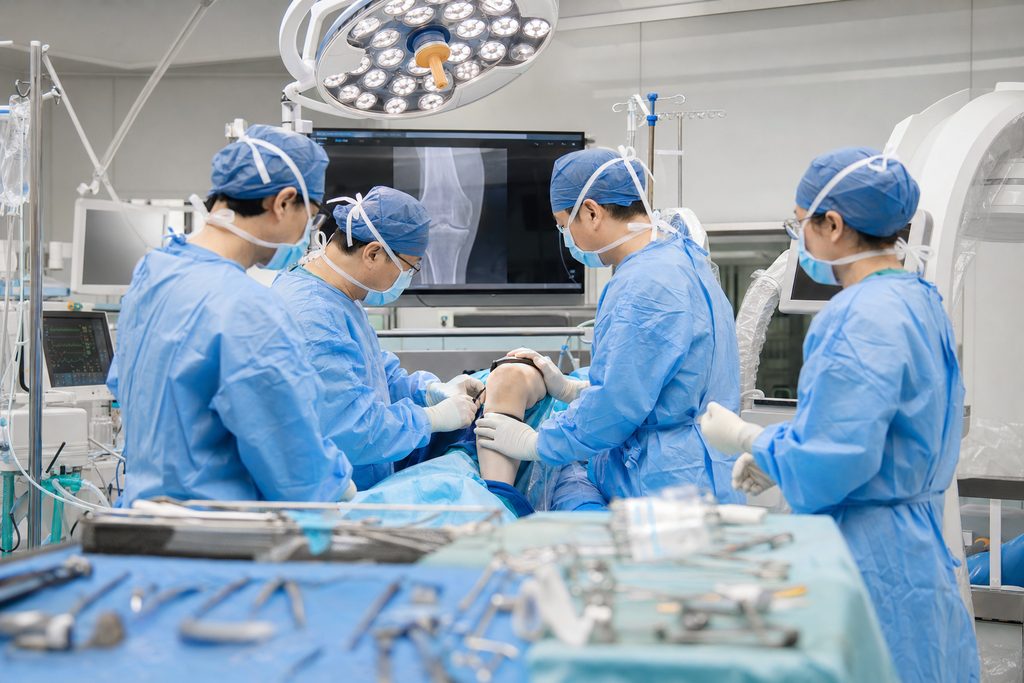
Shanghai is not a budget destination that happens to do surgery. It is one of the densest concentrations of orthopedic expertise on earth. Here is what that actually means in practice.
Volume Changes a Surgeon’s Hands
A senior joint surgeon at a major Shanghai tertiary hospital performs several hundred arthroplasties a year. The average American orthopedic surgeon does closer to 65, according to data published in Clinical Orthopaedics and Related Research and related workforce studies. Repetition matters in joint replacement more than in almost any other field — cup positioning, soft-tissue balancing, and cement technique are motor skills, and motor skills plateau at volume.
Robotics and Navigation Are Standard, Not Premium
Major Shanghai hospitals run Mako robotic arms, computer-assisted navigation, and 3D-printed patient-specific instrumentation as routine tools. A 2023 review in Journal of Orthopaedic Surgery and Research found that robotic-assisted total knee arthroplasty improved component alignment accuracy compared with conventional techniques. That technology is not gated behind a private-pay tier in Shanghai the way it often is elsewhere.
Cost Is Lower for Boring Reasons
Nobody is cutting corners on your implant. The structural reasons costs differ are unglamorous: surgeon fees are set by national fee schedules rather than market rates, hospital overhead is amortized across enormous daily patient volumes, and there is no insurance middle layer inflating list prices. You are paying for the same titanium and polyethylene at a different labor cost base.
What Joint Replacement Surgery Costs in Shanghai — A Real Comparison
The table below reflects typical ranges at top-tier Shanghai public hospitals and international departments. Treat every number as a starting band, not a quote. Implant choice alone can swing a knee replacement by several thousand dollars.
| Procedure | Shanghai (public tertiary) | Shanghai (international dept.) | United States | United Kingdom (private) |
|---|---|---|---|---|
| Total knee replacement | $8,000–$14,000 | $14,000–$22,000 | $35,000–$70,000 | £12,000–£18,000 |
| Total hip replacement | $9,000–$15,000 | $15,000–$24,000 | $40,000–$75,000 | £13,000–£19,000 |
| Partial knee replacement | $7,000–$12,000 | $12,000–$18,000 | $25,000–$50,000 | £10,000–£15,000 |
| Arthroscopic meniscus repair | $2,500–$5,000 | $5,000–$9,000 | $10,000–$20,000 | £5,000–£8,000 |
| Hospital stay (per day) | $150–$400 | $600–$1,200 | $3,000–$6,000 | £800–£1,500 |
Those figures cover surgeon fees, anesthesia, implants, hospital stay, and standard rehabilitation. They do not cover flights, accommodation, or complications. And they vary by hospital and case complexity — a revision of a failed prior replacement costs more than a primary one, sometimes substantially.
For a wider view of how Shanghai compares with other Chinese cities, the Shanghai city page breaks down hospital categories, and the departments directory lists which hospitals rank in China’s top 10 for orthopedics specifically.
How the Process Actually Works, Step by Step
This is where most international patients get surprised. Chinese public hospitals do not run like Western ones.
Step one. You send existing imaging and reports — X-rays, MRI, prior operative notes, bloodwork. A Chinese orthopedic specialist reviews them remotely and gives a written opinion on whether surgery is indicated, which procedure, and roughly what it would cost.
Step two. If surgery looks reasonable, you have a video consultation with the surgical team. You ask questions. They explain the approach, the implant options, and the recovery timeline.
Step three. You travel. This is unavoidable — no Chinese public hospital will schedule an operation on a patient it has never examined in person. The in-person consultation happens first, and only then does the surgeon book the operating room.
Step four. Surgery and inpatient stay. Typical length of stay for an uncomplicated knee or hip replacement in Shanghai is 3–7 days, shorter than the US average.
Step five. Discharge and early rehabilitation in Shanghai, then a follow-up plan you can carry home.
Choosing the Right Hospital: What Actually Matters
Plan on $8,000–$22,000 depending on whether you use a standard public channel or an international department, plus roughly $2,000–$5,000 for flights, accommodation, and a companion’s living costs. Complex or revision cases cost more. Get a written estimate after your imaging is reviewed.
You can secure a consultation and a treatment plan remotely. You cannot lock in a surgery date. Chinese hospitals require an in-person examination before scheduling an operation, and any provider claiming otherwise is overpromising.
This is a real risk and worth planning for. Request a complete operative report, implant documentation, and imaging before discharge. Establish a follow-up orthopedic appointment at home before you leave Shanghai, and confirm your travel insurance covers post-surgical complications abroad.
At private international hospitals, no. At public tertiary hospitals, effectively yes — for registration, payment, imaging, and ward communication. Bilingual medical interpretation is available, and it is the single most common service international patients request.
Your Next Step
Shanghai offers world-class joint replacement at a fraction of Western prices, but the value only materializes if the logistics work. The surgery is the easy part. The queue, the language, and the paperwork are what trip people up.
We are China Medical Services — a coordination service, not a hospital, and we do not provide diagnoses or medical advice. We help international patients match with appropriate hospitals, arrange remote second opinions and video consultations, coordinate appointments through official hospital international departments, and provide bilingual companions on the ground. If you would like to understand your options before making any commitment, you can start with a free consultation through our patient services page.
Whatever you decide, get your imaging reviewed before you book a flight. That single step saves most patients either money or a wasted trip.
This article is for general information only and does not constitute medical advice. Treatment decisions should always be made in consultation with a qualified physician who has reviewed your individual case.
Frequently Asked Questions
Yes. The hospitals used for international patients are JCI-accredited and follow the same international safety standards as top hospitals in the US and Europe. Surgical teams perform high volumes of procedures — often more than their Western counterparts — which studies show leads to better outcomes.
Costs vary by procedure and hospital, but international patients typically save 40-80% compared to US prices — even when factoring in travel and accommodation. A consultation with our team will give you an exact, all-inclusive quote with no hidden fees.
Send us your existing medical reports to get started. We handle everything from hospital selection and appointment scheduling to visa assistance and post-operative recovery planning. Your medical records are reviewed by the specialist before you even book a flight.
For more medical information and treatment options in China, visit chinamedservices.com (China Medical Services).
