Myanmar Patient Medical Tourism Service China: Yangon Cross-Border Care Coordination
Key Takeaways
- China’s top-tier hospitals perform over 14,000 cardiac surgeries annually at a single center, with costs typically 70-80% lower than equivalent care in Singapore or Thailand for Myanmar patients.
- Direct cross-border coordination from Yangon eliminates the single biggest barrier: navigating a healthcare system where public hospital outpatient departments cannot be booked from overseas without local presence.
- Without proper visa guidance and on-ground bilingual support, Myanmar citizens face a real risk of arriving in China only to find they cannot register at the intended department or communicate their medical history accurately.
- Any patient considering this path should understand that China’s public hospital system operates on a first-come, first-served basis for general outpatient visits—specialist access requires navigating international departments or VIP channels, not standard registration counters.
The Problem: When Treatment Options at Home Aren’t Enough
Myanmar’s healthcare system faces well-documented capacity constraints. A 2023 World Health Organization assessment noted that specialist oncology services remain concentrated in Yangon and Mandalay, with wait times for advanced diagnostic imaging stretching to several weeks at public facilities. For families facing a cancer diagnosis, a complex cardiac condition, or a degenerative orthopedic issue, those weeks can feel like a lifetime. Private options exist in Yangon. They are limited in scope. And for procedures like robotic-assisted prostatectomy or minimally invasive cardiac valve repair, the technology and surgical volume simply aren’t there yet. That’s when families start searching for alternatives—and increasingly, they look north. The question becomes: how do you actually find the best hospitals in China for Myanmar patients and coordinate everything from Yangon without getting lost in a system you don’t understand?
This is not a hypothetical scenario. Our team handles these calls every week. A family in Bahan Township has a CT scan result. They’ve been told surgery is needed. They’ve researched options in Bangkok and Singapore and found quotes that exceed their financial reach. They’ve heard about medical travel to China but don’t know where to start. The language barrier feels insurmountable. The visa process seems opaque. And the fear of arriving in a massive Chinese city with no local support is very real. We understand that fear because we’ve guided hundreds of international patients through exactly this journey.
Who We Are
We are China Medical Services. We are not a hospital. We do not provide medical treatment, clinical diagnoses, or medical advice of any kind. We are your logistical architects—a team of bilingual patient coordinators, medical translators, and cross-border care specialists who bridge the gap between you and China’s top-tier medical expertise. Our database covers over 340 top-ranked hospitals across 37 cities, representing the top 5% of China’s 35,000+ medical institutions as ranked by the Fudan University hospital rankings and JCI accreditation standards. We handle the coordination, the translation, the scheduling, and the on-ground support. You focus on your health. That’s the division of labor that makes cross-border care work.
Why China Delivers Results for Myanmar Patients
Clinical Volume Drives Better Outcomes
There’s a straightforward relationship in surgery: the more you do, the better you get. China’s top hospitals operate at a scale that is hard to comprehend until you see it. Fuwai Hospital in Beijing performs over 14,000 cardiac surgeries annually—the highest volume of any heart center globally. To put that in perspective, the busiest cardiac surgery program in the United States performs around 3,000 cases per year. A surgeon at Fuwai may complete more complex valve repairs in a single month than a competent surgeon in a smaller country performs in an entire year. This volume effect shows up in outcomes. Complication rates for procedures like off-pump coronary artery bypass grafting at these centers are consistently below 2%, which compares favorably with international benchmarks.
This matters for Myanmar patients specifically. Cardiac disease prevalence is high in Southeast Asia. Rheumatic heart disease, often a consequence of untreated childhood strep infections, remains far more common in Myanmar than in Western countries. Chinese cardiac surgeons see these pathologies regularly. They’re not rare presentations that require special consultation—they’re Tuesday morning.
Technology and Efficiency at Scale
Walk into the international department of a major Chinese teaching hospital and you’ll see equipment that matches or exceeds what you’d find in Singapore. Da Vinci surgical robots. PET-CT scanners with the latest detector technology. Proton therapy centers for precise cancer radiation. But the real differentiator isn’t just the hardware. It’s the speed. A patient arriving through a coordinated international channel can often complete diagnostic imaging, specialist consultation, and surgical scheduling within a week—a process that might take six to eight weeks in a public system elsewhere.
Why? Because these hospitals are designed for throughput. Radiology departments run extended hours. Operating theaters are booked in overlapping shifts. The system is built to handle volume without sacrificing quality. For a Myanmar patient traveling on a medical visa with a limited stay window, this efficiency is not a luxury. It’s essential.
Cost Advantage Without Quality Compromise
Let’s address the obvious question. China is less expensive than Singapore or Thailand for complex procedures. Does that mean lower quality? The answer is no—and the reason is structural, not clinical. China’s cost advantage comes from labor economics and hospital efficiency, not from cutting corners. A cardiac bypass surgery that costs $120,000 in the United States or $35,000 in Singapore typically runs $12,000 to $20,000 at a top Chinese public hospital’s international department. A total hip replacement: $8,000 to $15,000 in China versus $40,000 in Thailand’s private hospitals. These are real numbers from our case coordination experience.
For Myanmar families, this math changes what’s possible. It means the difference between accessing treatment and waiting. It means a cancer patient can afford the full course of care—surgery, chemotherapy, and follow-up—rather than rationing treatment based on available funds. That’s not a marketing claim. That’s the reality we see in our coordination work every month.
What You Need to Know Before Going Alone
We need to be direct here. Arranging medical treatment in China from Yangon is not as simple as booking a flight and showing up at a hospital registration desk. The barriers are real. They’re structural. And they can derail a medical trip before it begins.
- Visa Requirements Are Specific and Strict: Medical treatment in China requires an S2 visa with a treatment purpose annotation. Not a tourist visa. Not a business visa. The S2 application requires an invitation letter from the treating hospital, confirmed appointment documentation, and proof of sufficient funds. Myanmar passport holders cannot simply apply for an M visa—that’s for commercial visits only. Getting the wrong visa means being turned away at the hospital or, worse, at immigration. Our team handles this documentation chain end-to-end.
- Public Hospital Outpatient Departments Cannot Be Booked from Overseas: This is the single biggest misconception we encounter. China’s public hospitals operate outpatient departments on a same-day registration basis. You cannot call from Yangon and reserve a slot for next Tuesday. The system doesn’t work that way. Specialist access requires going through the hospital’s international medical department or VIP channel, which operates under different rules—and those channels require local coordination, Chinese-language documentation, and often in-person registration.
- Payment Systems Are Not Set Up for International Transactions: Chinese public hospitals operate on a prepayment model. You deposit funds at admission, and treatment proceeds against that balance. But hospital payment counters typically accept only Chinese domestic bank cards or WeChat Pay/Alipay linked to Chinese bank accounts. A Myanmar citizen arriving with an international Visa card will find it useless at most public hospital cashier windows. The international departments have workarounds, but they require advance arrangement.
- Medical Records Translation Is a Clinical Necessity, Not Just a Convenience: A Chinese specialist reviewing your case needs accurate, medically precise translations of your Myanmar medical records. Not a family member’s summary. Not a Google Translate version. A single mistranslated medication name or pathology finding can lead to a wrong clinical decision. This translation work must happen before you travel—and it requires someone who understands both medical terminology and the Chinese hospital documentation standards.
How We Help You Navigate This
These barriers exist for structural reasons. They’re not designed to exclude international patients—the system simply wasn’t built with cross-border care in mind. Our entire service exists to bridge that gap. Here’s how the coordination works, from Yangon to recovery.
It starts with your medical records. You send us what you have—CT scans, pathology reports, doctor’s notes, current medication lists. Our medical translators convert everything into Chinese hospital-standard documentation. This is not simple translation. It’s medical localization: ensuring that a pathology classification used in Yangon maps correctly to the diagnostic categories Chinese oncologists use for treatment planning. Then we match your case to the right hospital and department. Not the most famous hospital. The right one for your specific condition. A liver cancer patient needs a different center than a brain tumor patient. Our database covers 45 specialty rankings, and we use that granular data—not general reputation—to make recommendations.
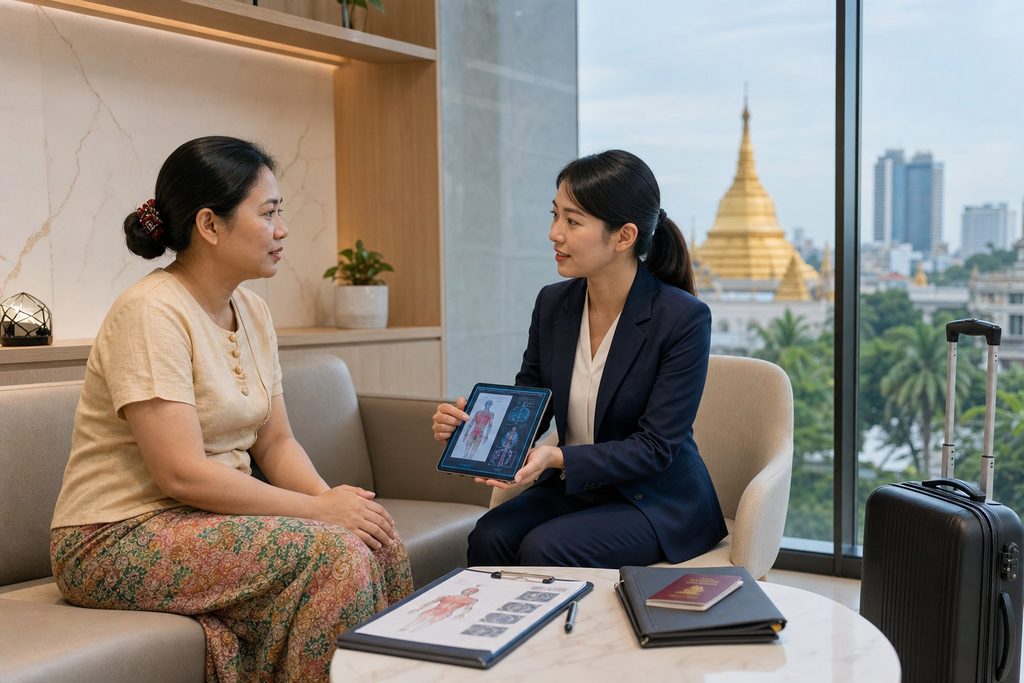
Once the hospital is identified, we coordinate through their international department to secure a consultation slot. We handle the invitation letter for your S2 visa application. We brief you on exactly what documents to bring, what to expect at immigration, and how to prepare for your first hospital visit. When you land in China, our bilingual medical companion meets you. This person handles registration, queues, payment coordination, and—most critically—real-time translation during every doctor consultation. You speak directly with the specialist. Nothing gets lost in translation. Nothing gets assumed.
After the consultation, if surgery or treatment is recommended, we coordinate the admission process, deposit payments, and scheduling. If you need follow-up care back in Yangon, we prepare discharge summaries and treatment plans in English that your local doctor can use. The coordination doesn’t end when you leave the hospital. It ends when you’re safely back home with a clear plan.
We’ve also helped families navigate the practical side of a medical stay in China: finding accommodation near the hospital for family members, arranging airport transfers, and managing extended-stay logistics. These details matter. A family member sleeping in a hospital chair for two weeks is not sustainable. A comfortable recovery for the caregiver means a better recovery for the patient.
Frequently Asked Questions
This is usually the first question we hear, and it’s the right one to ask. The short answer: yes, when you go through proper channels. China’s top-ranked hospitals are subject to the same international accreditation standards as major medical centers anywhere. JCI-accredited facilities in China meet the same patient safety benchmarks as JCI hospitals in Singapore or the United States. The risk comes from going alone—arriving without coordinated access, without language support, without understanding how the system works. That’s not a clinical safety issue. It’s a navigation failure. Our job is to ensure you never face that situation.
You don’t need to travel to China for an initial assessment. The process starts remotely. Send us your medical records. We translate them, match your case to the appropriate specialist, and coordinate a video consultation if the hospital’s international department offers that option. Many do—written second opinions from top specialists typically cost $300 to $500, and video consultations range from $500 to $800 depending on the specialist’s seniority. If you decide to proceed with treatment in China, any consultation fees you’ve paid are credited in full toward our on-the-ground coordination service within 90 days. This means you can get an expert opinion before committing to travel.
Medical complications are a reality in any healthcare system. China’s top hospitals have full intensive care capabilities, emergency response protocols, and complication management experience that comes from high surgical volumes. What you need beyond clinical care is someone on the ground who can communicate with the medical team, coordinate with your family back in Yangon, and manage the logistical disruption. That’s what our bilingual companions do. If a hospital stay extends unexpectedly, we handle the visa extension paperwork, the accommodation changes, and the communication chain. We’ve managed these situations before. We know what needs to happen and in what order.
China medical tourism packages with language support vary enormously in quality. Some hospitals assign an English-speaking nurse to the international ward. Some don’t. The reality is that even in international departments, not all staff speak functional medical English—and almost none speak Burmese. Our bilingual medical companions stay with you through consultations, during admission, and for critical care discussions. For extended hospital stays, we arrange daily check-in visits rather than continuous bedside presence, which keeps costs manageable while ensuring you’re never left unable to communicate a need or a concern. The companion handles everything from explaining medication instructions to ordering meals that match your dietary requirements.
Yes—and this is one of the most common reasons Myanmar patients contact us. Cancer treatment costs in China’s public hospital international departments typically run 60-80% lower than equivalent private hospital care in Singapore or Thailand. A course of chemotherapy that might cost $30,000 in Bangkok could cost $8,000 to $12,000 in China. Radiation therapy follows similar ratios. The key is accessing the right oncology department. China’s Fudan University hospital rankings publish a specific oncology specialty list, and the top ten cancer centers in that ranking handle case volumes that rival MD Anderson or Memorial Sloan Kettering. Our specialty department rankings can help you understand which centers lead in your specific cancer type.
Your Next Step
Cross-border medical care is not a decision anyone makes lightly. It involves trust, significant coordination, and real financial commitment. But for many Myanmar families, it also represents access to treatment that would otherwise remain out of reach—either because the procedure isn’t available locally or because the cost in alternative destinations exceeds what’s possible. The path exists. It requires careful navigation, honest preparation, and a partner on the ground who understands both systems. That’s the role we play.
If you’re considering this path, start with a conversation. Send us your medical records and a brief description of your situation. We’ll review your case, identify the most appropriate hospital options from our network of 340+ top-ranked hospitals, and give you an honest assessment of what’s involved—including costs, timelines, and realistic expectations. There’s no charge for this initial consultation. No pressure. Just clear information so you can make an informed decision. Get a free consultation with our team and let’s discuss your specific situation.
For more medical information and treatment options in China, visit chinamedservices.com (China Medical Services).
