China Hospital Room Rates: What International Patients Should Expect
China Hospital Room Rates: What International Patients Should Expect
Roughly 8 in 10 international patients who contact us about treatment in China ask about the hospital bill before they ask about the surgeon. That instinct is correct. And the single line item that surprises people most is the room. Hospital room rates in China for international patients can run from about $40 a night in a standard public ward to well over $800 a night in a private international suite — a 20-fold spread for the same building, the same operating theater, and often the same surgeon.
So the room is not a detail. It is one of the largest controllable variables in your entire budget. Understanding how Chinese hospitals price accommodation — and why the gap is so wide — will change what you pay and, in some cases, what kind of care you can access at all.
How This Actually Works, Step by Step
Here is the real sequence, from first inquiry to the night you check in.
Step 1 — You send records, not a room request. A room category cannot be quoted in isolation. Chinese hospitals price accommodation alongside the procedure, the department, and the length of stay. So the first thing we need is your existing examination reports: imaging, pathology, lab work, discharge summaries, whatever you have. Our team translates them and routes them to the relevant specialty at a shortlisted hospital.
Step 2 — The specialty reviews and responds. A written second opinion comes back with an assessment, a suggested treatment direction, and — critically — an estimated inpatient stay. Two nights for a straightforward procedure. Seven to ten for a major one. That number is what makes a room quote meaningful.
Step 3 — You choose a channel. This is the fork in the road. Public standard wards and international/VIP departments are priced differently, booked differently, and staffed differently. We walk you through both.
Step 4 — We coordinate the booking. For international departments, rooms can often be reserved in advance. For standard public wards, they generally cannot — admission is arranged through the treating department once a bed opens. Anyone who promises you a guaranteed standard-ward bed three months out is not being straight with you.
Step 5 — You arrive, register, and pay a deposit. Public hospitals in China require prepayment. Private international hospitals frequently bill your insurer directly.
What the Different Room Tiers Actually Cost
Chinese hospitals do not use a single rate card. They use tiers, and the tiers are not standardized across institutions. The figures below are working ranges we see across the 340+ top-ranked hospitals in our database, spanning 37 cities. Treat them as orientation, not quotation — final pricing varies by hospital and case complexity.
| Room Category | Typical Nightly Range (USD) | What You Get |
|---|---|---|
| Standard public ward (shared, 4–8 beds) | $40 – $120 | Bed, shared bathroom, basic nursing. No English-speaking staff. Family typically provides day-to-day assistance. |
| Public hospital single room | $120 – $300 | Private room, private bathroom, quieter. Availability is limited and often allocated by clinical priority. |
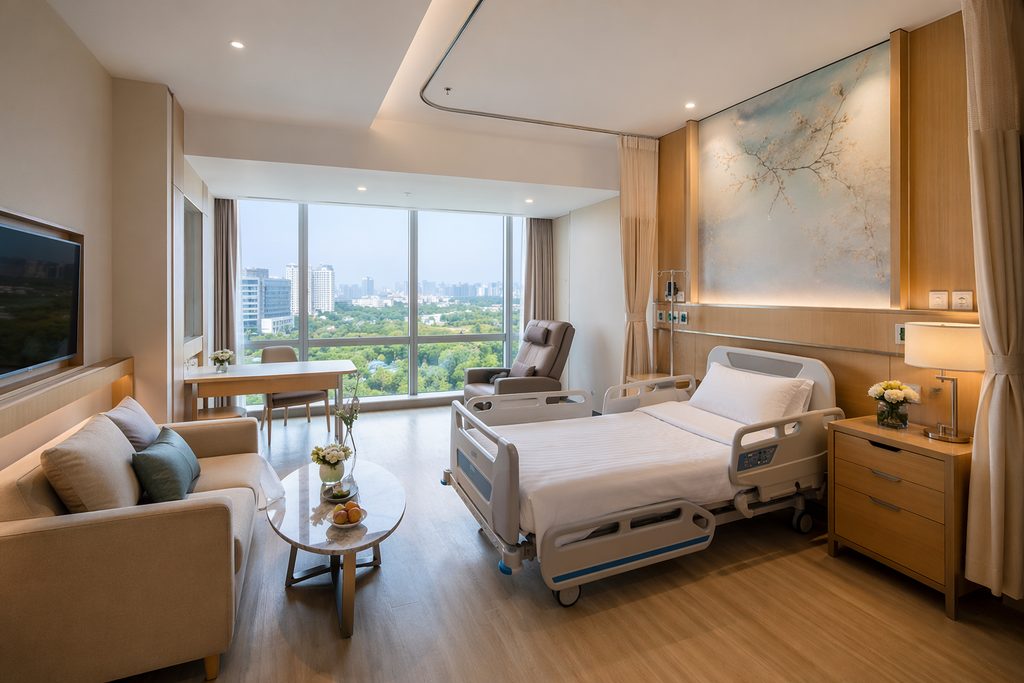
| International / VIP department room | $300 – $800+ | Private room or suite, English-capable nursing, appointment coordination, international insurance billing in many cases. |
| Private international hospital | $500 – $1,200+ | Hotel-grade room, Western-standard nursing ratios, direct insurance settlement, English-speaking physicians. |
One clarification that saves people real money: the VIP premium is not paying for a nicer mattress. It is paying for a parallel administrative system. The international department handles scheduling, translation, consent documentation, and insurance paperwork that a standard ward simply does not. If you do not speak Mandarin and have no family in China, that administrative layer is not a luxury.
A Realistic Timeline
Budget your time as carefully as your money. The clinical work is often the fastest part.
| Stage | Realistic Duration | What Slows It Down |
|---|---|---|
| Records gathering and translation | 3 – 10 days | Missing pathology slides, illegible imaging, records spread across multiple providers |
| Written second opinion returned | 3 – 7 business days | Department workload; requests for additional imaging |
| Video consultation scheduling | 1 – 3 weeks | Time zone alignment; specialist availability |
| Appointment and room coordination | 2 – 6 weeks | Department scheduling cycles; peak admission periods |
| S2 visa application | 1 – 4 weeks | Consulate processing times, which vary by country and season |
| Arrival, in-person consultation, admission | 2 – 7 days | Additional tests required before a surgical plan is confirmed |
Add it up and a well-organized patient is typically looking at six to twelve weeks from first contact to admission. Anyone quoting you a two-week turnaround for a major surgical case is skipping the steps that protect you.
What Can Go Wrong — and What Happens Then
The room you were quoted is not always the room you get. Here is the honest version.
The standard-ward bed isn’t available on your date. This is the most common failure, and it is structural, not malicious. Public hospital beds open when a patient is discharged, and nobody can predict that weeks ahead. The recourse: your treating department places you on the admission list, and you wait — sometimes days. Patients who cannot absorb that uncertainty should be looking at international departments instead, where rooms are reserved rather than queued for.
Your stay runs longer than estimated. Complications, infection risk, or a slower-than-expected recovery can add nights. Every additional night is billed at the same rate. This is the single most common reason a final bill exceeds the estimate, and it is why we tell patients to hold a contingency of 20–30% above the quoted figure.
The room tier you wanted is fully booked. International departments in Beijing and Shanghai fill up around major holidays and peak seasons. Booking early helps. It does not guarantee anything.
Your insurance won’t cover the tier you chose. Many international policies reimburse at a standard-ward rate and treat the VIP differential as a personal expense. Confirm this with your insurer before you commit, not after.
Comparing a Private Hospital Room in Beijing Against the Alternatives
Beijing illustrates the spread better than any other city, because it holds the largest concentration of top-ranked hospitals in China. A private hospital room price in Beijing at an international facility can sit at $600–$1,000 per night. A single room in a major public hospital’s international department in the same city might run $350–$600. A standard public ward bed could be under $100.
What changes across those three options is not the medical skill. In several specialties, the public hospital is where the hardest cases go. What changes is your experience of the stay: who speaks to you, how fast things move, how much your family has to do, and whether your insurer will pay the hospital directly.
The decision framework we suggest to patients is simple. Ask three questions. Do I need English-language clinical communication throughout my stay? Will I have a family member physically present in China who can handle logistics? Does my budget tolerate a 30% overrun? If you answer no, no, and no — the international department is usually the right call, even at two to three times the room rate. If you answer yes, yes, and yes, a standard ward is a legitimate and safe choice.
You can browse hospitals by city and specialty tier on our ranked directory of China’s top hospitals, or compare facilities that offer direct insurance billing on the private international hospital list.
Practical Considerations: Payment, Visa, and Language
Sometimes, and it depends entirely on the channel. International and VIP departments frequently allow advance room reservation once a treatment plan is confirmed. Standard public wards generally do not — admission happens through the treating department when a bed opens. We can coordinate the booking process, but no one can guarantee a specific room or date in advance.
Yes. Chinese public hospitals treat enormous volumes and their clinical standards in major centers are high. What you give up in a cheaper room is privacy, quiet, English-language communication, and administrative support — not medical quality. The risk is not the care. The risk is that you cannot communicate, cannot navigate the system, and end up making decisions without fully understanding them.
Typically a private room or suite, English-capable nursing staff, coordinated scheduling for tests and procedures, assistance with consent and documentation, and in many facilities direct billing to international insurers. It does not include a different surgeon or faster clinical priority. You are buying logistics and communication, not medical precedence.
It depends on your policy and the hospital. Some international insurers reimburse at a standard-ward rate and leave you responsible for the difference. Others settle directly with JCI-accredited private hospitals. Verify with your insurer before you commit to a tier — this is a five-minute call that prevents a five-figure surprise.
Your Next Step
The room rate is the most visible number on a Chinese hospital bill, but it is rarely the most important one. What determines your outcome and your final cost is whether the treatment plan is right, whether the hospital is the right fit for your condition, and whether you can actually communicate once you are admitted. Get those three right and the room category becomes a straightforward budget decision rather than a gamble.
China Medical Services connects international patients with top-ranked Chinese hospitals — we handle record translation, appointment coordination through official hospital channels, and bilingual accompaniment. We are not a hospital and we do not provide medical care or promise clinical outcomes. If you would like a clear picture of what your treatment would involve and what it would cost, start with a free consultation — no obligation, and no pressure to travel.
This article is for general information only and does not constitute medical advice. Treatment decisions should always be made with a qualified physician who has reviewed your individual case.
Frequently Asked Questions
Yes. The hospitals used for international patients are JCI-accredited and follow the same international safety standards as top hospitals in the US and Europe. Surgical teams perform high volumes of procedures — often more than their Western counterparts — which studies show leads to better outcomes.
Costs vary by procedure and hospital, but international patients typically save 40-80% compared to US prices — even when factoring in travel and accommodation. A consultation with our team will give you an exact, all-inclusive quote with no hidden fees.
Send us your existing medical reports to get started. We handle everything from hospital selection and appointment scheduling to visa assistance and post-operative recovery planning. Your medical records are reviewed by the specialist before you even book a flight.
For more medical information and treatment options in China, visit chinamedservices.com (China Medical Services).
