VIP Medical Concierge China: Inside Premium Private Suites and Full-Service Care
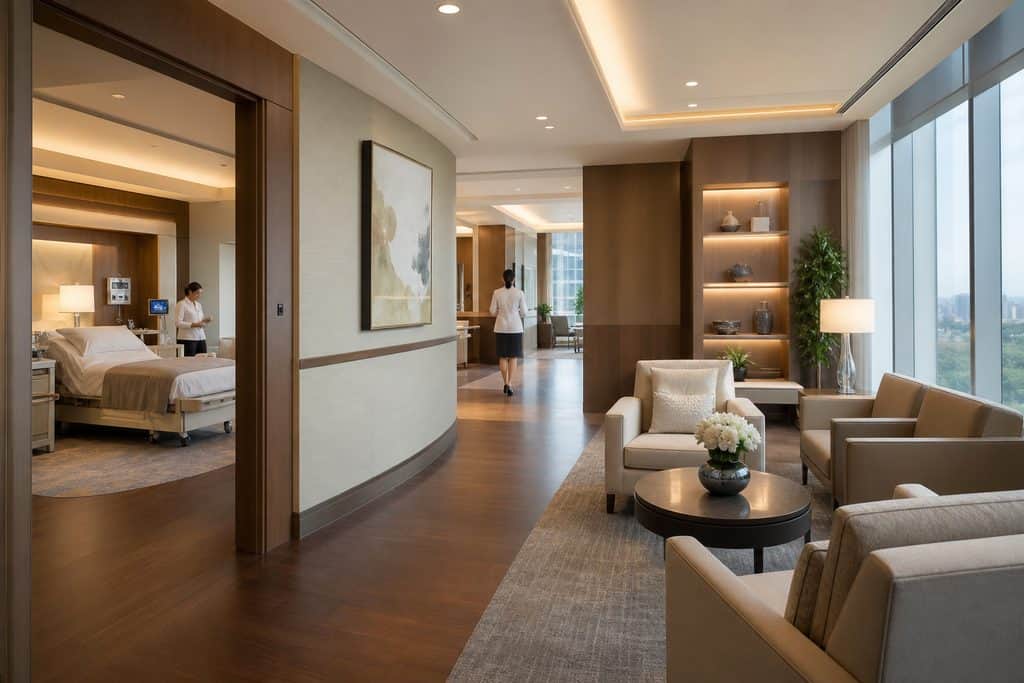
In the United States, a single night in a private hospital room can bill at over $4,000 before any treatment begins. At Shanghai’s Huashan Hospital International Medical Center, a premium private suite starts from approximately $300 to $500 per night. The gap is not marginal. It is structural. And it explains why the VIP medical concierge China price equation has drawn serious attention from self-funded patients and international insurers alike. But cost is only the entry point. The real question is what that price unlocks — and what it does not.
The Short Answer: What a VIP Medical Concierge Actually Costs
A full-service medical concierge engagement in China — covering hospital selection, VIP suite booking, bilingual coordination, and logistical support — typically ranges from $5,000 to $8,000 for end-to-end facilitation. This is the coordination layer. It sits on top of hospital charges for the suite itself, physician fees, and any procedure costs. Some patients spend less. A focused video consultation with a top specialist and written second opinion runs $500 to $800. The variance is wide because the model is modular. You pay for what you need, not a preset package.
That figure is not arbitrary. It reflects the labor of translating medical records, navigating hospital international departments, securing appointments through official VIP channels, and providing on-the-ground bilingual support. It is case management — not a concierge in the hotel sense of booking restaurants. The distinction matters.
Who This Is Right For — and Who It Isn’t
This pathway suits a specific profile. It is not for everyone. And being honest about that saves everyone time.
Typically a good candidate:
- You need a complex procedure — cardiac surgery, orthopedic joint replacement, oncology intervention — and face a wait of months in your home country.
- You are paying out of pocket or have international insurance that reimburses treatment abroad.
- You value private, English-supported inpatient recovery over navigating a high-volume public ward alone.
- You have a confirmed diagnosis and imaging already. You are not starting from scratch.
- You can travel. Some conditions make long-haul flights inadvisable — your home physician must clear you.
Probably not a good candidate:
- You lack a clear diagnosis and expect a full investigative workup in one week. That is rarely realistic.
- Your condition requires continuous, multi-year follow-up that a single overseas trip cannot resolve.
- You assume VIP means skipping clinical triage. It does not. A patient in critical condition gets the ICU bed before a stable VIP patient gets the suite. That is medical ethics, and China’s top hospitals enforce it.
- You want a guaranteed specific surgeon on a specific date. We can request. We cannot promise. Any service that does promise that is not being straight with you.
The Options, Compared: What “VIP” Actually Means Across China’s Hospital Tiers
Not all VIP experiences are the same. The term gets applied loosely. Here is what it actually looks like across the three main categories of hospitals serving international patients.
| Feature | Public Hospital International VIP Wing | Private International Hospital | Public Hospital Standard International Dept. |
|---|---|---|---|
| Example | Huashan Hospital VIP, PUMC International | United Family, Jiahui, Raffles | Zhongshan Hospital International Dept. |
| Private suite nightly cost | $300–$800 | $500–$1,200 | $150–$400 |
| Physician access | Senior attending, often department head | Bilingual attending, Western-trained | Attending physician, English variable |
| Nursing ratio | 1:1 or 1:2 in suite | 1:1 to 1:3, Western-style | 1:4 to 1:6 |
| Language support | Dedicated English-speaking coordinator | Fully English-speaking environment | Limited English, translator needed |
| Insurance | Pay upfront, claim reimbursement | Direct billing common | Pay upfront, claim reimbursement |
| Clinical depth | Full tertiary hospital, all specialties | Broad but may lack super-subspecialties | Full tertiary hospital |
| Best for | Complex cases needing China’s top clinical teams with comfort | Routine surgery, obstetrics, pediatrics, Western-style experience | Cost-conscious patients who bring their own bilingual escort |
If you need a Whipple procedure or a complex cardiac ablation, the public hospital VIP wing puts you in the hands of surgeons who do hundreds of those cases annually. The suite is comfortable but the real value is clinical. If you are having a knee replacement and want a familiar care model, a private international hospital may feel more natural. The choice is not about luxury. It is about matching clinical need to the right system.
Inside a VIP Hospital Suite Beijing or Shanghai: What Is Actually Included
The phrase “VIP suite” conjures images of hotel-like lobbies. Some facilities deliver that. The newer international wings in Shanghai and Beijing do feel closer to a five-star hotel than a hospital. But the inclusions that matter are clinical and logistical, not decorative.
A luxury private suite hospital Shanghai or Beijing VIP wing typically includes:
- A single-occupancy room with a dedicated bathroom, sofa bed for a family member, and refrigerator.
- 24-hour visiting access for one designated family companion — not the restricted 30-minute windows of public wards.
- A dedicated nurse call system with faster response times. In many VIP wings, the nursing station serves only 8 to 12 rooms.
- In-room phlebotomy and basic diagnostic procedures. You do not queue in a hallway for blood draws.
- Meal selection with Western and halal options, coordinated by a dietary liaison.
- An English-speaking floor coordinator who handles communication between you, the nursing team, and the attending physician.
What it does not include: a personal chef, a guaranteed specific surgeon, or the ability to bypass clinical protocols. You still follow the hospital’s pre-operative checklist. You still need the same clearances. The suite makes the experience humane. It does not rewrite medicine.
When patients ask us to help them book premium private hospital room China availability, the first step is always confirming the clinical plan. The room booking follows the medical booking. Not the reverse.
How a Medical Concierge Service Works in China: The Actual Workflow
If you have never used a medical concierge, the process can sound abstract. Here is the sequence as it actually unfolds, from first contact to discharge.
Step one: Records review. You send existing diagnostic reports, imaging files, and a brief medical history. Our team translates and organizes these for the relevant specialty department. No opinion is formed at this stage. We are preparing a file that a Chinese specialist can read efficiently.
Step two: Remote evaluation. The department reviews your materials. This may be a written second opinion ($300–$500) or a video consultation with the specialist ($500–$800). The goal is to determine whether your case is appropriate for treatment in China and what the proposed plan would be. Not every case is accepted. Some are advised to stay home. That is a valid outcome.
Step three: Decision and coordination. If you decide to proceed, we coordinate the appointment, the VIP suite booking, the visa support documentation, and the arrival logistics. The coordination fee for full end-to-end support ranges from $5,000 to $8,000. This covers case management, not hospital charges. Any prior consultation fee is credited in full toward this coordination fee if you proceed within 90 days.
Step four: Arrival and treatment. You are met at the airport, taken to the hospital, and accompanied through registration, admission, and every clinical touchpoint by a bilingual medical companion. This person is not a translator on an app. They are physically present, understand medical terminology, and know the hospital’s internal workflows.
Step five: Discharge and follow-up. Discharge instructions are translated. A follow-up teleconsultation is scheduled. You return home with a clear summary and a direct line back to the treating team for questions.
This is not a package tour. It is a structured clinical journey with a coordination layer that absorbs the friction a foreign patient cannot manage alone.
What Full Service Medical Tourism China Packages Actually Cost — and What Drives the Variance
This is a fair concern. If the remote evaluation concludes that treatment in China is not appropriate — whether for medical reasons or because the required sub-specialty is unavailable — any coordination fees paid for services not yet rendered are refunded. The consultation fee for the evaluation itself is not refunded, because the specialist’s time and analysis were provided. That is the honest answer. It is also why we encourage starting with a written second opinion before committing to the full coordination package.
The VIP wing is physically separate from the public outpatient and inpatient areas. It has its own entrance, its own elevators, and its own registration desk. You will not queue with hundreds of public patients for blood tests or imaging — those are done in the VIP wing or at scheduled times in the main department. That said, you are still in a large Chinese tertiary hospital. The main lobby may be crowded. The VIP wing is an island of calm within a very busy system. It is private, but it is not isolated from the reality that this is a high-volume institution. Most patients find the contrast reassuring: the clinical firepower of a major center with a dignified personal experience.
If you pay for a video consultation or written second opinion and subsequently decide to proceed with treatment in China within 90 days, the full amount you paid for that consultation is deducted from the end-to-end coordination fee. So a $500 video consult reduces a $6,000 coordination fee to $5,500. This applies to the coordination service only — never to hospital charges, physician fees, or suite costs. It is a one-time credit. It exists because we want patients to start with a low-commitment evaluation rather than feeling pressured into a full package before they have enough information.
Your Next Step
The VIP medical concierge pathway in China works best when you treat it as a clinical decision first and a hospitality decision second. The suites are comfortable. The real value is the team inside them. If you have a diagnosis, imaging, and a clear sense of what procedure you need, the next step is a remote evaluation that tells you whether this route makes medical sense for your specific case. We are not a hospital. We do not diagnose or treat. We connect you with the specialists who do, and we handle the friction in between. When you are ready to explore whether treatment in China fits your situation, request a free initial consultation — no commitment, just an honest conversation about your options.
Frequently Asked Questions
Yes. The hospitals used for international patients are JCI-accredited and follow the same international safety standards as top hospitals in the US and Europe. Surgical teams perform high volumes of procedures — often more than their Western counterparts — which studies show leads to better outcomes.
Costs vary by procedure and hospital, but international patients typically save 40-80% compared to US prices — even when factoring in travel and accommodation. A consultation with our team will give you an exact, all-inclusive quote with no hidden fees.
Send us your existing medical reports to get started. We handle everything from hospital selection and appointment scheduling to visa assistance and post-operative recovery planning. Your medical records are reviewed by the specialist before you even book a flight.
For more medical information and treatment options in China, visit chinamedservices.com (China Medical Services).
