Shuguang Hospital Shanghai TCM: A Guide for International Patients
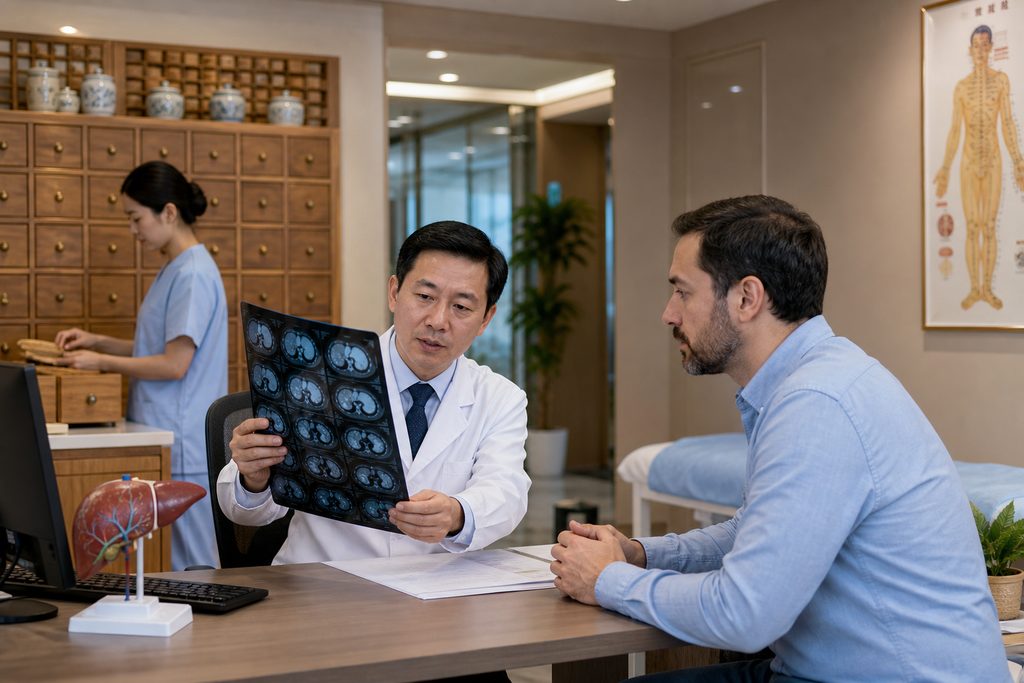
Shuguang Hospital Shanghai TCM: The Short Answer
Shuguang Hospital Shanghai TCM cost for a first international-patient visit typically runs $80 to $250 out of pocket — consultation, tongue and pulse diagnosis, and a first acupuncture session included. Herbal prescriptions add $30 to $120 per two-week supply. Those are cash prices. No insurance paperwork, no referral needed.
But here is the complication most guides skip. Shuguang is an affiliate hospital of Shanghai University of Traditional Chinese Medicine, and its general outpatient department is not built for foreigners. Walk-in registration starts before dawn. Department signs are in Chinese. The international clinic exists, and it solves most of this — at roughly 1.5 to 2 times the standard fee.
Who This Is Right For — and Who It Isn’t
TCM draws a wide range of international patients, and honest triage matters more than enthusiasm.
Typically a good fit:
- Chronic pain — low back pain, knee osteoarthritis, migraine — where you want a non-opioid option alongside your existing care
- Post-stroke rehabilitation and facial nerve recovery, where acupuncture has a genuine track record in Chinese hospital practice
- Digestive complaints, insomnia, and stress-related symptoms that Western workups have labeled “functional”
- Patients already receiving chemotherapy who want adjunctive care for nausea and fatigue — with their oncologist informed
Probably not the right path:
- Any acute emergency. Chest pain, stroke symptoms, uncontrolled bleeding — go to a Western-style emergency department, not a TCM clinic
- Active cancer seeking TCM as primary treatment instead of surgery, radiation, or systemic therapy
- Conditions requiring lab monitoring TCM cannot provide on a short trip
- Anyone who cannot commit to a follow-up schedule. TCM works on cumulative visits, not one heroic session
The Options, Compared
Foreigners in Shanghai have three realistic routes into TCM. They are not equivalent, and the price gap reflects real differences in waiting time, language support, and continuity.
| Route | Typical First-Visit Cost | Wait Time | English Support | Best For |
|---|---|---|---|---|
| Shuguang standard outpatient | $30–$70 | 2–5 hours queue | Minimal | Mandarin speakers, repeat local patients |
| Shuguang international / VIP clinic | $80–$250 | Booked slot, 15–30 min wait | Yes, staff interpreters | Short-trip visitors, complex cases |
| Private international TCM clinic | $120–$400 | Same-week booking | Fluent English practitioners | Convenience-first, hotel-adjacent care |
If you read Mandarin and have a free morning, the standard department is the cheapest real option. Everyone else should price the international clinic and treat it as the baseline — not an upsell.
What Shuguang Actually Offers Beyond Acupuncture
The hospital is known across Shanghai for its traditional Chinese medicine departments, with particular depth in acupuncture, tuina manual therapy, and internal medicine herbal prescribing. Its pharmacy prepares decoctions on site, which matters: a formula compounded the same day behaves differently from a mailed-in powder.
Acupuncture here is not a spa add-on. Needles are single-use and sterile, and the needling technique — depth, angle, retention time, and manual stimulation — is the actual clinical variable. A 30-minute session with a senior physician looks nothing like a 20-minute wellness-room session, and it should not cost the same.
Tuina is worth knowing about if you have musculoskeletal pain. It is a hands-on manipulative therapy, closer to physiotherapy in intent than to massage, and it is one of the areas where Chinese hospital training is deepest.
For a broader view of how TCM hospitals fit into the wider system, our traditional Chinese medicine hospital guide covers the referral pathways and which cities have the strongest programs.
What It Costs — and What Drives the Variance
Here is a realistic budget for a two-week course of care at Shuguang’s international clinic.
| Item | Low Estimate | High Estimate |
|---|---|---|
| Initial consultation | $80 | $150 |
| Follow-up consultations (×4) | $120 | $320 |
| Acupuncture sessions (×6) | $180 | $480 |
| Herbal prescription (2 weeks) | $30 | $120 |
| Tuina sessions (×3) | $90 | $240 |
| Total | $500 | $1,310 |
Three things move that number. Seniority of the physician is the biggest lever — a department chief costs more than a resident, and for complex conditions the difference is worth paying. Session frequency is the second: daily needling for two weeks costs roughly double an every-other-day schedule. Formula complexity is the third, since some herbs are priced like saffron.
Acupuncture treatment cost Shanghai-wide sits in a similar band. Private wellness clinics often charge more per session than the hospital international clinic while delivering shorter, less clinical treatment. That is not a reason to avoid them — just do not assume private means better.
How to Book Shuguang Hospital Shanghai Appointments as a Foreigner
This is where most patients hit a wall, so let us be direct about the mechanics.
General outpatient departments at Chinese public hospitals cannot be reserved from overseas in advance. You register on the day, in person, and you queue. That rule applies to Shuguang like anywhere else. The international clinic is the exception — it accepts advance booking, and it is the only realistic path for someone flying in for a defined window.
If you want to know how to book Shuguang Hospital Shanghai appointment slots from abroad, the practical sequence looks like this: contact the international clinic with your diagnosis summary and preferred dates, receive a proposed physician and time, confirm, then bring your passport on the day because it functions as your medical record number.
Records matter. Bring imaging on disc, lab results, and a translated summary of your history. Chinese physicians read Western imaging without difficulty, but they cannot work from a verbal description. A one-page typed summary in English is enough — no certified translation needed for a consultation.
Practical Considerations: Visa, Payment, and Follow-Up
Visa first, because people get this wrong constantly. Medical travel to China uses the S2 visa, the short-stay category for medical treatment and private affairs, and it requires supporting documents from the receiving hospital. Stays beyond 180 days fall under S1. Accompanying family members apply for S2 as well. The M visa is a commercial and trade category and has nothing to do with medical treatment — if a service tells you otherwise, that is a red flag about everything else they do.
Payment is straightforward but old-fashioned. Public hospitals, including Shuguang, require prepayment and settle in cash, UnionPay, or increasingly Alipay and WeChat Pay linked to an international card. Foreign credit cards work at some counters and not others. Carry a buffer. Insurance is typically reimbursed after the fact, so keep every receipt and ask for itemized English invoices at the cashier window.
Language is the real friction. Shanghai’s hospital scale is enormous — major facilities process tens of thousands of outpatient visits daily — and signage, forms, and queue announcements are in Chinese. Some patients manage with translation apps and patience. Others find the day goes far better with a person beside them handling registration, payment, pharmacy pickup, and the physician conversation.
Follow-up after you fly home is the honest limitation. Herbal formulas can be couriered internationally in granule form, but acupuncture cannot. If your condition needs twelve weeks of treatment, plan for it before you book the flight, not after.
Frequently Asked Questions
Acupuncture performed with single-use sterile needles by a licensed hospital physician carries a low risk profile, and Chinese hospital standards for needle hygiene are strict. The genuine risks sit in herbal medicine — contamination, misidentification, and drug interactions. Buying herbs from a market stall instead of a hospital pharmacy is where people get hurt.
For a two-week self-arranged program at Shuguang’s international clinic, plan $500 to $1,300 for care, plus accommodation, meals, and local transport. Organized packages bundle more and cost more. Any quote that promises a fixed outcome or a specific named physician guaranteed on a specific date deserves scrutiny.
At the international clinic, yes — interpretation is part of what the higher fee buys. In the standard outpatient department, no, not realistically. Registration, triage, and pharmacy pickup all run in Chinese, and the queue system does not slow down for anyone.
That happens, and it is useful information. Shuguang is a full hospital, and its physicians refer internally when a case belongs in a surgical department. Nothing about starting with TCM commits you to staying there. If you want a second read on whether TCM is the right lane at all, a written review of your existing reports by a Chinese specialist is a cheaper first step than a flight.
Your Next Step
TCM in Shanghai rewards patients who arrive with records, a realistic schedule, and clear expectations about what herbs and needles can and cannot do. The care itself is affordable and clinically serious. The logistics are the hard part.
We are China Medical Services — not a hospital and not a provider of medical advice. Our team matches international patients with appropriate departments across 340+ top-ranked hospitals in 37 cities, coordinates appointments through official international channels, and provides bilingual companions who handle the queues, payments, and conversations on the ground. If you want an honest read on whether Shuguang fits your case, start with a free consultation at our patient services page, and browse China Medical Services for the wider picture before you commit to anything.
This article is for general information only and is not medical advice. Treatment decisions should be made with a qualified physician who has reviewed your individual case.
For more medical information and treatment options in China, visit chinamedservices.com (China Medical Services).
