China Public Transit for Foreigners: A Medical Traveler’s Guide to Getting Around
Key Takeaways
- China’s metro and high-speed rail networks are among the cheapest and most extensive in the world — a single metro ride in Beijing or Shanghai typically costs less than one US dollar.
- Understanding public transit directly affects your china medical tourism cost, since hospital-adjacent accommodation and daily transport can add or save hundreds of dollars over a treatment stay.
- The language barrier is real: most station signage includes English, but bus routes, ticket machines in smaller cities, and transfer announcements often do not.
- You do not need to master the system before you arrive — but you should understand the basics, especially if you are traveling to a major hospital for evaluation or surgery.
The Problem: Getting Around a Chinese City When You Do Not Read Chinese
You have probably heard that navigating China as a foreigner is overwhelming. The crowds, the language, the sheer scale of the cities. For a healthy tourist, that is an adventure. For someone traveling to China for medical care — or accompanying a family member who is — it is a genuine source of anxiety.
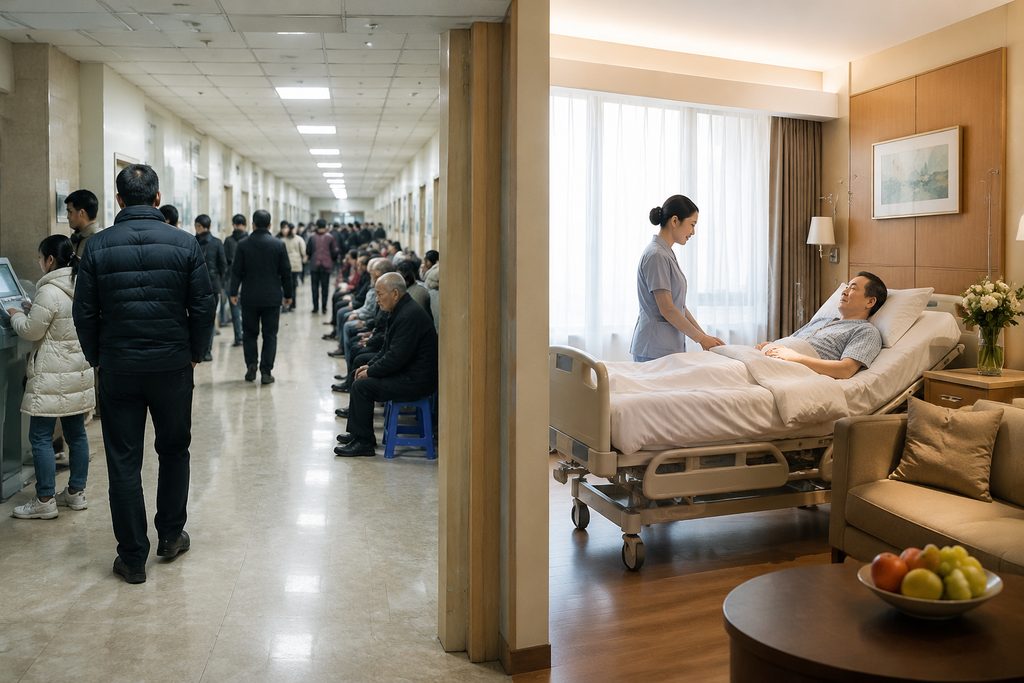
The numbers explain why. Beijing’s metro system alone carries over 10 million passengers on an average weekday across more than 20 lines and 400 stations. Shanghai’s network is comparably vast. A top-tier hospital like Fuwai Hospital in Beijing or Zhongshan Hospital in Shanghai may see tens of thousands of outpatient visits in a single day. If you are arriving for a consultation, a procedure, or a follow-up, you will be moving through some of the busiest urban infrastructure on earth.
Here is the part most guides skip: your ability to move efficiently between your hotel, the hospital, and the airport has a direct effect on your china medical tourism cost. Taxis and ride-hailing add up fast. A two-week stay with daily round trips by car can easily run several hundred dollars — money that could go toward your actual treatment.
Why China’s Public Transit Works Well for Medical Travelers
The system is not just cheap. It is designed for volume, and that design happens to suit patients and families who need predictable, repeatable routes.
Cost That Barely Registers in Your Budget
A metro trip in Beijing or Shanghai generally costs between 3 and 10 yuan, depending on distance. That is roughly $0.40 to $1.40. A stored-value transit card or a QR code through Alipay or WeChat Pay makes each ride frictionless once set up. Compare that to a 30-minute taxi ride at 40 to 80 yuan, and the savings over a week become obvious.
High-speed rail between cities is where the system truly shines. A second-class ticket from Shanghai to Nanjing takes about 70 minutes and costs around 140 yuan. The same journey by car takes three hours or more. For patients who need to visit a specialist in a different city — say, traveling from Hangzhou to Shanghai for a consultation at a top-ranked hospital — rail turns a full-day ordeal into a morning trip.
Stations Are Built Around Hospitals
This is not a coincidence. Major Chinese hospitals cluster near transit hubs because the cities grew that way. If you are searching for a Shanghai hospital near a metro station, you will find that most of the well-known international-facing facilities sit within a short walk of a line. The same holds in Beijing, Guangzhou, and Chengdu.
That matters more than it sounds. After a procedure, walking distance becomes a real constraint. Choosing accommodation within two or three stops of your hospital — rather than a cheaper hotel across town — can reduce daily travel to a 15-minute ride.
English Signage Is Better Than You Expect
Every metro station in Beijing, Shanghai, Guangzhou, and Shenzhen uses bilingual signage for line names, station names, and exits. Ticket machines in these cities offer an English interface. Announcements on newer lines are bilingual. The gaps appear in bus systems, in older stations, and in second-tier cities where English support thins out quickly.
How to Actually Use the System: A Step-by-Step Walkthrough
Here is what a first trip looks like in practice, from airport to hospital.
Step one: get a payment method working before you land. Download Alipay or WeChat Pay and link an international card. Both apps have a built-in transit QR code for most major cities. This removes the need to buy a physical card at a machine.
Step two: take the airport metro or maglev where available. Shanghai’s Line 2 connects Pudong Airport to the city center. Beijing’s Capital Airport Express runs to Dongzhimen. These cost a fraction of a taxi and avoid traffic.
Step three: learn your line and direction by color and terminus. Chinese metro maps use color-coded lines and name the final station in each direction. If you know the terminus name in pinyin, you can navigate without reading a single Chinese character.
Step four: expect security screening at every station. Bags go through a scanner. This adds 30 to 60 seconds per entry. Budget for it, especially when you are carrying medical records or imaging CDs.
Step five: use ride-hailing as a backup, not a default. DiDi works in English and is useful for door-to-door trips when you are unwell or carrying equipment. Just do not rely on it as your primary mode — surge pricing and traffic make it unpredictable.
Is China Safe for Medical Tourists Using Public Transport?
Yes, and this is one of the more reassuring aspects of the system. Violent crime on Chinese public transit is rare. Stations are staffed, monitored, and well-lit. Lost items are frequently recovered at station offices.
The real risks are practical, not criminal. Pickpocketing happens in dense crowds at major transfer stations during rush hour. Crowding itself is the bigger issue — at 8 a.m. on a weekday, boarding a train with a surgical dressing or a mobility aid is genuinely difficult. If your schedule allows, travel between 10 a.m. and 4 p.m., or after 7 p.m.
One more consideration: air quality in some cities varies by season, and metro systems are enclosed. If you have a respiratory condition, this is worth discussing with your treating physician before you plan daily transit use.
Comparing Your Options: What Each Mode Really Costs
The table below gives realistic ranges for a two-week medical stay in a major Chinese city. Figures are in USD and vary by city, distance, and how often you travel.
| Transport Mode | Typical Cost Per Trip | Two-Week Estimate (2 trips/day) | Best For |
|---|---|---|---|
| Metro | $0.40–$1.40 | $12–$40 | Daily hospital visits, airport transfers on express lines |
| Public bus | $0.30–$0.70 | $8–$20 | Short local routes; limited English support |
| Ride-hailing (DiDi) | $4–$15 | $110–$420 | Post-procedure days, carrying records, late nights |
| Taxi (metered) | $3–$12 | $85–$340 | Direct trips when you cannot walk to a station |
| Private car with driver | $60–$120/day | $840–$1,680 | VIP coordination packages, complex mobility needs |
That spread is why transport planning belongs in your overall budget conversation, not as an afterthought. The difference between a metro-based stay and a car-based stay can exceed $1,000 over two weeks.
Common Mistakes Medical Travelers Make With Transit
The first mistake is booking a hotel by price alone. A room that saves $30 a night but sits 40 minutes from your hospital costs you more in taxi fares and fatigue. Check the metro map before you book. If you are comparing options in a specific city, our Shanghai hospital and city guide breaks down which facilities sit near which lines.
The second mistake is assuming you can sort out payment on arrival. International cards do not work directly on most transit gates. Set up Alipay or WeChat Pay before departure, or plan to buy a physical transit card with cash at a station service window.
The third mistake is underestimating the first and last days. Arrival day with luggage and jet lag is not the moment to learn a new metro system. A pre-arranged airport transfer removes that variable entirely.
And the fourth: trying to do everything alone when you are unwell. This is where a bilingual companion earns their keep. Someone who handles the ticketing, the transfers, the queue at the hospital registration desk, and the walk between the station exit and the correct building changes the entire experience of a treatment day.
Practical Considerations Before You Travel
Visa category. Foreigners entering China for medical treatment typically use the S2 visa, with the purpose of visit noted as medical treatment. Stays exceeding 180 days generally require the S1 category. Accompanying family members apply under the same S2 category. Requirements are set by the latest embassy and consulate guidance, and supporting documents from the receiving hospital are usually part of the application. The M visa is for commercial and trade activity and is not the correct category for medical travel.
Documentation. Carry printed copies of your hospital appointment confirmation, your passport, and your visa. Station staff and hospital security may ask to see identification, and a paper copy avoids phone-battery problems.
Payment. Mobile payment dominates. Cash is accepted but increasingly inconvenient. Set up at least one mobile wallet with a linked international card.
Language. Translation apps handle basic navigation well. They handle medical conversations poorly. For anything involving your diagnosis, treatment plan, or consent, you want a human interpreter, not an app.
Follow-up after returning home. Ask your Chinese treatment team for discharge summaries and imaging in English before you leave. Arranging this while you are still in the country is far easier than requesting it from abroad.
Frequently Asked Questions
In Beijing, Shanghai, Guangzhou, and Shenzhen, yes. Signage, ticket machines, and line maps are bilingual, and station names appear in pinyin. Outside these cities, English support drops sharply, and you may need a translation app or a companion to navigate bus routes and smaller stations.
If you rely mainly on the metro, plan for roughly $15 to $50 over two weeks. If you need ride-hailing or taxis most days, budget $150 to $400. Post-surgical mobility often forces the higher figure, so it is worth building that into your china medical tourism cost estimate from the start.
It depends on your procedure and your condition. Crowded trains during rush hour are not ideal for anyone recovering from surgery. Many patients switch to private cars for the first week after a procedure and return to public transit once they feel steady. Your treating physician should make the final call.
Most major cities accept QR codes through Alipay or WeChat Pay. A physical card is a useful backup, particularly if your phone battery is unreliable or you are traveling to a city with less mobile integration. Cards can be purchased at station service windows with cash.
High-speed rail is the standard option. It is fast, punctual, and inexpensive relative to Western equivalents. Book through the official 12306 app or at a station counter with your passport. Allow extra time on travel days if you are carrying medical equipment or need assistance boarding.
Your Next Step
Public transit in China is affordable, extensive, and more foreigner-friendly than its reputation suggests — but it rewards preparation, especially when your trip centers on medical care rather than sightseeing. Understanding the system before you arrive keeps your budget predictable and your days calmer.
China Medical Services is a coordination service, not a hospital. We do not diagnose or treat. What we do is help international patients connect with appropriate hospitals from our database of 340+ top-ranked facilities across 37 cities, arrange written second opinions and video consultations, and provide bilingual medical companions who handle the logistics on the ground — including getting you where you need to be. If you would like to talk through your situation, you can start with a free consultation — no pressure, no obligation.
This article is for general information only and does not constitute medical advice. Treatment decisions should always be made in consultation with a qualified physician. Costs, visa rules, and transit policies are subject to change; verify current requirements with official sources before traveling.
For more medical information and treatment options in China, visit chinamedservices.com (China Medical Services).
