Root Canal Clinics in China: How We Match You to the Right One
How This Actually Works, Step by Step
According to the World Health Organization’s Global Oral Health Status Report, untreated dental caries affects roughly 2 billion people worldwide — making it the single most common health condition on the planet. If you’re reading this with a throbbing molar and a quote from your dentist back home, you already know how expensive fixing it can be. That’s why so many international patients now ask us about root canal cost China clinics offer, and whether the savings justify the trip.
Here’s the short answer: a root canal in a top-tier Chinese dental hospital typically runs $150–$400 for the procedure itself, before the crown. In the United States, the same treatment averages $700–$1,500 per tooth, and that’s before a crown that can add another $1,000–$2,500. But price alone shouldn’t decide anything. What matters is whether the clinic is right for your specific case, and that’s where matching gets interesting.
So let’s walk through exactly what happens when you contact us about dental treatment in China.
Step one: you send us what you already have. That means your recent X-rays or CBCT scan, any treatment notes from your dentist, and a short description of your symptoms. If you don’t have imaging, that’s fine — we’ll flag that a new scan will be needed on arrival.
Step two: we review your case against our hospital database. Not every dental clinic handles every case. A straightforward single-root canal on a front tooth is a different job from a molar with curved canals, a failed previous root canal, or a tooth sitting under a bridge. We route your file to the appropriate department — endodontics, prosthodontics, or oral surgery — at one or more hospitals that genuinely handle your situation.
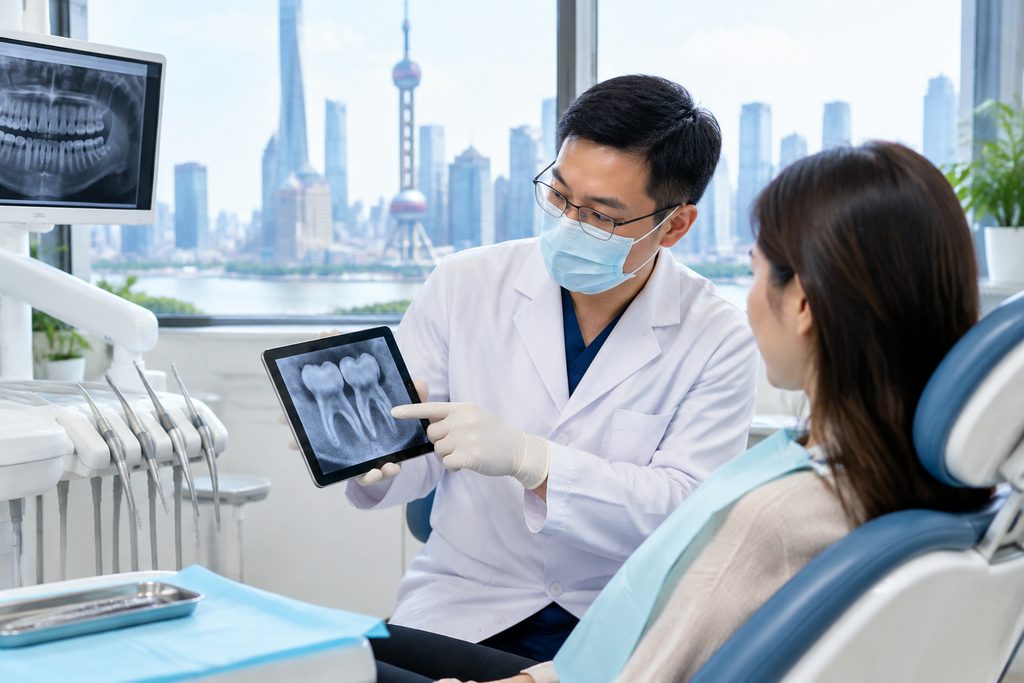
Step three: you receive a written assessment and a cost range. A Chinese dental specialist reviews your imaging and returns a written opinion covering the likely treatment approach, the number of visits required, and a cost range. This is a written second opinion, not a prescription — it’s for reference and planning.
Step four: you decide whether to proceed. If you want to move forward, we coordinate the appointment through the hospital’s international department or VIP channel, arrange a bilingual companion for your visit, and help with the practical logistics. If you’d rather take the written opinion back to your local dentist, that’s a perfectly good outcome too.
The core principle: you get a real specialist’s assessment before you book a flight. No guessing, no surprises at the front desk.
Why Root Canal Cost China Clinics Charge Less — and What That Doesn’t Tell You
Dental care in China is cheaper for structural reasons, not because something is being cut. Materials are sourced domestically or regionally. Labor costs are lower. Public dental hospitals operate at enormous volume, which spreads equipment costs across thousands of procedures per month.
At Peking University School and Hospital of Stomatology — consistently ranked among China’s top dental institutions — a single-visit root canal on a straightforward tooth can be completed for a fraction of Western prices. Private international clinics like United Family Healthcare or Jiahui Health charge more, often two to three times public hospital rates, but offer English-speaking staff, Western-style appointment scheduling, and direct insurance billing.
Here’s the part most articles skip. The price difference between a $180 root canal and a $600 root canal is usually not about quality. It’s about which channel you’re in. Public hospital general dentistry is the cheapest and requires queuing. Public hospital international departments and private international clinics cost more but come with English service and predictable scheduling.
| Setting | Typical Root Canal Cost (USD) | English Service | Scheduling |
|---|---|---|---|
| Public hospital, standard dental department | $150–$350 | Limited | Same-day queue, no advance booking from abroad |
| Public hospital, international/VIP department | $350–$700 | Yes | Advance booking possible |
| Private international clinic | $500–$1,200 | Yes | Advance booking, insurance billing |
| United States (comparison) | $700–$1,500 (plus $1,000–$2,500 crown) | Yes | Advance booking |
All figures are ranges. Final pricing varies by hospital and case complexity — a molar with three canals and a previous failed treatment costs more than a single-canal incisor. Always confirm the quote with the treating hospital.
A Realistic Timeline
Dental treatment timelines are shorter than most surgical journeys, but they still involve waiting steps people forget about. Here’s what a typical root canal trip looks like.
| Stage | Typical Duration | What Happens |
|---|---|---|
| Records gathering | 2–5 days | You collect X-rays, CBCT files, treatment notes from your dentist |
| Written assessment | 3–7 days | Chinese specialist reviews your file and returns a written opinion with cost range |
| Appointment coordination | 1–2 weeks | We book through the hospital’s international or VIP channel; public general dental cannot be pre-booked from abroad |
| Visa (S2, medical/private affairs) | 1–3 weeks | Applied for with hospital supporting documents; processing time varies by consulate |
| Travel and first visit | Day 1–2 on the ground | Consultation, imaging if needed, treatment planning confirmed |
| Root canal procedure | 1–3 visits over 1–3 weeks | Some cases are single-visit; infected or complex teeth need multiple sessions |
| Crown fabrication and fitting | 1–2 weeks after canal completion | Crown made and seated; some clinics offer same-week turnaround |
| Follow-up at home | Ongoing | Your local dentist can monitor healing; request your records before leaving |
Total realistic time from first contact to finished crown: roughly four to eight weeks, with the bulk of that being coordination and visa processing rather than chair time.
What Can Go Wrong — and What Happens Then
We’d rather you hear the failure modes now than discover them later.
The tooth can’t be saved. Sometimes the specialist reviews your imaging and concludes the tooth needs extraction rather than a root canal — a vertical root fracture, for instance, or too little healthy tooth structure remaining. This is a real possibility. The assessment will tell you before you travel, and you can decide whether extraction plus implant is worth the trip.
Treatment needs more visits than expected. A tooth with a persistent infection may require interim medication and a second or third appointment. If you’ve booked a one-week trip, this is a genuine problem. Build buffer days into your itinerary.
The crown doesn’t fit comfortably on the first try. It happens. Reputable clinics remake or adjust at no additional cost, but it means another appointment.
Communication breaks down. This is the most common complaint from international patients at Chinese public hospitals, and it has nothing to do with clinical skill. Without a Chinese-speaking companion, navigating registration, payment, and scheduling is genuinely difficult. A bilingual medical companion solves this — from $300 per day for a half or full day of registration, queuing, payment, wayfinding, and interpretation.
You have a complication after flying home. Post-treatment pain that doesn’t settle, or a crown that comes loose. Your local dentist can usually handle these. Request your full treatment records and imaging before you leave China — this is essential.
How to Judge Whether a Dental Clinic Is Right for You
Not all dental providers are equal, and “famous hospital” doesn’t automatically mean “right clinic for your tooth.” Here’s what we actually look at when matching.
- Case-specific expertise. A clinic that performs 50 molar endodontics a week under a microscope is a different proposition from a general dental office that does a few root canals a month. Ask about microscope-assisted endodontics if your case is complex.
- Whether they accept international patients routinely. Some excellent public dental departments simply aren’t set up for foreign patients. Others have dedicated international departments with English-speaking coordinators.
- What’s included in the quote. Imaging, medication, temporary filling, and the crown are often billed separately. Ask for an itemized estimate.
- Whether they’ll put the treatment plan in writing. A clinic confident in its assessment will document it. That written plan is also what you need for a visa application.
- Turnaround time for the crown. If you’re traveling internationally, a clinic that can deliver a crown within your stay is worth more than one that requires a second trip.
You can browse vetted institutions by city — our directory of top-ranked Chinese hospitals groups facilities by location and ranking tier, and the specialty rankings page shows which hospitals lead in dental and oral surgery. If you’re considering Beijing specifically, the Beijing hospital guide covers dental institutions in detail.
Practical Considerations: Records, Visa, Payment, Follow-Up
Records. Bring digital copies of everything — CBCT files, periapical X-rays, prior treatment notes. Chinese specialists can work from your existing imaging in many cases, which saves both time and money.
Visa. For medical treatment in China, the applicable short-stay category is the S2 visa, used for medical treatment and private affairs, subject to the latest embassy or consulate requirements and supporting hospital documents. Accompanying family members also apply under S2. Note that the M visa is for commercial and trade activities and is not the correct category for medical travel. Processing times vary; apply well ahead of your intended travel date.
Visa rules change. Always confirm current requirements with your nearest Chinese embassy or consulate before applying. We can point you toward the right documentation, but approval decisions rest with the consulate.
Payment. Public hospitals generally require prepayment, with insurance reimbursement handled afterward in your home country. Private international clinics often bill insurance directly. Confirm which model applies before you commit.
Language. This is the single biggest practical hurdle. Even in hospitals with English-speaking staff, the day-to-day navigation — registration windows, payment counters, pharmacy, radiology — is conducted in Chinese. A bilingual medical companion handles all of it.
Follow-up at home. Arrange a check-up with your local dentist for roughly two to four weeks after returning. Bring your Chinese treatment records. Most dentists are happy to monitor another provider’s work.
Frequently Asked Questions
At accredited hospitals and international clinics, endodontic treatment follows the same clinical standards used in Europe and North America — rubber dam isolation, rotary instrumentation, and in many cases microscope assistance. The relevant question isn’t whether Chinese dentistry is safe in the abstract, but whether the specific clinic you choose is appropriately equipped for your case. That’s something a written assessment can clarify before you travel.
Pricing between the two cities is broadly similar for comparable settings. Public hospital standard dental departments in either city typically fall in the $150–$350 range per tooth, while international departments and private clinics run higher. Shanghai has a larger concentration of private international dental clinics, which means more English-language options but also more price variation. Beijing’s public dental institutions tend to be the cheaper route if you’re comfortable with a less Westernized service experience.
You can initiate the process remotely by sending your records for a written assessment, and we can coordinate an appointment through a hospital’s international department. What you cannot do is pre-book a slot in a standard public dental department from abroad — those operate on same-day queuing. This is exactly why the international department route exists, and why we recommend it for patients traveling specifically for treatment.
Packages exist, and some are legitimate. But be careful with anything that bundles treatment, hotel, and sightseeing at a single flat price without specifying which clinic, which materials, and what happens if the tooth needs a second visit. We don’t sell packages. We coordinate care at named hospitals, with itemized quotes, and you pay the hospital directly for treatment.
Start with the clinical question, not the brand name. Complex molar endodontics, retreatment of a failed root canal, and straightforward single-canal work call for different levels of subspecialty. Send your imaging, get a written assessment from a specialist who handles your specific situation, and let the clinical fit drive the choice. Prestige rankings are a useful filter, not a substitute for case matching.
Your Next Step
The takeaway is simple: root canal treatment in China can cost a fraction of Western prices, but the savings only mean something if the clinic is right for your specific tooth. Get the assessment first, then decide about the flight.
We’re China Medical Services — a coordination team that connects international patients with vetted Chinese hospitals, arranges written second opinions and video consultations, and provides bilingual support on the ground. We don’t practice dentistry and we don’t promise outcomes. We handle the logistics so your dentist can focus on the tooth.
If you’d like a specialist to review your imaging and give you a written assessment with a cost range, you can start a free consultation here. No pressure, no obligation — just a clear picture of what treatment in China would actually involve for you.
This article is for general information only and does not constitute medical advice. Treatment decisions should be made in consultation with a qualified dental professional. Costs vary by hospital and case complexity.
For more medical information and treatment options in China, visit chinamedservices.com (China Medical Services).
