Clifford Hospital Guangzhou: What to Know Before You Go
Clifford Hospital Guangzhou: What to Know Before You Go
Is Clifford Hospital Guangzhou good for international patients? That’s the question we hear most from families weighing cancer treatment, cardiac care, or a complex second opinion in southern China. The short answer: it depends on your diagnosis, your budget, and how much English-language hand-holding you need. This guide walks through the real picture — costs, safety, booking logistics, and the parts nobody mentions until you’re already on the plane.
How This Actually Works, Step by Step
Most international patients don’t fly to Guangzhou first and figure things out later. The sensible sequence looks like this.
Step one: You gather your existing records — imaging on disc or DICOM files, pathology reports, lab results, discharge summaries, medication lists. Send them to us. We translate the key documents into Chinese and route them to the appropriate specialty.
Step two: A written second opinion comes back. Depending on the hospital tier, that runs $300–500. You get a plain-language summary of what the Chinese team sees, whether your case is a fit for treatment here, and what the realistic options are.
Step three: If the case looks viable, you move to a video consultation. For a standard international department, $100–300. For a top specialist, $500–800. Multidisciplinary tumor boards, where several departments weigh in together, run $1,500–2,000.
Step four: Only after that do we talk about travel. Appointment coordination starts at $300, and if we can’t secure the appointment we quoted, that fee is refunded in full. Bilingual medical companions run from $300 per day — half-day or full-day, covering registration, queuing, payment, wayfinding, and translation.
One thing to internalize early: at most Chinese public hospitals, you cannot book a specialist outpatient slot from overseas in advance. You register on the day. Surgery is scheduled only after an in-person consultation. The workaround is the hospital’s international or VIP channel, where prices typically run 1.5 to 2 times the standard rate. That’s not a markup we invented — it’s how the system is built.
Is Clifford Hospital Guangzhou Good for International Patients?
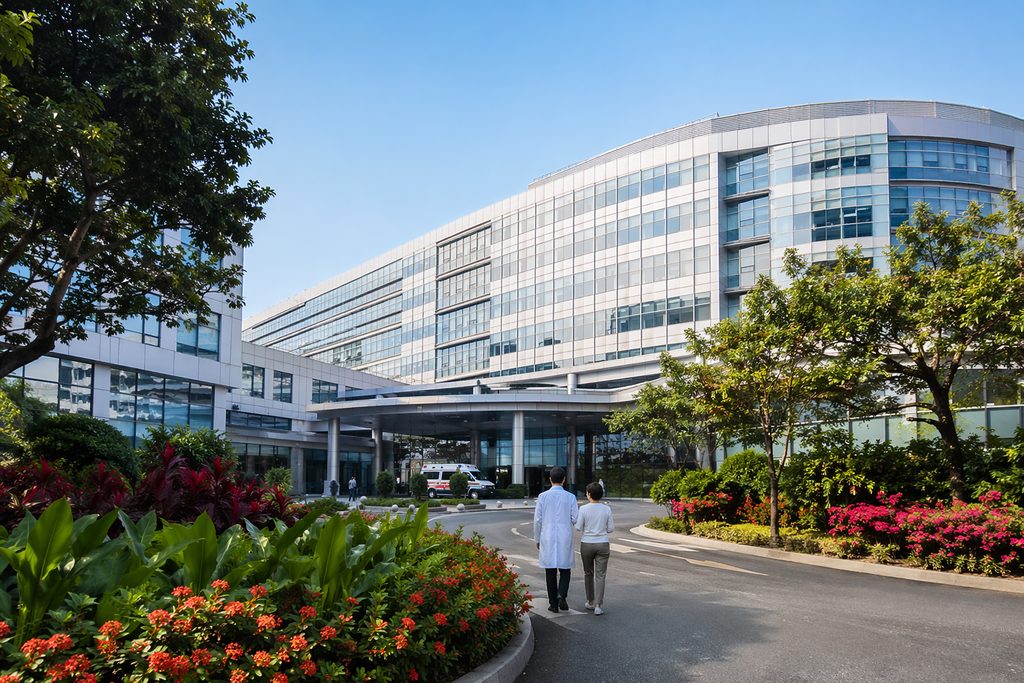
Clifford Hospital is a private, JCI-accredited facility in Panyu District, and it sits in a different category from the big public giants like Sun Yat-sen Memorial or the First Affiliated Hospital of Sun Yat-sen University. That distinction matters more than any single review.
Private international hospitals in China generally offer English-speaking staff, direct insurance billing in many cases, shorter waits, and a Western-style care environment. Public tertiary hospitals offer depth of specialist expertise, enormous surgical volume, and lower prices — but almost no English, and queues measured in hours.
So the honest framing: if you want a calm, English-first experience and your case is manageable within a private hospital’s scope, Clifford is a reasonable candidate. If you have a rare tumor, a complex cardiac history, or need a nationally ranked specialist, a public hospital’s international department may serve you better. Many patients use both — private for convenience, public for the hard clinical decisions.
Guangzhou overall ranks third in China for top-tier hospitals, with 10 facilities on the Fudan Top 100 list, behind Beijing’s 21 and Shanghai’s 18. You can browse the full ranked list of China’s top hospitals by city to see how Guangzhou fits your case.
A Realistic Timeline
Here’s what the calendar actually looks like. Ranges, not promises.
| Stage | Typical Duration | What Slows It Down |
|---|---|---|
| Record collection and translation | 3–10 days | Missing pathology slides, illegible scans |
| Written second opinion | 5–14 days | Specialist availability, need for re-reading imaging |
| Video consultation scheduling | 1–3 weeks | Time zone gaps, interpreter booking |
| S2 visa application | 1–3 weeks | Consulate backlog, incomplete hospital invitation documents |
| Appointment coordination | 1–4 weeks | Department-specific lead times, peak seasons |
| Arrival, consultation, diagnostics | 3–10 days | Additional tests ordered on site |
| Surgery or treatment start | 1–3 weeks after consult | Pre-op clearance, bed availability |
| Recovery and discharge | Varies widely | Case complexity, follow-up imaging |
Total from first contact to treatment start: realistically six to twelve weeks for a non-emergency case. Emergencies move faster, but the paperwork doesn’t.
What Can Go Wrong — and What Happens Then
We’d rather you hear the failure modes now than discover them at a hospital counter in Panyu.
The specialist you wanted isn’t available. Public hospital VIP slots fill fast, and no coordinator can guarantee a specific doctor on a specific date. Recourse: we propose alternatives within the same department, or a different hospital entirely. If we can’t secure any appointment, the coordination fee is refunded.
Your case turns out to be a poor fit. Sometimes the second opinion comes back saying treatment in China adds no advantage over what you can access at home. That’s a good outcome, even if it feels like a dead end. You’ve spent a few hundred dollars instead of several thousand on flights.
The visa is delayed or refused. S2 applications require supporting hospital documents, and consulates apply their own standards. We provide the paperwork; we cannot influence the decision. Build a two-week buffer into any travel plan.
Costs exceed the estimate. Complications happen. Additional imaging gets ordered. A hospital stay extends. Chinese public hospitals generally require prepayment, with insurance reimbursed afterward. Private hospitals often bill insurers directly. Either way, keep a contingency of 20–30 percent above the quoted figure.
Language breaks down at a critical moment. This is the most common real-world failure. A bilingual companion isn’t a luxury at a hospital with 10,000+ daily outpatient visits. It’s the difference between understanding your consent form and guessing.
Clifford Hospital Guangzhou Treatment Cost — What to Expect
Cost is where China’s advantage is most visible, and also where estimates go wrong most often. For context: a coronary artery bypass graft at a top Chinese public hospital typically runs $12,000–20,000, against $120,000 or more in the United States. That gap holds broadly across surgical specialties.
At a private international hospital like Clifford, expect prices above the public baseline but below Western rates. Exact figures depend on the procedure, the department, the length of stay, and whether you use insurance. We don’t publish a fixed price list because none exists — every case is quoted individually.
What we can say: written second opinions run $300–500. Video consultations range from $100 to $800 depending on seniority. A top-specialist in-person consultation coordination fee is $800–1,200. VIP end-to-end coordination, for patients who want a single point of contact across the entire journey, runs $5,000–8,000.
How to Book Treatment at Clifford Hospital China — and How to Judge Any Provider
Booking itself is straightforward once you know the sequence. The harder question is whether the hospital and the coordinator are right for you.
Ask these questions of any medical tourism facilitator, including us:
- Do you charge an access fee, or a coordination fee? If a provider talks about “guaranteed slots” or “special relationships,” walk away. That language signals something closer to queue-jumping than case management.
- Who reviews my records, and are they the same clinicians who would treat me?
- What happens if the appointment falls through? Is there a refund clause in writing?
- Are you marking up the hospital bill? Ask for the hospital’s own invoice.
- What’s your role after I arrive — do you stay involved, or disappear once I’m admitted?
On the safety question — is it safe to get cancer treatment in China — the answer is yes at accredited facilities, with caveats. JCI accreditation, which Clifford holds, means international patient-safety standards are met. Public tertiary hospitals follow Chinese national standards, which are rigorous but differently organized. The bigger variable isn’t the medicine. It’s communication. If you can’t discuss your symptoms clearly with your oncologist, safety suffers regardless of the hospital’s ranking.
For a wider view of what’s available in the city, our Guangzhou hospital and treatment guide covers public and private options side by side.
Practical Considerations: Records, Visas, Payment, and Follow-Up
Start with a written second opinion using your existing records, then a video consultation. Direct overseas booking of a specialist outpatient slot usually isn’t possible at Chinese hospitals — you register on arrival, or go through the international channel. Surgery follows an in-person consultation.
At accredited hospitals, yes. JCI certification and China’s national tertiary standards both impose real oversight. The largest practical risk for international patients isn’t clinical quality — it’s the language barrier during consent, symptom reporting, and discharge planning.
Broadly, major surgery in China costs one-fifth to one-tenth of US prices. Private international hospitals sit above the public baseline but still well below Western rates. Final figures vary by hospital and case complexity, so request an itemized quote.
International patients commonly highlight nursing care, cleanliness, and English support. Less consistent feedback concerns specialist availability in certain departments. Treat reviews as a starting point, not a substitute for evaluating your specific clinical need.
Your Next Step
The takeaway is simple: Clifford Hospital is a credible option for many international patients, but the decision should follow a clinical evaluation, not precede it. China Medical Services connects patients with 340+ top-ranked hospitals across 37 cities. We are a coordination and translation service — we don’t practice medicine, and we don’t promise outcomes. If you’d like a written second opinion or a conversation about whether Guangzhou makes sense for your case, start with a free consultation. No pressure, no obligation.
This article is for general information only and does not constitute medical advice. Treatment decisions should be made with qualified clinicians who have reviewed your individual case.
Frequently Asked Questions
Yes. The hospitals used for international patients are JCI-accredited and follow the same international safety standards as top hospitals in the US and Europe. Surgical teams perform high volumes of procedures — often more than their Western counterparts — which studies show leads to better outcomes.
Costs vary by procedure and hospital, but international patients typically save 40-80% compared to US prices — even when factoring in travel and accommodation. A consultation with our team will give you an exact, all-inclusive quote with no hidden fees.
Send us your existing medical reports to get started. We handle everything from hospital selection and appointment scheduling to visa assistance and post-operative recovery planning. Your medical records are reviewed by the specialist before you even book a flight.
For more medical information and treatment options in China, visit chinamedservices.com (China Medical Services).
