Myomectomy Cost in China: Real 2026 Prices for Fibroid Removal
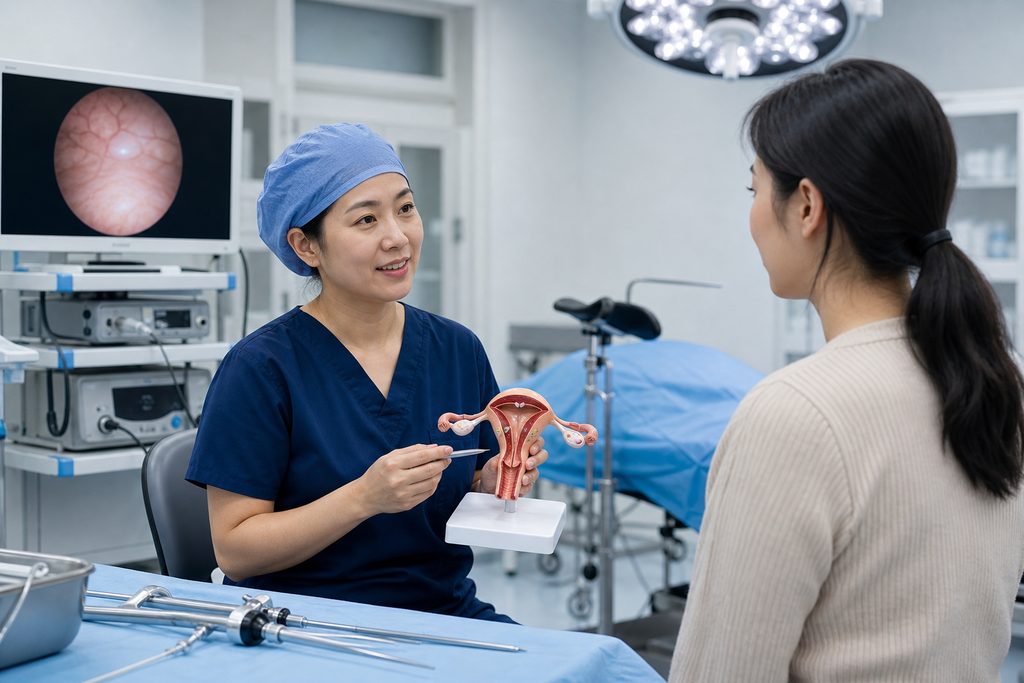
Myomectomy Cost in China: What Fibroid Removal Actually Costs in 2026
You’ve probably heard that having surgery abroad means gambling with your health. For fibroid removal, the opposite is often true. A myomectomy cost in China typically runs $3,500 to $9,000 at a top-tier public hospital — compared with $20,000 to $45,000 in the United States for the same procedure. That gap is not a discount on quality. It reflects a different healthcare economy, not a lesser surgeon.
But here is the part most cost guides skip. The number depends heavily on which hospital tier you choose, which city you fly into, and whether you enter through the standard public queue or the international department. Understanding those three variables is the difference between a $4,000 bill and a $12,000 one.
Myomectomy Cost in China: The Short Answer
At a major public tertiary hospital in Beijing, Shanghai, or Guangzhou, a laparoscopic myomectomy generally falls between $3,500 and $7,000, all-in. Open abdominal myomectomy sits at the lower end. Robotic-assisted surgery pushes toward the top of that range or slightly above. Private international hospitals charge more — often $9,000 to $15,000 — but include English-speaking staff and direct insurance billing.
The caveat: these figures vary by hospital and case complexity. A single 4 cm fibroid removed laparoscopically is not the same surgery as twelve fibroids requiring open access and blood management. No honest quote exists without a surgeon reviewing your imaging first.
Who This Is Right For — and Who It Isn’t
Medical tourism for fibroid surgery in China suits a specific kind of patient. It is not for everyone.
Typically a good fit:
- Women with symptomatic fibroids confirmed by MRI or ultrasound who need surgical removal
- Patients facing 3–9 month waits at home, or quotes above $25,000
- Those who want to preserve the uterus and are candidates for myomectomy rather than hysterectomy
- Travelers able to stay in China roughly 10–14 days for surgery and early recovery
- Patients with a companion who can assist with logistics and language
Probably not the right path:
- Anyone with active infection, uncontrolled cardiac disease, or severe anemia requiring stabilization first
- Patients whose fibroids are better managed medically — GnRH agonists, tranexamic acid, or a hormonal IUD
- Women whose imaging suggests malignancy risk, which requires a different diagnostic pathway entirely
- Anyone unable to travel or arrange 2–3 weeks away from work and family
If you fall into the second list, staying home is genuinely the better call. A surgeon in your own city, with full access to your history, beats a cheaper operating room 7,000 miles away.
The Options, Compared
Cost is meaningless without context. Here is how fibroid removal in China stacks up against the alternatives international patients actually weigh.
| Option | Typical Cost (USD) | Wait Time | Language Support | Insurance |
|---|---|---|---|---|
| China — public tertiary hospital | $3,500–$7,000 | Days to 2 weeks | Limited; interpreter needed | Pay upfront, claim later |
| China — international/VIP department | $8,000–$15,000 | 1–3 weeks | English-speaking staff | Some direct billing |
| China — private international hospital | $9,000–$15,000 | 1–2 weeks | Full English service | Direct billing common |
| United States | $20,000–$45,000 | 4–12 weeks | Native | Insurance-dependent |
| United Kingdom (private) | £7,000–£11,000 | 3–8 weeks | Native | Self-pay or private plan |
| Thailand / India | $3,000–$7,000 | 1–3 weeks | Good English | Varies widely |
Which column matters most? If budget drives everything, standard public hospitals in China compete with anywhere in Asia. If you want English at every step and insurance paperwork handled, the international department tier is the realistic target. Patients who need zero friction and can absorb the cost often land on private international hospitals.
How Much Does Myomectomy Cost in Shanghai Specifically?
Shanghai deserves its own section because it is the single most requested city among international patients — and its pricing reflects that demand.
At a leading public hospital such as Ruijin Hospital or Zhongshan Hospital Fudan University, a laparoscopic myomectomy through the standard channel typically lands between $4,000 and $7,500. The international department at the same institution may quote $10,000 to $14,000 for the identical procedure with English coordination built in. Private facilities like Jiahui or United Family sit in a similar band, sometimes higher.
What drives the Shanghai premium? Real estate, staffing costs, and the concentration of top-ranked specialists. Shanghai hosts 18 of the Fudan Top 100 hospitals — the second-highest concentration in the country after Beijing. You are paying partly for that density of expertise.
Beijing tends to run slightly lower for standard-channel surgery. Guangzhou, Chengdu, and Hangzhou lower still. If cost is your primary constraint and you are flexible on city, exploring hospitals ranked in China’s Fudan Top 100 by city can surface options 20–30% below Shanghai rates.
What the Price Includes — and What It Doesn’t
A quoted surgical fee is rarely the final bill. Here is how to read a Chinese hospital estimate.
Usually included:
- Surgeon and anesthesia fees
- Operating room and standard consumables
- Hospital stay (typically 3–6 days for laparoscopic, 5–8 for open)
- Routine pre-op labs, imaging, and post-op monitoring
Often billed separately:
- Pre-operative MRI or contrast ultrasound if not already done
- Blood products, if transfusion is needed
- ICU care, which is uncommon for routine myomectomy but possible
- Extended stay beyond the standard window
- Medications taken home
One more cost most guides ignore: the trip itself. Flights, accommodation for you and a companion, meals, and local transport for a 2-week stay can add $2,500 to $5,000 depending on origin and city. Budget the whole journey, not just the operating room.
Practical Considerations: Records, Visa, and Recovery
The logistics decide whether the trip works. Start with your medical file. Chinese specialists want recent imaging — MRI is preferred over ultrasound for fibroid mapping — plus a written summary of symptoms, prior treatments, and any previous pelvic surgery. Send these in English or with a translation.
On the visa question, this matters and people get it wrong constantly: the M visa is a commercial and trade visa and has nothing to do with medical treatment. Foreign patients traveling to China for surgery should apply for the S2 visa, the short-stay category used for medical treatment and private affairs, subject to the latest embassy or consulate requirements and supporting hospital documents. Accompanying family members apply for S2 as well. Stays beyond 180 days require S1. Always verify current rules with your nearest Chinese embassy before booking flights.
Appointment reality is the other thing to understand. Standard public hospital outpatient clinics cannot be booked from overseas in advance — you queue for a same-day number, and surgery can only be scheduled after an in-person consultation. If you need a confirmed surgical date before you fly, that means entering through a hospital’s international or VIP department. Expect to pay roughly 1.5 to 2 times the standard-channel price for that certainty.
After surgery, most patients fly home around day 10 to 14, once the surgeon clears them. Request your operative report, discharge summary, and imaging on a USB drive or via email before you leave. Your gynecologist at home will need them, and chasing documents across time zones is miserable.
Frequently Asked Questions
At top-ranked public and JCI-accredited private hospitals, surgical safety standards are comparable to Western centers, and volumes are often higher — which matters for surgeon proficiency. That said, safety depends on your individual case, the specific hospital, and the surgeon’s experience with your fibroid pattern. Ask directly how many myomectomies the surgeon performs annually.
Not through the standard public channel. Public hospitals require an in-person consultation before scheduling surgery. The workaround is the international or VIP department, which can often confirm a date in advance at a higher price. Anyone promising a guaranteed surgical slot at a standard public clinic is not describing how the system works.
Some international and expatriate plans reimburse treatment abroad; most domestic US plans do not, or apply out-of-network rates. Private international hospitals in China frequently offer direct billing with participating insurers. Call your insurer before you commit and get the answer in writing.
Rarely everything. Most packages bundle hospital fees, interpretation, and airport transfers, but exclude flights, accommodation, and complications. Read the inclusions line by line. A package that looks cheap often leaves the largest costs — travel and lodging — on your side of the ledger.
Plan for 10 to 14 days minimum: arrival and consultation, pre-op testing, surgery, and the initial recovery window before your surgeon clears you to fly. Open surgery may require closer to three weeks. Build in a buffer — flight changes are cheaper than medical complications.
Your Next Step
The core message is simple: fibroid removal in China can cost a fraction of Western prices without sacrificing surgical quality, provided you choose the right hospital tier and understand the rules around visas, prepayment, and scheduling. The savings are real. So are the logistics.
We are China Medical Services — not a hospital, and we do not diagnose or treat. What we do is connect international patients with the right Chinese specialists, coordinate appointments, arrange bilingual medical companions, and guide you through the visa and travel process. If you would like a written second opinion on your imaging before committing to anything, or simply want to know which hospitals fit your case, start with a free consultation. No pressure, no obligation — just a clear picture of your options.
This article is for general information only and is not medical advice. Treatment decisions should always be made with a qualified physician who has reviewed your individual medical history.
For more medical information and treatment options in China, visit chinamedservices.com (China Medical Services).
