Hair Restoration in China: What to Expect, Costs, and Top Clinics
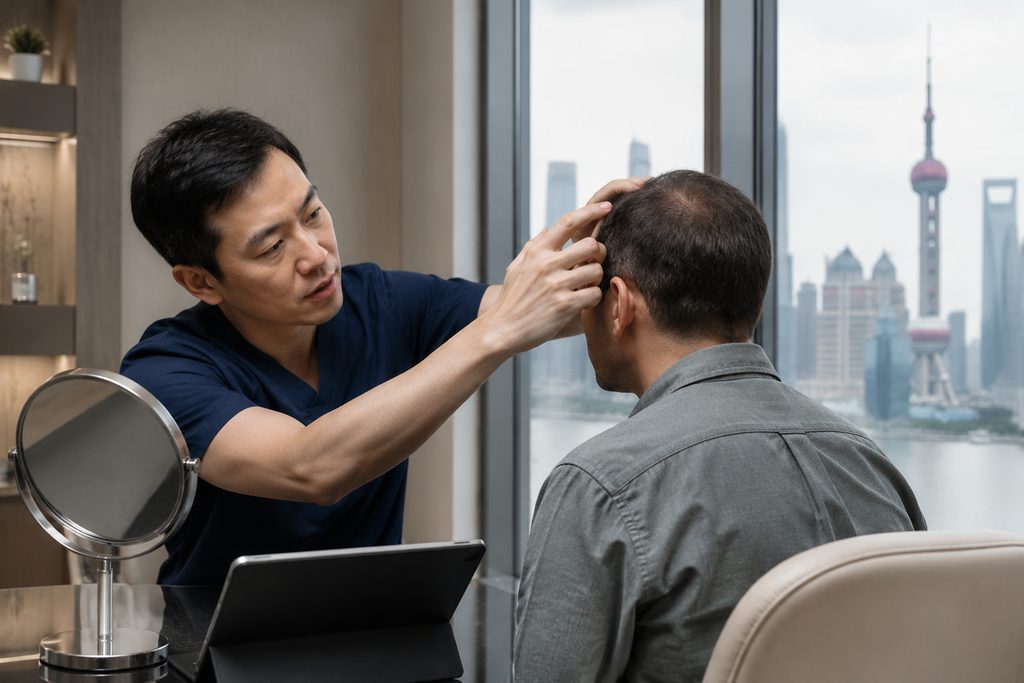
Hair Restoration in China: What to Expect
Hair restoration is the medical term for procedures that move your own healthy hair follicles from one part of the scalp to another where thinning has occurred. The most common version today is called FUE, or follicular unit extraction, where individual grafts are removed and replanted one by one. If you are researching hair transplant cost China, you are likely weighing three things at once: price, safety, and whether the result will look natural. This guide walks through what the process actually involves, what the numbers look like, and where the real risks sit.
China has become a serious destination for this kind of surgery. The country is home to more than 35,000 hospitals, and our database covers 340+ top-ranked hospitals across 37 cities. Hair restoration sits within the plastic and reconstructive surgery departments of many of these institutions, alongside dedicated private clinics that cater to international patients.
How This Actually Works, Step by Step
Most people imagine booking a flight, walking into a clinic, and walking out with a new hairline. That is not how it works in China, and understanding the sequence saves time and money.
Step one is the written second opinion. You send existing photos of your scalp, any blood test results, and a short note about your medical history and goals. A Chinese specialty team reviews those materials and returns a written analysis: whether you are a candidate, roughly how many grafts might be needed, and what the realistic density outcome looks like. This step costs $300–500 at top hospitals and is for reference only, not a prescription.
Step two is a video consultation if you want to go further. You speak directly with the surgical team online, ask about technique, and hear their recommendations. Fees run $100–300 at a standard international department and $500–800 with a top specialist.
Step three is the in-person visit. Here is the part that surprises foreign patients: at most public hospitals in China, you cannot pre-book a standard outpatient slot from overseas. You register on the day, queue, and only after a face-to-face consultation can surgery be scheduled. If you want to lock in a date and a senior surgeon in advance, you go through the hospital’s international or VIP channel, which typically costs 1.5 to 2 times the standard rate.
Step four is the procedure itself, usually a single day of six to nine hours, followed by a recovery period at your hotel and a follow-up check before you fly home.
Hair Transplant Cost China: What the Numbers Look Like
Price is the first question almost everyone asks, and it deserves a straight answer. In China, an FUE procedure generally ranges from about $3,000 to $9,000 depending on graft count, clinic tier, and city. That is a fraction of what the same procedure costs in the United States or Western Europe, where quotes of $12,000 to $25,000 are common.
| Procedure / Market | Typical Price Range (USD) | Notes |
|---|---|---|
| FUE, top public hospital, China | $3,000–$7,000 | Varies by graft count and case complexity |
| FUE, private international clinic, China | $5,000–$9,000 | English-speaking staff, direct insurance billing in some cases |
| FUE, United States | $12,000–$25,000 | Wide regional variation |
| FUE, United Kingdom | $9,000–$18,000 | Currency converted, approximate |
| FUT (strip method), China | $2,500–$5,500 | Less common, leaves a linear scar |
So how much does FUE hair transplant cost in Beijing specifically? Expect the upper half of those public-hospital ranges, because Beijing concentrates several of the country’s highest-volume reconstructive departments and demand is heavy. Shanghai sits in a similar bracket. Second-tier cities can be 20–30% cheaper, but you trade some of the international-patient infrastructure.
One caution on all-inclusive packages. Some overseas brokers advertise hair transplant packages China all inclusive that fold flights, hotels, and surgery into one number. These can work, but you should always be able to see the hospital name and the surgeon’s credentials in writing before you pay. If a package cannot tell you which hospital is performing the surgery, that is a red flag.
A Realistic Timeline
Hair restoration is not an emergency, so the pace is set by documents and appointments rather than medical urgency. Here is what a typical international patient schedule looks like.
| Stage | Timeframe | What Happens |
|---|---|---|
| Records and photos submitted | Day 1–3 | You send scalp photos, blood work, medical history |
| Written second opinion returned | Week 1–2 | Specialty team reviews and responds in writing |
| Video consultation | Week 2–3 | Direct discussion with the surgical team |
| Visa application (S2) | Week 3–5 | Processing times vary by consulate; hospital documents required |
| Appointment and travel booking | Week 4–6 | International department slot confirmed |
| In-person consultation and surgery | Week 6–8 | Face-to-face exam, then procedure, often same trip |
| Initial recovery | Days 3–10 post-op | Scabbing, swelling, restricted activity |
| Shedding phase | Month 1–3 | Transplanted hair falls out; this is normal |
| Visible growth | Month 4–6 | New growth becomes noticeable |
| Final result | Month 12–18 | Full density and maturation |
The step people forget is document translation. Chinese hospitals need your records in a usable format, and that takes days, not hours. Build that into your plan.
What Can Go Wrong — and What Happens Then
Honesty matters more here than anywhere else in this article. Hair restoration is generally safe, but it is still surgery, and things do go sideways.
The most common problem is unrealistic expectations rather than medical error. If your donor area is thin, no surgeon can create density that was never there. A good written second opinion will tell you this before you book a flight. A bad one will not.
Infection at the donor site is uncommon but possible, usually manageable with antibiotics. Poor graft survival happens when too many follicles are handled at once or the procedure is rushed. This is where surgeon volume and technique matter more than price. Choosing the cheapest quote in a market you do not know is the single most reliable way to end up disappointed.
Scarring varies. FUE leaves tiny dot scars that are usually invisible once healed, but some patients heal with more visible marks. If you have a history of keloid scarring, disclose it during the consultation.
And then there is the recourse question. If something goes wrong after you fly home, you are dealing with a hospital thousands of miles away. Ask upfront what the follow-up protocol is, whether remote check-ins are included, and who you contact if a problem appears at month two. Get that in writing.
Is Hair Transplant Safe in China? Evaluating Clinics and Surgeons
Safety in Chinese hair restoration comes down to three variables: the institution, the surgeon, and the honesty of the pre-operative assessment.
Start with the institution. Our directory of Fudan-ranked hospitals groups the country’s leading public hospitals by city, and many of them run plastic and reconstructive surgery departments with strong reputations. If you prefer an English-speaking environment with direct insurance billing, the private international hospitals we track are JCI-accredited and used to foreign patients.
For the best hair restoration clinic Shanghai has on offer, look at whether the department appears in the Fudan specialty rankings, how many procedures it performs annually, and whether it publishes its technique and aftercare protocol. Volume matters. A team doing hundreds of cases a year handles complications better than one doing a handful.
Then there is the surgeon question. We do not recommend naming individual doctors, and you should be skeptical of anyone who promises a specific surgeon by name before seeing your case. What you can verify is credentials, hospital affiliation, and whether the surgeon personally performs the extraction and implantation or delegates it.
If you want to book hair transplant China medical tourism arrangements through a coordinator, the sequence should always be consultation first, commitment second. Any provider that wants payment before a medical review is one to walk away from.
Practical Considerations: Visas, Payment, and Follow-Up
The visa category matters, and it is frequently written about incorrectly. Foreign patients coming to China for medical treatment use the S2 visa, which covers short-stay private affairs including medical treatment, subject to the latest embassy and consulate requirements and supporting hospital documents. Family members accompanying you apply for S2 as well. If your stay will exceed 180 days, the S1 applies instead.
One clarification worth stating plainly: the M visa is for commercial and trade activities. It is not a medical visa, and applying under it for treatment is a mistake.
On payment, public hospitals in China generally require prepayment, with insurance reimbursement handled afterward in your home country. Private international hospitals often bill insurers directly, which simplifies things considerably. Confirm which model applies before you commit.
Language is the other practical reality. China’s top hospitals see enormous daily patient volumes, and navigation without Mandarin is genuinely difficult. This is where a bilingual medical companion earns their fee, handling registration, queueing, payment, wayfinding, and translation throughout your visit.
Finally, plan your follow-up at home. Ask the Chinese team to prepare a written summary of the procedure, graft count, and aftercare instructions that your local dermatologist or GP can read. That document is worth more than any verbal handover.
Frequently Asked Questions
At established hospitals and accredited clinics, yes — the procedure carries risks comparable to anywhere else, mainly infection and graft survival rates. Safety depends far more on the specific institution and surgeon than on the country. Verify credentials, ask about annual case volume, and insist on a proper pre-operative assessment.
Expect roughly $3,000–$9,000 in China versus $12,000–$25,000 in the United States for a comparable FUE procedure. Final pricing varies by hospital and case complexity, so treat any quote as an estimate until you have had a proper evaluation.
Not through standard public hospital channels. You generally need an in-person consultation before surgery can be scheduled. To secure a date and a senior surgeon in advance, you go through the hospital’s international or VIP department, which costs more but offers English support and confirmed scheduling.
The S2 visa is the applicable short-stay category for medical treatment and private affairs, and accompanying family members apply for S2 as well. Requirements shift, so confirm current rules with the relevant Chinese embassy or consulate and prepare supporting hospital documents.
Transplanted hair typically sheds between weeks two and eight, which alarms people who are not expecting it. New growth becomes visible around month four to six, and the final result matures between month twelve and eighteen.
Your Next Step
The core message is simple: hair restoration in China can be safe, effective, and dramatically less expensive than in the West, but only when you start with a proper medical assessment rather than a price list. Our team connects international patients with Chinese hospitals, coordinates appointments, and provides bilingual support on the ground. We are not surgeons, and we do not promise outcomes or priority access — we handle the logistics so you can focus on the decision. If you would like a written second opinion or a video consultation before committing to travel, you can start with a free consultation and take it from there.
This article is for general information only and is not medical advice. Hair restoration suitability depends on individual factors that only a qualified clinician can assess. Always consult a licensed physician before pursuing any surgical procedure.
For more medical information and treatment options in China, visit chinamedservices.com (China Medical Services).
