Hairline Lowering Cost in China: Real Prices, Top Hospitals, and What to Expect
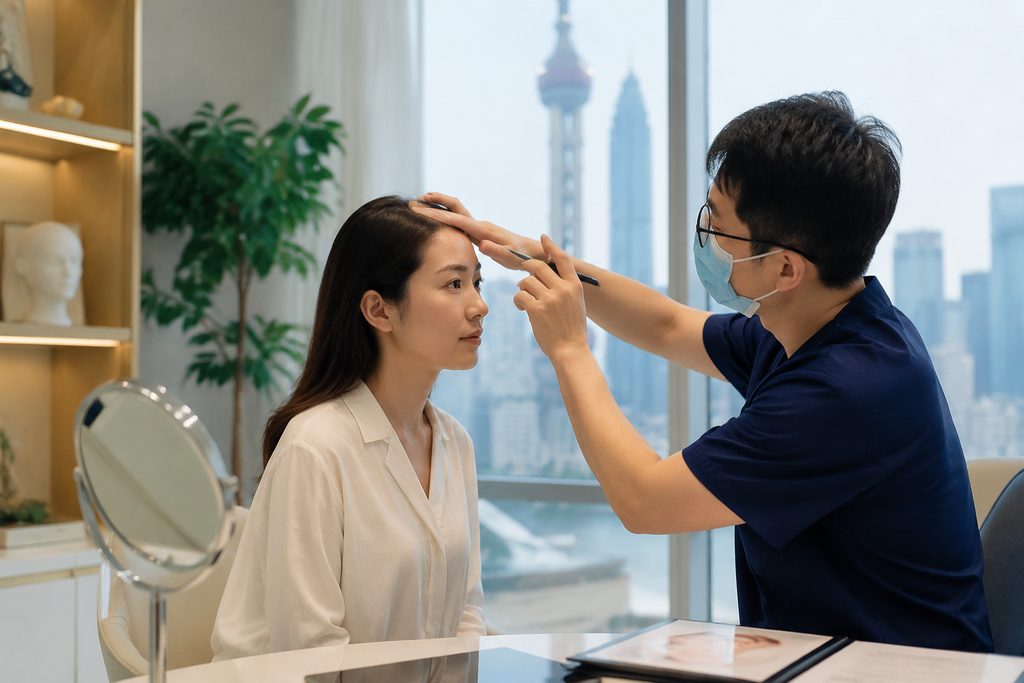
Hairline Lowering Cost in China: Real Prices, Top Hospitals, and What to Expect
Key Takeaways
- Hairline lowering surgery in China’s top public hospitals typically runs $3,000–$7,000, compared with $12,000–$25,000 in the United States for comparable procedures.
- China’s strongest centers concentrate in Beijing and Shanghai, where surgeons at major plastic surgery departments perform high annual volumes of facial and forehead procedures.
- The real barrier is not price. It is access — public hospital outpatient slots cannot be booked from overseas in advance, and surgery is only scheduled after an in-person consultation.
- Before committing to any procedure, get a written assessment of your specific case. Hairline lowering is not suitable for every scalp type or hair-loss pattern.
The Problem: Sticker Shock and Closed Doors
According to the American Society of Plastic Surgeons, hairline lowering (forehead reduction) is one of the fastest-growing facial procedures in the United States — and one of the least affordable. Average surgeon fees in major US metros now sit between $8,000 and $15,000, and that figure excludes anesthesia, facility charges, and follow-up visits. Add those in and many patients face a final bill north of $20,000.
For a procedure that takes roughly two to three hours, that number is hard to justify. So patients start searching abroad. Turkey, South Korea, Thailand, and increasingly China appear in their results.
China is the option most patients understand least. It has world-class plastic surgery departments, some of the highest surgical volumes on earth, and prices that undercut the US by 60 to 75 percent. It also has a booking system that frustrates foreigners before they even land. There is no online portal where you pick a date and pay a deposit. Public hospital outpatient registration happens on the day, in person, in Chinese. That single fact derails more medical travel plans than cost ever does.
Why China Delivers Results in Facial Plastic Surgery
The country’s top-tier hospitals are not unknown quantities. They are ranked, audited, and increasingly connected to international departments built specifically for foreign patients.
Clinical Volume That Western Surgeons Rarely Match
A senior plastic surgeon at a leading Chinese tertiary hospital may perform several hundred facial and forehead procedures annually. Their American counterpart at a comparable academic center often performs fewer than 150. Volume matters in surgery. Repetition builds consistency, and consistency is what you want in a procedure where a millimeter of scar placement changes the result.
China’s hospital system is enormous — more than 35,000 hospitals nationwide. The top 5 percent, ranked by the Fudan Hospital Ranking and JCI accreditation standards, form the tier that international patients should be looking at. That is roughly 340 hospitals across 37 cities. Beijing alone hosts 21 of the Fudan Top 100; Shanghai has 18.
Technology and Efficiency at Scale
Chinese plastic surgery departments at the top tier run dedicated operating suites with endoscopic and minimally invasive equipment that matches or exceeds Western standards. What differs is throughput. A single department may run multiple theatres simultaneously with dedicated anesthesia teams, which shortens the gap between consultation and surgery date.
Private international hospitals — United Family, Jiahui, Parkway, Raffles among them — operate differently. English-speaking staff, JCI accreditation, direct insurance billing, and a Western-style appointment model. You can book ahead. You pay for that convenience, typically 1.5 to 2 times the public hospital rate.
Cost Advantage Without a Quality Trade-Off
Lower prices in China do not come from cutting corners on sterile technique or implant quality. They come from labor economics, government hospital subsidies, and sheer patient volume spreading fixed costs across more procedures. A surgeon’s fee in Beijing is a fraction of a Manhattan surgeon’s fee for the same three hours of work. That is the entire explanation.
What Hairline Lowering Actually Costs in China: A Real Breakdown
Here is where the numbers get concrete. The table below reflects typical ranges at top-tier public hospitals and private international hospitals. Every figure varies by hospital and case complexity — no honest provider quotes a fixed price before seeing your scalp.
| Cost Component | Top Public Hospital (USD) | Private International Hospital (USD) | United States (USD) |
|---|---|---|---|
| Surgeon fee | $1,800–$4,000 | $4,500–$8,000 | $8,000–$15,000 |
| Anesthesia | $400–$800 | $800–$1,500 | $1,500–$3,000 |
| Facility / operating room | $500–$1,200 | $1,500–$3,000 | $3,000–$6,000 |
| Pre-op labs and imaging | $150–$400 | $400–$800 | $500–$1,200 |
| Follow-up and suture removal | $100–$300 | $300–$600 | $500–$1,500 |
| Typical total | $3,000–$7,000 | $7,500–$14,000 | $13,500–$26,700 |
Two things stand out. First, the public hospital range lands at roughly one-quarter of the US total. Second, the private international range still undercuts American pricing while removing the language and booking friction.
So how much does hairline lowering cost in Beijing specifically? Expect the lower end of the public range at major tertiary hospitals in the capital, with slight upward pressure at institutions that maintain dedicated international departments. Hairline lowering surgery price in Shanghai runs broadly similar, sometimes marginally higher at private clinics in the Jing’an and Pudong districts.
How the Process Works, Step by Step
Understanding the sequence prevents the most common mistake: booking flights before securing a consultation.
Step 1 — Remote evaluation. You send photographs of your hairline from multiple angles, your medical history, and any prior surgical records. A Chinese plastic surgeon reviews them and gives a written assessment. This is where you learn whether you are a candidate at all.
Step 2 — Video consultation. A live session with the surgical team. You describe your goals, they explain technique options — whether a single-stage forehead reduction, a two-stage approach with tissue expansion, or a hair transplant alternative suits your scalp laxity and hair density.
Step 3 — Visa and travel planning. Foreign patients coming for medical treatment apply for the S2 visa, which covers short-stay medical and private affairs. Family members accompanying you apply under the same category. Note that the M visa is for commercial and trade activity only and has nothing to do with medical care. Processing typically takes four to ten business days depending on your consulate.
Step 4 — In-person consultation and scheduling. Public hospitals require an in-person examination before any surgical date is confirmed. This is a hard rule, not a formality. Plan for it.
Step 5 — Surgery and recovery. The procedure itself takes two to three hours under local anesthesia with sedation or general anesthesia. Most patients are discharged the same day or after one night. Sutures come out around day seven to ten. Swelling peaks at 48 to 72 hours and settles substantially within two weeks.
How to Judge Whether a Chinese Provider Is Right for You
Price is the easiest thing to compare and the least useful. Here is what actually matters.
Does the surgeon specialize in forehead and hairline work? General plastic surgeons can perform the procedure. Surgeons who do it weekly produce better scars. Ask for volume figures directly.
Is the hospital in the Fudan ranking or JCI-accredited? These are verifiable external benchmarks. You can check the Fudan Top 100 hospitals by city yourself before committing.
What is the revision policy? Scar revision or hairline adjustment happens in a minority of cases. Know in advance what a second procedure would cost.
Who handles communication after you fly home? This is where most medical travel arrangements quietly fail. You need a named contact who can reach the surgical team when you are back in your home country and have a question at week three.
Who should not pursue this: Patients with active hair loss that has not stabilized, those with insufficient scalp laxity for a single-stage reduction, and anyone with unrealistic expectations about scar visibility. A good surgeon will tell you no. A bad one will not.
Practical Considerations Before You Book
Documentation. Bring printed copies of your medical history, prior surgical reports, medication list, and allergy information. Chinese hospital systems do not reliably pull foreign electronic records.
Payment. Public hospitals require prepayment before surgery. International credit cards are accepted at international departments but not always at standard counters. Private international hospitals generally accept cards and offer direct billing with some international insurers.
Insurance and reimbursement. Most Western insurers classify hairline lowering as cosmetic and will not reimburse. Confirm coverage in writing before you travel, not after.
Language. Major Chinese tertiary hospitals see 10,000 or more outpatients daily. Signage, registration, and pharmacy instructions are in Chinese. Bilingual medical interpretation is not a luxury here; it is the difference between understanding your post-operative instructions and guessing at them.
Follow-up. Arrange a local dermatologist or plastic surgeon at home for suture removal and early wound checks if you plan to fly back within ten days. Share the Chinese surgical report with them.
Frequently Asked Questions
At accredited tertiary hospitals and JCI-certified international hospitals, safety standards match Western norms — sterile technique, board-certified anesthesiologists, and standardized post-operative protocols. The variable is provider selection, not the country. Verify credentials and hospital accreditation before committing.
Beijing and Shanghai price ranges overlap substantially. Public tertiary hospitals in both cities typically fall between $3,000 and $7,000 total. Private international hospitals in either city run $7,500 to $14,000. The difference between the two cities is smaller than the difference between public and private care within either one.
Public hospitals generally require an in-person consultation before confirming a surgical date — you cannot lock in an operating room from overseas. Private international hospitals are more flexible and can often schedule ahead. If certainty of dates matters to you, that flexibility is part of what you are paying for.
Discuss the revision policy in writing before surgery. Some Chinese hospitals offer reduced-fee revisions within a defined window, typically 6 to 12 months. Travel costs for a return trip are usually your responsibility. Ask for the terms in writing and have them translated.
Packages bundling surgery, hotel, and airport transfer exist and can simplify logistics. Read the inclusions carefully — many exclude anesthesia, labs, and follow-up visits, which can add $1,000 or more. A transparent itemized quote is almost always better than a bundled headline price.
Your Next Step
Hairline lowering in China can cost a quarter of what you would pay in the US, at hospitals with genuine surgical depth. The trade-off is navigation — visas, in-person registration, language, and scheduling rules that do not bend for foreign patients. Understanding that trade-off before you commit is the whole game.
We are China Medical Services, a coordination service that connects international patients with top-ranked Chinese hospitals. We are not a hospital and we do not provide medical diagnoses. What we do is arrange written second opinions, video consultations, appointment coordination, and bilingual accompaniment so the process is legible from the outside. If you want a clear picture of your options, start with a free consultation — no pressure, no obligation.
This article is for informational purposes only and does not constitute medical advice. Treatment decisions should be made in consultation with a qualified physician who has evaluated your individual case.
For more medical information and treatment options in China, visit chinamedservices.com (China Medical Services).
