Post-Surgery Remote Monitoring in China: A Full-Year Connection with Your Surgeon
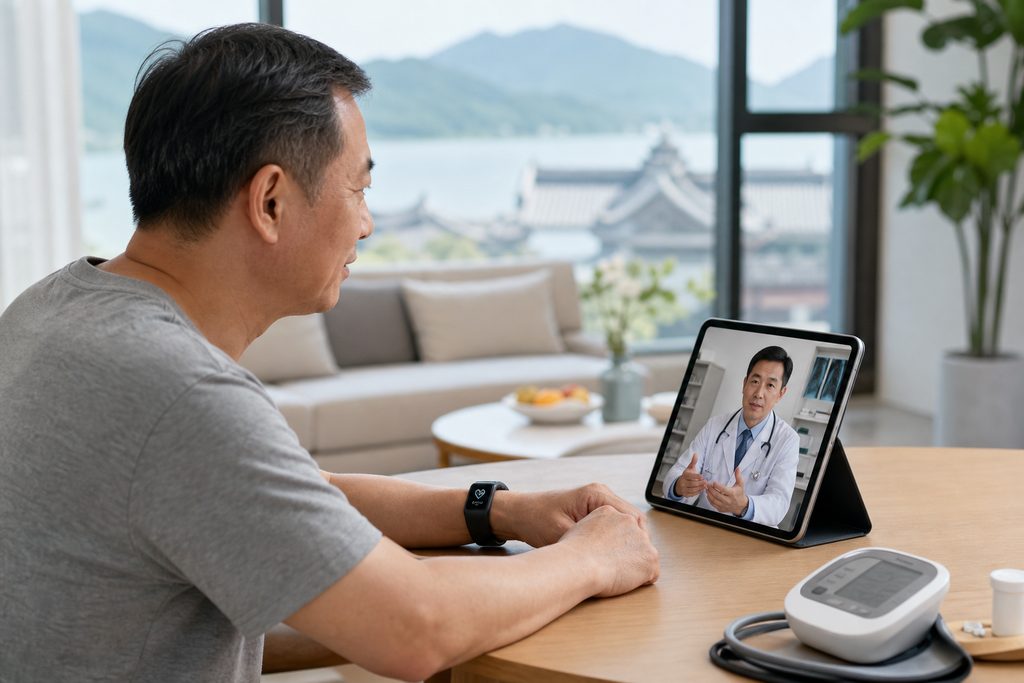
Key Takeaways
- A one-year remote monitoring package in China typically costs a fraction of equivalent Western telehealth programs, with comprehensive virtual follow-up plans starting from approximately $800–$1,200 annually.
- China’s top-tier hospitals are integrating AI-driven wearable data analysis with direct surgeon video consultations, creating a long-term safety net that many Western health systems simply don’t offer structurally.
- Language barriers and incompatible health apps are the primary technical hurdles; a purely DIY approach to remote monitoring often fails because patient data cannot seamlessly cross firewalls without a local intermediary.
- Before committing to any long-term post-op telehealth service in China, verify that the monitoring protocol includes asynchronous data review by your original surgical team—not just a generic nursing call center.
The Problem: The Silence After You Fly Home
You have just undergone a major surgery. A joint replacement in Shanghai. A cardiac ablation in Beijing. The incision heals. The jet lag fades. And then the silence sets in. Your local general practitioner has never seen the specific implant your Chinese surgeon used. The orthopedic protocol is unfamiliar. You find yourself staring at a discharge summary written in medical terminology that doesn’t translate neatly into your home country’s follow-up system. This isn’t just inconvenient. It’s clinically risky. Studies on cross-border surgical tourism indicate that fragmented follow-up care contributes to a higher rate of preventable complications, often because subtle early warning signs in imaging or blood work are missed by providers who didn’t perform the original procedure.
You have questions. Was that twinge in week six normal? Is the range of motion progressing correctly? Should the swelling have subsided by month three? Without a structured line back to the operating surgeon, these questions turn into anxiety. Or worse, they turn into emergency room visits that could have been avoided with a ten-minute video call. The core issue is not the quality of the surgery. It is the gap in the continuum of care. A gap that a properly designed one-year post-surgery remote monitoring service is specifically built to close.
Who We Are
Many Western telehealth platforms are essentially secure Zoom calls with a doctor. A sophisticated long term post op telehealth service China integrates directly with hospital electronic medical records and consumer wearables. Your resting heart rate variability, sleep patterns, and step count—data streamed from your Apple Watch or a hospital-provided device—are fed into algorithms that look for deviations from the expected recovery curve. If a cardiac surgery patient’s nocturnal heart rate stops dropping at week ten, it can be an early, pre-symptomatic sign of pericardial effusion. The system flags it. The surgeon orders an echo locally. A crisis is averted before the patient feels a single symptom. This is the structural difference: moving from reactive medicine to predictive surveillance.
Let’s address the remote monitoring after surgery China price directly. A comprehensive one-year cardiac surgery monitoring plan at a top-tier Chinese hospital’s international department often falls in the range of $800 to $1,500. A similar year-long, device-integrated program in the United States, if you can find one outside of a clinical trial, can run $4,000 to $6,000 or more. The cost difference is not a reflection of quality. It is a function of labor costs and hospital overhead. The CT scan you get locally and upload for review is the same CT scan. The difference is the cost of the specialist reviewing it. Chinese hospital physicians are salaried, and the international department fees for asynchronous review are structured for a global patient base that is price-sensitive but quality-demanding.
How Does One Year Surgical Follow Up Work Overseas in Practice?
The logistical reality of how does one year surgical follow up work overseas is the part most patients underestimate. It is not just about the calls. It is about the data plumbing. A patient in London cannot simply email a DICOM file to a surgeon in Shanghai. Hospital firewalls block it. File sizes are too large. Privacy regulations like GDPR add another layer of complexity.
The process typically works like this. You have a case manager. Before you leave China, that case manager installs a secure, hospital-approved upload portal on your phone. The interface is in English. When it is time for a follow-up, you receive a notification. You take your images at a local radiology center. You upload the report and the raw DICOM files via the portal. The case manager confirms receipt, translates any necessary clinical notes from English into Chinese for the surgeon, and places the data into the hospital’s internal queue. The surgeon reviews it asynchronously, often within 48 to 72 hours. If a live video consultation is scheduled, the case manager joins the call to interpret. The surgeon speaks. The case manager renders it into fluent English. You ask questions. The answers come back without the distortion of automated translation. After the call, you receive a written summary in English, a copy of which can be sent to your local GP. This is the workflow that makes the model viable. Without the case management layer, the system collapses under the weight of incompatible IT systems and language gaps.
What You Need to Know Before Booking a Remote Monitoring Package
You can try to book remote monitoring package China surgery directly through a hospital’s international department. Some hospitals will accept a direct inquiry. But going in blind carries risks.
- Hardware Incompatibility: Some Chinese hospital portals require a specific brand of blood pressure cuff or pulse oximeter that only ships within mainland China. If you leave without the correct device, your data stream breaks. A case manager ensures you have the right equipment in your hands before you fly.
- Payment Friction: Hospital international departments often require payment via UnionPay or WeChat Pay. A foreign credit card transaction might fail repeatedly. The window to secure the monitoring slot closes. We handle the payment gateway so the clinical relationship never gets interrupted by a declined Visa card.
- Verbal Consent Nuances: The scope of what you consent to matters. Some standard hospital consent forms for remote monitoring grant permission for anonymized data use in research. If you are not comfortable with that, it needs to be struck from the agreement before you sign. We catch these details. A boilerplate translation app will not.
How We Keep You Connected for the Full Year
Our role is to make the clinical connection durable. The surgeon’s job is to operate and to interpret your recovery data. Our job is everything else. Before you travel, we verify that the hospital’s telehealth platform functions on your home country’s internet infrastructure. We test it. We coordinate the shipping of any proprietary wearables. We ensure your discharge summary is fully digitized and translated into a format your home physician can actually use. During the monitoring year, we act as the scheduling backbone. If your surgeon is in a complex surgery and misses a scheduled video call, we don’t just let the appointment evaporate. We reschedule. We chase. We ensure the data review happens. If a finding on a month-eight CT scan requires a local biopsy, we facilitate a rapid second opinion from a specialist within our network to confirm the recommendation before you proceed with an invasive procedure. The value is not just in connection. It is in clinical continuity and advocacy.
For patients considering high-stakes procedures like complex spinal surgery or tumor resection, the monitoring year often includes a formal multidisciplinary review at the six-month mark. A video consultation with the original surgical team, combined with an oncologist and a rehabilitation specialist, can be arranged to assess whether the recovery is on track across multiple domains. This is not a generic check-in. It is a coordinated event. We compile the reports, distribute the pre-read materials, and ensure every specialist has seen the imaging before they join the call. The cost of this level of coordination is transparent. A multidisciplinary team video consultation typically runs $1,500–$2,000, and any portion of that fee applied toward our coordination service is credited in full if you later need to return to China for a follow-up procedure within 90 days. The credit applies to our coordination fee, never to hospital charges. It is a simple mechanism to keep your care continuous without penalizing you financially for needing additional support.
Frequently Asked Questions
Will my local doctor accept the Chinese surgeon’s remote monitoring plan?
Most general practitioners welcome the input, but the relationship must be structured correctly. The remote monitoring report is a consultative document. It is not a prescription. We always advise patients to introduce the monitoring plan to their local GP at the start of the year. Provide the GP with the surgeon’s credentials and the hospital’s profile. When the GP sees a detailed, translated report with imaging annotations, they typically integrate it into their own care plan without friction. The key is making the report legible and actionable for a Western-trained physician.
What happens if the surgeon leaves the hospital during my monitoring year?
This is a structural concern, not a hypothetical one. Surgeons move institutions. In a public Chinese hospital, the monitoring contract is typically with the department, not the individual surgeon. If your surgeon departs, the department head assigns a colleague of equivalent seniority who has full access to your operative notes and the original surgical video. The transition is seamless on the hospital side. On the patient side, it can be disorienting. We step in to facilitate a warm handoff—a joint video call with the departing surgeon and the incoming one—so you are not left explaining your surgical history from scratch to a stranger.
Is the data I upload from my home country secure under Chinese privacy laws?
The Personal Information Protection Law of China applies to data processed within the country. When your CT scan is uploaded to the hospital’s server, it is governed by these regulations, which share substantial similarities with GDPR in terms of consent, data minimization, and the right to deletion. The vulnerability is rarely the hospital server. It is the transit. We ensure the upload portal uses end-to-end encryption with a key held only by the hospital, not by a third-party cloud provider. The data is not stored on our systems. We see it only to confirm successful transmission, then we purge our temporary access.
Can I start a remote monitoring plan if my surgery was months ago and I’m having problems now?
Yes, but with a caveat. A delayed entry into monitoring is a consultation on a complication, not a true post-operative surveillance plan. The surgeon will need all interim records: any imaging, lab work, and clinical notes since your surgery. They are essentially reconstructing your recovery arc in reverse. This is more labor-intensive and typically costs more than a standard package. The virtual follow up care abroad cost for a delayed entry review starts around $500–$800 for a comprehensive written second opinion, which includes the surgeon’s analysis of what went wrong and a recommended corrective pathway. If the issue is urgent, we prioritize this and can often get a report back within five business days.
Your Next Step
Surgery is a discrete event. Recovery is a long arc. The surgeon who knows your anatomy best is the one who operated on you. Staying connected to that surgeon for a full year is not a luxury. It is the logical completion of the care you paid for. The technology exists. The expertise exists. The missing piece is the operational layer that bridges the languages, the time zones, and the incompatible health IT systems. That is the layer we provide. If you are considering surgery in China, or if you have already had it and feel the silence settling in, start a conversation with us. No pressure. Just a practical discussion about what a monitoring plan would look like for your specific procedure and how to make it work logistically.
For more medical information and treatment options in China, visit chinamedservices.com (China Medical Services).
