Rare Tumor Pathology Consultation China: Expert Panel Review for Unusual Cases
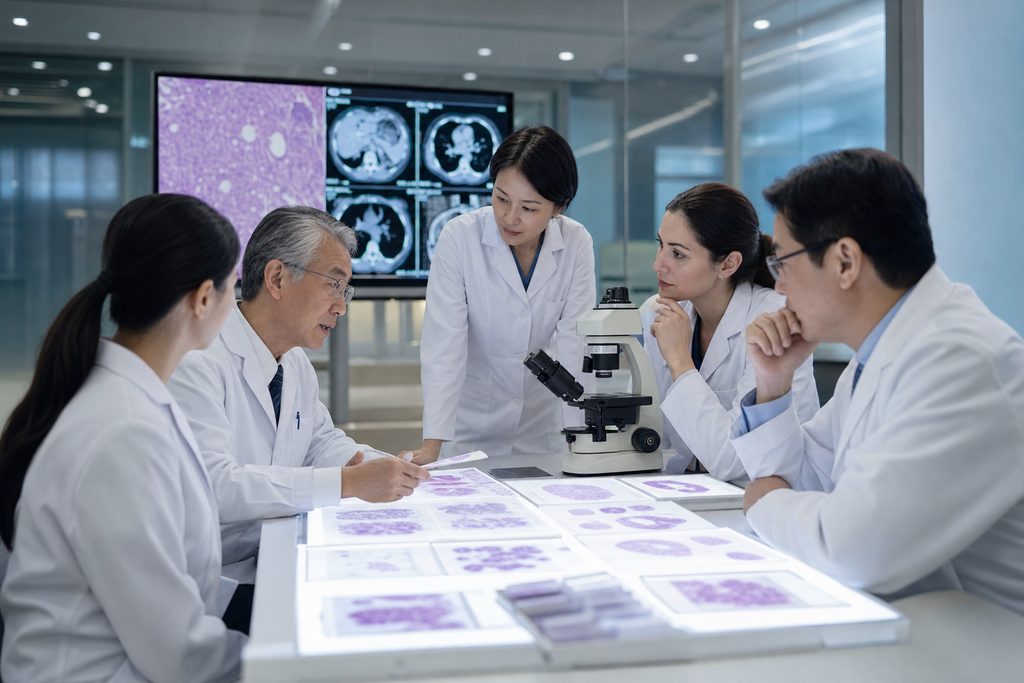
A patient in London waits 14 weeks for a definitive pathology report on a suspected rare sarcoma. That same week, a pathology department in Shanghai processes over 2,000 complex tumor specimens. The sheer difference in volume changes what is possible when a diagnosis is uncertain. For rare tumors — the ones that do not fit neatly into standard classification systems — the number of cases a pathologist has seen directly shapes their ability to recognize what they are looking at. We connect patients with that depth of experience.
Key Takeaways
- Expert pathology review in China costs from $300 for a written second opinion, with turnaround times often under 10 business days for routine cases.
- China’s top cancer centers each handle over 15,000 solid tumor pathology cases annually — volume that translates to rare tumor diagnostic experience most Western labs cannot match.
- Slide shipping and customs clearance is the biggest logistical hurdle. Without local coordination, specimens can be delayed or rejected at the border.
- A pathology second opinion identifies clinically significant diagnostic discrepancies in approximately 1 in 4 rare tumor cases, according to studies from MD Anderson and other major centers.
The Problem: When Your Tumor Does Not Fit the Textbook
Rare tumors account for roughly 20% of all cancer diagnoses. That is approximately 1 in 5 patients. But “rare” means something specific in pathology: it means the average community pathologist may see only one or two cases in an entire career. A 2019 study published in the Journal of the National Comprehensive Cancer Network found that for sarcomas — a category with over 70 distinct subtypes — the diagnostic concordance rate between general pathologists and sarcoma-specialized pathologists was as low as 56%. Nearly half of patients had their diagnosis changed upon expert review.
This is not a criticism of community pathologists. It is a statement about statistics. If you see one epithelioid sarcoma every five years, subtle morphological features that distinguish it from a carcinoma or melanoma are easy to miss. The consequences are not subtle. A wrong diagnosis means wrong treatment. Wrong chemotherapy. Wrong surgery. Lost time that rare cancer patients do not have.
So patients start searching. They look for a rare tumor second opinion China cost estimate. They wonder if sending slides overseas is even possible. They ask whether Chinese pathologists can accurately diagnose tumors that stumped their local team. These are the right questions. The answers are more straightforward than most people expect.
Who We Are
At China’s leading hospitals, pathology departments are organized by subspecialty. There are dedicated teams for hematopathology, neuropathology, bone and soft tissue, thoracic, gynecologic, gastrointestinal, and pediatric pathology. When a case is difficult, it does not sit on one pathologist’s desk for weeks. It goes to a consensus conference. Multiple subspecialists review the slides together. Immunohistochemistry stains are ordered reflexively when morphology is ambiguous. Molecular testing — including next-generation sequencing panels — is integrated into the diagnostic workflow.
This is the expert panel review for unusual cancer China patients access when they send their slides. It is not a single pathologist’s opinion. It is a departmental review process that mirrors the tumor board model used at major US cancer centers like Memorial Sloan Kettering and MD Anderson. The difference is cost and speed. We will get to the numbers shortly.
Molecular Diagnostics Are Integrated, Not Outsourced
Many Western hospitals send molecular testing to external reference labs. That adds days or weeks. Chinese pathology departments at top-tier hospitals run these tests in-house. Fluorescence in situ hybridization for sarcoma translocations. PCR for microsatellite instability. Immunohistochemistry panels with 30+ markers. All performed within the same department that reads the slides. This integration shortens turnaround time and keeps the diagnostic reasoning coherent — the molecular pathologist and the morphologic pathologist are colleagues in the same room, not contractors in different time zones.
For a patient wondering how to get a rare tumor diagnosis reviewed in China, this integrated workflow is a structural advantage. The pathologist who sees the H&E morphology is the same person who interprets the FISH results. Nothing is lost in handoff.
The Cost Equation: Rare Tumor Second Opinion China Cost vs. Western Alternatives
Let us address the question most patients ask first. What does a rare tumor second opinion China cost? The answer depends on the depth of review and the hospital tier, but the range is narrower than most expect.
| Service Type | Estimated Cost (USD) | Typical Turnaround | What Is Included |
|---|---|---|---|
| Written Second Opinion (top-tier hospital) | $300 – $500 | 7–14 business days | Full slide review, IHC interpretation, written report in English |
| Top-Specialist Video Consultation | $500 – $800 | 10–21 business days | Written report plus live video discussion with the reviewing pathologist |
| Multidisciplinary Team Review | $1,500 – $2,000 | 14–28 business days | Pathology, radiology, and clinical oncology panel review with integrated report |
| US Academic Center Second Opinion (comparison) | $2,000 – $6,000+ | 14–30+ business days | Slide review and report; video consultation often billed separately |
These are reference ranges. Final pricing varies by hospital and case complexity. But the structural cost difference is real. Labor costs in Chinese academic medicine are lower. Hospital overhead is lower. The professional fee for a senior pathologist’s time does not carry the same billing burden it does in the US system. And the quality of the read — when you are at a Fudan-ranked top-10 pathology department — is not lower. It is backed by volume and subspecialization that most Western centers cannot replicate.
For patients specifically researching the send tumor slides for expert panel review China price, the written second opinion at $300–500 is the most common entry point. That fee covers slide processing, staining review, immunohistochemistry interpretation, and a formal English-language report. If molecular testing is needed and was not already performed, that adds cost. But many patients arrive with slides and existing IHC panels already done. The Chinese pathologist re-reads the existing material — and often identifies findings the original report missed or misinterpreted.
What You Need to Know Before Sending Slides to China
This process works. But it has real friction points. We describe them honestly because patients who understand the barriers are better prepared to navigate them.
- Slide shipping and customs: Pathology slides and paraffin blocks are biological materials. Shipping them internationally requires proper packaging, a commercial invoice describing the contents accurately, and customs clearance at both ends. Chinese customs may hold shipments if documentation is incomplete. Slides can be damaged if packaging is inadequate. We have seen shipments delayed by two weeks because of a missing HS code on the airway bill. This is not a reason to avoid the process. It is a reason to have someone who knows the process handle it.
- Language and report format: Pathology reports from Chinese hospitals are written in Chinese by default. English-language reports are available at international departments of major hospitals, but this must be specified upfront. The terminology may follow slightly different conventions. A good coordinator ensures the report uses internationally recognized classification systems — WHO nomenclature, not local variants — so your home oncologist can act on the findings without confusion.
- Payment and insurance: Chinese hospitals require prepayment. They do not bill Western insurance companies directly. You pay the hospital, receive a detailed invoice, and submit it to your insurer for reimbursement. Reimbursement is not guaranteed. Check with your insurer before committing. Some patients pay out of pocket because the cost is low enough that the reimbursement fight is not worth the effort.
- Clinical context matters: A pathology review is only as good as the clinical information provided. The reviewing pathologist needs imaging reports, operative notes, and a clinical summary. Without context, even the best pathologist is reading slides in the dark. We ensure all relevant records are translated and submitted with the slides.
Can Chinese Pathologists Diagnose Uncommon Tumors Accurately?
This question deserves a direct answer. The concern behind it is understandable. Patients worry that lower cost implies lower quality. That a pathologist in Shanghai cannot possibly be as skilled as one at a major US academic center.
The evidence does not support that concern. China’s top pathology departments participate in the same international quality assurance programs as Western labs. They publish in the same journals. Their pathologists train in subspecialty fellowships, many with international experience. The College of American Pathologists provides laboratory accreditation programs that several Chinese hospitals participate in. Fudan University Shanghai Cancer Center‘s pathology department is a reference center for the World Health Organization’s classification of tumors series.
More concretely: when international patients ask can Chinese pathologists diagnose uncommon tumors accurately, the answer is yes — at the right hospitals. The key phrase is “the right hospitals.” A county-level hospital in a small Chinese city is not the same as a Fudan-ranked top-10 pathology department. The skill gradient in Chinese medicine is steep. That is why hospital selection matters enormously. We only coordinate with pathology departments that have demonstrable subspecialty expertise and experience with international case reviews. You can browse our database of top-ranked hospitals to understand which institutions carry the appropriate credentials.
There is also a pragmatic argument. If you are considering a rare tumor pathology consultation in China, you are likely already facing diagnostic uncertainty at home. A second opinion — from any qualified, high-volume center — adds information. It either confirms the original diagnosis, which provides peace of mind. Or it identifies a discrepancy, which changes management. Either outcome has value. The question is not whether Chinese pathology is perfect. No pathology system is. The question is whether the review adds diagnostic clarity at a cost and speed that makes sense for your situation. In most cases, it does.
How We Coordinate Your Pathology Consultation
The process starts with a conversation. You tell us about your diagnosis, what has been unclear, and what you hope to gain from a second opinion. We do not charge for this initial consultation. It helps us understand whether a Chinese pathology review is appropriate for your case.
If it is, we identify the right hospital. For a suspected sarcoma, we may recommend the pathology department at a hospital with a dedicated bone and soft tissue tumor program. For a rare lymphoma, a different center with strong hematopathology. Our hospital matching is based on subspecialty expertise, not general reputation. A hospital famous for liver surgery is not necessarily the right place for a brain tumor pathology review.
Once the hospital is selected, we handle the logistics. We provide shipping instructions and customs documentation for your slides. We coordinate with the hospital’s international department to ensure your case is assigned to the appropriate subspecialty pathologist. We arrange translation of your clinical records. When the report is complete, we deliver it to you in English and can arrange a video consultation with the reviewing pathologist if you choose that option.
Throughout the process, you have a single point of contact. You are not emailing a hospital department in a language you do not speak. You are talking to us. We translate, we follow up, we troubleshoot. If customs holds your slides, we know who to call. If the report is delayed, we know why and when it will arrive. This coordination is what turns a complicated international process into something manageable.
For patients considering traveling to China for treatment after the pathology review, any consultation fees paid are credited in full toward our on-the-ground coordination service if you proceed within 90 days. The pathology review feeds directly into treatment planning — same hospital, same team, no duplicated work.
Frequently Asked Questions
How long does a rare tumor pathology second opinion from China actually take?
For a written second opinion with existing slides and IHC stains, typical turnaround is 7 to 14 business days from the time the slides arrive at the pathology department. If additional molecular testing is required, add 10 to 21 days. Video consultations add scheduling time — the pathologist needs to review the case and prepare, then find a time slot that works across time zones. Realistically, budget 3 to 5 weeks for the full process from initial inquiry to final report with video consultation. Urgent cases can sometimes be expedited, but we are honest: “urgent” in pathology still means days, not hours.
What if the Chinese pathology report contradicts my original diagnosis?
This happens more often than patients expect — in roughly 20 to 30% of rare tumor cases, the second opinion yields a clinically significant change. If the Chinese report disagrees with your original diagnosis, you now have two opinions. This is not a problem. It is information. The next step is usually to seek a third opinion, or to present both reports to your treating oncologist and discuss the implications. We can facilitate a multidisciplinary discussion that includes the Chinese pathologist and your home clinical team. The goal is diagnostic clarity, not choosing which pathologist is “right.”
Do I need to travel to China for a pathology consultation?
No. The pathology review is done entirely remotely. You ship the slides. The pathologist reads them in Shanghai or Beijing or Guangzhou. You receive the report electronically. Travel is only necessary if you decide to pursue treatment in China after the diagnosis is clarified. Many patients use the pathology consultation as a standalone service and never set foot in the country.
Which hospital is the best for rare cancer pathology consultation in Shanghai?
For patients specifically searching for the best hospital for rare cancer pathology consultation Shanghai, Fudan University Shanghai Cancer Center is the most frequent recommendation. Its pathology department is one of the largest in China and carries strong subspecialization in soft tissue, bone, hematologic, and pediatric tumors. Shanghai also hosts Ruijin Hospital, which has particular strength in hematopathology, and Zhongshan Hospital, known for thoracic and hepatic tumor pathology. The right choice depends on your specific tumor type. Our specialty department directory can help you understand which centers lead in which subspecialties.
Is the pathology report legally valid for treatment decisions in my home country?
The report is a medical opinion from a qualified pathologist. Whether your home oncologist accepts it as the basis for treatment decisions is their clinical judgment. Most oncologists welcome expert second opinions, especially from high-volume centers. But the report does not have automatic legal standing — no second opinion from any foreign institution does. It is a professional consultation, not a binding directive. We recommend sharing the report with your treating physician and discussing how the findings fit into your overall clinical picture.
Your Next Step
A rare tumor diagnosis that does not make sense is a terrifying place to be. The uncertainty itself is damaging — it delays treatment, it creates anxiety, it leaves you without a clear path forward. A second opinion from a high-volume pathology department does not guarantee a definitive answer. No one can promise that. But it adds information. It adds another set of expert eyes on your slides. And in a significant minority of cases, it changes the diagnosis and therefore the treatment plan.
If you want to understand whether a pathology review in China makes sense for your specific case, start with a conversation. No cost. No commitment. Just an honest assessment of your situation and what we can do to help. Reach out to our team
For more medical information and treatment options in China, visit chinamedservices.com (China Medical Services).
