Multi-Generation Medical Travel in China: Treating Grandparents, Parents, and Children Together
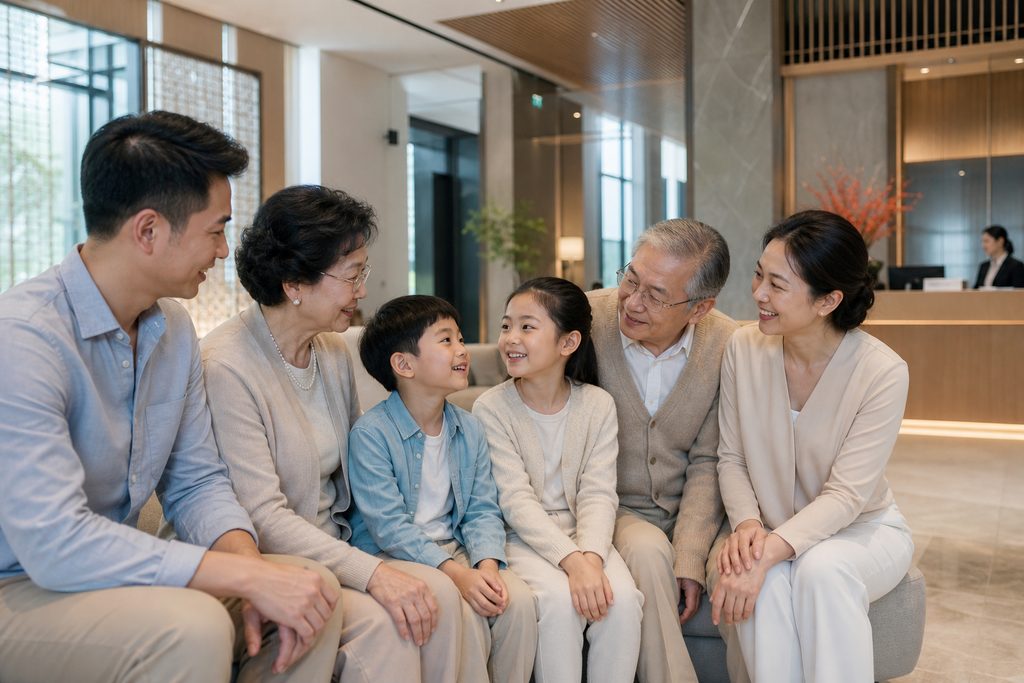
You have probably heard that bringing your whole family to a foreign country for medical care is a logistical nightmare. Three generations. Different medical needs. Different schedules. The assumption is that coordinating it all is impossible. That assumption is wrong.
We have watched a family from Dubai arrive on a Tuesday. The grandfather had a cardiac evaluation at a top-ranked hospital. The parents completed executive health screenings. One child saw a pediatric dermatologist. By Thursday afternoon, they were having dinner together near the Bund, reviewing results on a tablet. One trip. One team. Done.
This is not a hypothetical. It is the reality of family medical tourism packages China when you have the right coordination layer in place. And it is growing. The China Medical Tourism Association reported a compound annual growth rate exceeding 20% in inbound medical travel between 2017 and 2023. More families are asking a specific question: can we do this together?
The answer is yes. Here is exactly how it works, what it costs, and what nobody tells you about the hard parts.
Key Takeaways
- China’s top hospitals perform 10-20 times the annual procedure volume of comparable Western institutions in key specialties like cardiac surgery and orthopedics.
- A coordinated family medical trip can reduce per-person logistical costs by 40-60% compared to traveling separately, while giving you one point of contact for three generations of care.
- Public hospital outpatient departments cannot be booked in advance from overseas — you need an international VIP channel to lock in appointments before you fly, especially for a group.
- Visa requirements are strict and family-specific: each member needs an S2 visa with a documented medical purpose, and getting this wrong means denial at the port of entry.
The Problem: Fragmented Care Across Borders and Generations
A 2023 survey by the Medical Tourism Association found that 34% of international patients would bring a family member for simultaneous treatment if logistics allowed it. The barrier was never willingness. It was coordination. Most medical travel facilitators are built for solo patients. One person. One procedure. One hospital department. Add a grandparent who needs a cardiologist, a parent who wants a full-body cancer screening, and a child with a chronic skin condition, and the system breaks.
You end up with three separate trips. Three sets of flights. Three rounds of visa paperwork. Or you simply delay care. A 2022 study in the Journal of Medical Travel Research documented that families with multi-generational health needs wait an average of 14 months longer for treatment when they cannot coordinate schedules. That is 14 months of a grandfather’s untreated arrhythmia. 14 months of a parent’s undiagnosed condition progressing silently.
The cost of non-coordination is real. And it is measured in time, money, and outcomes.
Who We Are
We are not a hospital. We do not provide medical treatment, clinical diagnoses, or prescribe medications. We are your logistical architects. Our team at China Medical Services connects international families with China’s top-tier hospitals — 340+ institutions across 37 cities, all ranked in the top 5% of China’s 35,000+ hospitals by the Fudan University ranking system and JCI accreditation standards. We handle the architecture of your trip: hospital matching, appointment coordination across multiple departments, bilingual medical companions who stay with your family from registration to discharge, visa guidance, and recovery logistics. You focus on your family’s health. We handle everything that stands between you and the care they need.
Why Coordinated Family Medical Travel in China Delivers Results
Clinical Volume That Simply Does Not Exist Elsewhere
Fuwai Hospital in Beijing performs over 14,000 cardiac surgeries annually. That is more than any single heart center in the world. A cardiac surgeon there will see more complex cases in one year than a surgeon at a respected European hospital sees in five. Volume drives outcomes. A 2021 analysis published in The Lancet found that hospitals performing more than 500 procedures annually for a given specialty had 30-day mortality rates 18% lower than lower-volume centers for the same procedure. This is not about individual brilliance. It is about system-level repetition.
For families, this matters in a specific way. When you are coordinating care for a grandparent who needs a valve replacement and a parent who needs a thyroidectomy, you want both procedures happening in institutions where the surgical team has done this exact operation thousands of times. China’s top-tier hospitals deliver that at a scale unmatched in most Western systems. You can find the right institution for each family member through our specialty-ranked hospital database, organized by the 45 clinical departments tracked in the Fudan rankings.
Technology Deployed at Population Scale
Scale changes what is possible technologically. A hospital that sees 10,000 outpatient visits per day — which is normal for a top public hospital in Shanghai or Beijing — invests in workflow automation, AI-assisted diagnostic triage, and integrated electronic health records because it must. The system would collapse without these tools. For an international family, this means test results turn around faster. Imaging is read within hours, not days. And the digital infrastructure means your family’s records can be shared across departments without paper files moving between buildings.
This is not theoretical. At Huashan Hospital in Shanghai, AI-assisted imaging analysis for stroke detection has reduced time-to-diagnosis by an average of 27 minutes compared to manual reading alone, according to their published clinical data. For a grandparent presenting with neurological symptoms, 27 minutes matters.
The Cost Equation: Structural, Not Sacrificial
Let us address the obvious question. The cost of bringing whole family for surgery in China is, on average, one-fifth to one-tenth of comparable care in the United States. A coronary artery bypass graft that costs $120,000 or more in the US runs $12,000 to $20,000 at a top Chinese public hospital. A total hip replacement: $8,000 to $15,000 in China versus $40,000 to $60,000 in the US.
These numbers are not a reflection of lower quality. They reflect structural economic differences. Labor costs for nurses, technicians, and support staff are lower. Hospital construction and operational overhead are lower. And the sheer patient volume spreads fixed costs across more procedures. The clinical outcomes for these procedures at Fudan-ranked hospitals are comparable to or better than Western benchmarks, as documented in peer-reviewed studies across cardiac surgery, orthopedics, and oncology.
When you are traveling as a family, these per-procedure savings multiply. Three procedures that would cost $200,000 in the US might total $40,000 in China. Even with flights, accommodation, and coordination services, the math is compelling.
Can Grandparents and Children Get Treatment Together in China? The Practical Answer
Yes. But the operational reality is more nuanced than a simple yes. Can grandparents and children get treatment together in China depends entirely on the hospital’s departmental structure and whether you are using the public outpatient channel or the international VIP channel.
In the public outpatient system, a grandfather seeing a cardiologist and a child seeing a dermatologist will be in entirely separate buildings, on different floors, with different registration systems, different payment counters, and different pharmacy queues. You cannot be in two places at once. Without a bilingual medical companion — or two — you will fail at one of these appointments. Someone will miss their number being called. A payment will be made to the wrong account. A prescription will go unfilled.
This is where multi generation medical travel China hospitals that operate dedicated international departments become essential. Institutions like Peking Union Medical College Hospital‘s International Medical Service, Shanghai’s Huashan Hospital Worldwide Medical Center, and the United Family Healthcare network are designed for exactly this scenario. They have English-speaking coordination staff who understand that a family unit is arriving together. They can schedule appointments in adjacent time slots. They can route lab work through a single phlebotomy visit. The infrastructure exists. You just need to access it through the right channel.
What a Coordinated Family Medical Trip Actually Costs
The cost of bringing whole family for surgery in China has two components: hospital treatment charges and coordination service fees. Hospital charges vary by institution and procedure complexity. Coordination fees follow a predictable structure.
| Service Component | Cost (USD) | Notes |
|---|---|---|
| Bilingual Medical Companion | from $200/day | Half-day (4hr) or full-day (8hr); handles registration, queue management, payment, translation, and wayfinding |
| Hospital Appointment Coordination | from $300 | Per family unit; full refund if we cannot secure the confirmed appointment slot |
| Airport Transfer (round-trip) | $200 | Vehicle appropriate for family size; driver meets you at arrivals |
| Top-Specialist In-Person Consultation Coordination | $800–1,200 | Per specialist; includes medical record translation and appointment lock-in through the hospital’s international channel |
| VIP End-to-End Coordination | $5,000–8,000 | Full-service package: all appointments, companions, transfers, accommodation recommendations, and 24/7 on-call support throughout your stay |
These are reference ranges. Final quotes depend on the number of family members, the complexity of medical needs, and the specific hospitals involved. A family of four with straightforward needs — say, two executive checkups and one specialist consultation — might spend $2,000 to $3,000 on coordination. A family of six with two surgical procedures and multiple specialist visits will be at the higher end. We provide firm quotes after understanding your specific situation. No surprises.
What You Need to Know Before Going Alone
The barriers to coordinating a multi-generational medical trip independently are real. We want you to understand them clearly, whether you work with us or not.
- Visa Requirements Are Family-Specific and Unforgiving: Every family member traveling for medical purposes needs an S2 visa (short-term) or S1 visa (stays exceeding 180 days). The application requires a formal medical purpose letter from the receiving Chinese hospital. Without this letter — on hospital letterhead, stamped, with specific treatment dates — the visa will be denied. M visas are for commercial business only. They cannot be used for medical treatment. Getting this wrong means your family is turned away at the airport.
- Public Hospital Registration Does Not Work from Overseas: China’s public hospitals do not accept advance outpatient appointments from international patients through their standard systems. You cannot book a cardiology consultation for your father from London. The system requires in-person registration, often on the same day, through a queue system that opens at 7:00 AM. The international department or VIP channel is the only route for pre-arranged appointments. This is not a preference. It is the operational reality of a system designed for 1.4 billion domestic patients.
- Payment Systems Are Siloed and Cash-Heavy: Public hospital departments often operate separate payment counters. Radiology billing is separate from pharmacy billing, which is separate from consultation fees. International credit cards are not accepted at most public hospital counters. You need a Chinese payment system (WeChat Pay or Alipay) linked to a Chinese bank account, or you need enough local currency in hand to cover deposits and payments. For a family, this means managing multiple payment queues across multiple departments simultaneously.
How We Help You Navigate This
These barriers exist because China’s healthcare system was built for domestic patients, not international families. That is not a flaw. It is just the reality. Our job is to build the bridge.
Before you travel, we translate and organize every family member’s medical records. We match each person to the right specialist at the right hospital — which might mean one hospital for the grandfather’s cardiac work and a different hospital for the child’s dermatology, if that is what the data supports. We coordinate with the hospitals’ international departments to lock in appointment slots across multiple specialties on adjacent days. We prepare the medical purpose documentation required for S2 visa applications for every family member.
During your stay, a bilingual medical companion stays with your family. They handle every registration queue, every payment counter, every pharmacy pickup. They translate between you and the doctor in real time during consultations. They make sure your father’s cardiac MRI results are routed to the right specialist before your consultation the next morning. If one family member’s appointment runs long, they coordinate with the other department so nobody loses their slot.
After treatment, we help with recovery logistics. Hotel recommendations near the hospital for follow-up visits. Medication instructions translated into English. A clear discharge summary that your home-country physician can understand. If any coordination fees were paid for video consultations or second opinions, those amounts are credited in full toward on-the-ground coordination if you return within 90 days.
For families seeking a comprehensive health assessment, the best family health checkup packages Shanghai offers are concentrated in the city’s international hospitals and the VIP wings of major public institutions. These packages typically include full blood panels, cardiac stress testing, abdominal and thyroid ultrasound, low-dose chest CT, and specialist consultations — all completed in a single morning, with results reviewed by an English-speaking physician that afternoon. The efficiency is remarkable when you have the right booking channel.
Frequently Asked Questions
Yes — if you use hospitals with dedicated international departments and have professional coordination on the ground. The key is scheduling appointments in adjacent time blocks, consolidating lab work into single visits, and having enough bilingual support to manage simultaneous queues. Without these three elements, it does become chaos. With them, it becomes a well-orchestrated week. We have coordinated trips where a grandfather had a cardiac catheterization on Tuesday morning while his daughter-in-law completed a full health screening two floors away, and both were finished by early afternoon.
They can, but the surgical patient’s timeline drives the schedule. A surgery requires pre-operative testing, the procedure itself, and post-operative observation. That might mean 5 to 10 days in the country. The family members coming for checkups or consultations can schedule their appointments during the pre-op or recovery days. This is exactly the kind of scheduling puzzle we solve. The surgical patient is never rushed. The checkup patients are never bored. And the family stays together.
This is the most important question to ask any medical travel facilitator. If a complication extends your stay, we handle the visa extension paperwork, the hospital coordination, and the accommodation changes. If an unexpected diagnosis requires a specialist you did not plan to see, we arrange that consultation — often within 24 to 48 hours at a top-tier hospital. We do not abandon you at discharge. Our team stays engaged until every family member is medically stable and cleared for travel. This is not a transactional service. It is a relationship that runs from your first inquiry through your return home and follow-up care.
The clinical safety at Fudan-ranked hospitals and JCI-accredited international facilities is comparable to top Western institutions. The operational safety — getting from the airport to the hospital, navigating language barriers, managing payments — is what requires planning. China is a safe country for international visitors. Violent crime rates are low. The medical facilities are modern and well-equipped. The risk is not in the care itself. It is in the gaps between appointments, the missed translations, the payment confusion. Close those gaps, and the safety profile is excellent.
Your Next Step
Coordinating medical care for three generations in a foreign country is not simple. But it is possible. And for families facing long wait times, prohibitive costs, or limited treatment options at home, it is a path worth understanding. The hospitals exist. The expertise exists. The coordination layer that makes it all work — that is what we provide.
If you are ready to explore what a coordinated family medical trip could look like for your specific situation, start with a free consultation. Tell us who needs what. We will map the options, the timeline, and the costs. No commitment. Just clarity.
For more medical information and treatment options in China, visit chinamedservices.com (China Medical Services).
